Tiffany McLain [00:00:00]:
Inside of you, there’s so much messaging that you should be ashamed for desiring more. You’re not allowed to. You’re supposed to put your client’s needs first. And you’re not even supposed to have needs in any way, much less financial. What a recipe for disaster. What a recipe for shame.
Linzy Bonham [00:00:19]:
Welcome to Money Skills for Therapists, the podcast that helps therapists and health practitioners in private practice go from money confusion and shame to to calm, clarity and confidence with their finances. If you’ve ever felt overwhelmed by numbers or avoided looking at your business money, you’re in the right place. I’m Linzy Bonham, therapist turned money coach and creator of Money Skills for Therapists. Before we jump in, I want to remind you of something really important. Most of us highly skilled and competent therapists and health practitioners were never taught about money. Not in grad school, not in supervision, not anywhere. And yet here we are, running businesses that need to take care of us while we’re busy taking care of others. It is a lot of pressure.
Linzy Bonham [00:00:59]:
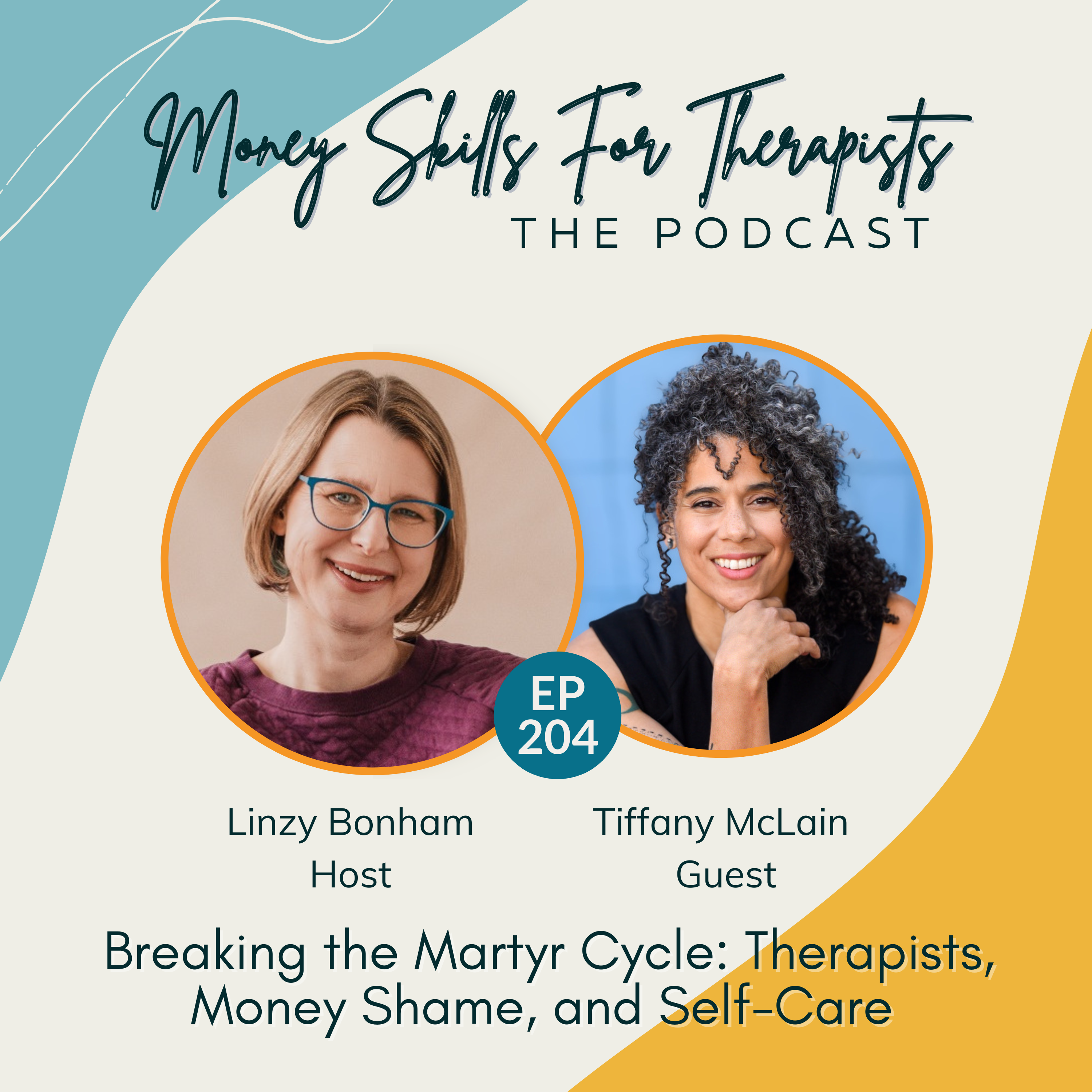
So if part of you feels anxious about money avoidant or like a bit of a hot mess financially, I want you to know that you are not alone and I am here to help. Through my free live workshops each month, I teach practical financial skills to help you feel more grounded, calm and confident with your private practice money. You can see what’s coming up and save your spot to join live or register for the replay@moneyskillsfortherapist.com workshops. Let’s get started. Hello and welcome back to the podcast. So, coming off of last week’s solo episode about money shame, today’s episode is with one of my biz besties, Tiffany McLain , and we’re talking about shame in therapists in private practice that we’ve seen in the work that we’ve done with therapists over the last 10 years. Tiffany and I share about what we see as some of the causes of this shame and how the shame shows up both in the area that she focuses on, which is fees and helping folks like own the cost of their lives and what I focus on, which is helping folks to actually get the numbers working and like owning your numbers, but actually also being able to understand how they work and making them work. We talk about why we see shame in this areas.
Linzy Bonham [00:02:07]:
We talk about the antidotes to shame. We talk about the impact that not taking care of our needs and not dealing with these things has on our clinical work. Here is my conversation with Tiffany McLain . TIFFANY McLain , welcome back to the podcast.
Tiffany McLain [00:02:29]:
Thank you, Linzy. Bottom I’m so happy to be here.
Linzy Bonham [00:02:32]:
So happy to have you here. Very tempted to just talk to you about a thousand other things that are not the topic that we’ve agreed to talk on today. But we are going to talk about the topic that we’ve agreed to talk on today, which is a common topic between the two of us. In terms of the work we do with therapists, it’s the funnest topic we could talk about, which is shame.
Tiffany McLain [00:02:52]:
Shame. Before we jump into it, I do
Linzy Bonham [00:02:56]:
want to tell you that I did a workshop recently. Some folks listening might have been at that workshop. It was kind of like the secret to getting unstuck, and it was about mindset. But in that workshop, it was February, and I feel like it was dark. Everybody was kind of tired and sad and, like, it got, like, real heavy. And I was like, shit. It’s easy to forget just how heavy our feelings are around money and, like, because I didn’t structure the workshop properly, Apologies, folks, at the workshop, to have that uplift at the end, like, strong enough. It’s like we went so deep in the shame hole, I was like, oh, no, we’re in therapy territory.
Linzy Bonham [00:03:28]:
Because it’s so heavy, our emotions around money, like shame, I think, is such a common part of how we experience it. It’s heavy shit.
Tiffany McLain [00:03:35]:
It is heavy shit. And I think that, you know, you and I do so much work around this money and numbers and the fee and the way shame comes into it. And we. I think, because you and I have been doing this for so long, and we have started with people who are in so much shame, and then we see the evolution, the joy, the ability to save for retirement, the ability to be charging life versus fees. We just have so much confidence because we’ve done it thousands of times with our students, that it’s a little bit harder to be like, oh, yeah. But it starts here. Like, this is where you all listeners might be in this dark phase. And you don’t know about what’s on the other side, but Linzyand I do.
Tiffany McLain [00:04:08]:
So we have to remember, like, oh, yeah, this is the. It’s hard work. When you haven’t been to the other side.
Linzy Bonham [00:04:13]:
It is hard work. It’s hard work. And I think that that shame and heaviness is why folks don’t even want to talk to us, because, again, we’re. We’re on the other side at this point. I think we’ve had just under 800 folks come through Money Skills for therapists. So we’ve gotten to, like, see so many incredible transformations, as you say. And, like, I’m on the other side where I feel like I’m kind of the cheerleader, where I’m like, it gets easier, it gets better. Like, remember that it gets better for, like, gay youth a few years ago anyways, where it’s like, just, like, it’s hard now, but it’s going to get better.
Linzy Bonham [00:04:39]:
And we live on that side. But, like, it’s really hard when you’re in that beginning place, that really dark place, to believe that there is another side because you’re like, no, no, no, no. This is what I hear people say, like, no, no, you don’t understand. Like, I am not good at these things. I can’t do this because xyz, it’s a tough place to start. So let’s talk about why we see so much shame with therapists. In your experience, what about private practice brings up shame for therapists?
Tiffany McLain [00:05:07]:
Mackerel, what a big question. I think that if you all have ever heard me, you’ve heard me talk about this before. I think about it in terms of this triple fold complex. This is by an analyst in the 80s. Ella Lasky talked about this. Therapists typically are the helpers in their family of origin. So you’re already, from the time you pop out, you’re just naturally inclined. My daughter’s like this.
Tiffany McLain [00:05:28]:
She’s mediating arguments, she’s stepping into help. She really wants to be a helper. Or just everywhere, all the, can I help you with the dishes? Can I get my clothes? Can I get my brother’s clothes? And so she kind of came into the world that way. And then if you’re a woman, a person of color, someone from a marginalized community, lgbtq, you then come into a larger system where, again, you’re asked to serve, you’re asked to be the helper, you’re asked to be selfless, the martyr. We’re just expected to do all the work without getting compensated for it. And then all of these people come into grad school, and we’re now in a system that’s, you know, the psychology industrial complex, which, again, reinforces you’re here to serve, you’re here to help, don’t expect to get paid. I’m not here to make money. So by the time you go on to private practice and you actually.
Tiffany McLain [00:06:09]:
Which you will step in and talk about beautifully, you actually need and want to make money so you can have retirement. So you have to understand those numbers by the time you come in, look at those numbers relationally between you and your client in private practice, inside of you, there’s so much messaging that you should be ashamed for desiring more. You’re not allowed to. You’re supposed to put your. Your client’s needs first, and you’re not even supposed to have needs in any way, much less financial. What a recipe for disaster. What a recipe for shame.
Linzy Bonham [00:06:40]:
Yeah, there’s so many layers there, as you say. And, like, as you describe kind of us all being grad school together, I’m like, what would be the kind of analogy for that? Like, is it like a little cultish? Like, what are we doing there when we’re in this little echo chamber where you’re like, where, like, the world is bad? I feel bad. We should help everybody. I also feel bad. There’s just such a deepening, I think, that happens in that grad school space where it’s like, you might have been like the helper in your group of friends, and now you’re in a room with every other helper from every other group of friends who, like, over functions and tries to take care of everybody else’s needs first. And now you all just reinforce to each other, like, yeah, this is the way. This is the right way to live. Because I think then there’s also, I think on the flip side of that shame, there’s like a virtue story, the martyr is a virtuous role to play, where it’s like, well, I do these things all day and I give and I give and I give and I give.
Linzy Bonham [00:07:25]:
And it’s kind of like, you know, I remember Brene Brown talking about, you know, being tired, being a badge. It’s like that life is about sacrifice and pain. And it’s like, aren’t we being virtuous when we give and give and give? So there really is this, like, deepening that happens in our professional training. And just by having colleagues and friends who are therapists, who are wonderful people, but it’s like we all have the same problems
Tiffany McLain [00:07:47]:
and we just reinforce it.
Linzy Bonham [00:07:48]:
We just reinforce it to each other. Yeah. And then the other piece that I also see brings up shame when we’re in private practice is that a lot of therapists aren’t good at money. This wasn’t our A plus topic. Right. So we talked first about martyrdom and kind of that, like, self sacrifice, people pleasing, caregiving. But I also see a lot of perfectionism, which feeds into shame. Right.
Linzy Bonham [00:08:11]:
Which is like, I’m good at things. I’m the good girl. Right? I’m perfect. I stay out of the way. And, and perfection is always about safety, right? So it’s like, I’m perfect, I do things perfectly. But money is often something that therapists have not done perfectly. And we didn’t start saving for retirement at 17 like we should have. And we haven’t made all the strategic choices and we haven’t stayed out of debt and we didn’t choose a career based on earning, you know, we chose a career based on like our calling.
Linzy Bonham [00:08:37]:
So what I find is a lot of therapists start to like turn towards the money part. Be like, I’m not good at that, like I don’t know how to do that and hide, turn, back away then, right? Because it’s like, well, if I’m not good at that, like I’m not good enough, I’m dumb. My grade three math teacher was right, I should just leave the math to other people. You know, it’s like whatever that narrative is, my dad was right, how am I ever going to make a career doing this like touchy feely work? And then we just turn away from it and avoid. Because it’s like, no, no, I can’t do that. That’s not me. That’s not who I am. I’m a helper.
Linzy Bonham [00:09:08]:
I’m not somebody who can do money and math. So yeah, we just kind of get really stuck. We’re both avoiding, I think what I’m hearing is we’re both avoiding our needs and our financial needs, but we’re also avoiding the skills, right? And the actual work that there is to be done that we all have to do because we’re people who live in a world where money is the means of currency universally, right? That’s how we exchange literally anything for anything else. Money is a mediator in most of those situations.
Tiffany McLain [00:09:33]:
It matters.
Linzy Bonham [00:09:34]:
It matters and it’s unavoidable.
Tiffany McLain [00:09:37]:
I’m thinking about this idea when you’re talking about the skill, like you, you when you talk about it, so calming, like, oh, money is a skill that can, you can learn raising fees. That’s a skill you can learn. Something that feels so important to say about shame, and you all know it, listeners, is that shame is I am bad, not I’ve done something bad, not oh, this skill is not developed yet. It’s I am bad. And anyone who’s a therapist, which is not the rest of the world, by the way, people, but most therapists, you come from an environment where when you showed up with a real feeling or a real desire or need, you got the message from the caretaker. You are bad, not that that was wrong or don’t ask that way. But you at your core are unworthy of my love or my attachment in this moment and total negation, which is just crushing. So then we all go in the world to become therapists and serve.
Tiffany McLain [00:10:26]:
So then when Tiffany says raise your fees or Linzysays, get your retirement, right? Let’s look at your numbers. If we don’t understand it or if we have a desire to do something and we’re not quite right at it, we don’t go, oh, that’s, that’s a skill that I’m bad at. Let me learn. We have, like, I am fundamentally bad. This is a deep source of shame. I’m going to lose all my loved ones and everybody that cares about me if I go more in this direction. So there’s a lot tied up in these ideas of numbers and our sense of self worth at its core.
Linzy Bonham [00:10:55]:
Yeah, absolutely. And you know, when you say that piece about how our needs have been negated as kids, I do think that’s really important to name, right? Because something that I find as folks start to unpack their stories around money is it’s like, well, whose voice is that, right? Like who’s in your head telling you that, like you’re too much, right? Or you shouldn’t need because, like, because your mom is sick or your brother’s having a hard time, right? Like once we actually start to identify those voices, I find that that really helps because even though that wounded 7 year old who’s telling you that you don’t deserve or that you’re dumb, right? Or like whatever younger parts of you, once we can start to name like just a second, that’s my dad. And as an adult, I can see my dad has these strengths, but also he has these struggles, often because of their own childhood experiences. Immediately we can start to make space from it, but when we’ve internalized it, it’s so deep and it can feel so heavy and so intrinsic that as we say, it does feel like part of who you are, right? And isn’t that the way with shame is first starting to name, like, that’s not actually who you are. That’s a story that you were told that you have taken on as your own, but it’s not, it’s not you. So I want to talk about how do people possibly get out of this shame hole? And I’m laughing because it’s such a terrible image. I should say to folks, I do laugh at times of emotional. Sometimes I laugh and I’m like, what am I doing, but it’s like the heaviness, humor, humor to cope.
Linzy Bonham [00:12:24]:
Right. So what do you see? Tiffany needs to be in place for folks to start to shift out of shame when it comes specifically to what you help them with, which is like fees and owning the fee that they need to charge to actually live their life.
Tiffany McLain [00:12:37]:
There’s so much in this because it’s relational. When we’re talking about fees, it’s between us and another person. Here is my desire as the therapist and you client. I’m going to ask for my $300 rate and it’s up to you to give it to me or not. Like that brings up all these relational wounds we were talking about earlier. Well, something that happens often is that people will send me as people will come to one of my live trainings or have an email from me that really moves them and they’re like, I’m so excited. I’m going to raise my fee. Thank you so much.
Tiffany McLain [00:13:08]:
I’m going to do it on my own. Sometimes they do, but more often than not, one year, two years, even five years later, they come back and they say, I tried to do it and I even raised it at first. And then I went back and I’m in this spiral again. I’m back where I was. My fees are low, I’m seeing too many people. And it brings up again this. The shame comes really. It’s really powerful in here for both what you and I do.
Tiffany McLain [00:13:30]:
Lindsay, One of the things that it’s a research shows this one of the things that allows people to move beyond shame is having it acknowledged by an other. And so it’s so hard for me when therapists are like, oh, I got the inspiration. I’m so excited to tackle this. And then they go back and they’re alone. When it’s like one of the things that’s going to help you move beyond is a community and a framework. Like actually having here. I do step one, step two, and step three. The step one, step two and step three is easy on its face.
Tiffany McLain [00:13:58]:
Raise your fees. Here’s what it looks like, Go forth, done. But it’s all of the stuff that comes up inside of us as we attempt to move forward in this process. And in order to do it consistently and sustainably, most people need a community of people who are on the journey with them, having the same struggles, the same hopes, asking for help, being vulnerable to counteract. What we were talking about happens in grad school where you reinforce the martyrdom, the you shouldn’t ask for more all of that is so strong that if you don’t have a powerful community of people who are doing it a different way to undo that conditioning, for most people, it’s hard, if not impossible, to keep moving forward. So one of the things that helps move past the shame and actually do the work is having a consistent community that’s reinforcing a totally different way to live your life and move forward in your business.
Linzy Bonham [00:14:47]:
Because there’s so many relational patterns to undo here, too, right? Like, there’s gonna be so many instances in your life where you tried to ask for more and the other person shut you down. Cause it’s like, no, no, no. You’re not my friend who asks for their needs. You’re my friend who listens to me. Right? Like, there’s all of these ways that this role has been reinforced and that we reinforce these roles, right? With the relationships that we’ve built, we tend to build relationships that keep us in this role. And so what I’m hearing is, you know, in community, you now have dozens of new relationships with people who are like, yes, go you. It’s scary. I know.
Linzy Bonham [00:15:20]:
I did it, too. Or like, you know, like, breathe through it. Like, you’re going to be getting people who are actually cheering for you for stepping up and owning your needs, rather than people who are like, oh, that seems high. Are you sure you want to do that? Because that’s the norm. That is what people will get, right. Like, if we talk about fees, I experienced that when I raised my feet of 150, right. People are being like, oh, oh, wow, you’re charging 150. Oh, like, you know, lots.
Linzy Bonham [00:15:47]:
Lots of subtext there. And that was only 150. It was a few years ago. But that’s not. That’s not a premium fee, and that’s not me owning what it takes to live in, like, San Francisco or New York, which you need to be charging a hell of a lot more than 150. So, yes, I’m hearing that there’s a chance here to rewrite so many of these relationships. But it’s almost like I’m thinking, like, you’re rewriting thousands of interactions, right? You have to overwrite thousands of interactions. So the more relationships you can have that reinforce this, the better, you know, as you’re talking.
Tiffany McLain [00:16:15]:
That’s absolutely right. And it makes me think about one of the things that’s so insidious for therapists. One of the things that makes it so hard, and you and I, I’m sure both encounter this, is that we should already know. It comes back to, like, we’re thera. We don’t need mindset work. We already. We could just do it ourselves. So even doing something like investing in a program to get help to move forward, we’re happy learning emdr.
Tiffany McLain [00:16:35]:
We’re happy learning, like a new skill set. Ifs. But when it comes to like, oh, I need help with my own thinking, my own relational dynamic and how it relates to money, there’s so much shame in even admitting I need help and I’m gonna. I actually want to step into a community and get help. Do you notice that with people considering coming to work with you?
Linzy Bonham [00:16:53]:
Yeah. And what it’s making me think of is I remember a meme back when I was on social media. I remember a meme crossing my path at some point that said something like, hyper independence is a trauma response. And it makes me think about that. Right? Like, what are we doing when we’re like, no, no, no, I can do it by myself. Where did we learn that from? That we have to do it by ourself or that it’s better to do it by yourself? You know, and usually that’s where it is. Like that over functioning. No, no.
Linzy Bonham [00:17:18]:
I take care of other people. Nobody takes care of me. I don’t need help. I don’t have needs. Often I think that what can seem like independence is actually just living out those stories in a way that you’re trying to make empowering.
Tiffany McLain [00:17:30]:
I think you’re right on. We’re going to put you on the spot because I don’t have the answer there. I don’t think. Why do you think that a therapist is. Feels so ready to go get a Gottman training? They’re not scared to get help in that realm. But when it comes to, like, raising fees or looking at their actual numbers, then it becomes like, I can do it on my own. Hyper independence. Why?
Linzy Bonham [00:17:52]:
Because it’s for other people. We’ll do it for other people. Right. Like, I’ll increase my clinical skills to help Nancy and Fred, who I can. Like, I’m like, oh, I love them. They’re my clients. You know, they’re struggling with these things. If I only build these skills, I can help this person.
Linzy Bonham [00:18:06]:
Right. I think this is where therapists were so quick and it’s so much easier to invest in our training because it’s for our clients. Right. It’s for somebody else. It’s a measurable thing that we can do for somebody else that makes us more valuable to them, prolongs the relationship Looking at your fees and looking at building financial skills is about owning your own needs, and it’s about owning the fact that you’re running a business. You’re not just helping people because you’re a really good person, which you are. But you also, as we’ve talked about, need to save retirement and pay your mortgage and all those kinds of things. So I’m playing with the idea right now of kind of like regularizing the way that we offer certain courses.
Linzy Bonham [00:18:42]:
So, Tiffany, you and I have built our businesses in the influencer model, which I have a lot of feelings about. One of my good friends, whenever he calls me an influencer, I have the desire to do violence to him, but he’s calling me out and it’s fair. So I’ve been thinking about moving into more of that. A standard education model where it’s like we always run cohorts here and here, right? And it’s like, here’s our brochure. Here’s what we do. Kind of like a college would do, right? But one of the things that Gemini suggested to me as I was thinking about this is have a certification that people could get that they could display on their website. But nobody, Tiffany, is going to display. I took Money skills for therapists, right, because what is that saying? It’s saying that I own the fact that I run a business and I have financial needs and I’ve owned my own financial needs.
Linzy Bonham [00:19:27]:
Like, nobody’s going to say that to clients. Like, it’s not good for marketing, first of all. But it’s also like, it’s almost counter to what we’re doing as therapists, which is like, it’s, you know, I’m here for you. This is all about you. And same with you. Nobody’s going to like, put a thing on their website, being like, I learned how to charge premium fees because it’s not for them, it’s for you. And I think that that’s 100% the difference is it’s like, it’s so easy for us to do things for other people and it’s much harder for us to actually just own that we have needs and we need to learn skills for us so that we can be okay, so we can take care of the people that we love, but also so we can retire and we can go on vacation. That I think is very hard for many therapists to own.
Tiffany McLain [00:20:05]:
This is where you’re going to have to soften my language here, Lindsay, with your kind hearted ways. The irony in this of a therapist who is like, I’m going to really help you grow. My client, meanwhile neglecting my own needs, my own desires, my own financial. All of it security. It’s a farce. Like, I have values for growth and change and financial security. I want all of this for you, my client, but I am not doing it for myself. I cannot actually look at my financial situation, see what I need to retire, and then enact fees in my business that allow me to actually have a life that takes care of me and my children.
Tiffany McLain [00:20:42]:
I don’t believe as a therapist, you can truly do your best work. If you’re overwhelmed, exhausted, you have no retirement. Even if you’re telling yourself it’s okay, but you’re not looking at the reality, then you’re in a fantasy, and you’re not truly doing the best work for your clients by any means.
Linzy Bonham [00:20:56]:
The way that I think about it is you’re not walking the talk, right? Which is uncomfortable. It’s uncomfortable to acknowledge that you’re not actually doing what you would help somebody else do, right? But I think that it’s a gift to yourself and your clients when you are in integrity and they see it and they feel it from you, right? Like, I have worked with health practitioners before who are like, oh, yeah, I can just squeeze you in at noon on Thursday. And, like, I can see their book. I see they’re like, squeezing me into their lunch hour, right? And I’m like, as a client, I could feel that even though they’re trying to help me, I can feel that they’re harming themselves to help me. And that’s. That’s in our relationship. And your clients can feel it from you too, right? As therapists, our clients can feel from us when we’re tired. They can tell when we’re distracted.
Linzy Bonham [00:21:35]:
They. They can tell when maybe we need a break, right? And so I think we have a fantasy that we present as that perfect, polished version of ourself, that perfect therapist version. And you. We. You wear your mask. I’m sure your mask is pretty good. But our clients, especially the ones who get to know us like, they. They can feel the cracks.
Linzy Bonham [00:21:52]:
They feel your energy. You’re sitting with them in close relationship for an hour at a time. They can feel what’s coming from you. And I think that, yeah, we need to stop pretending that they can’t because we’re not doing them any service. If people have to start at that place where it’s all about your client, then I’ll say you’re doing your client a disservice when you’re not taking care of yourself. And so for folks who can’t hear the second, hear the first, it is impacting your clinical work. But more importantly, and for the people who love you and for your kids who actually need you. Right.
Linzy Bonham [00:22:21]:
Like, we always think that our clients need us, but it was until I had a kid that I’m like, no, he actually needs me. Like, biologically, he needs me. The people who really rely on you in your life are also being impacted when you’re not taking care of your financial needs. Right. So your clients are impacted, your friends and family are impacted, and you are impacted. Right. So whichever one of those can be a motivator, use it to start actually looking at your numbers and owning your needs and being honest about what you need to be a human in this very expensive world that we live in.
Tiffany McLain [00:22:48]:
That’s beautiful.
Linzy Bonham [00:22:49]:
How’d I do?
Tiffany McLain [00:22:50]:
You did so well.
Linzy Bonham [00:22:51]:
I brought it from like an eight down to like a four or three, like a six.
Tiffany McLain [00:22:56]:
You said some spicy shit, but you said it so calmly, I could lean in, I could hear you. Yeah, that’s absolutely right. And I’m sure you find with your students, and I find with my students, hands down, that when they actually get clear about their numbers, start implementing in their practice, reduce their caseload, and are now charging life first fees, they’re showing up more boldly, more honest, more honestly in integrity. And their clients often stay even with the fee raise because they’re like, who is this person I haven’t never had access to? Yes. Or even often the clients will say, this is what it felt like at the beginning of our treatment, but it hasn’t felt like this in months or years because the therapist, if we’re not taking care of ourselves, if we’re resentful, overwhelmed, burdened, we’re not really showing up for our clients. And they feel it, like you said. And they also feel the other side when you are like, oh, my money’s going into retirement. Oh, I’m earning enough to like, be done at 2 o’ clock so I can pick my kid up from school.
Tiffany McLain [00:23:49]:
That joy, that presence, that energy comes right back into the work.
Linzy Bonham [00:23:52]:
It does, it does. And that’s what they really need from you. Right. Like, I think as therapists, I think we need to treat our work with a lot of reverence. People come to us with immense vulnerability. Right. Like, they come to us showing us parts that they’ve never even acknowledged themselves before. Right.
Linzy Bonham [00:24:10]:
And we really need to treat that with the. It’s like sacred work, right? To put it in a certain sense, and I’m saying this, I just was able to attend a friend’s retirement party from therapy. And Tiffany, did you have a retirement party when you stopped practicing therapy? I didn’t either. But my friend, she’s a little older than us, but she stopped practicing therapy three years ago. She’s gone on to write, but she’s not retirement aged, right, but she’s basically doing a career shift. But she had a retirement party. So she invited to this retirement party many of her professors from school, people who’ve mentored her over the years. So my old clinical supervisor was there.
Linzy Bonham [00:24:47]:
Cause he was her clinical supervisor too, which I didn’t even realize. And colleagues like me who got to consult with her, and we supported each other and it was really, really beautiful to be there. And something that she said that really struck me is like, when the work stopped giving me energy, I had to stop because it’s such sacred work. And that really struck me. Like, I feel, even when I say that now, I feel that because that was my own decision too. Like, I was still good at it, but I was no longer my best at it. And I was only willing to give my best because the work is so vulnerable again. People are laying bare themselves to us.
Linzy Bonham [00:25:22]:
So I think we need to come to this work with a lot of reverence and respect. And part of that is like, we need to be well. And part of being well is you need to be able to pay for food and pay your mortgage. Like, I’m not even talking about Tiffany. You can talk to them about like the fun, extra shiny stuff you vibrate at a higher level than me. I’m talking about like stability, predictability, being able to like just take time off to be a human. Last week I took off for my birthday. I take off my week of my birthday every.
Linzy Bonham [00:25:48]:
Every year as you’re chatting about. I mostly just like watched heated rivalry and like I had some naps. It was awesome. It was so grounding. But that’s me taking my needs seriously of like, I deserve my own time and company and then I can come back to work and show up. Just so much pressure. Today. Today I’m a new woman from literally just having a week off where I just live my life, but slower.
Linzy Bonham [00:26:11]:
Right? So yes, this is my thinking about therapy is we need to really acknowledge that we have a lot of power and we need to really be taking care of ourselves to be using that power responsibly. What do you think? Give me thoughts.
Tiffany McLain [00:26:23]:
I love that. I love this idea of the sacred work, the reverence. I love when you said reverence. That’s how I. When I’m working with our therapist, that’s how I feel. So. So when you know. And I want.
Tiffany McLain [00:26:36]:
You said, I can. I could take it to the next level. I want my people to be going on an Italian vacation. Like, I want my people to live the same things I want for my children. Be safe. Yes. Secure. Yes.
Tiffany McLain [00:26:45]:
And then, like, what does it take for you to live, Be fully showing up in the world, Whether that is watching heated rivalry for a week, whether that’s going to a hot spring, like, whatever it is. And so when somebody comes into me and they’re on an insurance panel and making, you know, get $20 copay and then maybe 80, I’m just like, oh, it really devalues the work we’re doing. And that doesn’t mean the person’s wrong. I don’t want you to take this and be like, I’m shameful. I don’t need to feel shame about this. But like Linzyand I are saying, the power of the work you do is profound. It ought to be held in reverence. And as the owner of your business, you are the only one who can go first and say, this work is worth 200, 300, 400, $500 per session.
Tiffany McLain [00:27:27]:
Because that’s what I need and want to truly show up and live my life fully. So I’m gonna. I. That’s. That’s my thought. I love this idea of the sacred work, of the reverence that we need to hold for it.
Linzy Bonham [00:27:39]:
And as you said, I think being in connection is a really important way to start to shift this right and to start to own. This is what I need. This is what I want. This is what it costs to live my life and really be with that. Because I do think that can be a lot. It can bring up a lot of emotion. Right. Shame is one of the emotions, but there’s many other emotions we could talk about.
Linzy Bonham [00:28:01]:
But when you’re in connection with the right people, you know, there’s like. There’s this song. Your love is lifting me higher than I’ve ever been lifted before. And I remember when I sang it in choir once, I was like, this reminds me of my partner. When we’re with the right people around us, they do lift us up, right? And, like, for me, you know, you are one of those people. Megan Meganson is one of those people. Like, there’s people who have seen in me something that I wasn’t ready to acknowledge yet. And have helped to amplify that.
Linzy Bonham [00:28:26]:
And we all need that. And you’re not going to get that by just like trying to do it yourself alone in your office.
Tiffany McLain [00:28:33]:
Exactly right. And we’ve been, you and I have been in groups, paid high paid consultation groups together because we understand the power of being with people and community who are like minded and also who challenge and push us to play a bigger game. And just like you said, see things about us that we can’t yet see.
Linzy Bonham [00:28:49]:
We all need it. Humans are social animals. So, Tiffany, you lovely human, thank you for being here. For folks who want to get further into your world, where can they find you?
Tiffany McLain [00:29:01]:
I would recommend you go listen to our podcast, the Money Sessions. You’re a podcast listener. The Money Sessions is where we’re literally having this conversation week after week. The people who are doing it, people who are terrified and feel shame and yet they want to see what it’s
Linzy Bonham [00:29:16]:
like to play a different game.
Tiffany McLain [00:29:18]:
A life first fee game where they’re putting their life first. So go check out that podcast, Spotify, Apple, at all the places.
Linzy Bonham [00:29:25]:
All the places. All the places. Thank you, Tiffany, it was lovely to have you here.
Tiffany McLain [00:29:30]:
Thank you.
Linzy Bonham [00:29:35]:
I so appreciate Tiffany being here today to talk about shame with me. Like said, it’s. Shame is something that is often a starting place. But I also want you listening to know that if you’re in that starting place and it feels like you’ll never get out of it, I can also tell you that at this point, the work that I’ve personally done on myself and my needs and my business and what my business actually needs and what I actually need to live has gotten me so far from that place that as Tiffany and I said, it’s like we’re at this place of being excited and cheering you on and it’s just so completely different than that starting place that you start. Because shame actually can change and it can transform and it can dissipate and it can go away. So if you take anything from this conversation today, I hope that you take that which is the knowledge and the hope that you can move out of whatever stuck hard, emotional place you are with money out of that shame place and move to that place of, of owning your needs and owning that there’s skills here to learn that you can absolutely learn. So appreciate always having Tiffany’s perspective and our complimentary energies sometimes saying, saying similar things, but you know, in our own, in our own vibes. Thank you so much for joining me today.
Linzy Bonham [00:30:54]:
I am LinzyBonham, a therapist turned money coach and the creator of Money Skill for Therapists. If you’re ready to feel more calm, confident and grounded with your private practice finances, attending one of my upcoming Free Live workshops is the best place for you to start. From saving enough for taxes to creating stability in your private practice, to overcoming money shame and building a private practice that actually takes care of you, we are bringing you a variety of workshops to help you begin to shift your relationship with money and get your private practice finances working for you. Register today at the link in the Show Notes notes or@moneyskillsfortherapist.com workshops. I look forward to supporting you.