Dr. Annie Krajewski 00:00
I would say, the number one thing people come to me for is, “What do I do when I go abroad?” like, “How am I gonna continue to make money?” That is second to people being afraid that they’re gonna lose their license, ’cause they feel like their license is gonna be revoked.
Linzy Bonham 00:14
Right. ‘Cause they’re doing something wrong or bad. The fear of getting in trouble, right? Like, we wanna be good. And we’re afraid of doing it wrong, right?
Linzy Bonham 00:22
So I’m hearing, like, people are just afraid, like, “Am I even allowed to do this?” And what I’m hearing from you is yes, you are allowed to practice abroad. You’re not gonna lose your license for that.
Linzy Bonham 00:37
Welcome to Money Skills for Therapists, the podcast that helps therapists and health practitioners in private practice go from money confusion and shame to calm, clarity, and confidence with their finances.
Linzy Bonham 00:48
If you’ve ever felt overwhelmed by numbers or avoided looking at your business money, you’re in the right place. I’m Linzy Bonham, therapist turned money coach and creator of Money Skills for Therapists.
Linzy Bonham 00:57
Before we jump in, I want to remind you of something really important. Most of us highly skilled and competent therapists and health practitioners were never taught about money, not in grad school, not in supervision, not anywhere.
Linzy Bonham 01:10
And yet, here we are running businesses that need to take care of us while we’re busy taking care of others. It is a lot of pressure. So if part of you feels anxious about money, avoidant, or like a bit of a hot mess financially, I want you to know that you are not alone and I am here to help.
Linzy Bonham 01:25
Through my workshops each month, I teach practical financial skills to help you feel more grounded, calm, and confident with your private practice money. You can see what’s coming up and save your spot to join live or register for the replay at moneyskillsfortherapists.com/workshops.
Linzy Bonham 01:39
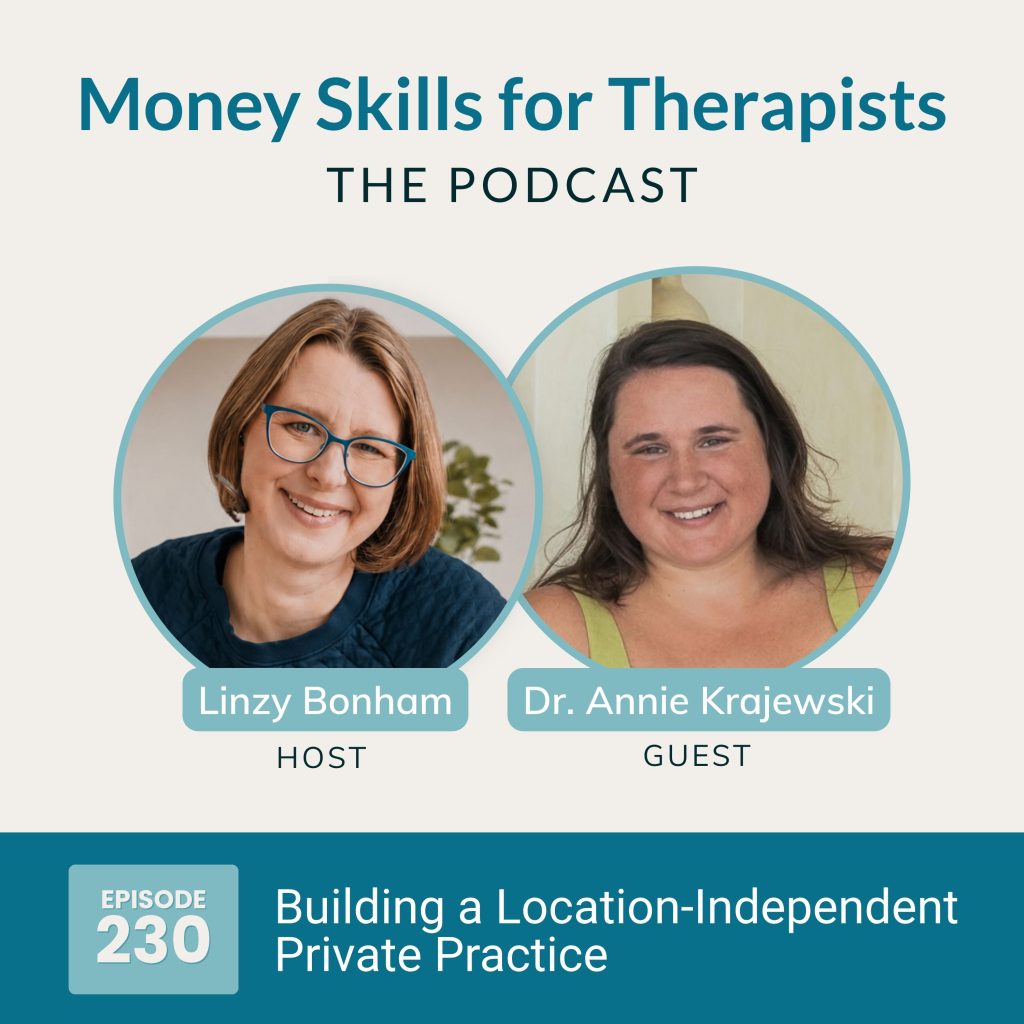
Let’s get started. Hello and welcome back to the podcast. Today’s episode is a really fun conversation with Dr. Annie Krajewski. She is a psychologist who works abroad, has a non-location dependent private practice, and helps other therapists also develop digital nomad therapy practices.
Linzy Bonham 02:02
Today, we talk about some of the financial misconceptions that people have about being a nomadic therapist. We talk about some of the things that stop us from making these kinds of moves, and in our tendency to be small and really owning what we want, in life and the ways that we get in our own way.
Linzy Bonham 02:21
But that really when you open up your idea of what’s possible and start to own what you want, there’s so many cool ways to live life and, working and living abroad is one of them.
Linzy Bonham 02:31
Here is my conversation with Dr. Annie Krajewski. So Annie, welcome to the podcast.
Dr. Annie Krajewski 02:42
Yes. Thank you so much for having me.
Linzy Bonham 02:44
I’m very excited to have you here. We just had some n- nice chats off microphone before. Sometimes I think like, “Oh, the off microphone chats are just as nice as the on microphone chats.” Like, uh, so Annie, you are joining us today from Brazil, which I feel like is, you know, very important, mm, context for the conversation we’re about to have.
Linzy Bonham 03:05
So tell us a little bit about you and where you are and what you’re doing right now.
Dr. Annie Krajewski 03:10
Sure. So I am a licensed psychologist and I have a private practice, but I am also a digital nomad, so I move around. Um, right now I have a home base in Washington State because of my husband’s immigration status.
Dr. Annie Krajewski 03:25
But otherwise, we try to travel as much as possible, and currently I, we are staying and I am working from Brazil, more specifically Florianopolis, which is a little island… Well, not little, but which is an island on more of the south coast of Brazil.
Linzy Bonham 03:44
Okay. Florianopolis. That sounds made up.
Dr. Annie Krajewski 03:48
Yeah, I know. Or more, more affectionately called Floripa by the lo- locals, which I’m like, “I love that.”
Linzy Bonham 03:55
That’s so good. Okay. So your thing then is you, you work abroad yourself, like traveling and working and running your psychology practice.
Linzy Bonham 04:05
Um, but you also help other therapists who might want to not be trapped wherever they are and be out in the world somewhere else instead.
Dr. Annie Krajewski 04:14
Yes, exactly. I, after a couple of years of doing this, I was like, I, I wanna use the wisdom that I’ve learned through all of this to help others, ’cause I know so many other therapists love traveling too and/or need to live abroad for whatever reason.
Dr. Annie Krajewski 04:29
And so I decided to start Digital Nomad Therapist, which is my second business, which like you said, is all about helping therapists build location independent private practices so they can have the freedom to travel and still see the clients they love in the US.
Linzy Bonham 04:44
Right. Yes. Okay. Yeah, so this is US clients. I think it would apply to Canada too, and, and other countries that folks are joining us from. So, I mean, let’s think about the financial part of digital nomadism.
Linzy Bonham 04:54
One of the things that I hear people think about and talk about a lot when they’re thinking about maybe traveling and living abroad is that, uh, it’s expensive, right? Like, the… it, it’s a big move, is what we think, right, to travel or move abroad.
Linzy Bonham 05:09
And I see many therapists who put big expectations about how much money they’re gonna have to save to make this possible. So I’m curious from your experience, from your perspective, is it expensive to move abroad?
Linzy Bonham 05:19
How much does it cost? Like, what does this look like financially for therapists who might wanna do this?
Dr. Annie Krajewski 05:24
So there are a couple of different ways that you could live this type of lifestyle. There are people who actually move abroad. Then there’s people like me, who like to bounce around and don’t stay maybe in one location.
Dr. Annie Krajewski 05:37
And I would say both of those are kind of different in terms of the financial requirement. So typically, if you’re thinking about moving abroad to another country, like Spain and Portugal are the most popular countries that therapists love moving to.
Dr. Annie Krajewski 05:55
I mean, I think 90% of people are saying they wanna move to Spain who end up talking to me or working with me. And so, the thing that people often think about is they need to get a digital nomad visa, which there are some financial requirements to that, or you might need to have some savings.
Dr. Annie Krajewski 06:11
And then the digital nomad side, where you’re actually moving around, it’s less upfront costs because you’re just oftentimes working off of tourist visas. You’re bouncing around.
Dr. Annie Krajewski 06:21
You’re not staying in one place. So there are some costs that are associated with, like, the visa side of things. But I think a lot of misconceptions are really about how much it actually costs to live abroad, l- let alone moving abroad or, like, physically getting there.
Dr. Annie Krajewski 06:37
‘Cause obviously, moving is expensive n- no matter where you move with any type of massive life change like that. But, a lot of therapists that I talk to are like, “Oh, well, I need to have this, like, huge nest egg, or I need to have this huge savings account because I’m gonna be going abroad, and I have no idea what’s gonna happen.”
Dr. Annie Krajewski 06:55
And so they… Like, I remember the first therapist I ever talked to about moving abroad. She had said she needed to have a savings account, and two years later, I had reached out to her again, and she still was like, “I still don’t have enough money to, like, feel safe about going abroad.” So I think that, you know, people are like, “Oh, it’s expensive,” partially because people go abroad for, like, two weeks at a time, and they’re like, “Your trip… They’re thousand-dollar trips,” “multi-thousand dollar trips.” And so then there’s this idea that if I move abroad, it’s going to be the same exact price.
Dr. Annie Krajewski 07:30
But ultimately, from my experience, it is so much more affordable to live abroad. And America, and I could imagine Canada as well, is extremely expensive to live in, like extremely expensive.
Dr. Annie Krajewski 07:47
And so I think people who have never lived abroad before just have such a hard time understanding just how much we have to pay for in the United States or Canada, the Americas, I guess, that you don’t in other countries.
Dr. Annie Krajewski 07:59
‘Cause other countries just, I guess, don’t try to bleed us dry of every single penny we have.
Linzy Bonham 08:06
Okay. Yep, yep. That’s a perspective. I hear that perspective. Yeah, yeah, ’cause as what I’m hearing is we’re kind of making apples to oranges comparisons sometimes when we think about what it would be like to live somewhere.
Linzy Bonham 08:16
Like, if I’m going to… If I’m going on vacation in Barcelona, the cost of my Airbnb and what I’m gonna do when I’m there, and, like, touristy things and nice restaurants, that trip is gonna cost significantly more than if I move to Barcelona for six months and, like, rent a flat for six months, right?
Linzy Bonham 08:32
So tho- those are two very different things. Like, vacation expenses, very different than living somewhere expenses. And you’re right, we do live in some of the most expensive countries in the world. I feel like there’s a couple that are more expensive.
Linzy Bonham 08:43
I’m thinking, like, somewhere in Northern Europe. In Europe, there’s some more expensive places, maybe Switzerland.
Dr. Annie Krajewski 08:48
Yes, Switzerland for sure.
Linzy Bonham 08:50
Yes, and Iceland. Iceland’s a big one, too, which is also my favorite place to travel, um,
Dr. Annie Krajewski 08:55
I love it.
Linzy Bonham 08:56
Yeah. But this is what I’ve seen with, people that I know who have done this, is once you get there, it’s like you can have an incredible dinner for, you know, $10 US gets you, like, some of the best food you’ve ever eaten in your life, right?
Linzy Bonham 09:10
Compared to, like, stopping at a Chipotle or whatever that would get you in America. I’m thinking of American food chains. Um, you know, so it’s like the… When you actually settle somewhere, the cost of living is much, much lower than what we’re used to paying for those of us living in, like, North America or certain places in Europe.
Dr. Annie Krajewski 09:27
Yes, exactly. The cost of food, the cost of just mostly everything is just so much more affordable. But especially the big ticket items like food and especially if you live in a place that is walkable, you don’t have to pay for a car and cars are extremely expensive.
Dr. Annie Krajewski 09:45
You think about gas, oil changes, repairs, or even just car payments. We as a, like in, you know, a car-centric society spend a lot of our money on cars.
Dr. Annie Krajewski 09:59
And so there’s just a lot of things I think we don’t think about that other people live their lives in a way that just consumes less as well.
Linzy Bonham 10:07
Yeah, and this makes me think about kind of the, the North American model for many of us. Not for people in major cities where there is, like, good transportation, but for most of us in North America, we live places where you need a car to get around.
Linzy Bonham 10:19
We usually don’t buy, drive really shitty cars. I’m thinking about the amount of Teslas that I see when I go anywhere in life, you know? Like, it’s something that culturally we tend to value and put a lot of money into.
Linzy Bonham 10:30
And so that in itself is a huge expense that we’re incurring just for living where we live. Whereas if you move to a city somewhere else in the world where, like, food is cheap, you can walk places, transportation is cheap, the cost of living, my guess is it must plummet.
Linzy Bonham 10:45
Like, you mu- it must cost much, much less to live than what we are used to living. And what I’m hearing you’re helping people do is make American dollars but live a non-American life expenses-wise.
Dr. Annie Krajewski 10:57
It is very good math. It is very good math, and I think especially as a therapist, I mean, our work is so heavy, and I know so many therapists are dying to see less clients without taking such a hit on their financial, you know, take-home.
Dr. Annie Krajewski 11:17
And I’ve found that I’ve been able to maintain such a lower caseload, ’cause I originally had opened up my private practice in Arlington, Virginia, which is just right outside of Washington, DC, so a very metropolitan, expensive area.
Dr. Annie Krajewski 11:32
So I had to see a certain amount of clients just to afford not only my own personal cost of living, but also the cost of living… or like the cost of my business for having an in-person practice.
Dr. Annie Krajewski 11:44
And so I was able, when I switched to virtual and then eventually was abroad, I was able to have a much lower caseload and a much better quality of life. But also, I’m taking home more money, which…
Linzy Bonham 11:57
Yes.
Dr. Annie Krajewski 11:58
You know, very helpful when it comes to work-life balance as a therapist.
Linzy Bonham 12:03
Certainly. And I mean now I’m gonna ask you for numbers ’cause I, I need, I need numbers. Like, yeah, how many clients are you seeing now compared to how many folks you were seeing when you were living in Arlington?
Dr. Annie Krajewski 12:14
So when I was in Arlington, I had to see about 20 to 25 clients, just ’cause my rent was like $2,000. My, I was renting an office part-time, which was windowless, and it was $900.
Dr. Annie Krajewski 12:29
So just there it was like $3,000, but then all of the other costs of living in a big area. But now, I mean, throughout my time since I’ve been, become a nomad, I’ve seen around 13 to 15 clients a week, which is, um, feels like a massive change.
Dr. Annie Krajewski 12:48
And, and so I make a lot less, like probably around 10 to 13,000 a month versus probably upper 17 to potentially 20, $25,000 when I was in person.
Dr. Annie Krajewski 13:01
But I, feel like I don’t know how it happens, but life in America is just so expensive that that money disappeared somehow. Like it, I wasn’t necessarily seeing it.
Dr. Annie Krajewski 13:12
And so, now I just, my money gets to go so much further.
Linzy Bonham 14:18
And you’re still making good money. I wanna reflect that, ’cause what I’m hearing before is you were making insane money, to be clear. Um, if you, if you’re seeing $25,000 months, that’s potentially a $300,000 practice that you had, which is…
Dr. Annie Krajewski 14:31
Yeah, that was rarer.
Linzy Bonham 14:33
Those were your upper months. I was gonna say, I have seen folks make, like, $350,000 a year before, but they burned out of the profession, actually, not surprisingly. Um, you know, 350,000 a year is a… You gotta work a lot to, to, uh, make that kind of money.
Linzy Bonham 14:46
But I’m hearing that you were making very good money before living in Arlington, but didn’t necessarily actually feel the impacts of that money on your life, ’cause it kind of disappears into all these cost of living expenses.
Dr. Annie Krajewski 14:57
And I was also trying to go on trips ’cause I love traveling. That felt like what really gave me life, and so I feel like I was taking vacations, but also spending so much more money on traveling than I do now.
Dr. Annie Krajewski 15:09
Um, so it did feel like, yeah, my, the money just poof,
Linzy Bonham 15:15
Yes. Yeah, yeah. I mean, I’m curious, what do you see are the motivations that folks often have to become, like, nomadic therapists?
Dr. Annie Krajewski 15:25
Yeah. So, I mean, I think it really ranges. There’s a lot of people who have lived abroad previously, like they’ve done study abroad or they’ve like, you know, there’s a couple people that I’ve worked with that have gone and taught English in other countries.
Dr. Annie Krajewski 15:42
So there’s those people who have lived abroad before, and so they’re like, “Oh my gosh, I’ve been dying to get back there.” And then, I would say there’s some people who are just really unhappy with how the American politics are going and really want to move to a place that feels more aligned, um, and safer ultimately, um, especially because of this administration, in the United States.
Dr. Annie Krajewski 16:06
So there’s some people that like, it’s more of like political and safety reasons. And then there’s just a lot of people who really are burnt out from being a therapist and living in America, and they love traveling and love being abroad, and so they just really want something different.
Dr. Annie Krajewski 16:22
So it really ranges. But I also, the other part is there’s so many of the people I talk to who ha- are in international relationships, so either their relationship, their romantic partner is from another country and, it’s just so hard to immigrate to the United States, which I am intimately aware of ’cause my husband is Moroccan, and we, you know, have successfully gotten him a green card, but it was a process.
Dr. Annie Krajewski 16:50
And so, you know, people wanting to move abroad to be with their families or their families can’t come here, and so there’s a variety of reasons people wanna move abroad, and I think our society nowadays is so global that it makes sense.
Linzy Bonham 17:04
Yeah, I’m thinking about our, our one team member who I mentioned to you when we were chatting before, Clinton, a good friend of mine who’s come onto our team, brings us strategy and brilliance, just moved to Thailand for the winter.
Linzy Bonham 17:16
He is 32 years old. He’s essentially a 32-year-old snowbird. Uh, he, he grew up in Hong Kong till he was 10, and so that, that kind of tropical climate is what he really enjoys.
Linzy Bonham 17:27
That feels like home to him. And, uh, when he’s in Canada in the winter, he just kinda gets sad, and his skin gets really upset.
Dr. Annie Krajewski 17:35
Yeah.
Linzy Bonham 17:36
So why would you stay if you don’t have to, right? And it’s interesting ’cause I look at his life where he currently is, you know, single and doesn’t have kids and doesn’t plan to have kids, so there’s a lot more freedom there too.
Linzy Bonham 17:46
Like, I have two kids, and my husband’s a city councillor, and that’s, that’s a hard job to do from abroad.
Dr. Annie Krajewski 17:51
That is very hard.
Linzy Bonham 17:52
Would not like that. So we’re not going anywhere anytime soon. Um, but when I look at the photos now that Clinton is sending us, I just feel so excited for him because I think it’s so easy for us to get trapped in this idea of like, “Well, this is my life.
Linzy Bonham 18:04
This is what I have. This is where I live. If I want something exciting, I guess I could go work from the cafe instead of working from home.” Like, we make our world so small, but as you say, we live in such a global world.
Linzy Bonham 18:15
Like, um, Clinton is still working for us. It’s just, you know, when it’s 10:00 AM our time, it’s 9:00 PM his time. He’s just working a shift a day. But he’s sending me photos now of beautiful, lush, you know, tropical… He’s living in Thailand now, I should say.
Linzy Bonham 18:29
Um, this gorgeous building. I’ll talk to you afterwards. I’ll get, I’ll get it from his chats ’cause he sends a lot of pictures of food and beautiful things.
Linzy Bonham 18:36
But living in a beautiful building. He’s rented, uh, an apartment ’cause he had, you know, a connection there with a friend. He’s got a n- beautiful apartment and beautiful complex. He’s already, like, joined gyms.
Linzy Bonham 18:45
He’s meeting people. The weather is so much better for him. The food is incredible. Everything’s affordable. And I just think, like, how easy it would’ve been for him to just not go and just stay here and be like, “Well, this is where I live. My family’s here, and I see them once every five months, so I guess I shouldn’t go.” You know, like, how easy it is to box ourselves into a life that isn’t really serving us and how we live in an age where you actually really don’t need to do that.
Linzy Bonham 19:11
You know, there was a time when traveling meant walking on foot for 50 days to get, you know, to, you know, migrate. But, um, you know, technology’s improved.
Dr. Annie Krajewski 19:20
Yes, it really has, and I think it would surprise people. And it’s so, it really, I think that there’s something about, like, American propa- I know in the US, but I could imagine in Canada.
Dr. Annie Krajewski 19:34
Well, I think less in Canada. I have met so many Canadians abroad, and you guys are always the best. Um, yeah.
Linzy Bonham 19:42
We try.
Dr. Annie Krajewski 19:43
But yeah, I, and I feel like it’s probably the connection probably to, Europe or I guess England. But I feel like especially in the United States, there’s so much propaganda about the US being the best, and other countries just not having it.
Dr. Annie Krajewski 19:57
Like, I was so terrified about not having stable internet connection. And I look back at that, and I’m like, I was so naive because, I mean, the internet abroad is so great.
Dr. Annie Krajewski 20:08
And actually, there’s some places where the internet is significantly better than the United States. But there’s just so much I think we are brainwashed or indoctrinated to believe about the United States that’s just not true.
Dr. Annie Krajewski 20:20
And so a lot of people are like, “Oh, I can’t go abroad ’cause I’m not gonna have this or that or whatever.” like it’s so different from, I think, what we’re kind of made to believe.
Linzy Bonham 20:31
I agree. And I think, you know, I remember a few years ago hearing this stat, which I… stats don’t stick in my brain, but I’ll just tell you a stat exists about the low amount of US senators who have passports, right?
Linzy Bonham 20:42
And just, yeah, yeah. It’s, it’s a very low number. I don’t think that number would exist for Canadians. Like, there, there really are not Canadians who don’t have passports. Like, everybody has a passport.
Linzy Bonham 20:51
Of course, you go places. But I do agree. I think that there is some strong cultural messaging that I, you know, observe from across the border. I don’t live it. But yeah, about, like, being the center of the world and everybody else is doing it wrong or, like, is uncivilized.
Linzy Bonham 21:02
Like, it’s a lot of, like, colonial narratives really, that limit people’s ideas of how many great places there are to live in the world, and there are literally thousands of great places that you could live in the world that have great internet.
Dr. Annie Krajewski 21:16
Yes. And I mean, this is for something I’ll maybe share a little bit later, but I gave birth to my daughter in Thailand, um, which is why I’m like, I love that Clinton is in Thailand because it’s like, I feel like, has a hold- holds such a special place in my heart.
Dr. Annie Krajewski 21:31
But, the medical care there is just really exceptional, and I think when people find out that I gave birth in Thailand, they’re like, “Oh my gosh, what?” And I’m like, “Yeah, I’m pretty sure, uh… Well, I know for a fact that Ameri- or Thailand’s medical system is ranked so much higher than Ameri- or like the United States’ medical system.” But most people wouldn’t assume that because they would assume America has the greatest healthcare in the world, which it’s like, no, absolutely not.
Linzy Bonham 21:58
No. As we get older and our finances become more stable, sometimes I think maybe we should go to Turkey and get those full medical workups done at one of those clinics where you just get like, just look at everything.
Linzy Bonham 22:09
Like, can you look inside my husband’s arteries and tell us if we have to do something so he can stay alive? You know, like truly though. Um, and that is available all over the world. There’s, there’s amazing services and places that are doing things better than we do things in North America or better than they’re done in some places in Europe, right?
Linzy Bonham 22:24
So I do think there is still, even for, for those of us who have worked very hard being part of movements to be like, be anti-racist and like undo this like old thinking, I do still think when people think about global travel, there are a lot of very colonial ideas about the world outside of where we live that are completely wrong.
Dr. Annie Krajewski 22:48
Yeah, I would 100% agree with that. It’s…
Linzy Bonham 22:51
And you’re living that.
Dr. Annie Krajewski 22:52
Yes. Yeah, I feel like I had to really go through this, like, American destructuring,
Linzy Bonham 22:57
Deprogramming.
Dr. Annie Krajewski 22:58
Like dec- de- deconstructing my American, yeah, my American, like, brainwashing.
Linzy Bonham 23:06
Totally. Yeah.
Dr. Annie Krajewski 23:08
So wild how different it is. And I think it, you know, that is just about being an American, but something I really talk a lot about is also what it is to be an American therapist, ’cause then I think there’s an even more brainwashing layer of being afraid of, you know, really just, like, having such a limited mind of what you can do as a therapist or as, you know, I guess technically as a therapist, ’cause so many are like, “I can’t go abroad and be a therapist.
Dr. Annie Krajewski 23:37
That’s not allowed. Um, I can’t live to… in another country.” I think therapists are so afraid and so limited in terms of just even what they can do in their own practices.
Dr. Annie Krajewski 23:49
Like, I can’t not take insurance, or I can’t have a no cancellation policy because that’s, like, so wrong.
Linzy Bonham 23:57
Mm-hmm.
Dr. Annie Krajewski 23:57
And so I think that as therapists, there’s even a greater, you know, destructuring that has to happen to be able to choose a life where you’re, you’re choosing to move abroad for yourself, and that is a massive decision and a massive commitment, that I think a lot of therapists have a hard time making because it’s not about, you know, the system or the group that they’re in.
Linzy Bonham 24:20
Absolutely. You know, I think, there’s a few things that come to mind for me when I think about that. One is I think about the kind of people who become therapists, and just, like, kind of our orientation and helping, helping, helping, focusing, focusing.
Linzy Bonham 24:30
But also the, like, smallness and tightness that can come with that role, and how much that role can constrain us personally in terms of owning what we actually want in life.
Linzy Bonham 24:39
Um, but then I also think about the piece about just valuing ourselves and saying, you know, we can actually have what we want, that that’s okay, and, like, it- that it can be safe and that it can be okay.
Linzy Bonham 24:49
Like, I think as therapists, we can fall back on this idea of, like, what’s ethical. You know, that can be something that we use to be like, “Oh, no, I can’t do that. That’s not ethical.” but we just end up boxing ourselves into lives that are so small and, you know, it’s like I don’t know how the universe works, but i- if this is your one and only human life,
Dr. Annie Krajewski 25:07
Yeah.
Linzy Bonham 25:07
Probably a good idea to do what you want to some extent. Um, you know, but I think of how many people… how easy it is for all of us, I think, w- in the profession we’re in and the kind of people we are to just be like, “Well, no, I’ll just keep doing this for now, and I’ll just… When… After this, I’ll think about myself,” or like, “Later, I’ll think about doing this thing.” And, you know, have, have you read Die With Zero, Annie?
Dr. Annie Krajewski 25:28
Mm-mm.
Linzy Bonham 25:28
The book… Okay. It’s a book. It’s written by a guy who’s not a financial advisor, but he was, like, a very successful p- some sort of, like, m- energy investor or something. He got super rich.
Linzy Bonham 25:38
And his whole argument is we spend our life often trying to, like, accumulate wealth, where it’s like you’re building.
Linzy Bonham 25:45
You’re tr- you gotta build, you gotta save, you gotta build, you gotta save, right? Like, kind of like squirreling. Um, but often, by the time we get to the point where we actually have significant money to work with, our health is gone.
Linzy Bonham 25:56
So there’s kind of this, like, health and money equation that you have to think about. You know, what can your money do with you now, for you now? What can your money do for you now at this point in your life that maybe you actually can’t do in five years because you’re just gonna be older or because you’re gonna have kids at that point and you don’t have kids now, right?
Linzy Bonham 26:13
And, like… Or your parents will be older and you won’t wanna live abroad when they’re 85, but now’s a good time when they’re still in good health, right? So just really understanding what’s important to you and where that fits into this idea of, like, buckets.
Linzy Bonham 26:24
And so I think about this. Like, there’s times in life when it’s amazing and great to, like, m- live abroad and, and move around, and then there’s gonna be times where maybe you wanna live somewhere and stay still.
Linzy Bonham 26:33
But really owning the season you’re in, and I think it’s really easy for us as therapist-type people to not do that and not own what we actually want, and not actually own that maybe actually now is the right time, and later might not come.
Dr. Annie Krajewski 26:46
Yeah. I think we get really stuck in this, like, all or nothing thinking, or it needs to be perfect. Like, I have… You have to have it all figured out because you can’t make mistakes or you can’t change.
Dr. Annie Krajewski 26:57
Like, I think a lot of the work I do with, people, it’s like, I make a simple suggestion even of, like, you know, thinking about doing it, like making a transition slowly, and they’re like, “Oh.
Dr. Annie Krajewski 27:07
Oh my gosh. I can slowly get off of insurance? I don’t have to do it all at th- all at once,” you know? But I think it’s a similar thing where it’s like people are like, “Oh, well, I have to move abroad, and it has to be all or nothing.”
Dr. Annie Krajewski 27:20
But it’s like you don’t have… It doesn’t have to be all or nothing. You can… Or, you know, you can even try it out. You can go live in Spain for a month, or you can go, you know, travel during this, n- you know, be a snowbird.
Linzy Bonham 27:34
Yes.
Dr. Annie Krajewski 27:34
Um, and…
Linzy Bonham 27:35
Be a 32-year-old snowbird. You can do that. That’s allowed.
Dr. Annie Krajewski 27:38
Yes. And I think it’s just, like, really we get so stuck that we forget how to problem solve and, like, think out, you know, think outside the box of how to make our dreams come true or how to really get what we want.
Dr. Annie Krajewski 27:53
Like, I think some people are like, “Oh, it’s, it, it’s too much work. It’s too much work to do this.” Which moving abroad or taking a practice even for six months is, like, it does require some work.
Dr. Annie Krajewski 28:04
Like, it’s not this easy, like, flip of a switch thing. I mean, for some people it might be if they have a fundamental structure that you need.
Dr. Annie Krajewski 28:12
But I think sometimes people get really scared of like, “Oh, well, I’m gonna invest in this thing,” or, “I’m going to invest my time or money. And so I need to know for sure if it’s gonna work out.” But nobody can ever get that, you know, certainty ever.
Dr. Annie Krajewski 28:26
And so so many people don’t end up doing anything ’cause they’re like, “Oh, well, what if it fails?” And it’s like, yeah, I mean, it could fail. I mean, that’s just life.
Dr. Annie Krajewski 28:33
But also, what if it doesn’t? Which is, I know, such a common thing nowadays for people to say, but it’s so true.
Linzy Bonham 28:40
Absolutely. And I mean, what I hear there is basically like perfectionism about your life. You’re like, “Well, if I can’t do it, I gotta do it all the way. I, I can’t do it halfway.
Linzy Bonham 28:49
What if I do it, if it doesn’t work? Maybe I just won’t do it.” Um, in the meanli- meantime, your life is going by.
Dr. Annie Krajewski 28:56
Yeah. Which is like, you know, the, I guess to go back to the original question about the, like, savings account, it’s like, oh, well, like, I need certainty that I’m not, you know, I need this certain amount of money to feel safe enough to make this type of risk or commitment.
Dr. Annie Krajewski 29:11
But it’s like, well, you know, that money… Like, but then two years later I talk to the same therapist, and they’re still don’t have enough money, um, which is like, that’s two years of your life.
Dr. Annie Krajewski 29:21
But I guess one other note of that is I like to tell people, it’s like I had, you know, I didn’t have, like, a massive savings account, but I had an emergency fund.
Dr. Annie Krajewski 29:29
And funny enough, I never, I didn’t even, in the two years I was a nomad, didn’t even touch that emergency fund until I went on maternity leave.
Linzy Bonham 29:37
Right. Yeah.
Dr. Annie Krajewski 29:38
You know, you might waste all this time saving this money that you don’t even need when you could have, you know, been living abroad and saving money, saving, being able to save that money so much more easily.
Linzy Bonham 29:50
Well, yeah, and it makes me think about how sometimes our fixation on safety just, like, puts us into a freeze,
Dr. Annie Krajewski 29:56
Oh, yes, absolutely.
Linzy Bonham 29:58
It’s like, “No, I, I can’t do it till I’m safe. I can’t do it till I’m safe.” But at a certain point, you just need to move, right? And, and it, it makes me think too about self-trust, right? This is something that I’ve been thinking about more over time with, with business and, and life in general, is, like, trusting that your future self can figure it out.
Linzy Bonham 30:12
Like, you don’t actually have e- have to have everything lined up for them perfectly, ’cause they are also gonna be a capable adult who’s even a little wiser than you actually, ’cause they’ll have a few more months and years on, on you, who also will be able to figure things out.
Linzy Bonham 30:25
So if you get abroad and life costs a little bit more than you planned, they can pick up more clients. They can find some cool project to do with somebody they went to grad school with.
Linzy Bonham 30:33
Like, but it’s this… Sometimes I think that we… It, it’s a type of perfectionism, and it’s a fixation with safety. I don’t… I’d be curious to hear what you think it is too.
Linzy Bonham 30:42
But yeah, we feel like we have to have it all, all figured out now, have it all set up now, and forget that, like, we can continue solving problems tomorrow and the next day, and the next day, and the next day.
Linzy Bonham 30:52
Um, we don’t actually have to have everything under control today to be allowed to do what we want with our life.
Dr. Annie Krajewski 30:58
Yeah. I mean, I think I talk about self-trust a lot on my, you know, my Instagram account ’cause it does, it, that does feel like such a massive part of making a big life decision.
Dr. Annie Krajewski 31:10
I mean, I think for, I could imagine you see it as well of, like, people in private practice. Like, it requires so much trust to, you know, I don’t, you know, get off insurance or even go into private practice.
Dr. Annie Krajewski 31:21
Or, you know. I feel like there’s so much self-trust is required.
Linzy Bonham 31:24
Yeah,
Dr. Annie Krajewski 31:25
So many decisions in life.
Linzy Bonham 31:26
Yes. Yeah, it’s a huge part. So I mean, Annie, I’m curious, what are the things that you notice are, like, the top financial worries that people have about working from abroad, becoming, you know, digital nomads, therap- therapist nomads?
Linzy Bonham 31:43
Is that what we call… Was that the term?
Dr. Annie Krajewski 31:45
I mean, I say digital nomad therapist, but it really, you can, there’s, you can take any term.
Linzy Bonham 31:50
Combine these words as you would like. Um, yeah, and then, and what do you think helps to navigate those worries, right? ‘Cause as we said, there’s always gonna be things that, you know, we can feel like trying to get safer and safer.
Linzy Bonham 32:01
So what do you notice, yeah, what do folks get caught up on.
Dr. Annie Krajewski 32:04
I would say the number one thing that I see with therapists is they’re so terrified of relying on themselves, ’cause I, I end up seeing a lot of people who come to me who want to move abroad for whatever reason, but they don’t have a private practice or they’re working for someone else.
Dr. Annie Krajewski 32:23
And so they’re having… Or if they have their own private practice, they don’t really have marketing set up. So the, honestly, the biggest worry is that they’re afraid, you know, they have built something in America, they’ve built, you know, their private practice, but then when they go abroad, they’re afraid it’s all gonna fall apart.
Dr. Annie Krajewski 32:42
You know, they’re not gonna be connected to their local communities anymore. They just feel like there’s, like, so much less control, ’cause for some reason it feels like if you’re in the local community, you’re gonna have more control over getting clients, which isn’t really true.
Dr. Annie Krajewski 32:56
But I think that is, like, this fear that people can have is, the number one fear really is, like, that they’re not gonna be financially stable in making this life transition.
Dr. Annie Krajewski 33:07
And that is, I would say, the number one thing people come to me for is, “What do I do when I go abroad?” like, “How am I gonna continue to make money?” That is second to people being afraid that they’re gonna lose their license, ’cause they feel like their license is gonna be revoked.
Linzy Bonham 33:23
Right. ‘Cause they’re doing something wrong or bad. Mm-hmm.
Dr. Annie Krajewski 33:26
Like the, the police are gonna come get them and…
Linzy Bonham 33:30
For sure. In the middle of the night, yes, the SWAT team is coming in. Yeah. Yeah. But I feel like…
Dr. Annie Krajewski 33:35
Number one thing.
Linzy Bonham 33:36
That’s so the way with us though, I think. Um, and I say us in a very broad sense. I’m sure there’s some folks listening who are like, “I don’t feel like that at all.” Um, but kind of, you know, the fear of getting in trouble, right?
Linzy Bonham 33:45
Like, we wanna be good. Helpers are usually focused on being good. We wanna be good people. We wanna do it right, and we’re afraid of doing it wrong, right? So I’m hearing, like, people are just afraid, like, “Am I even allowed to do this?” And what I’m hearing from you is yes, you are allowed to practice abroad.
Linzy Bonham 34:00
You’re not gonna lose your license for that. But yeah, like, that piece about losing their practice I think is really interesting. ‘Cause what I’m hearing from you is people kind of overestimate how important it is to be local in order to have a successful therapy practice.
Linzy Bonham 34:13
You know, tied to a certain state or province is where, you know, how it’d need to work. Yeah, what have you, what have you observed? And like, how do people make their practice really successful even though they’re maybe on the other side of the world?
Dr. Annie Krajewski 34:23
Yeah. So part of this is like people, therapists in general, unless they’re somehow on the online Instagram community, like following someone like you or other Instagram therapy people.
Linzy Bonham 34:37
Our Instagram strategy is signs of life, I’ll just say. We, we post things on there to just show you we do still have a business, but really we just want people in our podcast and WhatsApp communities and our email list.
Linzy Bonham 34:46
So yes, but yeah. Y- go on, go on.
Dr. Annie Krajewski 34:49
Yeah. Some people have a little bit more awareness of, like, online marketing. But in general, therapists are like, “Oh, well, networking is the only way to actually get clients.” But then two is insurance, and most importantly is these platforms that I guess take away this idea that you need to market.
Dr. Annie Krajewski 35:09
And so oftentimes what I help therapists do is develop online marketing strategy that doesn’t require like in-person networking or relying on insurance or these platforms.
Dr. Annie Krajewski 35:24
And I specifically teach people how to do SEO and, you know, set up a Google Business profile and all those different things. And learn how to market effectively ’cause obviously as, as therapists, we don’t learn how to market, we don’t learn anything about business.
Dr. Annie Krajewski 35:39
And so, what I usually do is really help people get more in control of their marketing because you don’t have a business unless you’re marketing, which I know you’re probably very acutely aware.
Dr. Annie Krajewski 35:52
But I think a lot of therapists do… are not aware of that, of like how important to have a therapy business, th- m- marketing is a non… like they’re… you don’t have a business without marketing.
Dr. Annie Krajewski 36:02
And so, yeah, and so I think that’s the biggest thing that I help people um, do, is really set up their marketing so that they can be financially secure and have a profitable business abroad.
Dr. Annie Krajewski 36:15
But I think it’s something as therapists we’re so… I mean, there are so many money issues with therapists. It’s really quite wild.
Linzy Bonham 36:22
Mm-hmm. I’ve, I’ve noticed that. Yep,
Dr. Annie Krajewski 36:24
Yeah, I know you are probably very intimately aware of that. But as I started to work with therapists, it’s like, I think I didn’t quite realize how many, how much money stuff comes up for us therapists.
Linzy Bonham 36:38
Oh yeah,
Dr. Annie Krajewski 36:38
Is what, exactly what, um, you’ve talked about before of like, just like the type of role that people are in that propels them into therapy world. But I think that there is like so much shame around money, so much scarcity around money, and, I think that probably is just like a symbol for a, a variety of things.
Dr. Annie Krajewski 37:00
But so, I think that’s a big part of it, it’s helping them see that if they invest themselves in marketing, if they kind of set these things up, that they can have a profitable business.
Dr. Annie Krajewski 37:09
But I think that too is a little bit scary to them because they might feel guilty. I actually get a lot of social workers who reach out to me, which I think is so funny because, I would say 70% of the people who reach out to me are social workers.
Dr. Annie Krajewski 37:21
But I also feel like social workers, at least in the United States, get the most, brainwashing around private practice. Like so many social workers were like, “Oh yeah, my grad school professor told me that I’m selfish for going into private practice.” And so it… But it’s so interesting like, I think there’s almost this like reaction where they’re like, “I want freedom.
Dr. Annie Krajewski 37:40
I wanna build something that like actually gives to me.”
Linzy Bonham 37:44
Yes.
Dr. Annie Krajewski 37:45
It’s not like I’m not teaching brain science. I think there’s tons of other people teaching the same thing, but I, I feel like as therapists, we need so much help seeing that it’s okay to market, it’s okay to, make money as a business, and that it’s actually important.
Linzy Bonham 37:59
Yeah, I think we need permission for a lot of things, uh, because we’re, we’re people who are used to waiting to be told that something is…
Dr. Annie Krajewski 38:01
Okay.
Linzy Bonham 38:07
Yeah, I mean, this piece about digital marketing. ‘Cause basically what I’m hearing is if you’re living abroad, especially if you wanna be, like, moving, but no, no. If you’re serving a place that you’re not living, you need to have an online business marketing system.
Linzy Bonham 38:20
So yeah, it’s not gonna work for you to just, like, run into a friend from grad school at the local cafe. But I mean, I will say my experience is that it is possible to have a successful online business that has no physical location.
Linzy Bonham 38:31
Like, if I think about my own business, we didn’t start doing a little tiny bit of in-person stuff until this year, which is year six of our business. Previous to that, we’ve only been online, right?
Linzy Bonham 38:40
And so there’s certainly ways to find your people through the internet, and if you’re a digital therapist, that’s gonna be the strategy that you’ll be using, is those online marketing strategies is what is gonna work for you.
Dr. Annie Krajewski 38:51
Yeah. And that could be, you know, I specifically teach websites and SEO, um, mainly ’cause that is what I, how I built my practice and was able to sustain it.
Dr. Annie Krajewski 39:02
I have been able to sustain it abroad. Obviously there’s like Instagram or those other types of online social media marketing. Honestly, it’s like actually very helpful for you and the person looking for you.
Linzy Bonham 39:14
‘Cause we want them to find you.
Dr. Annie Krajewski 39:16
Yes.
Linzy Bonham 39:17
And if they find you, then you’re also able to, um, live your life, and maybe live somewhere that’s not the place that you don’t wanna live that you’re currently stuck.
Linzy Bonham 39:25
Um, so I’m curious, Annie, for people who are listening who, are maybe feeling a little bit nomad curious at this point in the conversation, where would you suggest they start?
Linzy Bonham 39:34
Like, how… What is, what is step one of starting to move towards a, a nomadic therapy practice? I know that’s a really big question, but I can just see there’s so much to do.
Linzy Bonham 39:45
Where…
Dr. Annie Krajewski 39:46
Yes, there really is. There is a lot to do. I guess the first thing is you need a, a private practice. That is one thing.
Dr. Annie Krajewski 39:55
And some people don’t have a private practice, but if you do have a private practice, it’s really important to understand, like, kind of audit your private practice to see what can go or what needs to change.
Dr. Annie Krajewski 40:05
Cause obviously, especially if you have an in-person practice, there might be things that you’re not thinking about. I would also say, really understanding the legal piece because yes, it is 1,000% possible to legally work abroad, but there are some legal pieces that you wanna look at to be able to do that.
Dr. Annie Krajewski 40:21
Like, you know, you wanna check your licensing board. I personally have never found a licensing board, and I’ve looked up several at this point, that have said that you’re not allowed to go abroad while serving your client or clients in that state.
Dr. Annie Krajewski 40:33
But there are, some stipulations they might have, and so it’s always important to check that. But then, you know, checking your malpractice insurance, making sure your EHR allows you to go abroad, which I usually recommend Jane, which I think you, I think you partner or you have partnered with Jane.
Linzy Bonham 40:48
I have partnered with Jane. Yeah, I love Jane.
Dr. Annie Krajewski 40:49
Oh, okay. Yeah. And then also I think the biggest thing is, like, billing and insurance, because there are some insurance companies that allow you to go abroad, and bill for services, but there are a lot that restrict it nowadays, and I think every day more and more are restricting it.
Dr. Annie Krajewski 41:06
But most importantly, the platforms do not let you go abroad, like Alma, Headway, Rula.
Linzy Bonham 41:10
Oh, interesting.
Dr. Annie Krajewski 41:12
Yeah. So I think oftentimes that is one, you know, one of the biggest things I help people do is, like, figuring out that transition because I think at this point, so many therapists are on platforms that, have some degree of relation to insurance that that’s a big starting point is really just trying to figure out what can stay the same and what needs to change.
Dr. Annie Krajewski 41:31
And I think the biggest thing is the way you bill clients, um, which is why marketing is so important because I think a lot of people are, don’t have, like, private pay marketing set up.
Linzy Bonham 41:41
What I’m hearing is having a private practice, great place to start. But I’m hearing if there is gonna be some sort of roadblock that you hit, it’s probably gonna be insurance.
Linzy Bonham 41:49
That probably it’s very likely that the insurance companies that you are working with will not let you work abroad, and those online platforms will also not you… let you work abroad, which is just a great reason to stop working with them.
Dr. Annie Krajewski 42:01
Yes. Absolutely. Yeah.
Linzy Bonham 42:04
And I, I’m seeing more moves, um, you mentioned that you’re helping people with this, you know, moving off of platforms, get their marketing working. I saw Allison Puryear is now offering a program for this.
Linzy Bonham 42:12
Like, I think this is the next…
Dr. Annie Krajewski 42:13
Wow. Yeah. Yes.
Linzy Bonham 42:15
Um, the therapy space is like the, you know, these platforms have been so effective with, you know, collecting therapists, and now a lot of therapists are like, “This sucks.”
Linzy Bonham 42:23
Um, and so I do think there’s gonna be more and more resources out there to help folks get off of those platforms. So if you wanna live abroad, you know, getting off that platform is possibly probably a very good thing anyways, and it means that you could live abroad.
Dr. Annie Krajewski 42:36
And you can have a better, like, financial life. Yeah.
Linzy Bonham 42:41
Yes, 1000%.
Dr. Annie Krajewski 42:42
Money can’t buy happiness, but it can really help you a lot.
Linzy Bonham 42:46
It solves a lot of problems. This is how I think about it, is money can’t buy you happiness, but it solves a lot of problems. And the less problems that we have, the more space there is to just enjoy life.
Dr. Annie Krajewski 42:56
Yeah, and it gives you freedom. You know, like so many, you know, I guess these platforms have done effective enough marketing that therapists in droves have joined them because it makes it seem like it’s easier, but then they get trapped because it’s safe.
Dr. Annie Krajewski 43:10
They know… they don’t know h- anything different, yeah. Um, but it does take some risk to, to build something really worth happening.
Linzy Bonham 43:17
That’s it. I have one, one final question for you, and that is what is your favorite part about working from abroad?
Dr. Annie Krajewski 43:27
That I get to live near the beach without paying $10,000 a month in rent. Literally the best thing ever.
Linzy Bonham 43:38
Nice. Great. Much, so there’s better beachfront property available, I’m hearing, than what people are paying for in the United States. Yes.
Dr. Annie Krajewski 43:46
Oh my gosh, so much so. And it’s, I was living in Morocco, that’s probably the ti- the place I’ve spent the most time outside of Thailand.
Dr. Annie Krajewski 43:54
And, you know, living in these beautiful places, like, less than 10 minutes from the beach, sometimes literally on the beach, for less than $1,000 a month, which is insane.
Dr. Annie Krajewski 44:08
Like these two, three-bedroom apartments. Wild. And that you get to go out to eat and enjoy and not feel like you’re spending an arm and a leg.
Dr. Annie Krajewski 44:18
Like, it’s so affordable.
Linzy Bonham 44:20
Well, that’s… I don’t even like the beach, but that sounds very appealing. I think that was a good, a good sale. Again, Iceland girl, but I’m just gonna translate that into my own…
Dr. Annie Krajewski 44:27
Yes.
Linzy Bonham 44:28
Uh, Annie, thank you so much. This has been really fun. For folks who are listening who wanna get further into your world, where can they find you?
Dr. Annie Krajewski 44:36
So they can find me on Instagram at Digital Nomad Therapist. I would say that’s kind of my most active channel, but I’m also on YouTube. And I do have a really tiny podcast that I’m committing to growing.
Dr. Annie Krajewski 44:48
But, um, definitely on Instagram.
Linzy Bonham 44:51
Okay, and what is your podcast called?
Dr. Annie Krajewski 44:54
The Digital Nomad Therapist Podcast, so…
Linzy Bonham 44:56
The Digital Nomad Therapist Podcast. Great. Thank you so much, Annie, for joining me today.
Dr. Annie Krajewski 45:01
Yes. Thank you so much for having me.
Linzy Bonham 45:07
What strikes me in my conversation with Annie is how the world is often bigger than we let ourselves think it is. And if you are interested in traveling while working, living abroad, if, if you wanna marry somebody who lives on the other side of the world and work from there, those are actually options that are open to us as therapists.
Linzy Bonham 45:30
Now, you might be listening and thinking, “Absolutely, I do not want that.” I know for me right now at this stage in my life, I’m in more of a nesting stage, uh, in terms of like building out our home and really establishing ourselves in our community.
Linzy Bonham 45:41
So for me, this doesn’t speak to me in this moment, but it might make sense for me in 10 years when my kids are no longer home, or when my husband is retired from being a city councillor and is able to move around.
Linzy Bonham 45:53
So it’s something that is an option for all of us at some point if it is something that we want, right? So if this is something that speaks to you in any way, I would encourage you to think about what Annie said about the steps.
Linzy Bonham 46:07
You know, getting a private practice established is really important. That allows you to work from anywhere. Um, not being on those online platforms because many of them will not let you do this.
Linzy Bonham 46:19
You know, not being on insurances that are gonna be restrictive. If you build a private practice that is robust and allows you to basically work on your own terms, you know, which in many cases will be private pay, then you also have the flexibility to do that work from literally anywhere in the world that you want to.
Linzy Bonham 46:37
So just, you know, planting that seed for all of you I hope that you found my conversation with Annie today a little bit inspiring. And if you’re enjoying the podcast and enjoying these conversations, you definitely wanna check out our WhatsApp community.
Linzy Bonham 46:50
This is a free community that we have. We’ve been playing with it. Diane and I have been just figuring out how to create a nice community space. Unlike social media spaces, our WhatsApp community is not loud or random.
Linzy Bonham 47:03
The only people in it are people who listen to this podcast and hear these kinds of calls to action, to join the community or people who are on my email list.
Linzy Bonham 47:12
So it’s a very specific curated group of people in our free community. We have monthly calls, often with guests from this podcast. You will hear about workshops.
Linzy Bonham 47:22
Diane is in there answering questions. People are sharing resources. I’m in there posting, answering questions, sharing. So if you are interested, we would love to have you in our community.
Linzy Bonham 47:32
Just email us at hello@moneynutsandbolts.com, and we will send you the form to join. Thank you so much for joining me today.