







Money Skills for Therapists Podcast

Money can be stressful and confusing for therapists and health practitioners in private practice – dealing with all of our feelings and stories about it, understanding how to actually manage our business finances, and making money work for us in our lives can feel so daunting that many therapists just avoid dealing with money altogether. Join Linzy Bonham, therapist and creator of Money Skills for Therapists, as she demystifies all things private practice finances through short and sweet solo episodes, conversations with therapists who have transformed their relationships with money, and live coaching calls with Money Skills for Therapists students.

Listen to the Money Skills for Therapists podcast in your favourite app!

Want to hear from me?

Get money skills tips right in your inbox!

    We value your privacy and will never share your contact information. By submitting this form, you are consenting to receive tips and advice on private practice and group practice finances.

    Picture of Hi I'm Linzy

    Hi I'm Linzy

    I’m a private practice therapist turned money coach, and the creator of Money Skills for Therapists. I help therapists and health practitioners in private practice feel calm and in control of their finances.

    Do you have a question for Linzy?

    Record your message below, and we’ll do our best to answer it on an upcoming podcast episode!

    Please say your first name and then share your question. We do edit these questions, so don’t worry if you make a mistake! Just start your sentence again if needed.

    And be sure to tune in to our new Q&A episodes to hear thoughtful questions and insightful answers about money.

    Check out our latest episodes....

    In this episode, Linzy is joined by Elana Sures, creator of the Client Retention System (and recent Money Skills for Group Practice Owners graduate), to talk about client retention — a key metric in both group and solo practice.

    Together, they discuss what retention actually measures, why it can feel so uncomfortable for therapists and practice owners to talk about, and how improving retention benefits both the clinical relationship and the financial health of the practice.

    Go to this episode »

    In this solo episode, Linzy explains why an expense occurs the moment you use your credit card — not later when you pay your credit card bill — and how paying your credit card weekly instead of waiting for the monthly statement is a simple yet powerful habit that can create greater financial clarity, improve cash flow awareness, and help you stay in control of your money.

    Go to this episode »

    In this “Best Of” episode, Linzy revisits one of the most downloaded conversations from the past year with Diane Webber, a financial therapist, private practice owner, and coach in the Money Skills programs. Together, they explore the freedom, responsibility, uncertainty, and purpose that can come with self-employment.
    Diane shares how private practice has allowed her to be present for her family while navigating the changing needs of the sandwich generation. She and Linzy also talk about why therapists do not have 40 hours of quality emotional energy to give every week, how rest and time away support better clinical work, and why appearing busy is not the same as doing meaningful work.

    Go to this episode »

    In this first-ever compilation episode of Money Skills for Therapists: The Podcast, Linzy revisits conversations with Maegan Megginson, Karen Dyck & Melissa Tiessen, Kasey Compton, and Darya Zuychenko about why self-sacrifice can feel so normal for therapists and healers, and what it looks like to build a private practice that makes room for you, too. Together, these conversations explore how professional training and cultural conditioning can shape the way therapists set their schedules, fees, and boundaries; why self-care needs to be part of the workday itself; and how self-love and self-awareness affect leadership.

    Go to this episode »

    For a long time, the biggest problem therapists faced in private practice was overworking.

    Burnout was a real risk during COVID — there were too many people needing care and too many therapists pushing past their own limits because there was always one more person to help. But what if that is no longer the challenge your practice is facing?

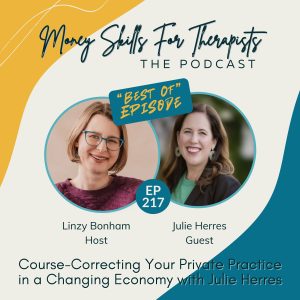
    In this “Best Of” episode, Linzy revisits her conversation with Julie Herres, founder and CEO of GreenOak Accounting and author of Profit First for Therapists, about what private practice owners can do when demand slows down, clients become more cautious with money, and the boundaries and structure that were once put in place to protect you from burnout start to feel a little too rigid for the season you are currently in.

    Go to this episode »

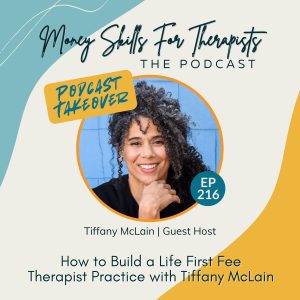
    What if your life first fee isn’t just about earning more — but about creating a practice that can truly support your life?

    In this podcast takeover episode, Linzy hands the mic to her biz bestie, Tiffany McLain — founder of The Lean In. MAKE BANK. Academy and host of The Money Sessions — for a bold conversation about what it really takes to build a life first fee practice.

    Go to this episode »
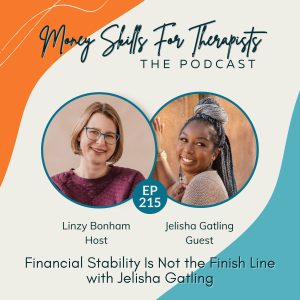
    Money Skills For Therapists Ep 215 - Jelisha Gatling Cover Art

    For many therapists and health practitioners, financial stability is the first goal: being able to pay yourself, cover your expenses, stop riding the monthly income rollercoaster, and feel less anxious about money. But what happens when stability is no longer the whole dream?

    In this “Best Of” episode, Linzy revisits her conversation with Jelisha Gatling: Therapist, Money Skills for Therapists graduate, and former coach inside our comprehensive program for solo practice owners. Jelisha shares the story of a major life shift: selling her belongings, packing two bags, and traveling abroad while continuing to run her solo private practice.

    Go to this episode »

    Money conversations in the therapy world often focus on getting out of scarcity — leaving agency work, raising fees, or building a sustainable private practice. But what happens after that? What happens when your financial circumstances change, but your money beliefs haven’t caught up yet?

    In this episode, I’m joined by Allison Puryear, founder of Abundance Practice Building, who has supported more than 10,000 therapists in creating practices that work for their lives. Together, we talk about money not as a measure of worth, but as a tool for creating a life that reflects your values. We explore how our relationships with money evolve over time — from the early days of practice building to navigating financial security, lifestyle creep, sliding scale therapy, and retirement savings.

    Go to this episode »

    If private practice has felt harder lately, you’re not imagining it. Caseloads can take longer to fill, marketing strategies that once worked may not be working the same way, and many therapists are carrying more anxiety about money than they were a few years ago.

    This week, I’m joined by Diane Webber, a coach in both Money Skills for Therapists and Money Skills for Group Practice Owners, to talk about how we’ve been responding to these shifts inside our own work. We share some of the changes we’ve made in our business, from changing our outward-facing name and restructuring programs to creating more community and bringing fresh energy onto the team.

    Go to this episode »

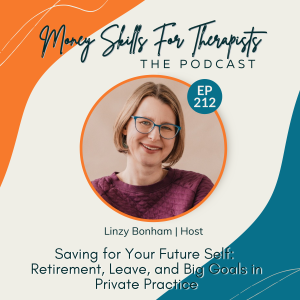
    As a therapist in private practice, there can be a moment when you realize that you are the one responsible for caring for your future financial needs.

    No employer is automatically setting aside money for your retirement, your maternity leave, your next chapter, or the bigger life goals you’re holding.

    In this solo episode, I walk through how to think about future-focused financial planning in a way that feels practical, compassionate, and doable.

    Go to this episode »

    Many of us become therapists because we care deeply about people, not because we want to spend our days looking at business data. So, it makes sense if tracking metrics feels a little cold, overly analytical, or disconnected from the human side of the work you’re doing.

    But the truth is, good data can actually support you in caring for both your clients and your clinicians more effectively.

    Go to this episode »

    There’s a particular kind of stress that comes with spending a large amount of money on your practice while not fully knowing if it’s paying off yet.

    In today’s coaching session, I’m joined by Dana Corr—a graduate of the Money Skills for Group Practice Owners program—to explore what it means to be in an investment period inside a private practice.

    Go to this episode »