Linzy Bonham [00:00:01]:
And a churn indicates that somebody’s, you kind of lost them.
Tory Krone [00:00:04]:
We lost them.
Linzy Bonham [00:00:05]:
They’re gone.
Tory Krone [00:00:06]:
They’re gone after one, two, or three sessions. So they come in for an intake and, like, are basically out the door. So we think of it as the revolving door metric. Really hard to get a client. Yes. They come in, we’re tracking down paperwork, we’re verifying benefits. You know, we’re doing a lot of work to get that new client. And then they meet with the therapist and they just don’t really come back.
Linzy Bonham [00:00:31]:
Welcome to Skills for Therapists, the podcast that helps therapists and health practitioners in private practice go from money confusion and shame to calm, clarity and confidence with their finances. If you’ve ever felt overwhelmed by numbers or avoided looking at your business money, you’re in the right place. I’m Linzy Bonham, therapist turned money coach and creator of Money Skills for Therapists. Before we jump in, I want to remind you of something really important. Most of us highly skilled and competent therapists and health practitioners were never taught about money. Not in grad school, not in supervision, not anywhere. And yet here we are, running businesses that need to take care of us while we’re busy taking care of others. It is a lot of pressure.
Linzy Bonham [00:01:11]:
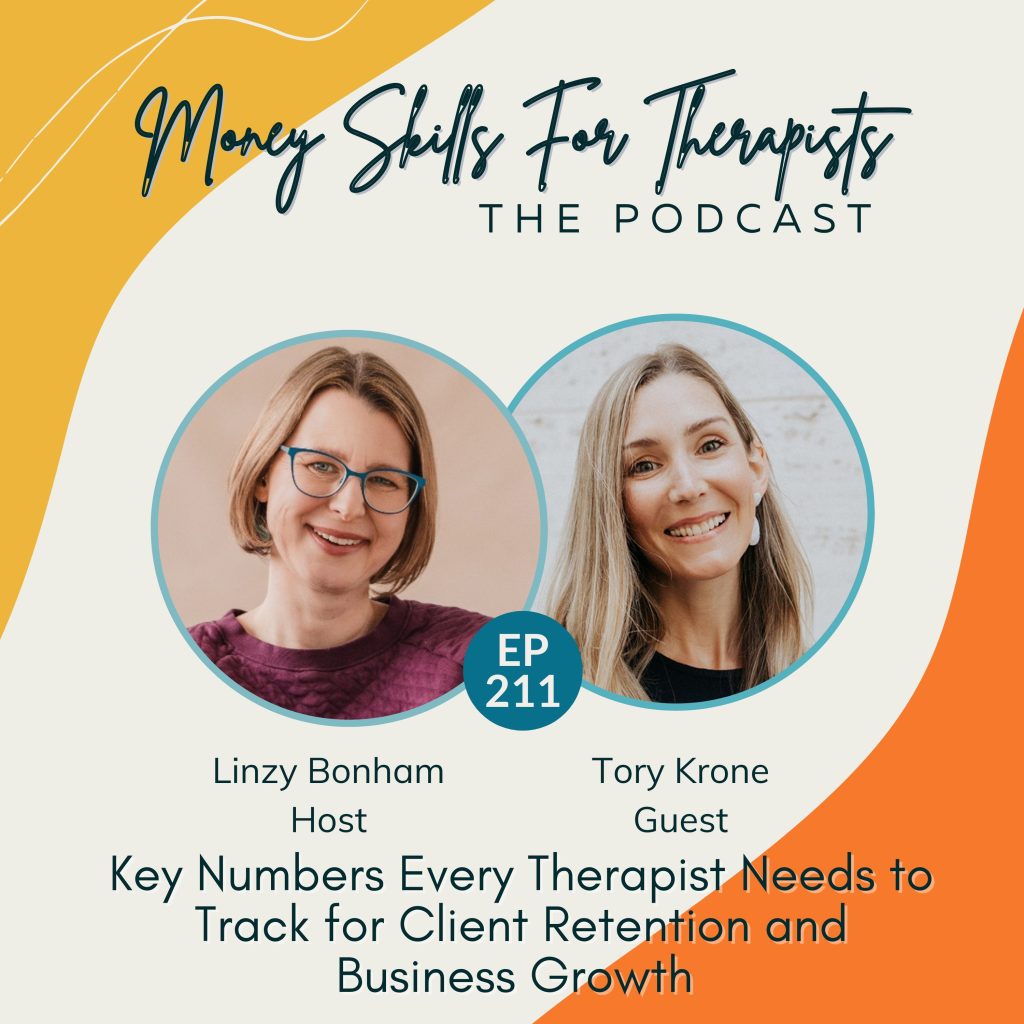
So if part of you feels anxious about money avoidant or like a bit of a hot mess financially, I want you to know that you are not alone. And I am here to help. Through my free live workshops each month, I teach practical financial skills to help you feel more grounded, calm and confident with your private practice money. You can see what’s coming up and save your spot to join live or register for the replay@moneyskillsfortherapist.com workshops. Let’s get started. Hello and welcome back to the podcast. Today’s guest is Tory Krone. Tory is a group practice owner and she is the creator of PractiveVital, which is a dashboard that helps group practice owners understand and see their numbers, understand what’s actually happening under the hood of their practice.
Linzy Bonham [00:01:56]:
Tracking all sorts of numbers that are also relevant to all of us, including folks in solo practice, about how many people are coming in the door, how many people are being seen, how are you losing people? These are numbers that matter at every level of practice. But at the group practice level, these numbers get big and there’s a lot to track. And so today, Tory and I talk about what are some of those key numbers in a group practice that you need to be keeping track of? What do those numbers mean? What do we tend to see as like Good benchmarks, for instance, for Churn, which is where somebody comes and they don’t stay. How little churn can we expect? How good can it get? What are the numbers that we should be aiming for when it comes to how clients work and how these numbers, too, can tell us sToryes of what’s happening clinically with clients and where areas of improvement are in the way that clients are being served. Generally speaking, healthy numbers in a business means healthy business in general. It means that the clients are being served well. It means that they’re coming to the right place. They are turning from that first phone call into a client.
Linzy Bonham [00:03:01]:
They’re sticking around. They’re having their needs met. They’re actually getting the problem solved that they came for. So numbers, in addition to being fun for me, because they’re numbers also for all of us, give us really good information about what’s actually happening, both with the quality of what we’re providing and also with the financial health of our practice. Here is my conversation with Tory Krone. So, Tory , welcome to the podcast.
Tory Krone [00:03:32]:
Thanks. Thanks for having me. I’m so excited to be here.
Linzy Bonham [00:03:34]:
I’m very excited to have you here. And we were just talking off mic that we’ve talked a lot this week, more than ever before, because I had the privilege yesterday of doing a workshop for your folks inside your PractiveVital community. So we chatted in advance of that. We did that yesterday. Now today we get to talk. So I feel like. Like we’re just keeping a conversation rolling that we’ve been having all week at this point.
Tory Krone [00:03:56]:
Yeah, I love that it’s piggybacking off of that because it was a great webinar that you did. And we have a lot to say. We have a lot to share.
Linzy Bonham [00:04:02]:
There is a lot to say. So PractiveVital, you came onto my radar because some of my students in money skills to group practice owners, started talking about your tool, right. Like your software. So this was last year. I remember people being like, oh, PractiveVital gives you that information. It took me a minute to actually get around to looking at your software. And I think when I reached, when you reached out to me, I was about to reach out to you. Because what you do is such a beautiful complement to what I do in that I’m teaching folks group practice owners in money skills, practice owners how to understand their numbers, develop that financial literacy, learn how to be leaders and hold values and numbers kind of in equal weight.
Linzy Bonham [00:04:44]:
But PractiveVital gives you this gorgeous summary of so much helpful information in a way that I’ve been Able to do, because you built a whole software to do that thing. So before we get too far into what I want to talk about today, which is data, could you just tell people, like, two or three sentences about PractiveVital? If people are like, what are they talking about? What is PractiveVital?
Tory Krone [00:05:06]:
Yeah. And I will say also that I’m a group practice owner myself, and I have been since 2015. And so the idea for PractiveVital was rooted in my own pain points as a practice owner, things that I felt like I needed. I didn’t want to spend a lot of time gathering data and figuring out how to make it look nice or what it all meant. And so I heard a lot about dashboards. People were talking about dashboards. How do you build your dashboard? What can that look like, how to do it? And from there, we. Yeah, we built the first and only automated metrics dashboard designed specifically for therapy practice owners that Brenna Group.
Linzy Bonham [00:05:44]:
Yes. So this is like coming out of solving your own problem. You’re like, you wanted to see this information in a clear, automated way. You made it. And now other people get to benefit from that thing you made, right?
Tory Krone [00:05:56]:
Absolutely. And I think that the key thing to really emphasize there is automated. So it pulls directly from the EHR from about eight of them, including Jane simple practice therapy notes sessions, several others, and it updates the data automatically for you every 12 to 16 hours. You can always see when the last data import was without you having to lift a finger. So for busy practice owners, this is a huge advantage to be able to just open up a tab and be able to see everything that you need to know about the health of your business, Right?
Linzy Bonham [00:06:29]:
Yes. So data, for some people listening. I’m sure there’s more than one person listening right now who’s like, I’m sorry, we’re talking about data.
Tory Krone [00:06:36]:
Right.
Linzy Bonham [00:06:37]:
It’s making me think about Star Trek the next Generation that I watched as a child. Like, data, you know, the character. Because that might not be something that folks are used to thinking about when it comes to therapy. Right. Like, therapy is such a highly interpersonal. Such like kind of like a vulnerable exchange that we have with people. And yet, because we’re running businesses, there is data. So can you tell me a little bit about how you think about data or how you would explain data to somebody listening who’s like, sorry, what did you.
Tory Krone [00:07:04]:
Yeah, yeah. It’s just the numbers that you need to run a business. And every business has data and has numbers that they need to know. It can be as simple as how many clients were new clients in a given period of time, who has been rebooked. Right. That can be data. You know, what percent of our clients are coming back and for how long, how many sessions are clients staying for? And some of those are signals that let us know what type of care they’re getting and if they’re getting the care that they need in order to be successful in treatment. For example, we know that clients, if they stay for three sessions, they’re probably very unlikely to have been successful and had a good experience in therapy.
Linzy Bonham [00:07:44]:
Right?
Tory Krone [00:07:44]:
Yeah.
Linzy Bonham [00:07:45]:
If they leave after three sessions, they haven’t got what they were looking for.
Tory Krone [00:07:49]:
Yeah, absolutely. So data is really a mirror. It can reflect what’s already happened and then it also tells us where we need to go.
Linzy Bonham [00:07:57]:
Right. And there’s data in group practices, you know, which is where it gets like to be a lot. There’s a lot there. But there’s also data in solo practices. Right. And this is a conversation I have with folks in money Skills for therapists, too. The course for solo practitioners is, yeah, like, how long does somebody stay when you get a new client? Like, you know, based on the type of work that you do and just your ability to retain, when somebody new comes in the door, on average, are they going to stay for five sessions, 10 sessions, 50 sessions? Like, those numbers make a big, big difference to the health of your business. But they also, you like how much marketing you’re going to have to do.
Linzy Bonham [00:08:30]:
There’s. There’s so much information there. When we can look at the numbers associated with these clinical relationships.
Tory Krone [00:08:36]:
Absolutely. And, you know, if you think of an example, like a client comes in the door and they’re just a blank slate, and you put them with one therapist on your team and that therapist keeps them for four sessions, it’s like maybe not a good fit there. It’s just not. It’s not working. Something in the relationship isn’t working. The client leaves. Let’s say that client comes in the door and they stay with another therapist and for 42 sessions. And let’s say that that client is paying $130 per session, or maybe 100 to make it easier.
Tory Krone [00:09:06]:
Math, you know, but we’re talking about thousands of dollars difference in terms of revenue coming in for the practice and in terms of profit as well.
Linzy Bonham [00:09:16]:
Yes. And so thinking about that, I want to think about it in terms of the different data that’s there in a clinical relationship, because this is going to apply for folks who have a solo practice, and it’s also going to apply for group practice owners, as you think about the healthier practice, what are some of those things that we can measure? To get more specific, what should we. Or could we be measuring to help us understand how the business is doing?
Tory Krone [00:09:38]:
Yeah, yeah. So the first and simplest is probably what often we call productivity. And we think of it as our clinicians kind of meeting the goals, or are we meeting our goals for ourselves in terms of the number of sessions that we complete each week? So the problem there is often that people think they’re doing more than they are, and so they might have a good week where it’s like, oh, I saw, you know, 25 people that week. But then we think about, we’re not going to see people every week of the year. Maybe we’re working 48 weeks of the year. And so we want to be looking at the average number of sessions that we or our therapists see and that the practice sees as a whole on a weekly basis. So we want to know what that rolling average is over time so that we can intervene if it gets too low.
Linzy Bonham [00:10:23]:
Right? Yes.
Tory Krone [00:10:24]:
That’s wrong.
Linzy Bonham [00:10:25]:
Yeah. Because something I notice is we all have a tendency to be overly sunny about our numbers. I call it. You know, I see this in money skills for your practice owners, when folks have to project forward. Like, okay, well, this particular clinician, how many clients did they see? And then by the time we play out those numbers, it’s like, well, this says you’re making, you know, $50,000 a month. Are you making $50,000 a month? It’s like, no, we’re only bringing in 40. So there’s like. There’s like, 20% of extra numbers that’s been added there of, like, overly optimistic.
Linzy Bonham [00:10:52]:
Because, yeah, we forget about the human element of performing. Or as you say, like, I think it can be very emotional, too. It’s like, I feel tired. I feel like I’m seeing a lot of clients. But it really is about those averages over time. That’s what actually gives us the financial results. So if one week you see 15 clients, you’re really tired. And then the next week you see six.
Linzy Bonham [00:11:10]:
Your average is actually, like, between those two numbers. Right. But it’s, you know, we. Word of word, we’re quite bad at actually estimating how in this. In the terms we’re using, how productive we’re actually being both for ourselves and for our teams.
Tory Krone [00:11:25]:
Yes. And I love that you said, I feel that I’m busy. And it’s such a therapist way of looking at this, too. It’s like, I Feel busy or I feel tired. And yet we’re using that gut instinct. We’re overly reliant on our gut instinct because it’s probably worked well in our. In our clinical relationships. In a lot of ways.
Tory Krone [00:11:43]:
You know, we’re really cued into, like, our intuition. But I’ve found that the intuition is wrong most of the time when I meet with practice owners when it comes to what they see in their numbers. And that’s why we work with. At Practice Metal, we work with 600 active group practices right now. And I’ve met with all of them individually, and I’d say probably 75% of the time, people get on a call with me and they go, like, I’m shocked by what I’m seeing. I’m really surprised that the data is what it is. I thought this was happening.
Linzy Bonham [00:12:16]:
Yes, And I think that’s such a valid point. Just about the strengths that we have as therapists. Right. Like, we are very attuned to those Spidey senses and the emotional information that’s happening in an interaction. You know, like, we can read, like, micro fractions of movements on people’s faces without even being able to name that we are. But we just know, like, oh, what was that? There’s something there. We are so smart in those particular ways. But it’s true, like, if I think about where our energy is as therapists, like, often we are more.
Linzy Bonham [00:12:44]:
More in the body. You know, there’s that kind of joke about therapists of, like, what are you feeling in your body? You know, and we do ask that question a lot. Cause it’s a damn good question. But it’s like, when. When we need to steer the business and be strategic, we also need to bring on our head. But also we need to have the information to actually understand what we’re looking at. Right. Or the language, the information.
Linzy Bonham [00:13:03]:
So there’s like, a literacy piece there, and then there’s like, you know, a wise brain balance of, like, being really clear about the numbers, understanding the numbers, and still having our feelings on board. So, yeah, what I notice is, like, often group practices and solo practices, too. It’s like, I feel like the business is going well, or I feel like the business is not going well, but there’s no actual information in the mix. It’s more about our emotional experience at any given moment than it is about actual data and actual numbers.
Tory Krone [00:13:31]:
Right, right. And we’re thinking more on an individual basis when we have a feeling about it. You know, it might be. I’m feeling like that therapist is doing well, but we need the big pict sure to kind of zoom out. And it’s the same with supervision. Like, I still supervise. I love supervising. It’s my favorite part of the job.
Tory Krone [00:13:47]:
And when I’m meeting with people, like, I’m gonna feel like we might just focus on one, one case the entire session. But when I look at the data for that therapist overall, I might realize, wow, like, they’re not rebooking their clients.
Linzy Bonham [00:14:03]:
Yes.
Tory Krone [00:14:03]:
Your clients are coming super infrequently and, you know, or Maybe they saw 200 their clients in the past 12 months, which is insane. Right. A ton of clients. And so if we’re kind of focused on that, like, micro zoomed in lens of how we’re feeling sitting with one person. Yes. It’s super beneficial in some ways. I think we need both. We need to still meet and we still need to talk about a case in depth.
Tory Krone [00:14:30]:
And then we can use the rest of that supervision time to also zoom out and say, hey, let’s look at like 50% of your clients aren’t rebooked for next week. What’s going on?
Linzy Bonham [00:14:40]:
Yes. Yes. Well. And this is what I really love about PractiveVital is the concept that I teach, like, really the kind of whole philosophy of money skills for good practice. That idea of financial leadership and being able to, like, be grounded in values and still be your incredible self who’s built this thing because you want to make the world a better place. But then also connected to the numbers, PractiveVital gives you those numbers to actually be able to have conversations about things that would be really, really difficult to figure out manually. Right. So there’s a couple of numbers that we were talking about yesterday during the presentation that I did for your folks that I see when it comes to flags that, you know, some benchmarks here that are new to me.
Linzy Bonham [00:15:25]:
Right. I’m used to looking at financial benchmarks with folks and like, understanding what the relationship is between those numbers. You have so much knowledge in this area of kind of like caseloads and like, healthy numbers around that. So there was two numbers that I see in the PractiveVital dashboard that I think are really interesting that I would love to zoom in a little bit. One is the churn number and then one is the retention number. Right. Can you define churn for folks who are listening? What does churn mean?
Tory Krone [00:15:53]:
Churn, we define as the percent of clients who leave before the fourth session. And I’ll also say that we give the freedom for customers to customize that to their own likings. And their own, you know, decision for their practice. But that’s kind of our starting point.
Linzy Bonham [00:16:07]:
Okay.
Tory Krone [00:16:08]:
And so we’re saying that clients are staying for one, two, or three sessions if they’ve churned.
Linzy Bonham [00:16:13]:
Okay. And a churn indicates that somebody’s. You kind of lost them.
Tory Krone [00:16:18]:
We lost them.
Linzy Bonham [00:16:19]:
They’re gone.
Tory Krone [00:16:19]:
They’re gone after one, two or three sessions. So they come in for an intake and, like, are basically out the door. So we think of it as the revolving door metric. Really hard to get a client. Client.
Linzy Bonham [00:16:30]:
Yes.
Tory Krone [00:16:30]:
They come in, we’re tracking down paperwork, we’re verifying benefits. You know, we’re doing a lot of work to get that new client. And then they meet with the therapist and they just don’t really come back.
Linzy Bonham [00:16:41]:
Right. Yes. And with that particular data point, if you could give a generalization. And I know, of course, every practice is different. I feel like, you know, always. It depends, you know, is. Is a natural answer. But what do you see as, like, a good churn rate? Because we’re.
Linzy Bonham [00:16:57]:
We’re all going to churn. Like, we’re all gonna have somebody who meets with us and they’re just like, I don’t like your face. And there’s nothing.
Tory Krone [00:17:02]:
We’re not going to have zero percent churn. That’s realistic.
Linzy Bonham [00:17:04]:
But what is a good churn rate? Like, what is a number that you’d be like, that’s solid. You can’t get better than that.
Tory Krone [00:17:09]:
To be honest, my. My Practice is at 8%, and it’s the best one that I’ve seen across all of our practices. Okay.
Linzy Bonham [00:17:16]:
Okay.
Tory Krone [00:17:16]:
And so I don’t think you can get better than that. Yeah, I think that that’s like, really? I’ve seen a few other practices who have. Who’ve come close to that or have equaled that. I would say people should be shooting for about 15% as the ideal. We’re seeing practices with 30%, 40% churn.
Linzy Bonham [00:17:36]:
Yes.
Tory Krone [00:17:36]:
But they’re losing a third of their clients right out of the gates. And that’s when it’s like, that is hurting you.
Linzy Bonham [00:17:43]:
Yeah.
Tory Krone [00:17:44]:
I love about working with you, Linzy, is that we are like, we fit like a glove. Like, we are the signal that ends up on the ultimate QuickBooks, you know, formation that you might be looking at. Like, this is. These are the inputs. These are the things that we have to work on in order to optimize the ultimate profit.
Linzy Bonham [00:18:06]:
Yeah. Because, you know, there’s this, this idea in business too, of, like, lead indicators and lag indicators. Right. So, like, what you are Zooming in on what that data is, is lead indicators. It’s like things that are like at the beginning, kind of at the beginning of the process, things that are not working. And then the lag indicator that I help people see and understand is like, exactly. There’s less revenue this month. Right.
Linzy Bonham [00:18:28]:
Or like, yeah, your, your numbers are, your profit is low. Like, that’s where we would see this show up later as the financial impact of people churning, like people coming and not staying. And I’m so curious, Tory , like for you as a group practice leader, if you saw the churn number going up, what would you do? How would you start to problem solve for that?
Tory Krone [00:18:50]:
Yeah, I mean, the first thing I would look at is the types of referrals that we’re bringing in. Like maybe we’re doing something new marketing wise, where you’re casting this really wide net and you’re reaching new people, but they’re just not a good fit for your specialty area or your practice or they’re not real. They’re not really people who can commit to it. So, because I, I wouldn’t expect Churn to go up, I will say, like, I think Churn is gonna. You. It is what it is. Unless it’s going down. Like, I’d be surprised if it goes up.
Tory Krone [00:19:20]:
I think that on an individual basis with therapists, it’s often an indication of their confidence, the type of information that they’re giving clients in the first few sessions, like what to expect, the really immediate relationship that they’re creating with that client. These are the things, because I have pre licensed therapists who are doing killing it in the churn area and they’re brand new.
Linzy Bonham [00:19:43]:
Right.
Tory Krone [00:19:44]:
They’re giving clients the confidence that they can help them right from right out of the gate.
Linzy Bonham [00:19:48]:
So I’m hearing it has to be the right people coming in the door. It can be an indication that you’re attracting the wrong people. And I see this like in our world with the online business education space, it’s a little bit different. But the equivalent of this is if I run a Facebook ad and we kind of target a really broad audience, we might get people who like click over because they’re people who like to click stuff, but it doesn’t mean there actually are people and that they’re gonna go anywhere. Right. So it’s like we’re paying money to bring people to our doorstep, but they’re the wrong people. Right. So that could be part of it is it could be that you’re attracting the wrong people.
Linzy Bonham [00:20:18]:
They’re not actually a fit for what you do. Maybe in terms of the services, maybe just in terms of their ability to pay, the stability of their lives. There could be so many things there. Right. But I’m also hearing it’s about setting appropriate expectations and really helping new clients understand the path. Like, this is the path that we’re walking. I am going to help you get there. This is what to expect.
Linzy Bonham [00:20:38]:
Right. Because at the beginning we are really earning their trust.
Tory Krone [00:20:41]:
Yes.
Linzy Bonham [00:20:41]:
Right. Like they’re coming.
Tory Krone [00:20:42]:
It’s a sale. I know that feels me to therapists. And so I try not to really say it, but like, at the end of the day, there’s so much choice right now out there.
Linzy Bonham [00:20:51]:
Sure.
Tory Krone [00:20:51]:
People can see endless numbers of therapists and you really have their pick. And so you have to make an immediate connection with them and convince them you do you have the skills to help them and that you them and that you will help them.
Linzy Bonham [00:21:04]:
Yeah.
Tory Krone [00:21:04]:
The third thing I would say is it’s sometimes like we don’t want to be matching people just because somebody has availability. And so if the churn went up, I might start to be suspicious about. Is it just that Trevor had an opening and we had one client with an opening, or we had one client and we had one therapist with an opening and so we put them with them, or are we really thinking this client would be best with Whitney and maybe they have to wait two weeks, but that’s worth it because it’s going to be a better match.
Linzy Bonham [00:21:31]:
It’s gonna be the right fit. Yeah. And I think about this from the client perspective. Like when I’ve gone through times when I’m looking for help with very specific issues in my life. Like, I. I feel like I’m the kind of person who goes shopping for a therapist because I’m like, I have this problem and I want somebody to help me this problem. Like, I’m not a long term therapy stick around forever person. So when I’m first sitting with the therapist as a client, I’m kind of like, like scanning.
Linzy Bonham [00:21:53]:
You know, if we want to use the robot data thing, I’m kind of like scanning, scanning, scanning. Like, is this the right person for me? And I am kind of like waiting for them to convince me and show me that I should stick around. Because as you say, I have choice. I could, I could go down the road. I mean, now it’s like I’m online. I could see anybody basically anywhere in Ontario or Canada. Right. So, like I’m, I’m gonna be assessing.
Linzy Bonham [00:22:12]:
Like, is it. Is this person good enough that I should, like, stick around good enough in terms of a good enough fit. And I can think of, like, conversations that I’ve had when I’ve been filtering therapists where they say one thing and I’m like, I’m out complete. Like, I. I don’t know if that’s me, but I think that that’s A lot of clients is, like, at the beginning, you really need to be showing them what you offer, helping to set the expectations, helping them see that you can really help them. Otherwise, they’re at the door. And then you’re going to see Churn.
Tory Krone [00:22:38]:
Yeah. And I love, like, Churn feels teachable to me. I think part of it’s kind of your personality and, like, how quickly you make a connection with people. But I think there are also, like, some very concrete skills that you can teach your team. Some of them we’re talking about, and that’s why we need the data. Because if we kind of, like, set it and forget it, like, we’re giving a client, they’re coming to you with their life on the line. Like they. And we’re saying, go behind closed doors and do that work.
Tory Krone [00:23:03]:
And then we’re kind of just trusting that clinician to do it. It’s not to say they’re not trying their best, but we as leaders should be giving them some coaching, some tools to say, here’s where really, you’re losing people in one sessions, one, two, or three. Once you get them to session eight, it seems like they stay for a long time, but they have to really, maybe you’re not making that immediate connection. Here are some things you can do about this.
Linzy Bonham [00:23:26]:
Yes.
Tory Krone [00:23:27]:
That’s going to help them, it’s going to help their clients, and it’s going to help the business.
Linzy Bonham [00:23:30]:
Right? Yeah. Once you have the data, you know that you can just, you know where to lean in. Yes. And then that second metric is the retention. So tell me about retention rate.
Tory Krone [00:23:39]:
Yeah, it really works hand in hand with Churn. It’s just saying, have clients stayed eight or more sessions? And again, in Canada, I would say, you know, six sessions, five sessions, a little bit lower.
Linzy Bonham [00:23:51]:
Yes.
Tory Krone [00:23:51]:
But in the us, like, we kind of have this benchmark of eight or more sessions as, like, the minimum that a client would need in order to be successful in therapy. That’s true in Canada, too. It’s just whether you can get people there. Well, and that’s, you know, how much therapy you need, like, you know, in your own therapy, in your own life. We’ve all as Therapists been to therapy, how many sessions did you need in order to really move the needle?
Linzy Bonham [00:24:16]:
Yes. And you had mentioned that yesterday. You’re making reference to, to a metric you shared yesterday, which is from the data you’ve seen in Canada for our Canadian listeners, folks on average are staying for shorter periods of time for therapy.
Tory Krone [00:24:30]:
Hypertension looks real bad in Canada right now.
Linzy Bonham [00:24:32]:
Interesting.
Tory Krone [00:24:33]:
Yeah. I don’t know if any of them have gotten 50% really retained to eight sessions. Wow. It seems like it’s below 50% are staying for that long. But then think about how hard they’re working.
Linzy Bonham [00:24:48]:
Yes.
Tory Krone [00:24:48]:
And the other thing with being busy is like, you could have 200 people who are new clients and if they stay with a therapist for a year, you could actually bring in three more therapists. If you had somebody who is strong and they’re all retaining clients for three or more sessions versus the one therapist who’s maybe losing people. And again, it’s not all like, this is the therapist problem. I think it’s a, it’s a whole system. We solve it as a system.
Linzy Bonham [00:25:15]:
Right. The hardest is always getting folks in the door. Like having them, having them find you in the sea of therapists having enough language on the website that they’re convinced of, like, okay, I’m gonna reach out and I’m gonna book. Like, that’s, that’s the hardest part. You know, Like, I’ve looked at therapist websites before, for months before booking to be like, is this the right person for me? Can they really help me? Do I really want to? Like, do I want to. Can I love again? Do I want to try? You know, so it’s like that, that part is hard. Takes a long time to get a client. So holding onto that client when you get it is very valuable to your business to.
Tory Krone [00:25:48]:
Yeah, 100%.
Linzy Bonham [00:25:49]:
I am curious. Like, if you see, for instance, somebody being churned in your own practice, if you see somebody being churned, do you have a process of like following up with that client and potentially trying to rematch them? Curious about.
Tory Krone [00:26:02]:
Yeah. Yeah.
Linzy Bonham [00:26:03]:
How would you address that if you’re just like suspecting that it wasn’t a right fit in a group?
Tory Krone [00:26:07]:
Right, right. Yeah. So the trends lead us to more of those day to day workflows. Right. So we see the data, and the data is the signal of where can we lean in and make a difference. So first I start with a rebooking rate and if it’s a little bit lower or it’s dropped, then that’s my signal. I want to get even More granular. And look at which clients aren’t rebooking and how long they’re staying.
Tory Krone [00:26:30]:
So as part of our workflow for the practices, weekly, we’ll check who came in for an intake. You know, sometime this month, we would presume that they would still be rebooking because they just started therapy. And so then we’ll look for any clients who aren’t rebooked. And we start there because sometimes clinicians, it’s just an administrative thing, like, they’re just not strong at really following up, or they let the client come to them to rebook instead of, let’s get that next session on the. In on the schedule. So if I see that people aren’t rebooked, then our admin will reach out to them. You know, first they check in with the therapist and say, like, you know, is this as simple? Like, you just need to reach out or are you in the process of scheduling them? But having this data has even changed it for us where we didn’t even used to track that. We didn’t look at it.
Tory Krone [00:27:19]:
Now it’s changed it where we even make sure that every client who’s still a client for our practice, that we have a record of what’s happening with them.
Linzy Bonham [00:27:28]:
Yes.
Tory Krone [00:27:29]:
Imagine having a client who hasn’t been seen in two months and you haven’t closed off their chart and there’s no note about where they are. That’s a risk, it’s a liability, and it’s also just not great care. So we want to make sure that everybody has a next appointment. And that’s not something that I had ever even shared as a practice owner. I never had that expectation. It was kind of like, yeah, of course they would have a next appointment. These are things that, you know, as we grow, we need to have systems, we need to have written things so everybody can be on the same page. And that’s strong leadership.
Tory Krone [00:27:59]:
I think, you know, being really clear about expectations and processes is good leadership.
Linzy Bonham [00:28:05]:
Yeah. One of my students who actually was an MSW colleague of mine as well, she has built into her own practice a process where. Or process or culture where her admin has relationships with the clients. Like a Herdman’s very personable. She’s the one who’s like making contact with them. She chats with them when they come into the office. So if they see a client drops off or doesn’t rebook, the admin will reach out to them. Right.
Linzy Bonham [00:28:31]:
And the admin now has that relationship and trust to be like, hey, you know, I noticed you didn’t rebook with Jonathan. Is there anything like, is it not feeling like a fit? Like they’ll actually ask? Because if they say, yeah, Jonathan’s like, okay. But like, I don’t know if he’s really what I need. It’s like, okay, well let’s rematch you with David. Do you want to talk to David instead? Right now there’s a client who you spent all this money and time attracting getting in the door. And if they land up with the wrong person, they can still stay in the practice, they still get served. They, and they still are a client, but they’re with the right person now. Right.
Linzy Bonham [00:29:01]:
Which I think is just so wise.
Tory Krone [00:29:03]:
It is. And like, imagine if that therapist leaves your practice at some point, the client, maybe they go with them, who knows? But if they need therapy again in the future, they’re going to reach out to the practice because they had a good experience with the practice. They have a relationship with the practice.
Linzy Bonham [00:29:18]:
Yes.
Tory Krone [00:29:19]:
So I always say the same thing. Like they’ve come to the practice for help most of the time. And so then we want to make sure that we are responsible for taking them through. We’re not just handing them off to the therapist and assuming the therapist is going to get them all the way through. Help them, you know, accomplish what they came for. That’s our job. I think it really is our job. And so we need to be there every step of the way, just making sure, checking in with them.
Tory Krone [00:29:43]:
There’s also not much in it for the client to give genuine feedback to their therapist if it’s not.
Linzy Bonham [00:29:48]:
Well, no.
Tory Krone [00:29:49]:
And so they’re just going to ghost.
Linzy Bonham [00:29:51]:
Yeah, totally.
Tory Krone [00:29:51]:
And you know, if we can intervene there, then we are really optimizing the client load that we have rather than like, I’m going to spend more on the next Google Ad and get more people in the door. Like, it’s so inefficient. Practice owners are working so hard right now. We need to make things easier.
Linzy Bonham [00:30:08]:
Yes, agreed, Agreed. And when I hear about not rebooking, I have to say, like, there’s this part of me that gets like, kind of like haha, where I’m like, I’m so passionate about just regular appointments systems. Yeah, right. Of just like, Does Tuesday at 10 work for you? Great. Let’s book out a few weeks in advance. I have learned that the vast majority of therapists do not do this. And I know for myself when I was in solo practice and I was aware, I think, I think this came on my radar, maybe from Tiffany McLean I was resistant to it for so long because I was like, no, no. I work with complex trauma clients.
Tory Krone [00:30:39]:
They are.
Linzy Bonham [00:30:40]:
They are fragile. They cannot tolerate having to make a commitment. But when I finally rolled out in my practice, I literally had a teenage client jump with joy to be like, oh, my God, I get to see you on Thursdays. I just know I get to see you. Because little did I know that there was stress there for her of not knowing if she was gonna get on my schedule next week or, like, I only have Tuesday afternoon available, but her dad can’t drive her at that time, so now she can’t see me. Right. And so I’m curious about, like, your thought on regular appointment systems or what you do in your own practice.
Tory Krone [00:31:08]:
Yeah.
Linzy Bonham [00:31:08]:
Do you see cases where that doesn’t work? Like, partly. What I’m saying, Tory , is, why aren’t we not all doing that? Doesn’t that just make sense?
Tory Krone [00:31:14]:
It does. And I think we should be. I think when people don’t. Yes. It’s exactly what you said. First, that people have this fear of, like, I’m being too pushy, and I need to let the client come to me. And, like, it’s client agency, and I think we can absolutely support that. But they don’t know what to do in therapy.
Tory Krone [00:31:33]:
Like, that’s our job. We need to lead them and guide them. And, you know, you go to a doctor and they tell you when to come back, and they tell you what you need to do next. You get this refill, and you go and you get your X ray. And, like, we have to take that on ourselves, not just say, expect that they know to come back. I think it also could be a signal to the client that you’re less invested, that you don’t care as much about them. If you’re not reserving a regular time for them or being really, like, working to get them in, making sure that they have those regular appointments. And then the final thing is, it’s just.
Tory Krone [00:32:06]:
That’s better care, is more frequency of appointments. Like, you’re gonna get better faster. You’re gonna have more continuity. I just think, like, having a long leg between sessions. Three weeks. When you’re getting started with someone. Sure. A year later, like, absolutely.
Tory Krone [00:32:20]:
But you’re getting started with someone, you’re not going to get the momentum.
Linzy Bonham [00:32:24]:
No, no. Yeah. The word that’s come to me a couple times where we’re talking is container or holding. And I’m hearing at this larger level, if you’re in a group practice, you’re creating this container for the client and your therapists are in there in the therapist relationship. But if you can create a really solid container where people feel held and they feel like they can give feedback and their needs can be met and they can say, actually, this therapist wasn’t a fit, but they can see somebody else and they don’t have to leave. Like, if you can create that kind of safe space, that in itself is a great service that you’re providing and you’re going to retain. But also, as individual clinicians, we need to create containers for our clients. And I do think that, yeah, this tendency towards, like, putting a lot of, like, agency in the client of like, well, they’re an adult, they can decide what they want.
Linzy Bonham [00:33:07]:
As you say, like, they’re not trained therapists. They don’t know what an effective course of therapy looks like. They don’t understand for the kind of thing that they’re dealing with. Like, if they’re doing complex trauma emdr. I found for a lot of my clients, every two weeks was a good pace for them as a client. I’m an every two week client. Right. But it’s like, when I set that container to be like, yeah, once every week might feel like too much.
Linzy Bonham [00:33:25]:
Let’s do every two weeks. If it feels like too much. And that’s okay. Every two weeks can be good. I need to give them that education and create that regular holding for them because they are not trained therapists. And I’ve had this experience myself when I go. I went to a body practitioner because I was in a lot of pain. I had been in pain for six months.
Linzy Bonham [00:33:41]:
I’d been in pain every day. And when I mentioned him that I’d been in pain every day for six months, he was like, oh, oh, you booked for next week, too? I’m like, yeah, I booked for next week. I’ve been in pain for six, six months. I ended up canceling that next appointment because, like, what that signaled to me is like, you don’t have a plan for me.
Tory Krone [00:33:57]:
Totally.
Linzy Bonham [00:33:58]:
I’m telling you I’m in pain. You’re surprised that I’m seeing you again so soon. You don’t have a plan for me. You’re not telling me how you’re going to help me fix this. Yeah, I’m going to go somewhere else.
Tory Krone [00:34:07]:
That’s so interesting. And you’re feeling this urgency to get it going and so you want that provider to mirror that urgency.
Linzy Bonham [00:34:14]:
Exactly. And to say, we’ve got this. How about you come every week for four weeks? That’ll Help us get down the inflammation here. Then we’ll move to a two week schedule, like set the course. Because when we’re in pain, different types of pain, physical pain, emotional pain, and we’re not experts at the problem we’re dealing with, we can’t set that path for ourself.
Tory Krone [00:34:33]:
Right, right. We need to share the guidance. Yes.
Linzy Bonham [00:34:36]:
So that is part of our role as therapists is guiding.
Tory Krone [00:34:39]:
Right.
Linzy Bonham [00:34:40]:
Like don’t be scared to be the expert that you are. Right. And of course if you say you have to come every week and they say I can’t, you don’t say you must. There’s room there. But it’s better for our clients and it’s better for our businesses when we’re, we’re help folks understand what successful therapy looks like.
Tory Krone [00:34:56]:
Completely. Yeah.
Linzy Bonham [00:34:58]:
Tory , thank you. There’s so much more that we could talk about. PractiveVital. If folks are interested in checking out your beautiful dashboard, PractiveVital. Where can they go?
Tory Krone [00:35:10]:
Yeah, they can. The best is to Visit our website, www.practicevital.com. it’s all one word. We have a Facebook page group. We have an Instagram and a YouTube video. YouTube channel that’s brand new but we post webinars on there too for general education. So even if somebody’s not at the place where they feel like they can adopt a new dashboard or something, we give a lot of education.
Linzy Bonham [00:35:32]:
Yes. Beautiful. And as I mentioned before, we recorded I swore on the webinar yesterday, forgetting it was gonna be on YouTube. So I think we’re also gonna find out if YouTube censors. What does YouTube do when a random therapist educator swears? I don’t know. But yeah, it’s like I think that’s. If I think about the conversation that we had yesterday, the fact that you have that post on YouTube, I can say like there’s going to be some very like fulsome conversations there that folks can.
Tory Krone [00:35:53]:
Really rich.
Linzy Bonham [00:35:54]:
Yes. Yeah.
Tory Krone [00:35:55]:
Yeah. And our blog is great too for sharing education and concrete tips for how do you improve retention, how do you improve churn, cancel rate, how do you reduce that? So yeah, people should check that out too. Yes.
Linzy Bonham [00:36:07]:
And I will say for folks listening group practice owners, this is specifically for you, but everything we’re talking about right now around like churn and retention also just applies to us as individual clinicians. So even if you’re not a group practice owner, if you’re suspecting like, yeah, I do lose people after like two sessions, check out the blog resources because there could be some really good tips and skills There that you could be working on to keep the right clients around.
Tory Krone [00:36:28]:
Yeah. Yeah.
Linzy Bonham [00:36:30]:
Thank you so much, Tory .
Tory Krone [00:36:31]:
Thanks so much for having me.
Linzy Bonham [00:36:36]:
I appreciate Tory joining us on the podcast today. I could have talked numbers with her forever. And for those of you who have group practice, if you haven’t seen the PractiveVital Dashboard, I do suggest checking it out because it’s pretty. We’re very passionate around here about data that’s pretty. And something that I do like to brag about is the spreadsheets we make are quite pretty as far as spreadsheets go. Because I do think that there is something about having data in a way that is pleasant to look at that helps you break it out in ways that it’s easy to understand, is really important, especially for those of us who, you know, little on the sensitive side. Ugly things might be a little bit stressful to your nervous system. They certainly are to mine.
Linzy Bonham [00:37:17]:
So having data that is actually nice to look at really helps to then engage with it and be curious about what that data is telling you and then most importantly, take action on it. Right. You know, in many skills care practice owners in the course, we talk about how the information you get from numbers is really helpful, and then you have to do something about it. And it’s the exact same with any information you would get using PractiveVital.
Tory Krone [00:37:41]:
Right.
Linzy Bonham [00:37:41]:
If we identify that there’s a certain issue, if there’s a number that is like, ooh, that’s not a good number. You know, not even 50% of our clients are staying until eight sessions. You know, they’re not being retained. Now we have something we have to do something about, and we get to be curious what is happening there. What is happening around sessions six or seven that people are deciding not to stay? How do we, as clinicians improve what we’re doing so folks can stay and get the service that they came looking for? Right. When people came to us, they were in pain and they’re looking for support. They’re looking for a solution. So if people are not staying, it means that something is not working.
Linzy Bonham [00:38:17]:
And then we get to be curious about what that is that’s not working and work on tweaking our businesses. So the right people come to us in the first place, and those folks stick around and actually get their needs met, which is the whole reason that we went into this field in the first place. So. So appreciate Tory and what she’s built. You can check out PractiveVital using the link in the show notes, and I would suggest doing so because beautiful tools that help us understand what’s happening in our practice are a great thing to have and essential to be able to understand our numbers. Thank you so much for joining me today. I’m Linzy Bonham. Please.
Linzy Bonham [00:38:50]:
I am a therapist turned money coach and the creator of Money Skills for Therapists. If you are ready to feel more calm, confident and grounded with your prior practice finances, then I definitely suggest that you attend one of my free upcoming workshops. From Saving up to Taxes to Creating stability in your practice. Overcoming Money Shame Building a practice that actually takes care of you, I’m bringing you a variety of workshops that help you begin to shift your mindset and get your private practice finances working for you. Register today using the link in the show notes or@moneyskillsfortherapist.com workshops. I look forward to supporting you.