Tiffany McLain 00:00
If you want a practice that allows you to put your life first, your creativity first, your reputation first, your professionalism first, your deep present work first, then you have to have a practice that takes care of you financially.
Tiffany McLain 00:15
I’m so excited to speak to all of you, to have the opportunity to show you what is possible. It is possible. It is just a series of steps. Now that you have your money in place, now that you understand what you need, now it’s time to dream. Now it’s time to dream and then take action to make that dream a reality.
Linzy Bonham 00:34
Welcome to Money Skills for Therapists, the podcast that helps therapists and health practitioners in private practice go from money confusion and shame to calm, clarity, and confidence with their finances. If you’ve ever felt overwhelmed by numbers or avoided looking at your business money, you’re in the right place.
Linzy Bonham 00:56
I’m Linzy Bonham, therapist turned money coach and creator of Money Skills for Therapists. Before we jump in, I want to remind you of something really important. Most of us highly skilled and competent therapists and health practitioners were never taught about money, not in grad school, not in supervision, not anywhere.
Linzy Bonham 01:12
And yet, here we are running businesses that need to take care of us while we’re busy taking care of others. It is a lot of pressure. So if part of you feels anxious about money, avoidant, or like a bit of a hot mess financially, I want you to know that you are not alone and I am here to help. Through my free live workshops each month, I teach practical financial skills to help you feel more grounded, calm, and confident with your private practice money.
Linzy Bonham 01:36
You can see what’s coming up and save your spot to join live or register for the replay at moneyskillsfortherapists.com/workshops. Let’s get started.
Linzy Bonham 01:44
We recently finished season 15 of the podcast, but instead of pausing between seasons like we have done in the past, we have decided to use our off-season to revisit a few of our top episodes from last year, share a roundup of clips in a compilation episode, and to bring you a podcast takeover, which is happening today.
Linzy Bonham 02:02
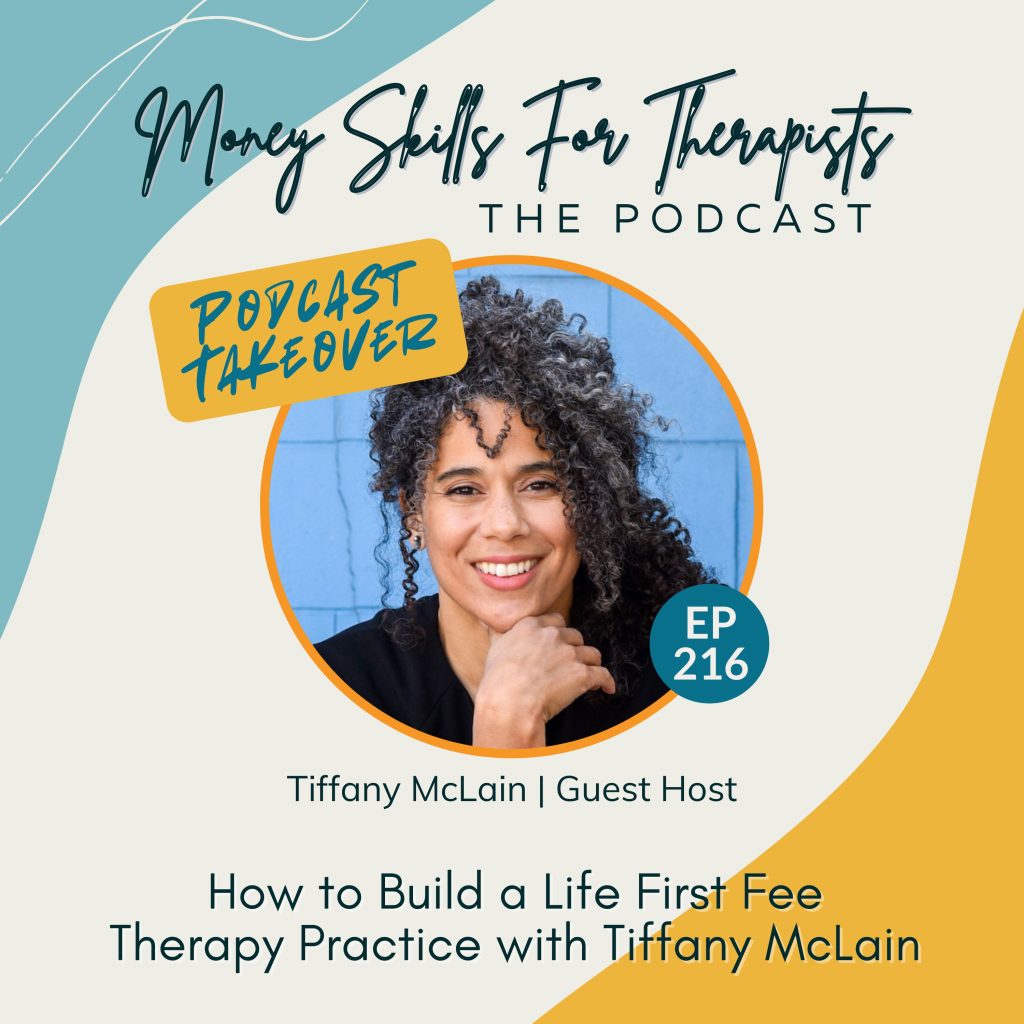
So rather than hearing from me today, you’re going to have the pleasure of listening to one of my biz besties, Tiffany McLain, talk about how the landscape has changed for therapists in private practice and what it actually takes to have a life-first fee practice that lets you live the life you want and the life you deserve.
Linzy Bonham 02:18
Tiffany is an absolute force, and I am so excited to share this podcast takeover with you to help you rethink what’s possible and start marketing and charging your life-first fee with confidence. Now, I’ll let Tiffany dive in.
Tiffany McLain 02:36
This is a podcast takeover. Hello, I am your guest host, Tiffany McLain, founder of The Lean In. MAKE BANK. Academy, where we have honest, real conversations about money as we help you, our fellow therapists, design your life-first fee practice. That means life-first fees, premium fees, cash pay, small caseloads, so you can actually show up and do the work you love, creative, present, spacious.
Tiffany McLain 03:10
A dream. So I hear that there are many of you who have now bought into the idea of a life-first fee practice. You’re not afraid. You’re, you’re down to get off insurance panels. You are open and eager and ready to charge $250 per session and up. You’re like, “I’m here for it. In fact, that’s what’s listed on my website.
Tiffany McLain 03:32
That’s what I tell my colleagues.” And behind the scenes, you’re not charging it, you’re not even charging close. Maybe you’re still on one panel and that panel is 99.9% of your caseload. Maybe you have some people at 150, 200, 225. But when it comes to actually charging your life-first fee, you say you want it, you’re here for it, and crickets.
Tiffany McLain 03:56
Who are those magical unicorn clients who actually pay their therapist $250 per session week after week, month after month, year after year? Do they actually exist? Are there actually enough of them? And if so, why are they not calling you? That’s what we’re gonna talk about today on this podcast takeover episode of Money Skills for Therapists, the podcast.
Tiffany McLain 04:22
So let’s talk about what has happened. We’re gonna talk about today how the landscape has changed, why you’re suddenly seeing a drop in referrals, why you’re not getting as many clients calling, and if they are calling, they are not paying you your $250, three, four, $500 per session.
Tiffany McLain 04:38
Why? We’re gonna talk about that. We’re gonna talk about what has changed. Therapy platforms, AI, you know the basic ingredients. I’m gonna pull it all together for you. Then I’m gonna talk about what it actually takes to have a life-first fee practice. How do you actually find the clients who are willing to pay?
Tiffany McLain 04:57
Because they are. Our students are charging those fees all the time and finding patients, clients who are more than willing to pay. And not for once a month or twice a month sessions, but for weekly sessions. Who are these people? How do you build demand such that they come to you? We’re gonna touch on that today. So if you have been in this field a while, 5 years, 10 years, 20 years, ah, you remember the good old days, right?
Tiffany McLain 05:21
And then, and then the, you know, those days when you would pay someone to do your SEO, maybe do a Google ad, but maybe not. You just have a pretty website and the clients come to you. Maybe they’re on insurance, maybe they’re cash pay. Whatever way they were coming in, they were coming. Maybe your fees weren’t actually what you wanted them to be.
Tiffany McLain 05:37
Maybe they were a little low. But you had so many referrals or regular enough referrals that you didn’t have to worry about it. If you are newer to the field and you have the idea, “I’m gonna open my practice. I wanna- I’m gonna be full within six months. That’s what my colleagues say. That’s what, that’s what I heard, word on the street used to be,” you fill up pretty quickly.
Tiffany McLain 05:55
And now you’re like, “I’ve been in practice 3 months, 6 months, 8 months and I’m not full. My referrals are slow. I haven’t gotten a referral in a month, two months. What am I doing wrong?” Well, you’re not doing anything wrong. The landscape has changed. Pre-pandemic things were very different as a therapist in private practice.
Tiffany McLain 06:15
I’m gonna talk about how. In the old world of milk and honey, clients flowed, especially during pandemic times. If you opened your practice during pandemic times or went full-time into private practice, you had a very different landscape. The referrals were coming in droves. You had no problem, especially if you were on insurance panels, bringing in new clients.
Tiffany McLain 06:36
And now it feels like, man, people are not coming. So pre-pandemic, things were pretty consistent. There were fewer therapists out there. There were still a lot of therapists in private practice, but not as many. During the pandemic, everything went virtual. The world was upside down. If you were a therapist either at that time or started your practice at that time, there were clients galore.
Tiffany McLain 06:58
The virtual space made it so easy for clients to come to you. People were desperate for help. When you could see people nationally for that short period of time, you could not open your email without seeing another referral request. So here’s what happened at that time.
Tiffany McLain 07:14
That was suddenly a time when Big Tech, people who are really good at business and marketing, also noticed how in demand therapists were. We had a feeling before the… You know? We know, we’ve always known we’re of value. We always knew people needed therapy. But suddenly in the pandemic time when virtual became the thing, Big Tech saw, “Oh my gosh, this is the land of milk and honey.
Tiffany McLain 07:41
We can scale this. We can actually turn this into a billion-dollar industry because we have the technological skills, the marketing skills, the business skills to make it happen.” And what do we need in order for something to scale? Say it with me. You need… cheap labor! You need to be able to have systems to make things easy and automated, and you need people who will provide the services for your client at bargain basement prices. In order to provide therapy or to be a big tech platform who can do therapy, operate in the land of therapy, what do you need?
Tiffany McLain 08:25
You need therapists who have licenses. Big Tech therapy platforms, they cannot operate, at least in the past, unless they had a therapist with a license who was willing to work under the contracts that they provided. And guess what? In the immediate time, especially pandemic and then a little bit post-pandemic, it was a dream for therapists.
Tiffany McLain 08:46
It seemed too good to be true. These big platforms are going to give you clients, and they’re gonna pay you pretty good wages. You don’t have to do any marketing. You just sit back. You know, you might not be earning as much as you want to, but the clients are coming in. You don’t have to waste your time marketing.
Tiffany McLain 09:01
You can just do the work you love, actually at a pretty good salary, be that on insurance panels, be that working for some big tech platform. It wasn’t so bad. And it turned out it was too good to be true because as scaled businesses do, and they’re not wrong for it, this is how business works, once they have you hooked, once they have you feeling, as the therapist, “This is amazing.
Tiffany McLain 09:25
I’m willing to work for this big tech platform. I like the stipulations. I’m getting paid pretty well. I have a consistent caseload. I can show up and do the work I love. This is great,” once you’re hooked, what happens? Um, they decrease your wages. They cut your reimbursements. It turns out it is too good to be true, at least for the long run.
Tiffany McLain 09:46
That is what happened.
Tiffany McLain 09:48
You went from being a skilled provider whose time was valued, who felt valuable, who was doing at least good enough client work to suddenly having to deal with a wild logistical nightmare with all the paperwork, having clawbacks happen more rapidly, having to be on the phone arguing about your reimbursement rates, and now you’re seeing more and more, “Wait.
Tiffany McLain 10:06
They’re slashing our reimbursement rates? Big tech is, is actually taking away our rights? They’re asking more for us. They’re wanting us to work more hours.” Suddenly the payoff doesn’t seem so good, and in fact, it’s starting to feel really bad. It’s almost as if you’re back in the agency job, except you have to pay for your own insurance.
Tiffany McLain 10:25
You have to pay for your own office space. You have to pay for all your own expenses, and you’re not getting reimbursed at near the rate you used to, and the clients are slowly decreasing. The referrals are slowly decreasing. Why? Because then we brought in AI, AI which can do what a lot of you are doing, unfortunately, better than you.
Tiffany McLain 10:46
Suddenly we have two options. As Big Tech comes in, as AI comes in, we can either have a race to the bottom where we are trying to see more and more clients just to make ends meet financially. We’re more and more burnt out, and we basically become McDonald’s line workers for big tech companies who need our license, and they have a whole workforce of therapists
Tiffany McLain 11:08
who devalue the work we do and are willing, out of desperation, out of a lack of knowing how to market or having business strategy or just out of exhaustion and having the martyrdom mentality built into our culture, we’re willing to work for lower and lower and lower wages. And the general public comes to understand that therapy is a cheap commodity.
Tiffany McLain 11:31
“I should get a therapist for a $20 copay.” I shouldn’t have to submit my own insurance reimbursements, my superbills. I want you to do all of that. So you’re getting less and less money, decreased reimbursement rates. You’re spending even more hours on the phone. You’re having clawbacks coming six months, a year after you were paid right out of your bank account, and you’re scrabbling around in Facebook groups commiserating over the state of the system.
Tiffany McLain 11:57
You’re surrounded when you’re not working or exhausted and back-to-back eight sessions in a row, Monday through Friday, sometimes Saturday, sometimes Friday nights. When you’re not in there commiserating on Facebook groups where everybody’s saying, “It’s terrible. No one can afford our rates.
Tiffany McLain 12:11
This is awful, the insurance company,” right? You could be scrabbling around in there, and therapy is becoming cheaper, and cheaper, and cheaper. This is terrible for you, of course. This is not good for your clients who are getting a burnt out, overwhelmed, resentful therapist, and it’s also not good for our industry.
Tiffany McLain 12:31
It’s completely lowering our industry standard. And it’s also making way for other types of providers to fill the quality gap. We are no longer high quality, expansive, spacious, creative providers. We’re burnt out, overwhelmed providers earning 75 cents per session, right? And then other providers, coaches, all kinds of service providers can come in and fill the gap.
Tiffany McLain 12:55
“Oh, you want to have an executive coach? $1,000 an hour, right? We really know how to do it.” Race to the bottom. The second option is to rise to the top by actually establishing ourselves as valued clinicians, valued white-collar professionals whose time is worth money.
Tiffany McLain 13:21
Race to the bottom, McDonald’s line workers, cheap commodity. LMFT, LCSW, even psychologists: cheap commodity. Or you can rise to the top, charge your life-first fee, and reclaim your status as a high-paid, highly valued professional in our society. When you charge life-first fees, you can do higher-quality work, have a smaller caseload, 12 to 15 consistent clients a week who you see weekly.
Tiffany McLain 14:00
You actually get to know them. You actually have time to see the patterns. With a smaller caseload, you have more room for creativity, play. When you’re taken care of financially, you’re safe. You have retirement. You have more than enough to pay for your own healthcare, vacation, time to let your mind rest, time to let your mind wander, time to write, time to consult with your colleagues. Retreats, right?
Tiffany McLain 14:27
You can write books. You can feed the chickens. You can go to yoga. You can get your facials on a Thursday evening. In this world, you actually get to reclaim your space as a cultural leader, as the person who has your finger on the pulse of our wider society. You can weigh in.
Tiffany McLain 14:47
You have something to say. You have power, influence, prestige, financial security, and you have more money and time and spaciousness to do good in the world. Do you remember when you watch those shows like Mad Men and they’re showing you the therapists of the 1950s who are in these beautiful offices?
Tiffany McLain 15:03
They are so well-respected. That is still the case. There is still room to get back to that place versus, you know, when, when you think about therapists now, you go into an office where there’s some Doritos piled up in the corner. Maybe not. Maybe kettle chips. An old Starbucks coffee cup from three weeks ago there, still there.
Tiffany McLain 15:21
Garbage not emptied because you’re exhausted. You don’t have time to dress well, do your makeup, slow down, be refreshed. You’re just trying to make it day to day. We can actually go back to reclaiming the authority, the reputation, the creativity, the play, the power of a professional who really shows up and does this work well.
Tiffany McLain 15:46
What does it take to do it? It requires that we go from this mass online marketing scaled game, which we cannot win.
Tiffany McLain 15:58
We cannot win the scaled game. The scaled system requires you see a lot of clients at low fees, and you’re just racing through. You can’t beat Big Tech at that. They have too many providers. They have too much marketing prowess. They have too much money, billions, to overtake the online space. You cannot compete in that world, and nor should you.
Tiffany McLain 16:18
You cannot compete with AI, who can mirror back, validate, reflect for understanding more than you ever could, in a more sophisticated, consistent, without emotion way than you ever could. And in fact, that’s not even the thing we provide as therapists. Those skills, anything that requires, like, do step one, step two, step three, workbook therapists, that kind of model is done.
Tiffany McLain 16:43
You cannot do that more cheaply, more consistently, more presently than an AI bot can. So we need to return to what we actually do: Intimacy, connection, understanding the unconscious process, human-to-human contact, and all the things that our bodies pick up, whether virtually or in person. As human beings, we understand how to communicate on a level that AI cannot.
Tiffany McLain 17:09
And if you’re relying on workbooks, one, two, three, four, five models to make your living, you’re gonna stay a cheap commodity. You actually have to shift over to a depth-oriented, human-to-human practice where you’re understanding and relating to the unconscious process in a deep way, and your marketing has to reflect this new reality.
Tiffany McLain 17:32
We’re shifting from… Again, you can still do SEO. You can still do Google Ads. You can still have a web presence. You should have all of those things, but not in a vacuum. And you must move away from this high turnover, 30 people I see a week, 50-person caseload, low-fee model into 12 to 15 clients a week, seeing them weekly, and high fees, $250, $300, $400, and not just on paper, but in reality.
Tiffany McLain 17:57
So what does it take? It takes having high-touch connections with the people who matter. That’s the rise to the top. The race to the bottom is spending your time doing too many things, going from one thing, writing a blog, getting on social media, making three posts, and then forgetting about it, getting on LinkedIn, going on 20 coffee networking dates with other therapists who are on insurance, getting on a Facebook group and complaining or asking for referrals.
Tiffany McLain 18:21
Moving away from that, that’s the race to the bottom. Moving into high-touch connections with the people who actually can allow you to move into the life-first fee practice, the people who have the resources to pay. Like it or leave it, that’s the option. If you want a practice that allows you to put your life first, your creativity first, your reputation first, your professionalism first, your deep present work first, then you have to have a practice that takes care of you financially.
Tiffany McLain 18:57
What does it look like?
Tiffany McLain 18:58
There are three components to marketing a life-first fee practice. We’re not gonna have the time to dive into all three deeply, but I can give you an overview. The first thing that must happen is that you have to understand what your life-first fee is and charge that fee. You must know what your life-first fee is, honestly, unequivocally.
Tiffany McLain 19:20
Linzy helps you understand your numbers all the time. If you’re listening to the Money Skills for Therapists podcast, you understand the importance of knowing your numbers. This takes it one step further and helps you not only understand your numbers now, but understand where you’re going. Your life-first fee is based on what you want, your hopes, your dreams, not only the things you need in order to survive your day-to-day, retirement, expenses paid, money set aside for time off, but we’re also talking about dreaming.
Tiffany McLain 19:50
A fee that allows you to see a smaller caseload and still be more than financially taken care of. A fee that allows you to be off by 3:00 PM so you can go pick up your kids from school. A fee that allows you to work three days a week and have four-day weekends every week. Write, dream, go to retreats, start your own retreats, get massages, do yoga, take care of your physical body, your emotional body, your psychological body.
Tiffany McLain 20:12
You need a fee that accounts for that. Go to the link under these show notes and you can find our life-first fee calculator. You can pause this episode, do that now. You need to download the life-first fee calculator so you can actually understand what your fee needs to be. And then, only then, can we move into: What do you actually need to do?
Tiffany McLain 20:30
Where do you actually find these people who are ready, willing, and eager to pay your life-first fees? Well, the first thing you need to have in place is what we call your R to the third client. Again, this can only come once you know your life-first fee. So if you’re listening to this, I encourage you to pause it.
Tiffany McLain 20:47
If you’re driving, I encourage you to pull over. Yeah, really pull over. Download the Fun With Fees calculator.
Tiffany McLain 20:55
And then we’re gonna find the person who can actually pay it. We call this your “R to the third”. “R to the third” stands for: Resourced, Ready, and Recognized. What do I mean by that? If you could have a life-first fee practice, you actually need to find the people who have the resources to pay you $300 week after week, month after month, year after year, come what may.
Tiffany McLain 21:16
They’re not always struggling financially. They’re not in a place where every other conversation is about, “Can we have a fee decrease?” Or, “I’m stressed financially.” Even now in this economy, there are people, and there are a lot of people, more than enough people for everybody listening to this podcast, to have 12 ideal clients.
Tiffany McLain 21:34
There are more than enough people who have the resources to pay you right now $300 per session or more. So you have to have a niche that reflects that, those resources, be that wealth, be that amazing PPO insurance, be that a great job at a two-income household, be that family money. There are all kinds of ways.
Tiffany McLain 21:53
Be that people who simply prioritize their mental health and their therapy over all other financial obligations. You have to have people who have the resources to pay. So if you’re somebody who’s like, “I really wanna work with kids who are in the foster care system and they’re just starting city college,” you’re not gonna be able to have a life-first fee practice.
Tiffany McLain 22:09
You can help those people in other ways, but it cannot be through your business. If you want to have a life-first fee practice where we are establishing ourselves as well-paid professionals, number one, they have to have the resources to pay. Number two, they have to be ready. When we talk about your niche, so often I hear people say, “Oh, I work with, you know, complex trauma, burnout, imposter syndrome.”
Tiffany McLain 22:31
When we talk about ready, we are talking about: We have to be able to speak to something that has happened in our resourced person’s life such that tomorrow cannot be lived like today. Something has happened usually externally in their lives such that they are desperate to go to a therapist today and pay $300 per session.
Tiffany McLain 22:49
That is no object, because what has happened is so intense, so eye-opening, that they cannot do it any other way. The example I love to use is, um… You probably remember, this was probably, I don’t know, two summers ago now, when there was a situation where there was a couple who was caught on the jumbotron at the Coldplay concert.
Tiffany McLain 23:11
You know what I’m talking about right now, right? This was a couple who was caught on the jumbotron. They were holding each other, swaying. As soon as the jumbotron lands on them, they, like, freak out. The woman jumps down. The man, like, turns around, “Look, da, da, da. Nothing to see here.” It turns out, of course, that they were, uh, coworkers.
Tiffany McLain 23:28
He was the CEO of a company, I believe. I think she was in HR or the HR director, and it looked as though they were having an affair. Right? So if you are a therapist, you know, I want you to hear the difference between I work with complex trauma and imposter syndrome in people, okay, you and every other therapist, versus I work with high-profile men who have been caught in a public infidelity.
Tiffany McLain 23:55
If you are that therapist, and you have done all the other marketing strategic things that we don’t have time to get into today to establish yourself as the therapist who works with high-profile men who have been caught in a public infidelity, they’re calling you, and he does not care if you’re charging three, four, $500, right?
Tiffany McLain 24:10
That is ready, especially when we talk about on a global scale, they went viral on a global scale. If you specialize in that, they’re calling you, and they don’t care about the price. Do you hear the difference between that and I work with ADHD? Right? Ready. So they have to have the resources to pay week after week, month after month, year after year.
Tiffany McLain 24:27
They have to have something that is so burning, a burning pain that is so immediate, that is so present that they need help with it right now, and they don’t care about the cost. Again, if you’re thinking, like, imposter syndrome, burnout, you as a therapist know, probably based on your own life, you will have burnout or imposter syndrome for years, sometimes decades, and not do anything about it until something snaps.
Tiffany McLain 24:51
Something has happened such that burnout or imposter syndrome can no longer be tolerated. It is done. You need to have that in place. That’s the second piece of the R to the third. The last one is recognized or recognizable. I know you struggle with a niche. I know you struggle with narrowing down because it’s so hard for you to believe that having a narrower niche actually allows you to charge life-first fees.
Tiffany McLain 25:10
But after teaching this for 10 years, having helped thousands of therapists do this work, I am here to tell you, you need to borrow my belief because yours is not working, by the way. Your broad, vague niche is not bringing you in people at $250. So I’m inviting you to imagine another way, and that is you need to be so specific in your demographic.
Tiffany McLain 25:28
We can’t say, “men, women, children, ages 18 to 35,” and charge. We can’t even say, “high executive men and women in their 30s.” Here’s what I mean. If we go back to this high-profile infidelity situation, if you are a 25-year-old with no kids who was caught in a high-profile infidelity, that’s gonna be a very different situation than if you’re a 45-year-old man with two kids in kindergarten and a high-profile wife.
Tiffany McLain 25:54
You’re gonna have very different concerns and issues and considerations, which is gonna be very different than if you’re a 75-year-old man who is caught in a public infidelity with two children out of the house and a… who is widowed, right? Or who’s seeing a, a, a… his wife has cancer and he’s, you know…
Tiffany McLain 26:10
It’s just a different situation, right? These are all… The way you’re talking, thinking, the considerations you have in mind for these three life stages are profound, and it’s gonna be very different if we’re talking about a gay man. It’s gonna be very different if we’re talking about a woman. It’s gonna be very different if we’re talking about someone who is just early into the relationship versus someone who’s just married, right?
Tiffany McLain 26:28
All of these things matter. And when developing yourself as a $400 an hour therapist or a $1,000 an hour therapist, these details matter. So if you’re someone who’s currently working with men and women ages 18 to 82 who suffer from anxiety, I want you to actually take a moment. You can write out three lines: Resourced, Ready, Burning Pain, such that tomorrow cannot be lived like today, and recognizable demographic season of life markers that are very specific, such that that person can recognize themselves in your marketing.
Tiffany McLain 26:59
Those three things must be on the table in order for you to move into this new marketing space. That’s the thing that differentiates you from all the big platforms who appeal to everyone all the time and inundate you with a general practice. You have to get specific, and you have to become an expert and an authority in a very specific realm.
Tiffany McLain 27:19
And then what? Well, then we get onto the second piece of this. Right story, right now. Once you know exactly who you’re talking about, you need to know exactly what story you are telling them such that they see, “Oh my gosh, you are the one to see. I wanna go to you, and I don’t wanna go to anyone else.”
Tiffany McLain 27:34
They’re calling you and begging you, “Please have an opening. I don’t care about the cost.” Right? It’s moving from you chasing to you being in demand. And the right story right now is not, “Here is my list of credentials. I have a master’s degree. I worked at this nonprofit for 10 years. I am licensed in EMDR, CBT, IFS, LMNOP.”
Tiffany McLain 27:54
Right? Nobody cares about those certifications. We’re so used to talking to each other and trying to show all of our expertise, that we lose sight of the person who has just been caught, the man who has just been caught in a public infidelity, and he has a seven and eight-year-old who understand what that means, and a wife who is shocked and can’t believe it, and was personal friends with the other woman in this case.
Tiffany McLain 28:14
They don’t care if you’re EMDR, brain spotting, IF- they don’t care what you do. They wanna know that you can help them. So you need to understand the right story right now. And then the last piece of this is the, what I call what, where are they, and how do we attract them? So once you know exactly who you’re speaking to, once you know exactly the right story to tell such that they are calling you and saying, “How can I see you tomorrow?
Tiffany McLain 28:36
I don’t care how much it costs.” Where do you actually go to be in the space with these people? You must know exactly where to go. Not virtually, not with SEO, not with Google Ads. In the spaces where you are, what I call the only game in town. When you have those three elements in place, the sky is the limit.
Tiffany McLain 28:57
You suddenly go from being the therapist who is on a race to the bottom, complaining that there’s nobody who’s willing to pay Life First fees, having to deal with clawbacks and insurance paperwork, to being the therapist who is in demand, who people are coming towards, who people are begging to work with, and who, bigger platforms, bigger publications, bigger stages are asking, “Can we book you?
Tiffany McLain 29:18
Can we feature you?” That’s the difference. It starts with knowing your Life First fee. It starts with making a decision to step into your authority as a professional and refusing to play the low fee, bargain basement, devaluing games that the big platforms need you to play in order to make their profit, in order to make their money. If you are interested in understanding more, this R to the third, right story right now, is just one part of a three-part sequence to establishing yourself as a life-first fee clinician.
Tiffany McLain 29:54
When you fill out your Fun with Fee Calculator, I will invite you to an exclusive training where I will walk you through those three steps more deeply and then walk you through the other elements that must be in place in order for you to actually bring in the clients who are willing and eager, desperate to pay you $250, $300, $400.
Tiffany McLain 30:12
Not just on paper, not just saying, “Oh, my fee’s $250, but actually everybody’s on insurance and I’m barely making it, bye.” But actually being the therapist who has a life-first fee practice. I cannot wait to show you. Go to the show notes to get your Life First Fee Calculator, and we will go from there. A huge thank you to Linzy, my friend, my traveling companion, for having me as a guest on your show.
Tiffany McLain 30:36
I’m so excited to speak to all of you, to have the opportunity to show you what is possible. It is possible. It is just a series of steps. Now that you have your money in place, now that you understand what you need, now it’s time to dream. Now it’s time to dream and then take action to make that dream a reality.
Tiffany McLain 30:57
Go to the link in our bio.
Linzy Bonham 31:04
I hope that you loved this podcast takeover. As I mentioned, Tiffany is one of my biz besties, and I always think of her as the “fee person” in our space. She is the one to go to when you’re ready to start charging the fee that you truly deserve. And as you heard today, she is so bold and so unapologetic, which is what I love about her.
Linzy Bonham 31:24
Tiffany just really wants the best for you, and she wants you to want that for yourself too, and then to actually go out and make it happen. Which, of course, is the hardest part. If you wanna learn more about Tiffany, you can check out her program, The Lean In. MAKE BANK. Academy, where she helps therapists ethically earn significantly more each month while seeing fewer clients and doing better clinical work.
Linzy Bonham 31:45
You can also listen to her podcast, The Money Sessions. And be sure to visit the link in the description if you haven’t already. Pause this podcast to do so, and use Tiffany’s Life First Fee Calculator to find out exactly what you need to charge per session in your current season of life and business with your future self in mind too.
Linzy Bonham 32:00
I have to say, it’s Tiffany’s fee calculator that led me to finding her years and years and years ago, and I can say it has only led to very, very good things in my business and my life. So I think you’re gonna have a very similar experience. Tiffany is also gonna be joining us in our new private WhatsApp community this week to chat about this episode, to answer questions and offer support, and I am so excited about that.
Linzy Bonham 32:23
So if you are not already in our private community, now is definitely the time to join. Get in touch with us at hello@moneynutsandbolts.com to request an invite, and we will send you the link to join. As always, if you’re enjoying the podcast, I’d love it if you could take a moment to leave me a review on Apple Podcasts or Spotify to help other therapists and health practitioners to find us and join these conversations.
Linzy Bonham 32:44
Thank you so much for joining us today.