Linzy Bonham [00:00:01]:
I would say it’s probably always true. We can never control what our clients do. We can’t be like, you will see me for therapy for 10 years. That’s not how it works.
Amber Vernon [00:00:09]:
I have a budget to run.
Linzy Bonham [00:00:11]:
Yes, you will not get better until this timeline. So that control piece, tell me about control, your relationship to control. Welcome to Money Skills for Therapists, the podcast that helps therapists and health practitioners in private practice go from money confusion and shame to calm, clarity and confidence with their finances. If you’ve ever felt overwhelmed by numbers or avoided looking at your business money, you’re in the right place. I’m Linzy Bonham, therapist turned money coach and creator of Money Skills for Therapists. Before we jump in, I want to remind you of something really important. Most of us highly skilled and competent therapists and health practitioners were never taught about money. Not in grad school, not in supervision, not anywhere.
Linzy Bonham [00:00:57]:
And yet here we are, running businesses that need to take care of us while we’re busy taking care of others. It is a lot of pressure. So if part of you feels anxious about money avoidant or like a bit of a hot mess financially, I want you to know that you are not alone. And I am here to help. Through my free live workshops each month, I teach practical financial skills to help you feel more grounded, calm and confident with your private practice money. You can see what’s coming up and save your spot to join live or register for the replay@moneyskillsfortherapist.com workshops. Let’s get started. Hello and welcome back to the podcast.
Linzy Bonham [00:01:32]:
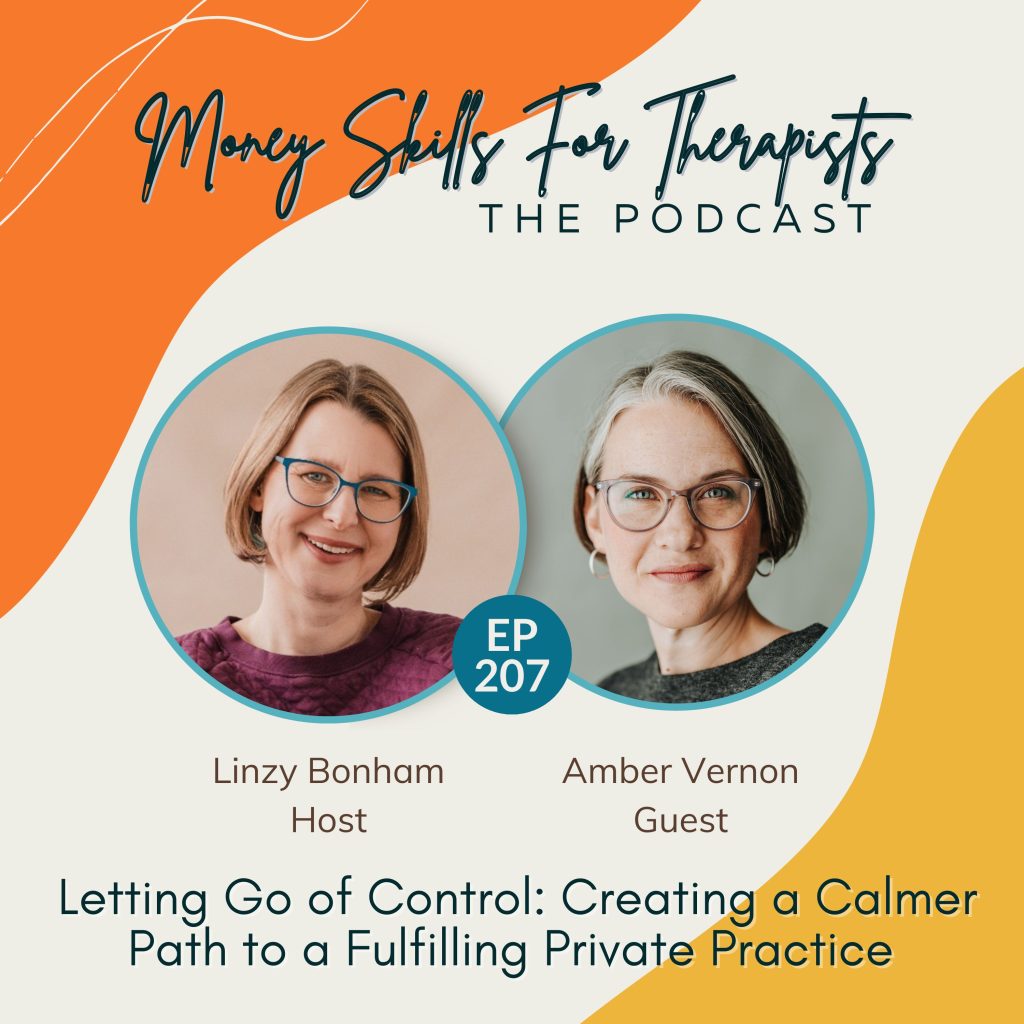
Today’s episode is a coaching conversation with Amber Vernon. Amber is psychologist specializing in working with the police. She’s also a recent graduate of Money Skills for Therapists. And today Amber and I talk about this stuckness that she’s feeling about sex. Stepping away from her part time W2 job, her job working for somebody else and going full time into private practice. We cover a lot of ground in this coaching conversation. We talk about the squirreliness that comes up whenever she thinks about making this decision. Kind of the anxiety and activation that comes with thinking about making the move.
Linzy Bonham [00:02:13]:
We explore that squirliness. We explore options and strategies around like niching. We talk about control. It’s this episode has a lot of range. I think there’s going to be something here for everybody listening. Here’s my coaching conversation with Dr. Amber Vernon. So Amber, welcome to the podcast.
Amber Vernon [00:02:40]:
Thank you.
Linzy Bonham [00:02:41]:
It’s so nice to have you here. And we were just chatting off mic before this conversation that you’re Feeling a little sweaty. It’s like a little activating what we are planning to talk about today. So let’s move right into it. What do you want to focus on during our time together today?
Amber Vernon [00:02:56]:
So during the course we had a coaching session that was not recorded except in my heart. And it was the same topic. So the sweat plus the fact that in about a year I’m having the same topic would tell me this is not a skills issue, it is a heart issue. So long and short of it in W2, work full time, long time. Wanted to be eligible for public service loan forgiveness. So had that 10 year mark in my head. Miraculously the program was still there. I got public service loan forgiveness and then started to move kind of gradually into private practice that has been going well.
Amber Vernon [00:03:46]:
I, despite not learning about business stuff, I’ve found supports for that, including you and your program. And so skills wise, I feel good. This stuck place feels like at what point do I move into full time private practice? At what time do I keep the foot in somebody else’s door? And over time I’ve gradually stepped out a bit, but I’m not fully out. And so there’s a lot of stuff. When I start to think about the logistics and putting into practice the things that I’ve known again from that data point and money wise and all of that that I’ve run, there’s this part that’s like, I don’t know about that. And so that’s that stuck point. Okay, so here we are. I would like to be unstuck.
Linzy Bonham [00:04:40]:
Okay. In the next 25 minutes. Let’s go.
Amber Vernon [00:04:44]:
Yes, please. No. Yeah, we’re gonna do it. You’re a pro.
Linzy Bonham [00:04:48]:
Okay, so data is good. You’re feeling the numbers are clear. And I’m curious, what are the numbers telling you about stepping out on your own?
Amber Vernon [00:04:57]:
It is doable.
Linzy Bonham [00:04:58]:
Okay.
Amber Vernon [00:04:59]:
And I know the numbers I would need to replace. Right. So I’ve run the numbers to say this is the kind of take home pay that I get from this job. I’ve been doing it enough that in the part time capacity, I’ve been doing it enough that I feel like those, those numbers are pretty stable. And so whether that’s a, I need to jump up the business to replace that or I make the strategic decision to save so that I can move, do that move and have a little bit of buffer, I could go either way with that. I don’t feel a particular like right or wrong. I feel like I have options to figure out where to go, where I get Stuck is the do I want to go? And then my brain goes to a million somewhat related but also unrelated spinouts.
Linzy Bonham [00:05:51]:
Okay, so let’s talk about the squirrely thoughts then. What are they squirreling about? What are they saying?
Amber Vernon [00:05:56]:
Okay, the first squirrely thought. And I. Although this is contextual to today’s date in today’s year, I don’t think it’s unique to timelines of the world, which is this is an unsustainable thing because soon everything’s gonna fall apart and nobody’s doing therapy. And this is an unsustainable just business because the world feels unpredictable and scary. So there’s that thought. The other thought is specific to the kind of work I do in police and public safety. There’s hiring crises that are going on. Recruitment is super low.
Amber Vernon [00:06:34]:
This is reliant on departments where there’s bigger picture things that I don’t have control over. So there’s that. Then there’s the part that says, is this really what I want to do? Or do I just want to go work like driving a school bus? I think the answer is no to that. But that similar vein of wait, if it’s 15 hours a week that I can. I know my hourly rate. Do I want to diversify and just do something that’s not at all related to therapy? And I would say the biggest piece of that often that comes in is this is all built on crumbling sand. Not my business, but just being in private practice.
Linzy Bonham [00:07:18]:
Okay. Okay.
Amber Vernon [00:07:21]:
So it gets big real fast.
Linzy Bonham [00:07:22]:
It does get big real fast, doesn’t it? Yeah. Like, I’m getting, like, a little bit of, like, the sky is falling vibe.
Amber Vernon [00:07:27]:
Yes. Yes.
Linzy Bonham [00:07:28]:
Okay. So like, this kind of, like, general, generally, everything’s going to shit. Yes. Okay. So just to turn that story over a little bit to be curious about it, I am curious, like, if the sky is really falling and if there’s this massive hiring crisis and you don’t have control over what departments do, is private practice, like, really that different from your W2 job that is also working within these same systems?
Amber Vernon [00:07:56]:
Right now? There’s a tiny bit of it that’s different because I do court evals, and people’s competency has been questioned in a forensic setting for, I don’t know, since the time we had courts. So that doesn’t feel like it’s going to go away. The other part that I do in my private practice or, sorry, in my W2, I’m contracted to do police and public safety work.
Linzy Bonham [00:08:18]:
Okay. Okay.
Amber Vernon [00:08:19]:
That contract part of it is going away And I don’t know if that department is going to stay with me in my private practice or find someone else. And that’s going to reduce the hours at the W2 pretty significantly.
Linzy Bonham [00:08:32]:
So there’s some flux at the W2 right now.
Amber Vernon [00:08:35]:
Yes, right now. That decision will have to be made by November, so about, you know, 6ish months from now. Okay.
Linzy Bonham [00:08:43]:
Okay. Yeah. You know, thinking about this, one of the words that you said was control. Right. Like you can’t control what these departments do right now. It’s also like, you know, within your W2, even you can’t control whether this department stays with you, goes to somebody else. Right. Like, which I would say is probably always true.
Linzy Bonham [00:09:01]:
We can never control what our clients do. We can’t be like, you will see me for therapy for 10 years. That’s not how it works.
Amber Vernon [00:09:08]:
I have a budget to run.
Linzy Bonham [00:09:09]:
Yes. You will not get better until this timeline. So that control piece, tell, tell me about control, your relationship to control.
Amber Vernon [00:09:20]:
I mean, does anybody have a good one?
Linzy Bonham [00:09:22]:
We’re not talking about anybody. We’re talking about you, Amber Vernon. That’s true.
Amber Vernon [00:09:25]:
That’s true. I like it. I like to have control, I would say. I like to have predictability. I like to plan. And so if I feel like things are shifty, squirrely, sinking, Sandy, whatever word we’re going to use, I have a hard time trusting that I can make plans and move forward with them. Coupled with I have a spouse who gets even more activated by that than I do.
Linzy Bonham [00:09:59]:
Okay.
Amber Vernon [00:10:00]:
So it’s both for myself and I know that when this stuff happens is very activating for him as well.
Linzy Bonham [00:10:06]:
Right. Okay. Yes. And you do love predictability and planning. Like, I mean, one of the things we’ve worked on together in money skills is actually like easing up that kind of anxious, over touching relationship to money. Yes. In terms of like the systems that you have in place. So.
Linzy Bonham [00:10:22]:
And that part of you is not going to go away. Right. Like that part that likes to plan. We love her. She’s doing some great stuff for you. Yes. If she went away, it’d be harder for you to take vacations and things like that. You know, with.
Linzy Bonham [00:10:33]:
Planning is an important thing. And so what I’m doing thinking about here is like, how do we take care of that planning part and give her some of what she needs, but also acknowledge that there’s things that we, we can’t control here. Right. Like it’s, I’m thinking like a both and way forward. Right. Because you mentioned we had a conversation about this Topic a year ago, one year later, here we be. And to be clear, you’ve been making lots of gains in lots of other ways, right?
Amber Vernon [00:11:07]:
100%.
Linzy Bonham [00:11:09]:
But this is a stuck point. This like kind of planning.
Amber Vernon [00:11:13]:
Yes.
Linzy Bonham [00:11:14]:
Control well.
Amber Vernon [00:11:16]:
And I think that what is what feels so much stuckier. So in the past when I felt stuck, I get data, I get clear.
Linzy Bonham [00:11:26]:
Yes.
Amber Vernon [00:11:26]:
The data helps me feel confident from the planning perspective and then I pretty quickly can move forward. This has felt so different because I thought, I’m going to get this data, I’m going to get clear on the numbers, I’m going to feel confident about these things and this stuck will go away and it hasn’t happened. And that is an unfamiliar place for me because my usual path is data, information. Wise decisions go. This is data information. My wise brain, just like who knows does. I don’t know where it is.
Linzy Bonham [00:12:07]:
Wise brain, not available currently. No. Yes. Yes, because tell me what happens then when you look at this data and you see and you’ve laid it all out. You got some beautiful data. The squirrely thoughts happen when you look at the data. And I’m hearing the squirrely thoughts are about unpredictable, scary, what’s happening in the world.
Amber Vernon [00:12:24]:
Yeah.
Linzy Bonham [00:12:25]:
Things are changing in your industry. You know, what if. Keep going with that. Tell me more about the squirreliness.
Amber Vernon [00:12:32]:
Oh, the squirreliness. I just stop.
Linzy Bonham [00:12:35]:
Okay.
Amber Vernon [00:12:36]:
I know people, I don’t know if they will see this or not, but I’m actively doing so many breaths, I feel like I’m moving my armpits because I’m just. This is again how we know. It’s mindset stuff.
Linzy Bonham [00:12:47]:
Yes.
Amber Vernon [00:12:48]:
So the squirrely thing happens. I start to think about, okay, what would be a timeline, what would I need, what would I want to do? All those things that I feel like I do have control over, do I want to do more of this or take a different job in a different, even just a different type of psychologist work or something totally unrelated. When I start to think about the myriad of options in front of me, that stuff gets activated and I just say, I don’t have to do it now. I don’t have to do it now. I’ll just keep doing what I’m doing. I’ll just not do that right now. And I don’t have to make a decision and just la, la, la, la, la, don’t have to do it. That’s what happens.
Amber Vernon [00:13:25]:
It just stops and I walk away.
Linzy Bonham [00:13:26]:
Yes. Okay. Okay. Which, you know, is adaptive. There’s gonna be a point where it’s like, bet Shut that shit down.
Amber Vernon [00:13:32]:
Yes.
Linzy Bonham [00:13:33]:
We’re just gonna keep it rolling as it is.
Amber Vernon [00:13:34]:
Yep.
Linzy Bonham [00:13:35]:
Mm. Okay. So we’re gonna be curious about this squirreliness. Cause I’m hearing there’s a lot of activation here. Is this the right thing to call it? Do we call it the squirreliness, or do we call it something else?
Amber Vernon [00:13:45]:
Squirreliness seems appropriate, partly because I have a big window outside of my kitchen and a big backyard, and the squirrels be squirreling, and I. They’re just running up a tree, running down the tree, running up the tree, running down the tree. My dogs go outside, and they’re just like. And then they dig things and they hide them, and maybe they go back and get them, but I don’t really know what their plan is. But they just running around. Right. And I think that feels true to me.
Linzy Bonham [00:14:12]:
Okay.
Amber Vernon [00:14:13]:
Okay. They probably have a plan, but I don’t really know what they’re doing. Seem to be running all around with no plan inside.
Linzy Bonham [00:14:20]:
They’re busy.
Amber Vernon [00:14:21]:
That’s what they’re busy.
Linzy Bonham [00:14:22]:
They’re busy.
Amber Vernon [00:14:24]:
I don’t know what they’re doing. I don’t know what their game plan is. So that’s how I feel about myself too.
Linzy Bonham [00:14:28]:
Okay, so this squirreliness, noticing it in your body,
Amber Vernon [00:14:34]:
how old do you feel now?
Linzy Bonham [00:14:36]:
Old. Okay. Okay. So it feels adult.
Amber Vernon [00:14:39]:
Yes.
Linzy Bonham [00:14:40]:
Yeah. Yeah. How long has this squirrely been around?
Amber Vernon [00:14:42]:
Probably about two years. Okay, so this is new squirrely around this topic?
Linzy Bonham [00:14:47]:
Yes. What about other topics?
Amber Vernon [00:14:49]:
The squirrely comes up when I feel stuck between things, between things that are equally right. Between competing demands or people. And I get kind of paralyzed in that.
Linzy Bonham [00:15:05]:
Right. So we’re going to do a little bit of digging back into the squirrel. Cause I hear that, you know, this part pops up in several circumstances.
Amber Vernon [00:15:14]:
Yes.
Linzy Bonham [00:15:15]:
When’s the very first time that the squirrel was around the squirrelly part?
Amber Vernon [00:15:20]:
I guess I don’t remember a time it wasn’t in the term of feeling stuck between things.
Linzy Bonham [00:15:28]:
Okay. Because that feeling stuck between things, what is the squirrel worried about? Like, if you’re stuck between two things that feel equally right, what is the concern about picking one? What will happen?
Amber Vernon [00:15:39]:
That typically has to do with things that are not about me. So if I feel stuck and I don’t feel a clear way forward in what I want, and I know that either one might have a negative connotation for another group. You know, whether it’s my family as a whole or whether it’s an individual relationship. Right. So the group as a whole or individual relationship. When I don’t feel clear about What I want, then I very quickly think about things in terms of what would be the cost or the downside to the group or to another person I’m in relationship with.
Linzy Bonham [00:16:16]:
Okay. And is that playing out here in your decision? Are you thinking about the impact of either of these choices on other people, the group?
Amber Vernon [00:16:24]:
I am aware there would be an impact, but I do feel like I’ve through, you know, therapy and all this stuff that doesn’t feel as strong as it did.
Linzy Bonham [00:16:35]:
Okay. Okay.
Amber Vernon [00:16:36]:
But I have a difficult time often being in touch with what I want.
Linzy Bonham [00:16:41]:
Yes.
Amber Vernon [00:16:42]:
So I can say I’m okay with this coming at a cost to other people, but if that’s what has driven different decisions in the past, and I can’t. I can’t seem to get clear on what I want, that’s where I feel stuck. Okay. Right now is what feels true is that I don’t actually know what I want to do, and that’s what feels stuck.
Linzy Bonham [00:17:04]:
Gotcha. Okay. Okay. So you don’t know if you wanna go into full time private practice.
Amber Vernon [00:17:11]:
Correct.
Linzy Bonham [00:17:12]:
Okay. Okay. Tell me what is keeping it unclear whether that’s the path that is actually the right path for you?
Amber Vernon [00:17:19]:
I’ve always liked to have my hands in a lot of things. That feels kind of some risk management stuff. And that’s been the case for quite a while. I’ve always had more than one job and more than one boss and all of that. And so part of that was because I needed to, and part of that was because I actually liked, A, the variety and B, the fact that if something went wrong in one area, I wasn’t. It gave me freedom and flexibility. So I do enjoy that. I do like that.
Amber Vernon [00:17:48]:
I think my activation is strong enough that I forgot the question already.
Linzy Bonham [00:17:51]:
Yep. So now I forgot the question too, because I was following your train of thought. I’m with you on the train. Let’s just keep going on the train. So my question was, what is not clear to you about whether this is what you want? You’re talking about how you like variety. You’ve always had multiple jobs. I can relate to that. You know, some of us like to do a little bit of.
Linzy Bonham [00:18:12]:
A little bit of everything. I want the dim sum. I want a little bit of everything at dinner. So you like that variety. And would moving into private practice be an end to that kind of risk mitigation variety strategy?
Amber Vernon [00:18:24]:
So what I do in my private practice feels very niche and very specific in police and public safety. That is a specialty. I’m actually right now going into Board certification. I’m applying for that process to be board certified as a police and public safety psychologist. And so that label and that professionalism around that, yes, I could add. I could add other types of services, I could add other things, but it still would be very much under that umbrella. And that’s lovely. But I think that is tied into those bigger picture things about associating myself with a general professional piece that has those uncontrollable dynamics.
Linzy Bonham [00:19:11]:
Right. Because if you really commit to, like, this is what I do, I work with police. This is my specialty. I have this like high level certification. Then you’re going to be impacted by whatever’s happening in that industry. Okay, what do you notice what’s happening right now?
Amber Vernon [00:19:26]:
That doesn’t feel great.
Linzy Bonham [00:19:27]:
Yeah. Okay, tell me what doesn’t feel great about it.
Amber Vernon [00:19:30]:
I don’t know if I’ll always want to still do that work. Things can shift, and that feels very different. To pivot out of something that is a very specific thing with a very specific identity and very specific relationships that don’t actually transition well into the broader picture.
Linzy Bonham [00:19:48]:
Okay, is that true?
Amber Vernon [00:19:50]:
So, for example, most people don’t find me through the Internet.
Linzy Bonham [00:19:55]:
Yes.
Amber Vernon [00:19:56]:
So much of it is relationship driven. And so if I were to say, hey, I’m not going to do that. I want to build clients in other ways in therapy or evaluation or whatever. It’s like, oh, I’ve had all these years where I’ve been building this thing, and now that feels like it. I don’t know if it’s true. I guess Lindsay is. I don’t know if it’s true.
Linzy Bonham [00:20:16]:
I don’t think it’s true. Which is why I’m challenging you. Because, like, what I’m essentially hearing here, if we put this kind of into therapy, marketing, wisdom space, niching is incredibly powerful for therapists. Right? Like, when we really own. This is what I do, this is what I’m good at, and I’m super fucking good at it. You know, I’ve gone all in on this thing. Then our people know, oh, Amber’s. For me, like, Amber’s gonna understand what I go through as a police officer, unlike anybody else who has not like, lived and breathed this.
Linzy Bonham [00:20:47]:
Right? So we know in the therapy space, from a marketing perspective, niching is really, really powerful. Right? So when you’re saying, you know, what I’m hearing is I’m kind of hearing this narrative of, like, there’s these certain relationships that you’ve built and if you decided to diversify more and go into, like, Other types of therapy, those would just like be like severed, useless, like sunk, cost, or, you know, wasted time in the sense of, like, they’re not going to help you build a new thing. I’m going to challenge you and say, that is absolutely not true. You have built a reputation with professionals who know you, like you, trust you. If you ever decide one day you’re like, actually, I’m going to diversify away from police stuff a little bit. If you sent an email to your police contacts to be like, hey, letting you folks know that I’m now also working with kids, they would be like, oh my God, Amber’s amazing. I’m gonna tell my friend who has kids. You know what I mean? Like, the relationships don’t go away.
Linzy Bonham [00:21:44]:
Those are things that you have built that are real. And especially if you have been nurturing them over years, that is actually a much more powerful connection that you’ve built there than like a Psychology Today profile. What do you notice when I say that?
Amber Vernon [00:21:57]:
Well, I know 100% what’s true is that I don’t want a full time practice of therapy.
Linzy Bonham [00:22:01]:
Yeah, okay, that’s good to notice.
Amber Vernon [00:22:03]:
Absolutely not.
Linzy Bonham [00:22:04]:
Yes. Well, that I don’t either, which is why I don’t do that. Yes. Okay. So noticing that, you know, you don’t want a full time therapy practice. No, but I’m thinking about, let’s think about the skills that you have and the things that you do that could be pieced together to make you a nice full time income. Tell me the different things that you offer and do that are not just therapy.
Amber Vernon [00:22:24]:
I love strategy and planning. In my other life, when I was an office manager, event planning, these are not psychological things. But sometimes I dream about being a high powered administrative assistant for a really high company where I say, I’m also a psychologist. And then they pay me a lot of money to do really stupid things because I’m good at it. Right. So that’s like sometimes the dream turn that part of my brain off. And I do have a lot of skills that are not psychology skills. And sometimes I think about, I would really just like to do those.
Amber Vernon [00:23:01]:
So there’s one, the evaluation part is something that I can do. I have a wider variety of evaluations that I can do. I’ve not focused on them and I have avenues that I could do that. If I opened up and said, oh, I’m going to do like decision making, capacity evaluations, I have some strong experience with that. Doing evaluations related to intellectual disabilities, developmental disabilities, that’s a big Part of work that I’ve done in the past as well, which people have a hard time getting into those sorts of things. And I have experience with both kids and adults. Okay, Right. So there.
Amber Vernon [00:23:35]:
There are things from an evaluative standpoint, even from the forensic evaluations that I do, I could just say toggle button, I’m accepting them, and I could just do them. And I have 10 plus years of experience with the court system that I could just flip that switch and accept referrals. Again, the one and done thing. So I have a lot of avenues that I could do. And yet that feeling of being stuck, because it’s not about what I could do or seeing paths or seeing things that make sense. It’s still feeling like, yeah, but I don’t know what I want to do. And I know we’re not going to figure that out now, which is a good problem to have, Right?
Linzy Bonham [00:24:16]:
Yes.
Amber Vernon [00:24:17]:
I feel like I have lots of options. I feel capable of doing those options. I feel like I know the details of the money to do those options. And yet why do I still feel stuck?
Linzy Bonham [00:24:29]:
And one phrase that comes to mind as you’re listening at these things is like, this is the curse of the competent.
Amber Vernon [00:24:35]:
Right.
Linzy Bonham [00:24:35]:
You’re good at a lot of things. You have a lot of professional training in a variety of areas. So it’s almost like before you are so many choices, and now you have to claim the agency and the power to choose one or two of those things out of kind of like there’s like a buffet of things that Amber could do to make money, but you can’t fit it all on your plate. And what do you actually want on your plate?
Amber Vernon [00:25:02]:
And what I want on my plate changes day to day.
Linzy Bonham [00:25:05]:
Yeah. Why? What’s different from day to day? What do you notice?
Amber Vernon [00:25:09]:
I think even if we use that buffet analogy, like, sometimes I want something sweet and sometimes I want something crunchy, and sometimes so that I think that goes back to that variety.
Linzy Bonham [00:25:19]:
Okay. Okay. So, Amber, what if you set up a practice where you are doing a nice variety of things and you just start to follow the path and see what comes? Right? Like, you don’t actually have to say, I only do this. Right. You can put out a couple feelers, put out some different things and see, because what I’m also hearing too is like, when we have stuckness, there’s a lack of movement. Right. Like you’re not moving. It’s like you’re sitting.
Linzy Bonham [00:25:45]:
Your brain is going. Your brain is squirrely, but your body is not.
Amber Vernon [00:25:50]:
Yes.
Linzy Bonham [00:25:50]:
Your Body is frozen, right?
Amber Vernon [00:25:52]:
Paralyzed. A lot of activation in the brain.
Linzy Bonham [00:25:54]:
Nothing happening in the brain’s going everywhere. Brain is running up and down trees and storing things away. But in actual physical space and professionally, you’re frozen. I’ve used the phrase before in money skills for therapists that like, you know, perfect is the enemy of done right. And I’m hearing like the planner part of you wants it to be safe. The planner part wants to know that you’re going in a direction that is like predictable and where it’s like you’re not relying on an industry where you can’t control what’s happening. That’s gonna be pretty hard just cause humans and there’s what can you control and what can you not control? But I’m curious about how you start to make movement, to see yourself moving and then actually live out what feels good in terms of expanding. Right? Because I’m also hearing you have like, you know, you could do some savings and then kind of like give yourself buffer to step in full time.
Linzy Bonham [00:26:51]:
You could start to ramp up. I’m kind of thinking about the ramp up idea because it’s almost like the buffet of like, have you done an intellectual capacity assessment in a long time? If you haven’t, maybe pick one up and then see, do you like this now or actually did you enjoy it 20 years ago, but now you’re like, ah, this actually isn’t what lights me up. Because part of it is a question of like, who are you today? What lights you up today? And I’m curious, in the work that you’re doing now, what is the most exciting work to you? What is the work that you enjoy the most?
Amber Vernon [00:27:18]:
It isn’t necessarily a task, so it’s not necessarily therapy or an eval or any of those things. What I really like is doing services for people who wouldn’t typically have access to those services. And that has been true for a long time. So high quality services for people who either because of financial limitations, systemic limitations, identity limitations, stigma within their own profession, people who don’t typically access those services. And I feel really, really good about helping unlock that door for people so they feel like those sorts of services are accessible. I love that kind of stuff. So if people are like stupid therapy, I’m like, tell me more.
Linzy Bonham [00:28:07]:
Yes, let’s do this. And what do you notice in your body talking about that?
Amber Vernon [00:28:11]:
I get excited. I get really excited. I really like working with people where things feel intention, which I realize is reflective of myself. Right. I really enjoy helping people when things feel at odds when who they are and what they need is at odds. Which is not lost on me, Lindsay.
Linzy Bonham [00:28:34]:
It’s not. You just did that one for me. Thank you so much. Yes.
Amber Vernon [00:28:39]:
And to go back to what you said earlier, too, this piece around control is that we’re using a lot of different metaphors, but if we looked at a road trip, right? I love having a game plan, but I’m not married to it. I’m somebody who will be like, okay, we’re going to go on the road. And like, here’s the thing. But if. If I’m like, this place looks cool. Pull over. We’re going to do this. Or, oh, I didn’t know about this.
Amber Vernon [00:29:05]:
Let’s. This thing just came up and, like, they’re in town for this place that we’re going through this night. Let’s get tickets. So I’m very comfortable with pivoting and kind of exploring those things, what it feels like. I mean, what I’m struggling with is not having the destination. I don’t know where I’m going. And so it’s really hard to feel flexible when I don’t know where I’m going. And that may be something that I need to do some more work with, is where do I want to go? And maybe there’s lots of places I could go.
Amber Vernon [00:29:40]:
You know, it’s like, if you’re planning a vacation, you say, well, I know I don’t want to go somewhere where it’s 500 degrees because I don’t like sweating, as we’ve discussed. But so where are the multiple options of places I could go that fit some of the things that are important to me, and then maybe start narrowing it down a little bit, and then
Linzy Bonham [00:29:59]:
how do you actually get going exactly?
Amber Vernon [00:30:01]:
I think timelines are super important. I was thinking about it coming into today, as I mentioned, this department that I don’t know if they’re gonna go with me in my private practice. I was thinking I need to call them and say, what’s your timeline for making that decision? Because if my income’s gonna drop off significantly six months from now, I need to know that.
Linzy Bonham [00:30:20]:
And I actually. I think that that could be a good little. And, like, you know, this is a podcast, not video. I’m making a little shove motion, little shove. Cause also, what I’m thinking about is just you living your daily life and your feeling state. Like, what is the feeling state you want to be in? And what I notice is when you talk about this work where it’s like, the people are at odds. They’re like, I hate therapy, I don’t even want to be here. This is dumb.
Linzy Bonham [00:30:44]:
You’re like, yes, let’s go. That is then the feeling state that you are experiencing that day, like that is the tone of that day, right? And I’m thinking about, we don’t know where your life is gonna lead. We don’t know the ultimate destination. I don’t know mine either. But when we build our businesses, one of the really beautiful things we get to do is we get to give ourself a regular daily experience of like, what are my days gonna look like? You know, am I gonna go to a job where I feel like stressed and anxious and unappreciated and that’s gonna be what I live for that day? Am I gonna go to a job that’s like cheap and interesting and I feel myself leaning forward and engaged and like, oh, this is crunchy. I love it. You know, it’s like we create a feeling state by choosing what work we’re gonna do, you know, and we all have different relationships, different work. And so part of what I’m even thinking of for you is like coming right down to like, how do you wanna feel in the next two months and what do you put into your schedule to get more of that feeling? Right? How do we move you towards work that lights you up now? And part of that is just trying the work and seeing what lights you up now.
Amber Vernon [00:31:43]:
Right?
Linzy Bonham [00:31:43]:
Cause you could do a thousand things and they all have pros and cons, but I don’t think that’s actually gonna give you the information that you need. Cause it’s not working. The data’s not working. And part of it too that I think about is you’re in a different chapter of life now than you were over the last 20 years of your career. Things have changed. So sometimes too it’s also surprising what we really enjoy as we move into our middle aged years. Women of a certain age, what lights you up now might be different than what used to light you up 10 years ago. How do you start to get yourself some more tastes? How do we start to put some stuff on your plate to see what makes you, what lights you up at this, this chapter of your life?
Amber Vernon [00:32:23]:
I think reflecting on the part of, although I mentioned feeling very paralyzed, that I know that that is not fully true. You know, at the beginning of the year I said, hey, I don’t know what’s gonna happen with this big contract. I don’t know what I’m gonna decide about this W2 job. But I really wanna strategically do some things now that I may not have time to do later. So things like getting credentialed with psypact so I can work across states doing the board certification, which is a. It is a process. It is a process. And I’ve made progress on just going through the application process, which.
Amber Vernon [00:33:05]:
Which was a huge thing. I’m getting two other certifications that are in line with what I want to do. So one is getting my dog therapy dog certified. Because I can then bring him to a lot of, you know, fire stations and dispatch agencies and things that I can give back in ways that help people feel a little bit more comfortable with the process. Meeting a therapist, things like that. I’m going through a program to. There’s a yoga for first responders training that again is. Is kind of getting in at some of those pieces that help build down or break down barriers to help people feel more comfortable.
Amber Vernon [00:33:44]:
I feel very excited about those things and financially I’ve been able to pay for them upfront. I can handle that. And at the end of the year to say I did side pact, I got this yoga certification, I got this therapy dog certification, I got my board certification that is going to feel like I have a lot of doors and there’s the variety. I mean, just even as I say that, the varieties, like I got a
Linzy Bonham [00:34:11]:
dog and I got a human, I
Amber Vernon [00:34:12]:
got this, I got that. So I think giving myself some credit for some of that I’m already doing. And what feels like the biggest thing I need to know right now is getting some more clarity on the timeline about this other agency. Because that’s gonna tell me, do I need to hustle, do I need to amp things up if they say they’re gonna stay with me? I actually don’t know that I need to do anything right now. Yes.
Linzy Bonham [00:34:38]:
Cause coming back to the very beginning question, I’m hearing there’s this question of moving into full time private practice, stepping away from this. W2, there’s part of me that’s also wondering, is there a reason to do that?
Amber Vernon [00:34:54]:
Maybe I have a manufactured problem.
Linzy Bonham [00:34:55]:
Not a manufactured problem. But I do think that we get certain kind of models put before us of what success looks like. And it’s like, well, you have your private practice and then eventually you go full time and that’s success. And it’s only success if it’s what you want. Right. But if it’s not what you want, like, I’ll say, Amber, that I was never a full time therapist. I Always like. It’s like I.
Linzy Bonham [00:35:18]:
Even when I was going through my master’s, I got a job doing community coordination. I was doing, like, coordinating a community committee, all these organizations, and I was doing that. And then I became a therapist at the same time. And then I went to private practice. But I did that for all of, like, two years before I started this business on the side. It’s like, some of us do need the variety because our brains need extra challenge, and we get bored. We get good at something, and then we’re like, well, did it. What’s next? Right? You know that, you know, you might be somewhere in the neighborhood of giftedness, just so you know.
Linzy Bonham [00:35:48]:
But if you can embrace that, like, maybe that’s not a problem. Maybe. Maybe keeping your W2 for as long as it serves you and doing these other things to fill in the rest of it might not be a problem. But if the W2 goes away or one day you’re like, I fucking hate this W2 job. Right? What I’m hearing is you’ve already lined up so many ways to make money. You are so wildly competent.
Amber Vernon [00:36:11]:
And that’s a really good reminder because that piece of. I would say the effort fund. I don’t know if we’re able to.
Linzy Bonham [00:36:18]:
Oh, I’ve sworn a couple times already. Go ahead.
Amber Vernon [00:36:20]:
Okay. So that idea of. I was in this training recently, and they said, like, instead of having your emergency fund, to call it the Fuck it fund, which is when you’re just like, I’m done. I’m out. Like, I just. It’s not about replacing your. I mean, it is about replacing your infram.
Linzy Bonham [00:36:37]:
But part of it.
Amber Vernon [00:36:37]:
It is about control, and it’s about that ability. I don’t need to stay in something because I’m afraid. And that, I think, is part of it, that if and when it no longer serves me, do I have a plan to flip the switch on? And I may not need to make that decision right now, but I want to be able to quickly make that decision the second I feel like. I mean, not. Not, like, flippantly, but when I. When I have that deep knowing that says it’s time, I don’t wanna be stuck there for another six months to save up money to leave.
Linzy Bonham [00:37:10]:
Yes, absolutely. And thinking about what you’ve put in place, we’re gonna start to bring this home. Thinking about what you put in place. Oh, I’m hearing you’re doing a bunch of new trainings this year. You’re doing yoga with dogs and at a board. There’s Lots happening. You’re like the Mary Poppins of therapy. There’s just things coming out of the bag.
Linzy Bonham [00:37:29]:
Thinking about all those things you have in place, thinking about all the career capital that you’ve built. Right. Building all these relationships over time, all of the skills you already have, all the different types of evaluations you could do, in addition to doing one to one therapy. What do you notice? Thinking about just all of these resources that you’ve amassed that you’re carrying with you basically wherever you go.
Amber Vernon [00:37:48]:
That there are a lot of things that I get to make choices about that I have control over. That variety is a big thing for me, and I need to remember to keep paying attention to that. And I really don’t like feeling trapped and stuck. And so part of that is making sure from a financial standpoint that I use my budgeting and my planning to ensure that I’m not stuck. I was stuck for so long because of wanting to be eligible for public service loan forgiveness. That was 10 years.
Linzy Bonham [00:38:22]:
That was a long time.
Amber Vernon [00:38:23]:
And I don’t want to feel that way again. So those things, I think if I can make a note to myself about whatever I do, whatever path, variety, not stuck, and that I. Where are the choices I get to make? Whatever the path is, if I can kind of always come back to that, I can keep moving.
Linzy Bonham [00:38:46]:
Yes. Yes.
Amber Vernon [00:38:47]:
Okay.
Linzy Bonham [00:38:48]:
What are you taking away from our time together?
Amber Vernon [00:38:51]:
I’m not as sweaty. That’s good. I’m really not as sweaty. So that tells me we’re doing good work.
Linzy Bonham [00:38:57]:
We’re going the right direction.
Amber Vernon [00:38:58]:
We’re going the right direction. And I feel. I definitely feel more kind of calm, a little bit more excited, less kind of squirrely. Squirrels are maybe taking a nap right now. I don’t know if they hibernate.
Linzy Bonham [00:39:12]:
Squirrels get squeaky sometimes.
Amber Vernon [00:39:14]:
Yeah, I’m sure they do. And I think the big takeaway is. Yeah. Reaching out to the one department to talk about a timeline.
Linzy Bonham [00:39:21]:
Yes. Getting that clarity. Part of you needs to know and many, many other parts of you are able to, like, do whatever you need to do once you have that information.
Amber Vernon [00:39:30]:
Yep. So I have one homework task, like task, task wise, and the rest of it is just reminders for my. My sweet, squarely heart.
Linzy Bonham [00:39:38]:
Beautiful. Thank you. Thank you, Amber, for coming on the podcast today.
Amber Vernon [00:39:41]:
Thank you. You’re the best.
Linzy Bonham [00:39:49]:
So a couple of weeks after this recording with Amber, she sent me an email called podcast recording Follow up. I totally assumed that this was going to be an email of her saying, can you cut this piece or that piece because we always give that option to folks when they record on the podcast to like, let us know if there’s something later that they would like removed. But instead, Amber in pure Amber Styles sent me this beautiful reflection and kind of continued processing of our conversations. So I’m going to share this with you here before we finish up.
Amber Vernon [00:40:21]:
Lindsay, just a quick message to check in after our podcast recording. I’ve been thinking a lot about what we discussed, and I think at the time I was feeling, you know, my experience of squirrely was feeling very chaotic. Very like that’s me shaking my, my head and making a noise. And after we spoke, what I’ve been reflecting on since is that although the chaotic energy of the squirrels I observe out of my window to my lovely backyard very much seems messy on the outside when I watch. But these are also animals that have found ways to navigate the ups and downs of different seasons and different resources and different needs. And they strategically have kind of stored things up and they can go back to those things and find them when the time is right. And, you know, what you have had really encouraged me about was this piece of everything that I’ve done to this date is stuff I can come back to. Whether those are relationships, whether those are skills, whether those are interests, Those are all things that I can come back to if I hit a point where things are feeling low resourced.
Amber Vernon [00:41:56]:
Right. So if I have a period of time where I live, lose a contract, I can really quickly pivot to where those nuts are, you know, squirreled away. And that has been really comforting to me. And so just to circle back on that and just thank you again for that time and that space. And it allowed me to see this kind of energy and this like, resource access in a very different way. And that’s been very helpful. So thank you.
Linzy Bonham [00:42:24]:
You. I really appreciate Amber sending this follow up message. First of all, it’s just so, Amber, just so thoughtful. And it also really shows, though, and reminds me that the conversations that we have, you know, as we’re working on these things, the kind of processing that we do when we’re doing coaching around our, our businesses and of course when we’re doing therapy often is the start of a process that our brains continue to work on later. Right. And so in the conversation with Amber, there was more of that. The squirreliness, the squirreliness of the squirrel felt more present. Right.
Linzy Bonham [00:43:01]:
The anxious kind of behavior we see on the surface is what Amber was really feeling was that kind of like anxiousness of being squirrely. But also as she reflected on it more. Squirrels are strategic, right? Squirrels are putting stuff away for later. And. And by having all of these different kind of trainings, all these different tools now Amber has something that she can draw on kind of no matter what’s happening in the economy or in different industries, right. She now has made herself really valuable in a whole number of ways, which is smart. And, you know, I think for those of us who also just have a lot of energy and are called to do a lot of things, sometimes we feel like we’re supposed to focus. You know, there’s the message, you know, as we talked about in the conversation with her, of like, there’s this story that you’re supposed to want to only do one thing.
Linzy Bonham [00:43:49]:
And you shouldn’t want to have a job and work in private practice full time. You should be in private practice full time kind of doing one thing. But there’s lots of people like Amber and like me who like to do lots of shit. We like the variety. We get a little bored maybe for just doing one thing. And by having a variety of skills that you developed in a variety of tools, there is a bit of like a crisis proofing there, right, that we’re able to offer to the world in lots of ways. And as things shift and change, we can still show up and do work. So grateful to Amber for sharing that follow up.
Linzy Bonham [00:44:23]:
The strategic nature of squirrels, which is not always what we think of when squirrels, but squirrels, they’re kind of onto something, right? Because sometimes you need a few nuts stored away. So appreciate Amber coming on the podcast and sharing that reflection with us. Thank you so much for joining me today. I’m Linzy Bonham, a therapist turned money coach and the creator of Money Skills for Therapists. If you are ready to feel more calm, confident and grounded with your private practice finances, then attending one of my free live workshops is the best place for you to start. From saving enough for taxes, to creating stability in your private practice, to overcoming money shame and building a practice that actually takes care of you. You. We are bringing you a variety of workshops to help you begin to shift your relationship with money and get your private practice finances working for you.
Linzy Bonham [00:45:06]:
Register today at the link in the show notes or@moneyskillsfortherapist.com workshops. I look forward to supporting you.