Cecilia Mannella 00:00
Leadership really is about guiding, right? It’s about being the captain of the ship, so to speak, knowing that you have to decide the direction in many ways, and everyone participates.
Cecilia Mannella 00:09
And people come to therapy for our wisdom, our clinical expertise, for our knowledge, for our training, for our years. And so it’s a disservice to not lead that and leaving it up to the client instead when in truth that really needs to be owned by us, and in that leadership we actually take care of people.
Linzy Bonham 00:33
Welcome to Money Skills for Therapists, the podcast that helps therapists and health practitioners in private practice go from money confusion and shame to calm, clarity, and confidence with their finances. If you’ve ever felt overwhelmed by numbers or avoided looking at your business money, you’re in the right place.
Linzy Bonham 00:49
I’m Linzy Bonham, therapist turned money coach and creator of Money Skills for Therapists. Before we jump in, I want to remind you of something really important. Most of us highly skilled and competent therapists and health practitioners were never taught about money, not in grad school, not in supervision, not anywhere.
Linzy Bonham 01:05
And yet, here we are running businesses that need to take care of us while we’re busy taking care of others. It is a lot of pressure.
Linzy Bonham 01:13
So if part of you feels anxious about money, avoidant, or like a bit of a hot mess financially, I want you to know that you are not alone and I am here to help. Through my workshops each month, I teach practical financial skills to help you feel more grounded, calm, and confident with your private practice money.
Linzy Bonham 01:29
You can see what’s coming up and save your spot to join live or register for the replay at moneyskillsfortherapists.com/workshops. Let’s get started.
Linzy Bonham 01:37
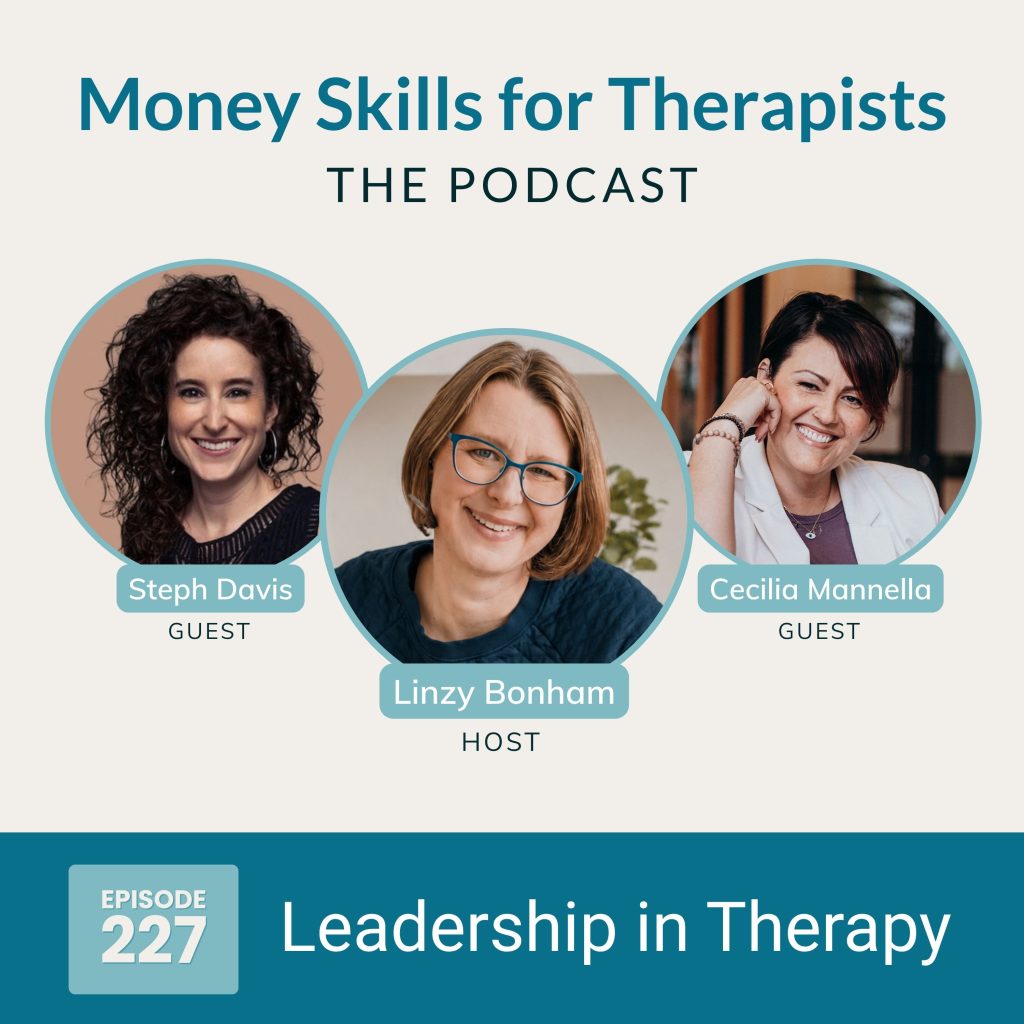
Hello and welcome back to the podcast. Today’s episode is a conversation with Steph Davis and Cecilia Mannella on leadership in therapy.
Linzy Bonham 01:48
So we talk about leadership both at, like, the clinical level, you know, which applies to all of us doing clinical work, whether you’re in solo practice or whether you’re a group practice owner, or whether you’re working for a group practice or even working for a hospital.
Linzy Bonham 02:02
What does leadership mean in that clinical relationship? We talk about leadership in a way that’s a little bit more obvious as a boss. How do you show up as a boss?
Linzy Bonham 02:12
We talk about why leadership is so hard for therapists, why it’s something that we can be a little bit phobic of, and why it’s difficult for us to develop our leadership skills or maybe use some natural skills that are there, why we don’t apply those in our group practice.
Linzy Bonham 02:28
And we talk about the summit that Steph and Cecilia are running. So I’m gonna be part of this summit that they’re doing. It’s gonna be so cool. Steph mentions at the end of this episode that they kind of… they assembled the A-team, and I’m very honored to be part of the A-team.
Linzy Bonham 02:42
It is the Together in Practice Summit happening in October. You can click on the link in the show notes to check it out. It’s gonna be so good. Just some really rich conversations with very smart therapists about leadership and what it means and what it looks like, and encouraging us to dig deep and think about what’s in the way of our leadership.
Linzy Bonham 03:02
How do we tap into our authentic leadership? But also talking about very specific pieces. I’m gonna be, of course, surprise, surprise, talking about money and leadership, showing up as the financial leader of your practice.
Linzy Bonham 03:15
Other folks are talking about culture building, decision making, client retention. It’s, it’s gonna be awesome. So you can check out that link in the show notes for the Together in Practice Summit.
Linzy Bonham 03:26
And here is my conversation with Steph and Cecilia. So Steph and Cecilia, welcome to the podcast
Steph Davis 03:35
Thank you. So happy to be here.
Cecilia Mannella 03:37
Thank you for having me. This is so great.
Linzy Bonham 03:38
Yeah, I am very excited to have you two here. Steph, you and I have the unusual, uh, relationship at this point that we’ve met in person,
Steph Davis 03:49
I know.
Linzy Bonham 03:49
Which is a big deal
Steph Davis 03:50
It was so great. Yeah, it was a big deal. It was a big deal. It was such a fun weekend when
Linzy Bonham 03:55
And yes, in internet land that’s a big deal ’cause you can have a relationship with somebody online for 10 years and never meet them in person.
Steph Davis 04:03
That’s right.
Linzy Bonham 04:04
But Steph recently hosted, myself and Diane and Clinton, our team member, at a BC event. So Steph was just telling us where she’s having pizza after this and I was saying how she’s bragging ’cause I’ve eaten there now and now I understand, um, that she’s actually just bragging about all the amazing food near where she lives.
Linzy Bonham 04:19
And Cecilia, I didn’t get to meet you in person which was a bummer ’cause, you know, ’cause you have a life and you were off doing fun things.
Cecilia Mannella 04:25
Total FOMO over here over that
Linzy Bonham 04:26
Yeah. But yes, our BC event that we did was so wonderful and, I think almost in a way, Steph, that BC event came up because of this summit that we’re doing together that we’re gonna be digging into today ’cause that kinda got us back in touch.
Linzy Bonham 04:41
You took Money Skills for Group Practice Owners two or three years ago,
Steph Davis 04:44
Three years ago,
Linzy Bonham 04:45
Three years ago now. Um, you were on the podcast at the time. Uh, Steph and Laura, synonymous with healthy partnerships, successful practices.
Linzy Bonham 04:54
We still refer to you. Also great internship programs. We sometimes like send our students to you to be like, “They run a great internship program. Go look at what they’re doing.” Yes.
Steph Davis 05:01
Oh, we appreciate that so much
Linzy Bonham 05:02
And now you are growing into the leadership space. So how about both of you just give a little intro of who you are before we dig into our conversation today about leadership and therapists.
Linzy Bonham 05:13
So, so Steph, can you give a little intro to who you
Steph Davis 05:16
Yeah. I mean, okay, just to add on to what you’ve said. So I am the co-owner of Shoreline Counselling in Fort Langley, British Columbia.
Steph Davis 05:23
We are a large group practice out here. I have the best business partner on the planet, and we have, uh, an awesome time, like, growing and building this business.
Steph Davis 05:32
We’ve been leaning a lot into the leadership space together as we have grown into our eighth year of running Shoreline, and this is sort of the evolution now is, like, how do we lead better?
Steph Davis 05:42
Business runs itself for the most part. And so this is an area of interest to me. I went back to school a couple years ago and did a coaching designation at UBC, and that really launched me into the leadership space in a new way.
Steph Davis 05:53
So on the coaching side. I work with therapists who are leading people mostly, and helping them to navigate the complexities of that space, how we lead a team of contractors, mostly, usually, uh, in the therapy space.
Steph Davis 06:09
So that’s sort of the work I’m leaning into now.
Linzy Bonham 06:11
I think complexity is the right word. I feel like therapists, we bring complexity to every situation
Steph Davis 06:16
Like, I, like for the sake of it, it feels like. You
Linzy Bonham 06:19
Yeah. Just, you
Cecilia Mannella 06:19
We come by it
Linzy Bonham 06:20
Right thing to do.
Steph Davis 06:21
Totally.
Linzy Bonham 06:22
We really do. So leadership, which I think is already an area that’s challenging for many people, for therapists, we just make it that much more complex and
Steph Davis 06:29
It does seem to be the case. Yeah. Yeah. I’m, I’m sure we’re gonna dive into that more, but yeah,
Linzy Bonham 06:36
Will. But first, Cecilia. Cecilia, can you tell folks a little bit about you?
Cecilia Mannella 06:39
Absolutely. I’m Cecilia, and I own, uh, Eterna Counselling & Wellness, which is a group practice out in Abbotsford, BC, and, and I’ve owned it for 17 years, so I’ve been in it for almost two decades, which makes me feel so old, by the way.
Cecilia Mannella 06:52
I don’t feel old until I start saying those kind of things. Um, yeah, and we’re a large practice, and we have, like, over 20 people, and I started off as a partnership, and unfortunately, not like Steph, I did not… it didn’t end well, so I bought out my partner, and it felt like a brand new business that happens when you buy somebody out.
Cecilia Mannella 07:09
And it’s not just rebranding, it’s just everything changes. That’s when I really dove into this leadership thing around, like, what did I want this practice to be about, and how do I build it, and how do I do this well for me, but also well for the people that I want working there?
Cecilia Mannella 07:23
And then a few years, I kinda dove into the coaching space when someone asked me to help them with their group practice, and it’s kind of just evolved through there.
Cecilia Mannella 07:31
And so I do that as well since the practice kind of runs itself.
Steph Davis 07:35
Cecilia’s like the OG of group practice owners.
Linzy Bonham 07:37
Yeah.
Cecilia Mannella 07:38
Listen, I was, I was around before, like, AI. Like, I was around when you had to list in the Yellow Pages. Like, like… Right.
Cecilia Mannella 07:47
So, OG.
Steph Davis 07:48
That’s right.
Linzy Bonham 07:49
Are OG
Cecilia Mannella 07:49
Feel old. I’ve been in it for a long time, so I’ve seen so many things, right? I think that that’s been the gift of it, is like I’ve been through two economic recessions, right?
Cecilia Mannella 07:59
So it’s like you kind of go through these cycles when you’ve been in it for a long time. And I think that’s kind of what I bring to it, is maybe some wisdom of everything that’s changed over the years.
Linzy Bonham 08:09
I, I think
Steph Davis 08:10
Hmm. Mm-hmm
Linzy Bonham 08:11
There’s so many therapists who have been in group practice ownership for three years or five years, and, you know, you experience things like that for the first time.
Linzy Bonham 08:19
It’s like your first recession. For you, you’re like, “Pfft, this is nothing compared to 2018,” you
Steph Davis 08:23
Right.
Linzy Bonham 08:25
So let’s talk about leadership and therapists, because when I think about therapists and leadership, I usually think about group practice, of course, because that’s where it’s very obvious and transparent, where it’s like you are a boss literally.
Linzy Bonham 08:39
Um, when you become a group practice owner, you are no longer just a therapist and no longer just a business owner and no longer just, you know, the main marketer and all these other things you were already doing, but you become a boss.
Linzy Bonham 08:49
But leadership also applies to solo practitioners. So tell me about how you think about leadership in private practice in general.
Steph Davis 08:58
I think that there’s a misnomer right now in the private practice world that you can, like, get a checklist, take a course, get a business license, get all the things that you need, and you, can run a successful private practice.
Steph Davis 09:09
And, like, I’ve seen the evolution into this in the six years since COVID, particularly when it seems to have, like, swept people into the counseling field and private practice in particular.
Steph Davis 09:19
And I don’t think that there’s a lot of awareness around this sort of like what I call the intersection of, like, where the business and the therapeutic work kind of align or connect.
Steph Davis 09:30
You can’t just, like, set up your SOPs and your system and get all your money stuff in order and expect to be successful. There’s, like, work that happens within our client relationships even that addresses this kind of, like, business dimension or leadership dimension, and I often find that therapists just don’t know how to deal with that.
Steph Davis 09:48
So, for example, you know, a client comes for a first session and the therapist at the end says, “I don’t know if that was helpful for you. If it wasn’t, I’d be, like, really happy to refer you.” Or, like, “You… If you wanna go home and think about it, and then you could, like, let me know if you wanna rebook or you can go ahead and book online.”
Steph Davis 10:07
And the therapist genuinely thinks that they’re being client-centered. That’s what I hear. They think they’re being client-centered, where they’re giving the client this, like, agency to go home and decide if this is the right fit for them.
Steph Davis 10:18
And the thing I’ve learned over the years is that clients have no idea. They have no idea. And often, if a client did feel good sitting there with you and did feel like it was helpful, they’re actually doubting it now because you’ve sort of planted the seed of doubt that, like, maybe actually I do have to think about this more.
Steph Davis 10:33
Maybe I’m missing something. Maybe they don’t wanna work with me. And so I think about that as leadership. I think about the end of a first session where a therapist says, “Here are the things that I think that we could do well together.
Steph Davis 10:45
Here’s how long I think it’s gonna take. Here is what I think will be involved for you over that period of time, and here’s what I hope the outcome will be based on the goals that you’ve set out. And, like, here’s how frequently you should come and here’s how often you should come, and, like, let’s get you booked in.” To me, that’s leadership, and that exists in a group practice and in a private practice.
Steph Davis 11:02
I’m coaching my contractors on these skills constantly, because I think that leadership in counseling is synonymous with good client care.
Steph Davis 11:11
I’m like, we actually can’t… We’re not actually doing good client care if we’re, like, sending people who have never been to therapy before out of our office after a first session with You know, you think about it and let me know.
Steph Davis 11:23
They just don’t know, you know? And so that’s, that’s just a, a simple example, but I think there are many examples just like that that are constantly happening at this intersection point where it’s important that we keep people in our schedule, of course, as private practice owners, we need to keep a, make a living.
Steph Davis 11:39
But also it’s actually just good client care to, like, provide some direction for folks around how therapy works, some education around what to expect, so that people can actually be, like, moving through a process in an informed way.
Cecilia Mannella 11:53
Can I add to that? Yeah. When I started in 2008, so it was a long time ago, it was really… it was assumed you would go into a system.
Cecilia Mannella 12:04
No one ever jumped into private practice. And so I think what happened, you know, Steph and I have talked a lot about this evolution, is that when you go into a system, you learn how to be a really good clinician, right?
Cecilia Mannella 12:14
You get great supervision, you have managers, you have… everyone’s taking care of everything, and what you do is focus on what you went to school for, right? How to really help clients get from A to B. And then as your career progressed, then you would look at private practice.
Cecilia Mannella 12:27
So you had kind of that good clinician thing, kind of that notch on your belt already done. So it became easier to jump into private practice where that leadership naturally showed up because you already had the clinical practice.
Cecilia Mannella 12:39
And I feel like now everyone is graduating going straight into private practice, and so the intersection, I think that Steph’s talking about, the overlap there too is like you’re trying to be a good clinician at the same time of trying to run a business, at the same time of trying to be a good leader, and there’s just not a lot of space for it.
Cecilia Mannella 12:59
And so there isn’t this room to have a discussion around how does the clinical practice and leadership actually work together? How do they live together?
Cecilia Mannella 13:08
How do they feed each other? Where you’re developing yourself instead of sacrificing one for the other.
Steph Davis 13:14
Totally. And I think the skills aren’t separate… Uh, the, the skills aren’t the same, and I think that’s part of the misnomer, I think, for therapists, where a lot of people roll their eyes at this idea of leadership in therapy because they’re like, “But I’m a therapist.
Steph Davis 13:25
I’m, like, empathic. I’m, like, so good at sitting with people. I’m, like, using all my really good relational skills. Like, I’m already doing it.” And I would argue that, there’s a lot of overlap in these skills, of course, but, they’re utilized really differently in a clinical relationship that’s serving a client than they are in a leadership dynamic which is serving your business and, serving you.
Steph Davis 13:48
And I think that those are two different things that I think people don’t always, recognize. I think there’s a lot of assumptions made about therapists being good leaders, but I do think that the skills are there.
Steph Davis 14:00
They’re just not being used as intentionally, I think, as may be necessary.
Linzy Bonham 14:05
Yes. Well, and, and a curiosity that I have, I’m curious what you two think about this. Something that is often drilled into us in, like, clinical training is this, you know, yeah, like, like the client is the expert, you know, like being really aware of your power.
Linzy Bonham 14:21
And I think that, it’s been kind of misapplied. you know, as you say, where it’s like, like if I went for some sort of, you know, medical consultation and they were like, “Well, you know, it seems like you have cancer, but I’m, you know, I, you know, you go home and
Steph Davis 14:34
Okay, that is a super extreme example. Okay? I was gonna say, I was gonna say, if I go to my physio and I say my knee hurts, and my physio says, “Okay, well, here’s what I think we should do, but, like, why don’t you tell me what you think you need, and then go home and think about it?” I would be like, “I have no idea.
Linzy Bonham 14:53
I know.
Steph Davis 14:54
Zero idea.” I’m like, “I’m just gonna do what you tell me to,
Linzy Bonham 14:57
And that’s how I feel literally every time any kind of manual practitioner tries to give me choice. I’m like, “No, you don’t understand. I do not know how to manage a body.
Linzy Bonham 15:05
Like,
Cecilia Mannella 15:05
Or else you wouldn’t be there.
Linzy Bonham 15:07
This is why I’m here.”
Steph Davis 15:07
Right. That’s right. But it seems so dumb
Linzy Bonham 15:10
The right YouTube videos and I’d be fixing myself.
Steph Davis 15:12
Right. But it seems dumb, right? Like, I would never go into my physio and expect for him to be like, “You tell me whether you think this is… or whether you think I’m helping you or not.” It’s like, it’s a complicated dynamic for therapists who are also often, like, overly parentified, overly empathic humans to start with, to, like, wanna know that they’re doing a good job and wanna know that they’re helping people, which comes from such a pure and lovely place, and doesn’t instill a ton of security in someone like me as a client.
Steph Davis 15:41
If I went in and my counselor was needing me to reassure them that what they were doing was helpful, I’m not going back.
Cecilia Mannella 15:48
Leadership builds trust.
Steph Davis 15:49
That’s right. It does.
Cecilia Mannella 15:51
Right? We often think in clinical practice it’s like in the relationship and what we’re doing and, but we don’t really connect the fact that leadership actually builds trust
Linzy Bonham 16:00
Mm-hmm. Mm-hmm
Steph Davis 16:01
Such a good way to say it. That’s exactly… I feel very strongly in agreement with that.
Linzy Bonham 16:05
Yeah. Yeah. And can you say more about that, Cecilia? ‘Cause I, I really like that idea, and I think there’s so much truth in that
Cecilia Mannella 16:11
Yeah, if we’re gonna use an example, it’s like I trust my chiropractor to treat my messed up back because there’s direction and leadership there. And so I automatically then can let go of the responsibility of managing the things ’cause someone else is going to do it for me.
Cecilia Mannella 16:26
And I think that leadership is about being the guide. It’s not about knowing everything. It’s not about misusing power.
Cecilia Mannella 16:34
Um, ’cause I think we have this confused sometimes definition of leadership, maybe ’cause we’ve all had terrible managers. Like, I think we’ve all had really our own traumatic experiences with managers or people in power who tell us what to do, and their leadership is kinda top-down heavy.
Cecilia Mannella 16:48
But leadership really is about guiding, right? It’s about being the captain of the ship, so to speak, knowing that you have to decide the direction in many ways, and everyone participates.
Cecilia Mannella 16:58
And people come to therapy for our wisdom, our clinical expertise, for our knowledge, for our training, for our years. And so it’s a disservice to not lead that and leaving it up to the client instead when in truth that really needs to be owned by us, and in that leadership we actually take care of people.
Cecilia Mannella 17:17
So it’s not through empathy in that… In the way I think we talk about being client-centered, I think it just sounds like empathy is like 10 out of 10, and there’s like zero to 10 leadership where it needs, it, it needs to be this place of like we need good leadership, and in good leadership there’s a lot of empathy and compassion and care.
Cecilia Mannella 17:36
But because of that leadership, it creates a container for trust, and I think then clients can relax into it. And I think that team members, when you’re leading a team, they can relax in that container.
Cecilia Mannella 17:48
And I think that’s why leadership really leads to building more trust.
Steph Davis 17:52
Yeah. I, I totally agree. I think it’s, it’s so interesting to me what you said about the misconceptions that people have about leadership.
Steph Davis 17:59
I mean, if you look at a lot of the leadership literature that’s out there, the Simon Sinek work and the Brené Brown work, the… it’s all about empathy, right? And that, that, like, leadership needs more empathy.
Steph Davis 18:10
But, like, we over-index on empathy as therapists, right? Like, There’s just not a lot of, like, literature or leadership training or, like, relevant literature often to those of us who don’t need more empathy in our leadership.
Steph Davis 18:25
But I do think it’s why a lot of counselors are like, “Eh,” because so much of the leadership that they’ve seen over-indexes on management instead of empathy.
Linzy Bonham 18:34
Yes. Well, and that’s such a good point that you make about leadership for therapists specifically, right? And like where our challenges tend to be, ’cause it’s so true. Like, I think about this with Money Skills for Group Practice Owners as well.
Linzy Bonham 18:46
My friend Clinton, who Steph you’ve now met, um, came into our business and when I was like, you know, telling him some examples of conversations that I’m having and whatever, and he’s like, “Okay, so people just like need to like learn how to understand numbers?
Linzy Bonham 18:58
Like what?” And I’m like, “Yeah, ’cause we have all the other stuff, and like this is what we’re missing.” But he’s like, he comes from a world where people only think about the numbers and they don’t think about the human impact at all, right?
Linzy Bonham 19:07
So we, we have to learn to fill in kind of our areas of deficit. And for therapists, empathy is not an area of deficit. It’s an area of overabundance.
Steph Davis 19:17
Yes.
Linzy Bonham 19:18
Um, and we over-function for other people, and we self-sacrifice kind of, you know, as just as our de facto state of being. So yeah, you’re right.
Linzy Bonham 19:26
I think that, we don’t actually need Brené Brown to tell us to be empathetic leaders. Like we should probably not read Brené Brown. It’s for everybody else, but it’s not for
Steph Davis 19:34
Yeah, like her leadership material is probably not what we should hold as gospel.
Linzy Bonham 19:39
Yes. Yeah, ’cause it’s not filling in the gaps that we have.
Cecilia Mannella 19:42
Yeah, and no shade to Brené Brown,
Steph Davis 19:44
No, she’s
Linzy Bonham 19:44
Obviously.
Steph Davis 19:45
She’s amazing, and she’s doing amazing leadership work, but I’m like, we gotta know what lane we live in here, and like, I just think that this sort of sense of giving so much to people and like over-empathizing and taking care of people in a way that can sometimes be disempowering or enabling when we’re doing too much of it, I’m like, it’s just not good leadership in this space.
Steph Davis 20:04
People who come into therapy, they need our empathy, of course, but they also need something else in order to feel like they can trust us, that we know what we’re doing.
Steph Davis 20:12
You know? I hate listening to people, like, talk about therapy often these days. Like, you see it on TV shows or you see it around where people are just like, “Oh, therapy, yeah, I’m so over talk therapy.
Steph Davis 20:21
It doesn’t help me. It doesn’t this, doesn’t that.” And I’m like, yeah, like I can appreciate, given a lot of what I see in the people I work with, I’m like, I don’t know if I would trust you either.
Steph Davis 20:30
You know? And not because I don’t think you’re a good clinician, but I don’t know if you communicate well enough how you are a good clinician and what you’re gonna, be doing to help the people you’re working
Linzy Bonham 20:41
Oh, 100%. Yeah. I’m on the hunt for a new clinician now, like for a new therapist for myself for chronic pain, which is a new area of life for me, and I’m like, I just booked in a session.
Linzy Bonham 20:51
I was like, “Just do it. Just book,” because I am a very hard client to have, like most therapists are,
Cecilia Mannella 20:57
I was gonna say all therapists are terrible clients.
Linzy Bonham 21:00
Worst. We’re the worst. But yeah, I’m also stuff, very sensitive to if somebody seems unconfident or like intimidated by me or wishy-washy, I’m like, “I’m out.” Like, “I don’t have time for this.
Linzy Bonham 21:11
Um, I need somebody who can like hold, like create the container, lay out the path for me. Like I’m a busy person.” Like don’t be like, “Would you like to come back?” Be like, “I think you should come back once a week for this much time.
Linzy Bonham 21:22
We will work on these pieces, and then we will check in on your goals.” I’m like, “Thank you so much.” And that is leadership. But I, my personal experience of therapy, both in the mental health space and the kind of other kinds of modalities like physical health, is that most practitioners lack those skills quite significantly.
Steph Davis 21:40
Yeah. They do. But like I said before, I’m like, I don’t know if they lack them. I think they just don’t, they just don’t utilize the skills they have in this way. I think that therapists just don’t think about using their skills in this way.
Steph Davis 21:52
You know? Like, uh, when I’m, I’m running these kinda like groups with my, uh, independent contractors, and a lot of them are just like mind-blown by the possibility that they could say that thing that they’re thinking, which is like, “I think they need to be here every week.”
Steph Davis 22:04
And I’m like, “Yeah, you should say that.” And they’re like, “Really? But what if they don’t wanna come every week?” Right. They’re like, “What if they don’t wanna come every week?” And I’m like, “They get that choice ultimately, but like your job is to inform them around your professional judgment and like what you think would be most useful for them.”
Linzy Bonham 22:19
Mm-hmm. Yes, absolutely. That sharing your professional opinion and creating a path doesn’t take away their agency.
Linzy Bonham 22:26
They can always say, “Actually, I can’t afford to do that,” or, “Actually, you know, I… now that I think about it, maybe I’ll start in the fall.” But yeah, if you’re not actually sharing that, you’re also doing a disservice because you’re not actually sharing your, your wisdom with them.
Steph Davis 22:41
Right. Exactly
Linzy Bonham 22:43
I’m curious for both of you, ’cause there’s so many areas of leadership. I wanna hear from each of you about kind of like the area that you are most jazzed about when it comes to leadership as a therapist, and both of you are also group practice owners.
Linzy Bonham 22:58
Steph, I’m curious for you, what do you get really jazzed about when it comes to leadership?
Steph Davis 23:03
I work mostly with therapists who are leading teams. Like, that’s the thing that’s most exciting for me and most interesting for me.
Steph Davis 23:10
The constant dilemmas that are emerging in the group practice as people are leaving, Matt leaves, client complaints, any, any kinds of like dynamic issues that happen within, a group practice.
Steph Davis 23:24
I do a lot of that kind of work. I’m really very, passionate about culture building and like building good culture. And I don’t know how it is in Ontario, but here in BC a lot of the practices are independent contractors who are working with us.
Steph Davis 23:36
And so there’s a bit of a different dynamic when they’re not your employees. And so Laura and I have like so intentionally worked over the years of building our, culture and trying to find that balance, you know, between doing what’s right for the business, which like you helped us a lot with in Money Skills for Group Practice Owners.
Steph Davis 23:54
We always thought that we were doing what was right for the business by just like keeping everybody happy. And then you told us that we were keeping them too happy and that we had to make a change.
Steph Davis 24:04
And, and, uh, we did. And, we are constantly dancing around that sort of like middle ground. But we, you know, have found this kind of like special sauce here that has actually made it possible to like hold both of those things really well, and I love talking about that with other group practice owners and helping them work within their teams.
Steph Davis 24:27
I mean, I think that group practice owners at the root of it want to do well by their clinicians and want to build good teams. But I think because of the lack of leadership skills, as we’ve been talking about, and the lack of business knowledge, like they just don’t know how to run a business, uh, things go sideways constantly and there is not a lot of obvious or common sense problem-solving that can happen.
Steph Davis 24:49
People get hurt, they get offended, they get scared, and so they don’t always know how to respond.
Steph Davis 24:56
And so that’s like where I love to be in that mess with group practice owners as they like are sorting out how to lead teams and build culture.
Cecilia Mannella 25:03
Hmm.
Linzy Bonham 25:04
Yeah. Yeah. And culture I think is such a powerful thing, ’cause one of the things that I say to group practice owners a lot is like, no one can build a practice like the one that you have, right?
Linzy Bonham 25:13
Like, every single practice, whether it is a solo practice or a group practice, is so specific to the leader of that practice and, you know, their vibe and their niche and the population they’re serving and the area they live in and their sense of humor, and like, do people swear there or not?
Linzy Bonham 25:31
You know? Like, is there, you know, are folks religious? Is it like queer-leaning practice? Like, it’s so specific, and I love that as somebody who loves humans because it’s just so each practice is its own special little thing.
Linzy Bonham 25:43
And so when I hear you talk about culture building, it just makes me think about how there’s so much opportunity and richness in building good culture, ’cause the culture you build will be nothing like the group practice down the road.
Linzy Bonham 25:52
Even if your best friend runs the group practice down the road, it’s gonna be completely different.
Steph Davis 25:56
Totally, which I think is the layer that people miss. I’m like, you can go and take a course and learn how to write your contracts and write your procedures and get your workflows going and all of those things, and those things can look similar or the same or whatever across the board.
Steph Davis 26:10
But the culture piece, that extra layer of like, what is that unique thing that you bring as the owner or leader of this practice that matters a lot to you to be what your practice is about?
Steph Davis 26:22
You know? And like, how do you get buy-in for that? And like, how do you get people to be as passionate about that as you are and want to be a part of that with you? It’s challenging.
Steph Davis 26:31
Yeah, it’s
Linzy Bonham 26:31
It is challenging. Yeah, it’s very challenging.
Steph Davis 26:34
Especially when they have to pay 30 or 40% and they’re, like, not happy about that.
Linzy Bonham 26:37
Right. Yeah.
Steph Davis 26:38
Mm-hmm.
Cecilia Mannella 26:39
The, the people part of a, of that is always the hardest.
Linzy Bonham 26:43
Yeah, absolutely. And, and the feelings, like you said, Steph, where it’s like where our feelings get hurt. And this is what I see with group practice owners a lot. Like we have a community of therapists, of folks who’ve graduated from Money Skills for Group Practice Owners called Financial Leader Circle, and a lot of what happens in that space is just people being able to express like how hurt they feel that this thing has happened or how mad.
Linzy Bonham 27:01
It’s like basically like, “Hold me back.” Um, because we, we are just so emotional and we’re so relational that if somebody does something, it’s not just like, “Nah, that’s a them problem.” You’re like, “Ah, but I thought we had something.”
Linzy Bonham 27:14
Or like, you know, “But you were, you know, you came from an intern,” and like just, yeah. We, again, we bring so much complexity to relationship, which, which makes leadership and culture building harder
Steph Davis 27:26
Well, and like, don’t get me wrong, I like got here because I used to… like we’ve been through that because like we’ve sat many times and been like, “What do you mean? We’ve like raised you. What do you mean you’re leaving to start your own practice down the road?” Like that’s so offensive to us or whatever, and it has taken many years and also a good handle on the numbers.
Steph Davis 27:46
That’s been the big game changer for us. “Our job here is to like train good therapists to do good therapy, and good therapists are gonna go on and do good things.” And I wanna be known for that.
Steph Davis 27:55
I wanna be like known for a place where people are like, “I had this great experience, and then I was serenaded out the door when I left, and it was all fine.”
Steph Davis 28:03
We love that to like be able to look out at many of our former interns and people who are out doing cool things in the world. I take a lot of pride in that now, and now that I feel different about it when somebody tells me they’re leaving than I used to, it makes all the difference, I think, to the culture also.
Steph Davis 28:19
We’re just like not holding on so tight,
Linzy Bonham 28:21
Yes. Yeah, you’re not like clingy. I was gonna say helicopter parents, that’s not right, eh? What, who are the parents that don’t let their kids… Clingers?
Steph Davis 28:28
Clingers. Stage five, stage five clingers.
Linzy Bonham 28:31
Fives, yeah.
Steph Davis 28:34
Yeah.
Linzy Bonham 28:34
And Cecilia, what about you? Like, what is the facet of leadership that you get really excited about these
Cecilia Mannella 28:39
Oh, so much. I’m a little adjacent to, uh, what Steph does. I work with group practice owners and solo practitioners as well, and I, um, really love working with practice owners who wanna develop their entrepreneurial mindset because I think that we become really good clinicians and then we happen to be business owners and then we start making business decisions with like zero business training or even understanding of how business works or the rules of business.
Cecilia Mannella 29:07
Um, and then you throw in that most of us are women who are owning businesses, so then we’ve got another layer of all our socialization of women and what’s possible and what’s not possible.
Cecilia Mannella 29:18
Um, and what I really love is engaging and teaching and shifting that mindset to being, um, running experiments.
Cecilia Mannella 29:27
Like be someone who is adventurous. Be someone who’s bold enough to try something new and something different. To imagine something beyond what we’ve been told is possible within a practice. It doesn’t have to look like everybody else’s.
Cecilia Mannella 29:39
It actually can be really unique. And I think that really came out of… I built my practice in Abbotsford, which is kind of known as the Bible Belt of kind of the West Coast.
Cecilia Mannella 29:49
And when I started it was very… I went very left. I was like not religious. We were queer. We were a safe place for anyone who didn’t really fit into anywhere else. So we were, queer safe and LGBTQ safe and people who’d had terrible experiences with maybe potential like Christian counseling.
Cecilia Mannella 30:05
So I had to be really creative. I couldn’t really follow the models that were out there in the community because they were very rigid and very kind of traditional. And I love that about being a group practice owner.
Cecilia Mannella 30:18
You can just try new things and try experiments and think like an entrepreneur, which means really stepping out of the box all the time and not thinking about, “Well, this is how everyone else does it so therefore I should probably do this,” instead of thinking, “Well, that’s not how everyone else is doing it, so I’m gonna go do this.
Cecilia Mannella 30:36
I’m gonna go do something different. I’m gonna create something new. I’m gonna open up a space over there. I’m going to explore feeding basically my heart and soul in a way that is authentic to me,” versus trying to build somebody else’s practice because that doesn’t really work.
Linzy Bonham 30:51
No. No, it certainly does not. I remember, um, when I was a teenager, there was a saying of like, you know, “Just be yourself, everybody else is
Cecilia Mannella 30:58
Yeah. So true
Linzy Bonham 31:00
It’s like probably on a bookmark at, you know, you know, the local bookstore. But, um, yeah, like really owning your own… Again, what makes you special. But also I love this point about entrepreneurship because I think in entrepreneurship, true entrepreneurship, as you said, there’s so much, making mistakes, trying things.
Linzy Bonham 31:18
Does this work? Oh, that didn’t work. Oh, that really didn’t work. Um, but the resilience that we build, and it makes me think too with leadership, like how building your entrepreneurial resilience and curiosity in play also is gonna inform how you respond when things don’t go well, which is a really important part of leadership, right?
Linzy Bonham 31:39
Because I think if we all think back to like bad bosses that we have had, and I think we’ve all had them, one of the things that can be really ugly is how leaders react when things don’t go as planned, right?
Linzy Bonham 31:53
Like do they blame? Do they brood? Do they like freeze people out? You know, and these kinds of like responses that people have when they’re just not able to bounce.
Linzy Bonham 32:02
And it makes me think about how in some ways like an entrepreneurial mindset is a cure to a lot of those things, which is like, “Okay, well, that didn’t work.”
Steph Davis 32:09
Mm-hmm.
Cecilia Mannella 32:10
Let’s try it again.
Linzy Bonham 32:12
That’s it. That’s it. Or like let’s, let’s like look at it from this slightly different angle and how, how much better that is for your team when you can be resilient as a leader instead of you falling into your own like pity cave because your marketing, you know, your, your Google Ads failed
Cecilia Mannella 32:26
Well, and it’s just more fun. I think we don’t often talk enough about how as much as owning a business is really hard.
Cecilia Mannella 32:34
Like there’s no sugarcoating that. There are days where you wanna burn it down and you’re like, “I’m done with this.” But there are also days where like it can be so much fun. The people you hire, the team that you’re building, the new thing that you’re trying, it… we can also have a lot of fun, and I don’t really think of people… we own that piece of it around this can actually be playful in many ways.
Cecilia Mannella 32:55
And when you’re playing, I think, within your business and within your practice and you have that fun part of it, then it actually has more legacy and more long-lasting in the community for sure, and within your team.
Linzy Bonham 33:06
Yeah.
Steph Davis 33:06
Hmm. I don’t know if you find this, but, I sometimes find leadership, the idea of leadership to be such a stretch for therapists. But the idea of entrepreneurship, I feel like often puts people kind of like way outside of their sort of like imagination or even around what’s possible or how they see themselves.
Steph Davis 33:23
And like, I even think about Laura, my business partner. I like… I’m the entrepreneurial, more outwardly entrepreneurial spirit in our team, and I’ve been connected to The Forum, uh, which is a women entrepreneurial program out here, and it’s in Ontario too, I think, for a long time.
Steph Davis 33:38
And Laura’s just like, “I just never saw myself. I just never saw myself.” And so they had this like sweatshirt that they were selling one year that said something like female entrepreneur or something. So I like bought her the sweatshirt and I was like, “I want you to wear this and like really embody it,” you know?
Steph Davis 33:52
Because I was like, this is the fun of like what we’re doing. Otherwise, we’re just slogging through client hours and slogging through leading people and slogging through management.
Steph Davis 34:00
And like, if we can’t imagine all the fun things that this could become like we did when we started building it, I don’t know if I like wanna do that. It’s like not enjoyable for me, you know?
Steph Davis 34:10
And now she wears the sweatshirt with like immense pride all the time.
Linzy Bonham 34:13
That’s adorable.
Cecilia Mannella 34:14
Love that. I love that
Linzy Bonham 34:16
In the mirror every day for 10 minutes? Take
Steph Davis 34:17
I didn’t. No, I didn’t. I didn’t. She was so excited to get the sweater, I didn’t really… No other coaching was really
Linzy Bonham 34:23
Oh, great. Wow. Okay. Well, uh, and there, there was a little thought that just popped in my brain, and I’m gonna say this, and then I’m gonna ask you too if you think this is accurate or not.
Linzy Bonham 34:32
But when you are running your own business, and as you say, there’s all these things that are hard, there’s these slogs, there’s conflicts, there’s things that don’t go to plan. We know all the hard parts.
Linzy Bonham 34:40
But I, I’m gonna say this statement. We’re gonna see if we think it’s true. I think if you’re not having fun, then you’re doing it wrong
Steph Davis 34:48
I don’t see the point
Cecilia Mannella 34:49
I totally agree
Steph Davis 34:51
I don’t see the point. Like, if there’s no fun, then like, uh, yeah. Honestly.
Cecilia Mannella 34:58
Just get out. Just… Well, and here’s the thing. I think there’s so much pressure for therapists to be self-employed, to run their own practice, to do their own thing and build a group practice.
Cecilia Mannella 35:09
And it’s like, it’s, there’s… If you’re not having fun with that, it’s actually a really good choice to be an associate.
Steph Davis 35:15
For sure.
Cecilia Mannella 35:16
We also have to talk about that around, like, leadership pieces too. Like, if it’s not the right fit, it’s okay. It’s not only just okay, it’s something to celebrate.
Cecilia Mannella 35:24
Like, being at the helm of a ship, to be a leader, the weight is legit. It’s a lot, right? Like, I know for me and I know for Steph and, and group practice owners I work with, I think about the fact that my group practice allows a single mom in my practice to, to get a mortgage and to buy a house for the first time.
Cecilia Mannella 35:42
And that, that her ability to feed her children and pay that mortgage is because… not because I’ve, I’ve built this space, but also I am the steward of that practice that enables that to happen.
Cecilia Mannella 35:52
She doesn’t wanna be a group practice owner. And good for her, because there’s a lot of weight that comes with that. So I think it’s okay to also say when you’re a leader and you’re having fun in your business, that’s usually a good sign.
Cecilia Mannella 36:04
Like, it’s a little bit of affirmation of like, “Okay, I’m on the right path.” If you are not having fun, like you can find zero fun in it, then maybe it’s actually not the right place and position for you, right?
Cecilia Mannella 36:15
And I think we need to kinda talk about that too, instead of everyone just automatically going to like, “I graduate, I’m gonna open a private practice.” It’s, it’s
Steph Davis 36:23
Why would I pay somebody else when I could just pay way less to do it my own way? And it’s like, totally. But like, if you hate that or if like that is not fun for you, then I’m like, I don’t… It doesn’t really make sense.
Steph Davis 36:35
You know, I think about our, one of our clinicians here, she sees a ton of clients. She sees our most complex clients. She’s like really kind of the backbone of the practice. She’s been here for a long time.
Steph Davis 36:44
She has a lot of opinions about things and wants to be involved. She contributes a lot in a lot of ways, but like she wants to come in and do her clinical work, and then she wants to go live her life.
Steph Davis 36:53
And like she doesn’t wanna worry about the elevator being broken or the front desk people getting paid or the single mom clinician paying her mortgage. Like, I think constantly every time we make a decision about 25 people’s livelihoods that I contribute to in some way by stewarding this business.
Steph Davis 37:08
So it isn’t for everyone, for sure. And I think we need to do more to like celebrate that. I think it’s like good leadership to be able to look at ourselves and be like, “That’s not for me,”
Linzy Bonham 37:19
Yeah. Yeah, I’m in the middle of doors open for Money Skills for Group Practice Owners right now for the fall cohort, and this is something that, like, I do, I do a webinar, which we just did last week, as of the time of this recording, um, how to run a successful group practice.
Linzy Bonham 37:33
And I say in that, and in, in emails too, like, when I do a discovery call with somebody who’s considering taking the course and they’re like, “Ugh, yeah, I don’t really like people.
Linzy Bonham 37:44
No, I don’t really like mentorship. This is really exhausting. I’m making less money.” I’m like, “Get the fuck out. Just get out. Like, don’t do it.
Linzy Bonham 37:51
No.” And, like, I should start making that a service of, like, “Come talk to me and I will tell you if I think you should be in a group practice or not.” Because there has been more than one person that I’m like, “I… You know what?
Linzy Bonham 38:00
You’ll make more money as a solo practice owner. If you were happy in that place before, go back to that place. You will have more time.
Linzy Bonham 38:07
You will not have to deal with all these other pieces.” Like, I really believe that folks should only be running group practices if they love to mentor, love to lead, love to build culture.
Linzy Bonham 38:16
That’s who we need running group practices. If folks cannot check off that list, like emphatically, there’s so many other ways to make money.
Steph Davis 38:24
Totally. And do good therapy,
Linzy Bonham 38:25
Yeah. Oh my gosh, yes. Yeah. Yeah. So the summit is coming up in October. I’m gonna be part of it.
Linzy Bonham 38:33
I’m very excited. Um, Elana Sures, who was on this podcast, yeah, it’s, mm, I feel like honorary BC. Um, frankly, I don’t wanna pay to live in BC, it’s way too expensive.
Linzy Bonham 38:44
Um, but I, I like that I get to hang out with you folks, you know, visit in person and be part of the BC summit. So it’s not really BC summit, but it’s, it’s BC grown.
Linzy Bonham 38:54
So can you tell us about the Together in Practice summit?
Steph Davis 39:00
Well, we like to think we’ve, compiled the A-team here for this summit. You know, we have. Yeah, we have. It’s us two, yourself, Elana, as you mentioned, and my business partner, Laura Bull, who will be all part of leading the summit.
Steph Davis 39:12
And, you know, so I’ll talk a bit about how the summit came about ’cause I think it’s a great story. So, Cecilia just spent time talking about the entrepreneurial mind. She is like the entrepreneurial hive.
Steph Davis 39:23
Like, this woman is just, like, constantly, constantly full of ideas. And she reached out to me on LinkedIn about a year and a bit ago, and we had a, what was supposed to be a 15 or 20 minute chat.
Steph Davis 39:33
We talked for 90 minutes, really, like, felt very aligned. It was amazing for me. I, like, was like, oh my gosh, there’s somebody out there who, like, thinks like me and who, like, sees this like I do.
Steph Davis 39:44
And as much as I love Laura and we work so well together, we’re very, very different. So meeting Cecilia was, like, kind of eye-opening to me. I often feel like a fish out of water, so it was so helpful to, like, feel so aligned with someone.
Steph Davis 39:58
And then fast-forward a few months, I get another LinkedIn message from her, and she’s like “Do you wanna build an online summit with me?” And I’m like, “Yes. Yes, I do.” I am, like, re-emerging from a maternity time-ish.
Steph Davis 40:12
I have, like, a little baby, a toddler at home, and I’m trying to, like, get… I was like, oh, I need something that is not just driven by me right now to, like, get going.
Steph Davis 40:21
And so I was like, “Yes, I would love to do this.” I love working in partnership. I love, like, being in a team environment. And so this thing sort of was just, like, born around this conversation that we’d had about this gap in leadership in the therapy world, and we thought we could put on a sort of two-day summit to begin this conversation.
Steph Davis 40:45
You know, the, the summit is not a training. The summit is a, is an opening, I think, to, like, a much, many different larger conversations about leadership, over two days in October.
Cecilia Mannella 40:54
It’s a room. I think, you know, I can speak to that. I… When I met Steph for the first time, we had our little coffee chat, I walked away with the same feeling, feeling that someone really… We were, like, so similar, and the conversation was so much around leadership.
Cecilia Mannella 41:09
And then spent weeks just, like, mulling. You know when you have that conversation with people and you’re just like, it, it goes around and around and around in your head all the time? And I was out for a walk and I’m like, “Screw it, I’m just gonna text her and see what she says.” And I think the, uh, the dream was really about taking the conversation Steph and I had and being able to have that kind of similar conversation or the vibe of that conversation, the energy of it, with a whole bunch of other people, right?
Cecilia Mannella 41:33
And so, because we can’t be the only ones, right? If, if, if it’s we had a great conversation, we had a great conversation with you, Linzy, about it, it’s like, well, there’s gotta be more people out there who wanna just be in a room where we can have these fun conversations, interesting conversations, and really hard ones where we need to, like, dig in a little bit, because I think the field of therapy is under a massive evolution.
Cecilia Mannella 41:56
We can talk about all the things that are happening right now, whether it’s war in other countries or it’s AI that’s kinda come on the scene or the… everyone’s talking about the saturation of so many grads in the market.
Cecilia Mannella 42:06
I mean, there’s so many things as leaders that we’re facing, and I think it’s really easy to get siloed and isolated in it, and we kind of, like, complain or bitch about it, and then we go back to what we’re doing, versus being in a room together to rumble with our own stuff around what leadership means right now, and then what is it gonna mean for us in three years from now.
Cecilia Mannella 42:26
And I think that was kind of the idea, that came from my conversation with Steph, and it kinda just evolved into what it is today, and we were so happy that you said yes to join
Steph Davis 42:36
Yeah. We
Linzy Bonham 42:37
Of course I said yes.
Steph Davis 42:38
Yeah. I think part of it, part of it is this extension, like there’s so much coaching out there for like how to build your business and like we just… That’s not what this is.
Steph Davis 42:46
This is like, okay, you’ve built it and it runs and it’s mostly sustainable and like there’s still so much that’s happening and going on all the time in the like leading of the business and so like let’s have those conversations.
Steph Davis 43:00
Let’s like support each other and talk about what’s working and what’s not working and the changes that are coming and like let’s really dig into how we grow personally as leaders and how that contributes both to like the building of our practices but like the evolution of the field which like needs to happen especially out here in BC, right?
Steph Davis 43:17
We’re moving towards regulation for therapists. This is like a gonna be a big landscape changer, you know? And so there’s lots of conversations I think that are relevant for people who are running group practice owners, as it pertains to leadership in this like ever-evolving climate.
Linzy Bonham 43:33
Yes. And to clarify for our wonderful Americans listening, the summit completely applies to Americans as well. I know we’ve, we’ve been making Canadian references.
Steph Davis 43:41
No. We just all happen to be here.
Linzy Bonham 43:44
Yes. But yes, it’s, it applies to Canadians and Americans. And can you share the date and the details?
Cecilia Mannella 43:50
Yeah, it’s, uh, over two Saturdays, so it’ll be October 17th and 24th. So they’re broken up into kind of four-hour, sessions. So we didn’t want to do, like, one full day, ’cause we know how exhausting it is to sit in front of a computer screen for an entire day, so we’ve broken it up into two different days, and every session is gonna be really interactive.
Cecilia Mannella 44:08
Like, this isn’t a sit back and listen, kind of summit. I know there’s a lot of summits that are pre-recorded. It’s not. It’s all live.
Cecilia Mannella 44:15
So we want people to show up live even though they have access to the recordings, as they, do at most, uh, you know, events. And every session will have a speaker, and there’ll be lots of time for Q&A.
Cecilia Mannella 44:25
So this is really about being ready to do some work when it comes to leadership. This isn’t a, a course that you’re taking. It’s a conversation that we’re wanting to have with everybody in that space.
Linzy Bonham 44:37
Mm-hmm.
Steph Davis 44:38
We’re trying to set it up, in a way that, provides some sort of like accountability and like tangibility. So there will be a workbook, uh, that participants will all get. They will have pages, for each session.
Steph Davis 44:49
You have a lot of pages for your session. We were like quite Impressed, actually. Yeah.
Steph Davis 44:56
Yeah, we were
Cecilia Mannella 44:57
I was impressed.
Steph Davis 44:58
No, we were quite impressed. We’re quite impressed. But also I was like, “Oh my God, how am I gonna make this many pages?” No, so it was very impressive. Um, and the pages are oriented towards like some pre-work, so like what do we need to do to like get the gears moving around this topic and how it relates to us, and then there is some work to be done while we’re moving throughout the sessions, and then there is some reflection/like action, uh, steps at the end that we’re asking people to, to take.
Steph Davis 45:26
And we are, you know, going to be following up with people two weeks after the summit, you know, trying to hold people accountable a little bit, you know. This is a coaching forward event.
Steph Davis 45:35
It’s not a therapy event. We want people to, do the exploration. We want them to understand why this matters to them. We want them to take away something significant, and then we want them to do something about it.
Steph Davis 45:46
And then we want them to reflect on that and like recognize where the growth is coming from as a consequence. So it’s a very interactive summit. It’s not really a sit back and listen summit.
Linzy Bonham 45:56
Yeah. Yeah, I think the word summit, as you say, has become synonymous with just like pre-recorded things and you’re like, um, “Oh God, I’m so tired,” and also somehow, you know, not nourished at all.
Linzy Bonham 46:07
Um, and what I’m hearing here is this is much more like an interactive, generative, kind of like dig deep kinda space to also just be around people who want to think about, yeah, how to show up and, and, and own the power that we have, you know, as therapists and as, as group practice owners and as business owners.
Linzy Bonham 46:26
Um, and we know, you know, how one good event like that… You know, like Steph, I got an email recently from, one of the therapists who attended our, you know, I say our live event ’cause Steph hosted it in her space, the
Steph Davis 46:36
Yeah, it had nothing to do with me. It was
Linzy Bonham 46:38
No, it had a couple things to do with you. Um, but I got an email just the other day saying like, “I’m still buzzing from the event,” and it was like, you know, three or four weeks ago at this point.
Linzy Bonham 46:47
But just how much it, it feeds us, like spiritually and emotionally to be around our people having these like rich conversations and yeah, it just, um, it’s just such a worthwhile experience.
Linzy Bonham 46:59
So, uh, for folks, you know, listening, there’s a link in the show notes, uh, where you can register for the Together in Practice summit, and there’s a few different levels of registration.
Linzy Bonham 47:09
It’s gonna be so good. These women are amazing, let me tell you. I don’t know what’s in the water in BC, but the group practice owners who happen to be here, also other therapists I’m sure, but the group practice owners, you guys are like just fucking baller.
Linzy Bonham 47:21
I don’t know what’s happening with you. But it’s great. Yes. You’re all very, very competent and very lovely and much too fit. That’s just my personal opinion.
Linzy Bonham 47:29
Yeah.
Cecilia Mannella 47:29
Not me.
Linzy Bonham 47:30
Yeah.
Steph Davis 47:30
No.
Cecilia Mannella 47:31
I wasn’t there, so you can’t say that. Whatever. Look, my little plug for, like, our American friends is that the summit’s actually priced in Canadian, like CAD.
Cecilia Mannella 47:39
So if you’re an American, you’re actually gonna get a really good deal. Just saying, just putting it out there. So we are not excluding our American friends at all. Um, but we wanted to, to price it CAD just for… ’cause that’s where the roots are from.
Cecilia Mannella 47:53
So I know that, um, it might be a better deal for them, so hopefully we’ll see them there.
Steph Davis 47:58
Yeah. And you know, the, the price is intended to encourage entry. It’s like a low cost barrier type of event because we, we see it as a jumping off point for folks.
Steph Davis 48:07
It’s not the whole meal, you know? It’s like, it’s the jumping off point and then opportunity to like take what’s simmering, take the learning, take the evolution, and, and take a next step somehow, you know?
Steph Davis 48:19
So
Linzy Bonham 48:20
Awesome.
Steph Davis 48:21
Yeah.
Linzy Bonham 48:22
Steph and Cecilia, thank you so much for joining me today. This was very fun. I’m very excited for the summit and, um, yeah, just thank you for bringing this topic of leadership to therapists and, uh, group practice owners.
Linzy Bonham 48:33
It is much needed
Cecilia Mannella 48:34
Thanks for…
Steph Davis 48:34
Awesome. So nice to be here. Thanks for, yeah, thanks for having us.
Linzy Bonham 48:40
I so appreciate Steph and Cecilia coming on the podcast today to talk about leadership, share about some of their experiences and challenges and what lights them up about leadership and therapy and group practice.
Linzy Bonham 48:54
I encourage you to stop now after listening to this episode and think about what is your own relationship with the idea of leadership. Do you see yourself as a leader in your solo practice, in your clinical work?
Linzy Bonham 49:07
Do you see yourself as a leader in your group practice? How do you feel about being a leader? ‘Cause whenever we are in business, we are leaders.
Linzy Bonham 49:17
But also in the work that we do as helpers and healers, we also have to be leaders. So this could be a moment for you to take stock on how do you feel about the fact that you’re a leader?
Linzy Bonham 49:27
Are you owning the fact that you are a leader in these spaces? And what need… and what might need to change or be different for you to really step into your leadership as a business owner, as a clinician, or as a group practice owner?
Linzy Bonham 49:43
I really encourage you to check out the Together in Practice Summit. The link is in the show notes for you to register. It’s gonna be great.
Linzy Bonham 49:50
I’m speaking on the first weekend. And as they said, they’ve broken up into two four-hour sessions, so it’s not gonna be one of those staring at the computer for an eight-hour day.
Linzy Bonham 49:59
Happening on Saturdays. You know, they didn’t tell me that I could say this, but I would say just come in your jammies, bring your tea, join from the park. Maybe don’t join from the park.
Linzy Bonham 50:07
You might wanna be sitting at a desk. But I think it’s gonna be a very rich, interesting conversation. Every time I spend time with Steph Davis, I’m just so impressed by her, and anything that she’s gonna create is going to be gold.
Linzy Bonham 50:20
Cecilia is also very cool, but Steph Davis I know really well. So Together in Practice Summit, you can check out the link in the show notes. If you are enjoying the podcast, you might also wanna know about our WhatsApp community.
Linzy Bonham 50:30
We have our WhatsApp community, which is our private community where we have a space where you can talk about the podcast episode every week. What stuck out to you?
Linzy Bonham 50:39
What did you like? What did it bring up for you? What action steps are you taking? We also have rooms for solo practice owners, group practice owners, workshops, and we have private calls that take place just for folks who are in that community every month, where we kind of jam out on one of the topics from a recent podcast.
Linzy Bonham 50:56
We’ve been having a lot of fun in there. You are welcome to join us in that space. And also Money Skills for Group Practice Owners, the doors are open. We’ll put that in the show notes too.
Linzy Bonham 51:05
It’s an amazing program. I would love to support you in there to become the empowered leader of your group practice. Thank you for joining me today.