Linzy Bonham 00:00
You are in charge of the money in your life and you get to decide how to direct it so it reflects your real values at this time. Being curious with your numbers and exploring what it would look like to pay off a certain debt faster, what would that cost you each month to make a certain debt go away faster, allows you to explore the financial impact, but also the emotional impact of taking that action with your money.
Linzy Bonham 00:26
Welcome to Money Skills for Therapists, the podcast that helps therapists and health practitioners in private practice go from money confusion and shame to calm, clarity, and confidence with their finances. If you’ve ever felt overwhelmed by numbers or avoided looking at your business money, you’re in the right place.
Linzy Bonham 00:41
I’m Linzy Bonham, therapist turned money coach and creator of Money Skills for Therapists. Before we jump in, I want to remind you of something really important.
Linzy Bonham 00:48
Most of us highly skilled and competent therapists and health practitioners were never taught about money. Not in grad school, not in supervision, not anywhere.
Linzy Bonham 00:56
And yet, here we are, running businesses that need to take care of us while we’re busy taking care of others. It is a lot of pressure.
Linzy Bonham 01:03
So if part of you feels anxious about money, avoidant, or like a bit of a hot mess financially, I want you to know that you are not alone, and I am here to help. Through my live workshops each month, I teach practical financial skills to help you feel more grounded, calm, and confident with your private practice money.
Linzy Bonham 01:18
You can see what’s coming up and save your spot to join live or register for the replay at moneyskillsfortherapists.com/workshops. Let’s get started.
Linzy Bonham 01:27
Hello, and welcome back to the podcast. We are currently between season 16 and 17 of the Money Skills for Therapists podcast, but instead of taking a five-week hiatus, we are keeping the momentum going this time.
Linzy Bonham 01:40
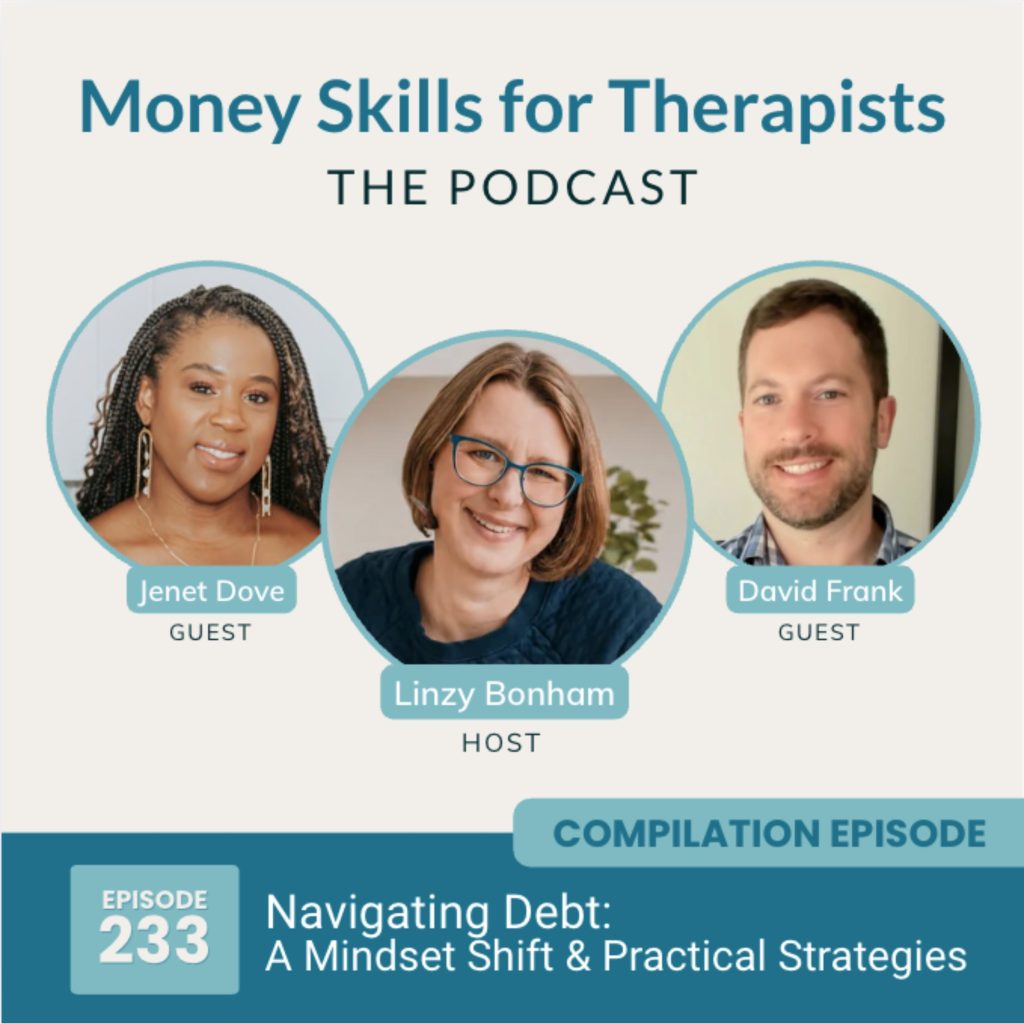
So my team has put together a mix of best of episodes, a podcast takeover, and today’s compilation episode, which is focused entirely on debt. It is very, very common for therapists, health practitioners, and private practice owners to carry debt, along with a whole bunch of heavy emotions that can go with it.
Linzy Bonham 02:00
So this compilation episode offers valuable insights for many of you because chances are, I’m going to say there’s a 95% chance that you have some sort of debt you are managing. You’re going to hear clips in this episode where I reframe how to think about debt.
Linzy Bonham 02:16
You’re going to hear a conversation with Dave Frank, a financial advisor who I really, really enjoy talking about balancing debt repayment and life, and a coaching session where I support a Money Skills for Therapists graduate on navigating personal debt. So here is our carefully curated compilation of conversations around debt.
Linzy Bonham 02:44
Debt is something that a lot of therapists coming into Money Skills for Therapists or Money Skills for Group Practice Owners are dealing with. And I say dealing with because there are some challenges associated with debt.
Linzy Bonham 02:56
One of the challenges that we see about debt is that it can feel very emotionally heavy. And the other thing that impacts us about debt is that it’s expensive.
Linzy Bonham 03:04
It costs money. I want to start by saying that there is nothing morally wrong about debt.
Linzy Bonham 03:11
I’m going to say that again because I think that sometimes as perfectionists, therapists can struggle with this piece. There’s nothing morally wrong about debt.
Linzy Bonham 03:20
Debt does not mean that you have failed. Debt doesn’t mean that you’re bad.
Linzy Bonham 03:25
Having debt, maybe even debt that’s kind of grown out of control, doesn’t mean that you’re dumb. You know, I’ve heard so many mean stories that therapists carry around about ourselves because we have debt.
Linzy Bonham 03:35
And I want to dispel all of those right now. All the debt means is that you’re living in today’s economy.
Linzy Bonham 03:44
We all rely on debt now in the 2000s in order to live, right? If you don’t have debt for school, then you will take on debt when you buy a home.
Linzy Bonham 03:54
And many of us are relying on debt to pay for the everyday things in life, especially for those of us who have come through long educations to become therapists. You know, if you were first doing your master’s, then doing a PhD, or if you had to do an internship as part of getting your licensure and work for free, there’s probably no way that you have gotten through school without having some sort of consumer debt too, right?
Linzy Bonham 04:17
You’re in a student debt, but you’re also going to have some credit card debt because that is how the system is set up. The system is set up in therapist schooling that it is almost impossible to become a therapist without having accumulated some sort of debt to get there, unless you come from significant family wealth, which for some folks is the case, but for most of us is not.
Linzy Bonham 04:36
So there’s nothing wrong with debt. The second idea that I really want to make clear is that debt is not an emergency.
Linzy Bonham 04:42
Having a debt, even credit card debt, doesn’t mean you need to direct every extra dollar that you have towards making that debt go away. It doesn’t mean that you have to stop enjoying life until that debt is paid down.
Linzy Bonham 04:54
Debt is not an emergency. Debt is just an expense.
Linzy Bonham 04:55
Right? There’s interest associated with debt.
Linzy Bonham 04:58
And that’s where we can start to think about it strategically. Debt is a tool that allows you to get the things that you want or need now, even if you don’t have the money on hand.
Linzy Bonham 05:10
But the risk of debt is that that just comes at a cost. It costs us money to have taken on a debt.
Linzy Bonham 05:15
And that is really how we need to be thinking about debt when we’re starting to move into a more neutral, positive, strategic relationship is how much does a certain debt cost you each month? What’s the number associated with having that debt?
Linzy Bonham 05:30
And if we think about that number, whether it’s that there’s $200 a month of interest that you pay to hold money on a credit card, or whether it’s a $1,500 payment you have to put down on your student loan, or a $3,000 mortgage payment, how do you feel about your money going towards those debts rather than something else in your life? Every dollar has what we call opportunity cost.
Linzy Bonham 05:50
And when we’re putting our dollars towards debt, it just means that it’s going towards paying for that debt for something that’s already happened rather than being able to go towards something else. So starting to be curious for the actual numbers associated with those debts, how much is it actually costing you to carry this certain debt?
Linzy Bonham 06:07
The risk of having debt really is just having so much interest that it eats our ability to enjoy life now, right? This is where debt actually is risky or can become a negative presence in our life.
Linzy Bonham 06:20
When we take on more and more debt, more and more of our money each month is going towards paying this interest. And it starts to stop us from being able to make free choices about what we want to do because our money’s already tied up in paying these debts.
Linzy Bonham 06:33
And if you’re just making the minimum payment on something like a credit card, that kind of debt, that amount will continue. You’ll have to pay it forever, right?
Linzy Bonham 06:40
And then over time, as we start to add it up, it’s like that $150 that you put on the credit card to buy a nice sweater ends up being $800 over time, right? Because you’re just continuing to pay interest on it over and over again.
Linzy Bonham 06:54
Understanding the dollar amounts associated with your debt is where we can start to move out of just kind of general negative feelings or feelings of stuckness and overwhelm and start to think strategically about managing debt as just one part of our financial picture. The answer in how we deal with debt, how we make it something that actually feels neutral, is in math.
Linzy Bonham 07:15
There is actual math to be done when it comes to debt.
Linzy Bonham 07:23
And then there’s emotional math. Yeah.
Linzy Bonham 07:25
There’s an equation, right, that you get to run to decide how much you want to put towards debt each month. How important is it for you to be paying down these debts either at a faster rate than has been forecasted for you?
Linzy Bonham 07:37
You are in charge of the money in your life and you get to decide how to direct it so it reflects your real values at this time. Being curious with your numbers and exploring what it would look like to pay off a certain debt faster, what would that cost you each month to make a certain debt go away faster, allows you to explore the financial impact but also the emotional impact of taking that action with your money, right?
Linzy Bonham 08:00
When we zoom out and we look at numbers as numbers and we use curiosity, we can find a way forward to have debt as part of our picture in a way that feels neutral or even positive and empowering. How important is it for you to pay down a debt faster compared to having that money to do other things in your life?
Linzy Bonham 08:22
I have a debt calculator that I created to play with this idea. And I made this debt calculator.
Linzy Bonham 08:26
I should give full credit. My husband, Rodrigo, who’s our spreadsheet technician, made this calculator with my input back several years ago when we ran a mastermind program called Money Boss.
Linzy Bonham 08:38
And the calculator helps you to see your different debts. What’s the interest rate associated with that debt?
Linzy Bonham 08:42
What’s the minimum payment? And then has you think about how much money a month do you want to put towards servicing your debts?
Linzy Bonham 08:50
When we look at that number, and I want that number to be a number that still means you can live your life. Again, debt is not wrong.
Linzy Bonham 08:55
Debt is not an emergency. So this lets you see the timeline of paying down debts in a different way.
Linzy Bonham 09:03
And it also lets you see how much over time you’re paying for these debts. Again, interest, it’s expensive.
Linzy Bonham 09:07
It’s a cost. We have to think about that cost as we’re thinking about our strategy.
Linzy Bonham 09:11
I’m going to link this calculator in the show notes. So if you are managing different debts and you’re curious about what it could look like to pay them down in different ways and to put a certain amount of your budget each month towards servicing debt, you can play with this tool and be curious.
Linzy Bonham 09:28
Once we can zoom out and just be curious and observe… the impact of making different financial decisions, then we can move forward in a way that is purposeful and grounded and know that the actions that we’re taking are going to have results that we want to see happen in our life. We’re going to see our money doing what we want it to do for us.
Linzy Bonham 09:50
Money is a tool, debt is a tool, and it’s the way that we use those things that actually creates a certain outcome in our life and makes us feel that we’re actually living our values. Because that’s what money is about at the end of the day, is actualizing your values in your life and using the tool, the power of money, to create what you want to make, to create what you want to create in this life.
Linzy Bonham 10:12
As I mentioned in this solo episode, debt itself is neutral. It’s not wrong.
Linzy Bonham 10:17
It’s not an emergency. It just costs you some money.
Linzy Bonham 10:20
And when we can make strategic decisions about debt, like we make strategic decisions about money in all areas of our lives, it can be neutral or even a positive part of our financial picture. I’ve included a link to the debt calculator in the show notes of this compilation episode.
Linzy Bonham 10:34
And I encourage you to download it and start playing with it to bring some curiosity to your own relationship with debt and start to play with how you could pay down debt in your life and what it would feel like to do that. I will say that I am using this debt calculator in my own life right now because I’ve made the decision to take on a huge chunk of debt to rebuild our family home, make it exactly what we want it to be.
Linzy Bonham 11:00
We’ve built out our forever home, and that is very expensive. And we did that with a lot of debt.
Linzy Bonham 11:04
So I’ve been using the tool that you can find in the show notes myself to play with our own debt pay down schedule and balance the pacing of paying that debt and creating strategy around which debts we’re going to pay down first, what we’re going to pay down next, which just gives me a sense of clarity and control over debt. I get to go on and live my life and still enjoy money and do things with my money while knowing that I’m working a plan that will get me where I want to go with debt in the amount of time that I decide works for me.
Linzy Bonham 11:35
So you can pause this episode now to go download that debt calculator tool, or you can keep listening to hear our next segment about debt, which is Dave Frank talking about how to manage debt. More specifically, balancing debt repayment and real life.
Linzy Bonham 11:58
How do you balance paying down debt and knowing what is strategic versus having money to live life, like holding both of these things at the same time. Yeah.
Dave Frank 12:09
Yeah, it’s such a great topic. And just as you were sort of teeing up this conversation, what came to my mind is that I think sometimes what can happen is that earlier in our lives, we are perhaps a little bit less focused on some of our personal finances.
Dave Frank 12:24
And so maybe we accrue some debt and we develop some I don’t even like the word bad habits, but we learn some lessons and we do some things. So we’re kind of almost at one end of the behavioral spectrum, if you will.
Dave Frank 12:38
And then all of a sudden we realize, wait a minute, something’s not working here for me. And so now I’m going to fix it and I’m going to fix all the things overnight.
Dave Frank 12:47
And we quickly go all the way to the other end of the spectrum. If we start to dive into the world of personal finance online and some of the bigger voices out there, they really do like demonize debt and make it seem like it is the worst thing in the world.
Dave Frank 13:01
And so, yeah, especially consumer debt and student loan debt, they can be like very triggering. And there’s a lot of shaming sort of around having debt as well.
Dave Frank 13:10
And so I think that can be a different type of danger, like racking up a bunch of debt without really thinking of it is a bit dangerous.
Dave Frank 13:19
But equally paying debt down really aggressively and quickly without being thoughtful about it is, I would argue, equally dangerous, just sort of in a slightly different way. Yeah.
Dave Frank 13:30
And so I think as with most, if not all things in life, the trick is to find the balance, is to find the middle ground or the middle path. And so that’s in general how I try to coach people.
Dave Frank 13:43
Part of the work is internal work, sort of like our emotional reaction, the stories that we’re telling ourselves about our behavior and our future and all that. And then there’s the external work of what actually are the accounts and the amounts and the dollars and interest and all of that stuff.
Dave Frank 13:58
And the external part also includes what is the right approach and path for you. So that’s really what a financial plan is.
Dave Frank 14:06
I mean, I’m a financial planner. I put together financial plans for folks.
Dave Frank 14:07
And that’s really just a holistic approach that looks at all of the elements of your life and says, okay, given what you want to do in life, what’s important to you, how you’re working, you know, your family status, the reality of what your today looks like, including how much debt you have. What is the best way to move forward?
Dave Frank 14:28
We can’t change the past, but we can change how we move forward. So I think that’s just sort of like the frame.
Dave Frank 14:34
It’s just like, let’s work to sort of forgive ourselves for our past mistakes. Because guess what?
Dave Frank 14:39
Anytime you’re dealing with a new area of life in any capacity, we make mistakes because it’s new for us. So why would money and borrowing money be any different?
Dave Frank 14:49
Like, of course it wouldn’t.
Linzy Bonham 14:50
Yeah.
Dave Frank 14:50
So what I always say is like, hey, when I talk to a lot of my clients, they’re therapists, right? Most of them have their own therapist.
Dave Frank 14:54
So stuff will come up as we’re working through it. And I’ll, you know, we’ll talk about it a little bit and I’ll be like, great.
Dave Frank 15:01
So we’ve identified some amazing things for you to go out and talk to with your therapist about. So what we’re going to work on is the sort of the external piece.
Dave Frank 15:07
And I’m always happy to have an internal conversation, but I want to be clear that I’m not the person for that, right? Like I’m not a mental health professional and it will be our work together.
Dave Frank 15:17
Our external financial work will be much more powerful if you are also doing some of the internal work with your therapist, or maybe you even want to find a specific financial therapist, which is something that’s out there. But yeah, let’s like think about this thoughtfully.
Dave Frank 15:33
So like, let’s just look at the debt and figure out what actually makes sense to do? So let me just share sort of like the approach that I kind of walk through with debt for people.
Dave Frank 15:43
So, you know, again, I work with therapists. So big surprise, most folks show up with debt, especially student loan debt.
Dave Frank 15:50
So there’s lots of different sort of flavors of debt, I guess I would say, but I’ll put them in three kind of general buckets. There’s a mortgage, which most folks have.
Dave Frank 15:59
If you’re a homeowner, you probably have a mortgage. Then there’s student loan debt, which, yeah, that’s that.
Dave Frank 16:04
And then there’s what I call consumer or revolving debt. So that would be credit card debt principally, but it could be also maybe a home equity line of credit or something that you had to draw on.
Dave Frank 16:15
So I kind of say, in general, the mortgage, I kind of set it to the side and I’m just like, you know, it is probably just okay. We will focus on paying it down, but just in accordance with what’s called an amortization schedule, which is just, it’s just a fancy table that determines what you pay on a monthly basis.
Dave Frank 16:31
And you’re sort of every month making a flat payment. Mortgage debt, generally not so bad.
Dave Frank 16:38
Student loan debt, equally generally not so bad. There’s a lot of alternatives and complex alternatives to deal with student loan debt.
Dave Frank 16:46
For student loan debt, it’s just like, I just want folks to be looking at it and let’s think about it. And then there’s the last piece, that consumer revolving debt or credit card debt.
Dave Frank 16:53
And that is certainly the most expensive form of debt, by which I mean the interest rate is going to be the highest. So that means it’s expensive to have.
Dave Frank 17:01
That high interest rate makes it even more difficult to pay off. So I think if there is consumer or revolving debt with higher interest rates, that’s what I like to focus on first.
Dave Frank 17:11
Those other categories, student loans, mortgages, let’s just pay those in accordance with the terms that the lender has given us. Let’s focus on the consumer debt or credit card debt, and then let’s be balanced about it.
Dave Frank 17:23
Debt, as you said, Linzy, there’s moral judgments around it, but at the end of the day, debt isn’t good or bad. It’s just a tool.
Dave Frank 17:30
It’s an available tool out there. And there are some circumstances in which it makes a lot of sense and can be very helpful.
Dave Frank 17:37
And I am a huge fan of sort of when you’re working to pay down that type of debt to split your goals. Yes, be paying down on the credit card debt.
Dave Frank 17:43
And yes, also be building up an emergency fund, because if you’re paying down debt as aggressively as you can and not putting any money towards an emergency fund, well, guess what? Something’s just going to happen again, and you’re going to end back in debt like that.
Dave Frank 17:59
I’ve seen that happen so many times.
Linzy Bonham 18:01
Yes.
Dave Frank 18:02
And that’s not necessarily bad. It’s just sort of what’s happening.
Dave Frank 18:05
You’re kind of learning. But I think building up liquidity, and by that I mean kind of having an emergency fund, is important for everyone.
Dave Frank 18:14
It’s particularly important for those of us that are self-employed and any therapist in private practice, whether you’re a group practice owner or a solo practitioner, You’re a small business person, like you’re in business for yourself and having personal liquidity funds in addition to potentially business emergency funds really can make a big difference and help reduce stress overall.
Linzy Bonham 18:35
Absolutely. And what I see the biggest cost for folks who are doing the aggressive debt pay down and then end up needing to put money back on debt because their stove breaks or their car needs to be repaired is that it’s demoralizing.
Linzy Bonham 18:47
It’s just so defeating when you’ve been working so hard and you’ve been sacrificing so much.
Linzy Bonham 18:54
As we’re talking about debt pay down, something else that I think is helpful for us to think about and talk about is simple interest, compound interest. When you’re paying down debt, does it make sense to still put money into your investments?
Linzy Bonham 19:06
I’m wondering if you have any thoughts on balancing not just debt pay down with life, but debt pay down with saving for your future, like retirement savings. Yeah.
Linzy Bonham 19:13
How do you think about these two things side by side?
Dave Frank 19:17
Yeah, it’s a great question. Maybe I’ll just start with sort of a hopefully understandable explanation of the difference between simple interest and compound interest.
Dave Frank 19:27
So simple interest, perhaps ironically named, I’m not sure how simple it is, but like it basically says the interest is only accruing on the principal. Yeah.
Dave Frank 19:37
So let me explain what that means. So let’s say we make an investment of $100 into the stock market.
Dave Frank 19:43
That $100 is the principal. So then let’s say you earn 10% interest on that investment in the first year.
Dave Frank 19:51
So 10% of 100 is 10. So your principal was 100.
Dave Frank 19:55
The first year’s worth of interest growth that you’ve experienced is the $10. So that’s 10% of that original principal.
Dave Frank 20:03
So if we were living in a simple interest world in the subsequent year, you would earn just another $10 interest because you’re earning interest on that original principal or the original investment. So year one, 10%, $10.
Dave Frank 20:19
Year two, 10%, $10. That’s simple interest because it’s just looking at the principal and it’s ignoring the interest that’s building up over time.
Dave Frank 20:29
In contrast, compound interest means that you are something is compounding, it’s multiplying, it’s becoming sort of geometric in growth. And what that means is that you are not only earning interest on that principal, but you are also earning interest on the past interest that you have gained.
Dave Frank 20:47
So in this simple $100 investment example, in year one, we get 10% of the initial principal because we’re just getting started. So that’s 10 bucks.
Dave Frank 20:56
At the end of year one, we have $110 now sitting in that account. Over the course of year two, yes, we are earning that 10% on the initial principal of $100.
Dave Frank 21:06
And we are earning interest on the $10 of interest we earned in the previous year. And so that just continues to happen.
Dave Frank 21:15
All the interest that you’ve earned in subsequent years, in future years, is also earning interest. Yes.
Dave Frank 21:22
And that’s what’s compounding. That’s compound interest.
Dave Frank 21:24
And that’s what can be so powerful and really counterintuitive about long-term investing. You can’t believe how quickly compound interest will build up, but it takes quite a few years for that to really kick into gear, for the power of compound interest to really show up.
Linzy Bonham 21:43
It’s kind of like a snowball, right? Like it starts small, but the bigger that it is, the more that it accumulates and it just gets bigger and bigger and bigger and bigger.
Linzy Bonham 21:51
But yeah, it’s a slow roll, slow rolling snowball to start. It’s not always obvious at the beginning just how powerful that is.
Dave Frank 21:57
Yeah, absolutely. And so that’s one of the reasons why it does compound interest.
Dave Frank 21:59
I mean, it’s typically one of the reasons why we say that starting to invest for your long-term goals like retirement is earlier is always better because it gives you more time for that compound interest to really start working. And so that is one of the reasons why I think it does make sense in most cases to balance things between paying down debt and building up retirement savings.
Dave Frank 22:26
The one caveat that I give to that is that retirement accounts or retirement plans that you can put money into are great and they have a lot of advantages. Yeah.
Dave Frank 22:35
One of the disadvantages is that it is typically pretty difficult to get your money back out. So putting a lot of money into a retirement plan or any other spot where it is very difficult and or costly to get your investment back out when you have a lot of expenses like younger kids or kids in college, when you’ve got a lot of debt that you need to be taking care of.
Dave Frank 22:54
It’s not that you shouldn’t be putting no money into those types of investments. It’s that you do need to be very cautious and mindful.
Dave Frank 23:05
So the way we were talking about compound interest is in the area of investing or savings. The other area where interest rates show up or interest shows up is on the debt side when you’re borrowing.
Dave Frank 23:16
The idea of compound interest isn’t so much a thing in debt. And let me explain what I mean by that.
Dave Frank 23:23
If you take the mortgage interest, just like the most kind of basic debt that we’re perhaps more familiar with, or kind of basic sort of kind of quote-unquote good debt or more sustainable debt, you’re borrowing a certain amount of money and then you’re paying interest on that principal. It’s like that initial balance.
Dave Frank 23:40
So that amortization schedule that I mentioned the bankers come up with, they’re just like, great, over the next 30 years, you’re every month going to make a payment. The payment is going to be exactly the same.
Dave Frank 23:49
It is going to pay down both principal and interest. In the beginning, you’re paying a lot of interest and not paying down very much principal.
Dave Frank 23:57
Toward the end of that 30-year period, each payment is kind of reversed in terms of where the money is going. It’s paying just a little bit of interest and a lot down in payment.
Dave Frank 24:02
And the reason that happens is because as you pay things down, there is less interest. You’re just paying interest on that principal amount.
Dave Frank 24:13
And every month you’re whittling down that balance. So each month your interest expense goes down a little bit.
Dave Frank 24:22
So we can really just think of that as like simple interest. Again, meaning you’re just paying interest on that initial principal amount, the initial amount borrowed.
Dave Frank 24:31
The only time that compound interest really works to your disadvantage in the debt world is when you’re not able to fully pay enough money for interest. I’ll explain what I mean by that in a second.
Dave Frank 24:43
That most commonly happens in the world of credit cards. So if you’ve got like $10,000 on a credit card, that might have a 26% interest rate.
Dave Frank 24:52
Like that’s not unheard of. So like there’s a huge amount of interest and you will have a minimum payment that the lender dictates you make.
Dave Frank 24:59
And in some cases, a lot of cases, actually, that minimum payment is not going to fully pay for the interest that you’ve accrued during that month. So the balance actually grows.
Dave Frank 25:12
So you haven’t earned interest. You’ve sort of been hit with some interest.
Dave Frank 25:16
And so at the beginning of the month, your balance was $10,000. Let’s say just to keep things simple over the course of the month, you were charged $1,000 in interest and you only paid $500, for example.
Dave Frank 25:29
Well, there’s an additional $500 of interest that you were charged that you didn’t pay off. So now that’s part of the principal balance.
Dave Frank 25:37
And so now that’s bad compounding. So it is out there, but for student loans, for mortgages, compound interest really isn’t, it really isn’t a thing.
Linzy Bonham 25:47
Yeah.
Linzy Bonham 25:47
For folks who have debt, taking some time to understand what is your debt and how does it work? Is it simple?
Linzy Bonham 25:51
Is it compound?
Linzy Bonham 25:52
Can help you make those balanced decisions we talked about earlier.
Linzy Bonham 25:55
I’m really grateful to have gotten to share Dave’s perspective on balancing financial goals and well-being with you again today on this compilation episode. Yeah.
Linzy Bonham 26:04
If you haven’t heard it before, if you have debt that you want to pay down, you can think about what the financial benefit would be for you to pay down that debt faster, especially if it’s a simple debt that’s not going to continue growing and you’re not going to have to pay interest on interest like we do with compound debt versus putting that money into your investments, where money can be compounding, and where you’re earning interest on interest and your money is growing more efficiently. It’s important to take time to really understand your numbers and the money stories that are coming up for you, so you can gain clarity and make informed decisions about the best way to move forward with your debt.
Linzy Bonham 26:39
And that is exactly what we focus on doing in our next episode in this compilation, which is my coaching conversation with Money Skills for Therapists grad, Jenet Dove. Jenet and I dig into the complexities of managing debt.
Linzy Bonham 26:50
In Jenet’s case, it’s personal debt, and come up with some actionable steps for a new debt repayment strategy for her that’s actually sustainable for her life. You should not be over-saving in your business when you are hurting at home.
Jenet Dove 27:13
Right.
Linzy Bonham 27:13
That’s not integrated, right?
Linzy Bonham 27:15
We want separation, but we also want you to be okay. So I would actually challenge you to trust yourself and take action.
Linzy Bonham 27:27
I think you need to really settle into your power because part of what I’m hearing is you’re waiting for this accountant to tell you what to do. They can’t.
Linzy Bonham 27:35
They can’t tell you what to do. They could also make suggestions, but you’re the boss.
Linzy Bonham 27:40
You know where the money is going to serve you well. You know where things are working.
Linzy Bonham 27:44
You know where they’re not. Nobody, nobody can make that work except you.
Linzy Bonham 27:46
Right. So I, part of it is I’m challenging you to own, own the skills that you have developed that I don’t think you’re really owning yet.
Linzy Bonham 27:59
Right.
Linzy Bonham 27:59
Because we started, obviously this is a coaching session, so we’re not coming just to talk about everything that’s working. Right.
Linzy Bonham 28:04
But we started by talking about at home, how you feel like you’re kind of like failing, falling behind. This debt is growing.
Linzy Bonham 28:09
Meanwhile, in your business, you have more than the extra debt that you’ve accumulated sitting in your business in cash.
Jenet Dove 28:14
Yeah.
Linzy Bonham 28:15
So both of these things are true. Both at home, this strategy has not been working.
Linzy Bonham 28:17
And in your business, you’re kicking butt. You’re like a disciplined, like queen of the universe, right?
Linzy Bonham 28:24
Like both of these things can be true.
Jenet Dove 28:26
Yeah, absolutely.
Linzy Bonham 28:29
So if you could trust yourself, what would be your next step coming out of this conversation? Yeah.
Jenet Dove 28:34
My next step would be to create a two-year plan, which I mean, we’ve kind of already done. That feels very safe to do.
Jenet Dove 28:47
And then also think about how I can leverage that 5K to set a foundation.
Linzy Bonham 28:56
Yes. What do you think about the idea of not using that credit card anymore?
Jenet Dove 29:02
Oh, that’s fine.
Linzy Bonham 29:03
And just…
Jenet Dove 29:04
That’s good? I have no problem not using a credit card, 100%.
Linzy Bonham 29:10
So you’re going to stop using that credit card. Let’s even say if you need to start, like have a credit card for something, use a different credit card.
Linzy Bonham 29:18
Let’s almost like separate out these two bits of debt.
Jenet Dove 29:21
Okay.
Jenet Dove 29:22
When you say that, tell me what you mean.
Linzy Bonham 29:25
What I mean is… You have been feeling this defeat because you’re not seeing progress happen on this card. What I want you to get the experience of is a card that’s just going down.
Linzy Bonham 29:34
You’re just seeing yourself pay it down, pay it down. It’s not growing again.
Linzy Bonham 29:37
It doesn’t mean you’re not going to have to use a credit card sometimes, but you can have a different credit card you use at home. You put your car payment on it.
Linzy Bonham 29:43
You pay it off in cash. You start to develop that habit of paying down that card in cash every month.
Linzy Bonham 29:47
So it can still be part of how you manage cash. But it’s not a debt that’s growing.
Linzy Bonham 29:52
It’s just like another tool you have in your bank, but you pay it off every month. While this credit card with the 9,800 is steadily going down.
Linzy Bonham 29:59
500 bucks is going on it every month.
Linzy Bonham 30:02
And you’re seeing it go down, down, down over the next two years. Yeah.
Jenet Dove 30:06
Okay. I think I get it.
Jenet Dove 30:08
But tell me why I would need another credit card again.
Linzy Bonham 30:11
If you need a credit card to like make online purchases or yeah, that’s all. You might not need it.
Linzy Bonham 30:17
You might not need it at all. If you have like a visa debit, you just might not need it.
Linzy Bonham 30:21
Was that a sigh of relief there?
Jenet Dove 30:22
Well, yeah, because what I don’t want to do is create the problem on another credit card.
Linzy Bonham 30:26
Exactly. If you can get away with not having another card, I would say do that.
Linzy Bonham 30:31
Do that. Because what you are going to be doing is keeping more money in your bank account.
Linzy Bonham 30:35
You’re going to be starting to build a cash buffer in like a savings account, which means that when the car repair comes up, you’re just going to pay in cash. So yes, I think that that is beautiful if you can just… Your credit card is just going to go down.
Linzy Bonham 30:47
There’s going to be no other credit card. You’re going to be dealing in cash in the future.
Linzy Bonham 30:51
Okay. Okay.
Linzy Bonham 30:53
So that’s the next step. Stop using the credit card.
Linzy Bonham 30:54
So what I have here is create your two-year debt repayment plan, which could be just like locking in the numbers that we just looked at or playing with them a little bit on a calculator. Leverage that $5,000 to set your foundation at home.
Linzy Bonham 31:05
Stop using that credit card and just start paying with cash at home.
Jenet Dove 31:09
Absolutely.
Linzy Bonham 31:09
So, Jenet, what are you taking away from our conversation today?
Jenet Dove 31:13
You know, that aggressiveness, that perfectionistic aggressiveness, it no longer serves, it hasn’t served me in a while in other areas of my life, and I’ve come to terms with that. But I think this is probably one of the last places where I was holding on to it.
Linzy Bonham 31:31
Yeah. And part of me wonders, you know, like, from kind of like a parts of self perspective, where this is a part that’s trying to take care of you.
Linzy Bonham 31:36
How can you thank that part for what it’s been trying to do for you? Because that part cares about you.
Linzy Bonham 31:39
Right. But you’re going to start going with a different strategy.
Jenet Dove 31:45
Yeah, absolutely.
Linzy Bonham 31:46
Yeah. What do you notice when you think about that?
Jenet Dove 31:49
Tearful, you know.
Linzy Bonham 31:51
Yeah.
Jenet Dove 31:51
I get it. It’s more about trying to keep myself safe and be proactive, but it’s not working.
Jenet Dove 31:57
Yeah.
Linzy Bonham 31:59
Yeah, and you have some new strategies that you can try now.
Jenet Dove 32:02
Absolutely.
Linzy Bonham 32:03
I really appreciate Jenet coming onto the podcast to talk about her financial situation and being open to new strategies for paying down her personal debt. I feel such gratitude for everyone who comes on the Money Skills for Therapists podcast.
Linzy Bonham 32:14
Because talking about money is vulnerable, right? So every time folks come onto this podcast to talk about money, whether they’re folks like Dave Frank bringing their professional opinion, or whether they’re folks like Jenet really bringing their own experience with money, all of us are better off for it because there’s just such a poverty of information and honesty around money.
Linzy Bonham 32:36
So, so much gratitude to Jenet for coming on and sharing her questions about debt with us. The aggressive debt repayment strategy that Jenet had set for herself might work well for others in certain situations, but it just wasn’t the case for Jenet as a solo earner and a solo parent.
Linzy Bonham 32:53
Rather than making her financial situation better, that aggressive strategy was actually causing her more pain and feelings of failure. As you think about your own debt and the repayment strategy that you’re putting in place, I hope you’ll give yourself the grace to make it easier on yourself.
Linzy Bonham 33:07
Setting a plan that’s actually doable and one that allows you to breathe and one that offers a more positive experience of paying down debt while also taking care of your life is completely an option for you. If you want to dig into these conversations a little deeper, you can check out the full episodes that are linked in the show notes.
Linzy Bonham 33:28
And if you want to be part of the conversation, you are welcome to join our private WhatsApp group to share your thoughts about this compilation episode, to ask questions and get support from me, my team and other lovely folks in our community. You can head over to the link in the show notes and submit your request to join the community or you can reach out to my team at hello@moneynutsandbolts.com.
Linzy Bonham 33:47
And if you’re enjoying the podcast, it’s always helpful if you leave us a review on Apple Podcasts or Spotify to help other therapists and health practitioners find us and join these conversations. Thank you so much for joining me today.