Diane Webber 00:00
As our students are learning these new skills, money is still flowing. They’re learning how to swim or how to fish in a moving stream, where their money’s still coming in and still going out.
Diane Webber 00:10
So even the complexity of changing a bank account has to be done with some thought. And so teaching patience through that process—that’s why we’re gonna go slow.
Linzy Bonham 00:21
Yeah.
Diane Webber 00:22
And we’re gonna look at these small wins, and we’re gonna celebrate when there’s a small win.
Diane Webber 00:25
Because that’s important—because this is hard.
Linzy Bonham 00:29
Welcome to Money Skills for Therapists, the podcast that helps therapists and health practitioners in private practice go from money confusion and shame to calm, clarity, and confidence with their finances. If you’ve ever felt overwhelmed by numbers or avoided looking at your business money, you’re in the right place.
Linzy Bonham 00:49
I’m Linzy Bonham, therapist turned money coach and creator of Money Skills for Therapists. Before we jump in, I want to remind you of something really important. Most of us highly skilled and competent therapists and health practitioners were never taught about money, not in grad school, not in supervision, not anywhere.
Linzy Bonham 01:06
And yet, here we are running businesses that need to take care of us while we’re busy taking care of others. It is a lot of pressure. So if part of you feels anxious about money, avoidant, or like a bit of a hot mess financially, I want you to know that you are not alone and I am here to help. Through my free live workshops each month, I teach practical financial skills to help you feel more grounded, calm, and confident with your private practice money.
Linzy Bonham 01:30
You can see what’s coming up and save your spot to join live or register for the replay at moneyskillsfortherapists.com/workshops. Let’s get started.
Linzy Bonham 01:38
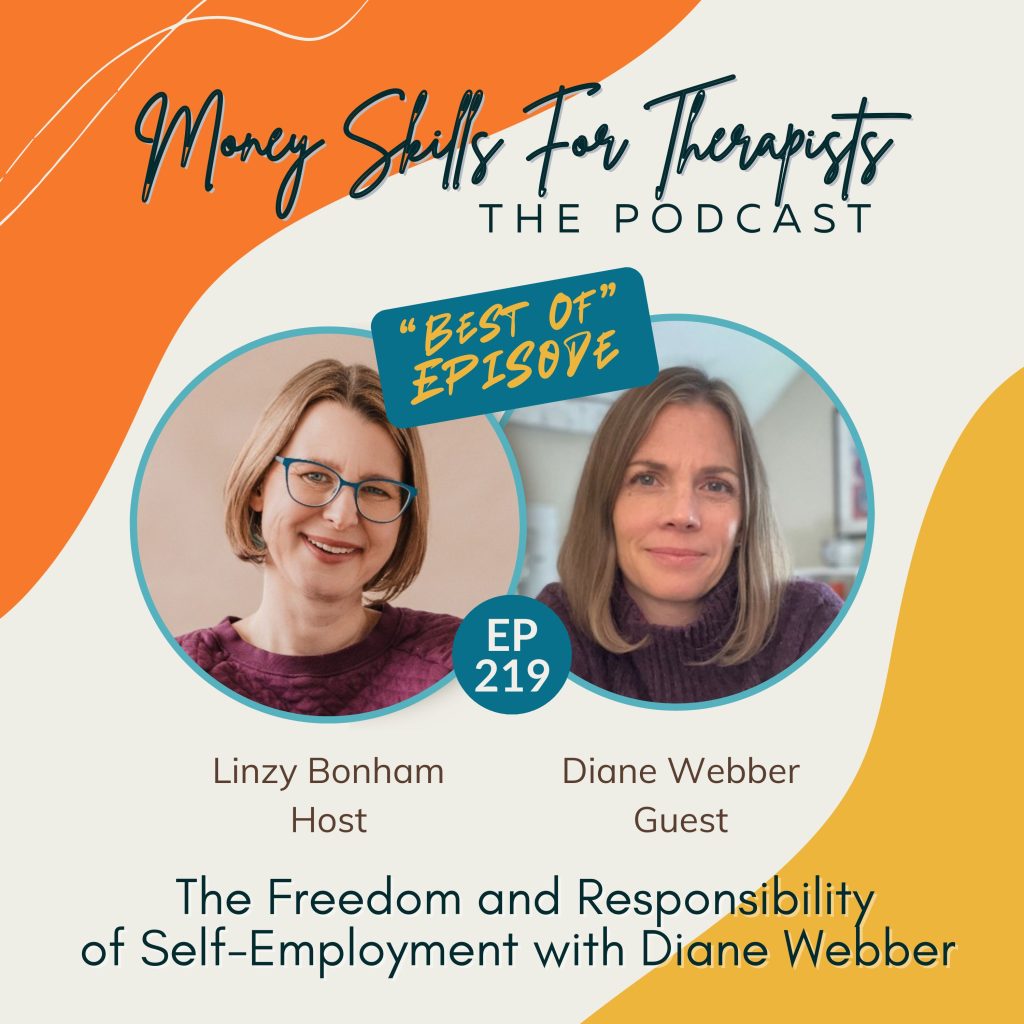
Hello and welcome back to the podcast. Season 16 of the Money Skills for Therapists podcast is about to drop next week. But we still have one more best of episode to share with you during this break between seasons before we bring you all the new content and conversations in the new season of the podcast. Today’s episode is one of our most downloaded episodes from the past year, and it’s with our very own money skills coach, Diane Webber.
Linzy Bonham 02:02
Diane is a financial therapist based in Pennsylvania and a graduate of both the Money Skills for Therapists program and the Money Boss Mastermind. And she’s a wonderful coach and human who works alongside me in all of our programs. As therapists and health practitioners, so many of us struggle to redefine what a successful workweek actually looks like once we step into private practice, right?
Linzy Bonham 02:25
The rules really change from what we used to see as normal and successful working for somebody else. And we often force ourselves into a traditional 40-hour grind that just leaves us exhausted because that’s what we know. In this conversation, Diane and I talk about the highs and lows of choosing to be self-employed.
Linzy Bonham 02:45
We dig into the freedom of private practice, like the joy of finding yourself running errands at Sam’s Club on a Monday morning and the flexibility to show up for your loved ones when you’re navigating the changing needs of being in the sandwich generation. We also explore the challenges of shifting away from the performance of busyness, remembering that we simply don’t have 40 hours of quality emotional energy to give every week.
Linzy Bonham 03:08
That is just not how therapy works. We talk about the importance of letting your programs run in the background instead of always trying to push through and figure things out with your frontal lobe and the beautiful reality that you get to set a schedule that actually works for your life. Let’s dive in.
Linzy Bonham 03:32
So Diane, welcome back to the podcast.
Diane Webber 03:34
Thanks, Linzy. I’m glad to be here.
Linzy Bonham 03:36
I’m very happy to have you here. You are one of the parts of the business that I think is one of our best-kept secrets. Like, I realize, you know, with the folks listening to the podcast, it would seem like it’s just me in this business.
Linzy Bonham 03:48
But something that I really value about my business is that I have a team of wonderful people who support me in different ways, and you are our coach. You are our one and only coach who works alongside me in both of our courses and gets to, you know, support folks and walk them through all the things with me.
Linzy Bonham 04:05
So I’m excited for folks listening to actually get a chance to get to know you better today as we dive into our topic.
Diane Webber 04:11
That’s great.
Linzy Bonham 04:12
Yeah.
Diane Webber 04:12
That’s great. I’m excited too.
Linzy Bonham 04:14
No pressure, but you’re about to be known.
Diane Webber 04:17
Okay. All right, I’m ready.
Linzy Bonham 04:19
So as we were thinking about what might be fun to dig into today, we were each reflecting a little bit on our own careers and private practice and, like, the place of that in our lives.
Linzy Bonham 04:30
And I was thinking about how, you know, we’ve both made this very specific choice to be self-employed, right?
Diane Webber 04:36
Yes.
Linzy Bonham 04:36
And that’s a choice that, statistically speaking, most folks don’t make. Most folks are employees their whole life. I don’t have the stats on hand, but I know that it’s a very small amount of folks who end up starting a business, an even smaller amount of people who end up staying in business, and we are part of that little cohort of humans.
Diane Webber 04:53
Yes.
Linzy Bonham 04:54
And that comes with some highs and lows.
Diane Webber 04:56
Absolutely. Yeah. A lot of feeling terrified, and then feeling good, and then terrified again.
Linzy Bonham 05:02
Yes.
Linzy Bonham 05:03
The rollercoaster. Yeah. The rollercoaster. So I wanted to start by thinking about the highs as we think about our own experiences of self-employment, entrepreneurship, like, private practices.
Linzy Bonham 05:13
What are your favorite parts of having a private practice and being self-employed?
Diane Webber 05:19
The first thing I immediately thought of was early on when I first opened my private practice, I found myself at Sam’s Club on a Monday in the late morning. I kept looking around, and then there were other people shopping there too, and I was like, “What do they do
Linzy Bonham 05:33
Like, who are you?
Diane Webber 05:34
that they can be at a Sam’s Club on a Monday in the middle of the day? Like, this is so weird.” And that freedom in a schedule has become really great. I have found that I take advantage of it a lot, and I don’t mean take advantage of it in terms of exploiting it. But I really think carefully about how I want my time spent and with whom—people I love, care for,
Diane Webber 05:57
or am caring for. And so having a private practice has really helped me be able to do that and still pay the bills.
Linzy Bonham 06:06
Yes.
Diane Webber 06:07
You know? Which has been really nice. I’m at a stage in my life where my father passed away a couple years ago, my mom is now 81, and my kids are 18, almost 19, and 13. And my husband is recently retired but working part-time, and so there’s a lot of needs and wants to be with my loved ones.
Diane Webber 06:26
And I’ve been able to do that as an entrepreneur.
Linzy Bonham 06:28
Yes. Yeah, you’re really in that sandwich generation position, which I see coming for myself. You know, right now my parents are in their early 70s, and they’re super healthy in terms of early 70s. You know, barring, like, a hip replacement and some cataract surgery.
Linzy Bonham 06:43
But I can see how even in just 5 to 10 years, it’s gonna shift a lot in terms of where the caregiving is happening. And I’m hearing for you, like, being self-employed means that you can show up in those places for your people.
Diane Webber 06:56
Exactly. It does take work. I have to remind myself and not feel like I’m suffering somewhere else.
Diane Webber 07:03
So, for example, last week I drove to West Virginia to pick up my son Cameron from his freshman year at college. And the next day, I drove to Rochester, New York, to see my mom and help her through cataract surgery. And there were certainly moments where I felt very stretched thin and thought, “Well, when am I gonna earn money?”
Diane Webber 07:23
You know? And then reminding myself I had a busier schedule the week before. I have a busier schedule this week. And I could use those three days and just be with those people that I loved, and that my business was also taking care of me, and I could be with them. You know, it’s not always that they needed to be taken care of, but just that I could be present
Diane Webber 07:42
and be with them in that too.
Linzy Bonham 07:43
Yeah. Yeah, and this is what we teach folks, right? Is like building businesses that you can take several days off, and it doesn’t negatively impact your income, right? Like, you have that stability that you’ve created. I’m hearing there’s still that, like, playing hooky feeling or that, like, something’s wrong still that kind of comes into your mind.
Linzy Bonham 08:00
I wonder—
Diane Webber 08:01
Yeah.
Linzy Bonham 08:01
why do you think that is?
Diane Webber 08:03
I think for me personally, I spent so many years working at least eight to five, nine to five, nine to seven. I worked in a corporate environment, and then I worked in a higher education environment for many years. And so there was a lot of, like, putting your time in. And so it’s more like you’re putting your time in effectively and efficiently, not necessarily in quantity.
Diane Webber 08:28
And I’m also coming to realize that I do better work when I have room to rest or I have room to play. And that has taken a lot of practicing it or reinforcing it to go, “See? Like, this thing you keep hearing? See, there it is again.” You know, and so it’s like, no, I know they say it, but I don’t know if it’s really true.
Diane Webber 08:48
Mm-hmm.
Linzy Bonham 08:48
Not for me.
Diane Webber 08:50
Right. Yeah. And then just really recognizing that that space, especially for the clinical work, is really important to get refreshed. In your most recent podcast, you talked a lot about the length of time and the relationships that we build with our clients in a clinical setting that are quite different from other medical providers.
Diane Webber 09:10
Yeah. And so, you know, I think a lot about how I’ve been with clients through miscarriages and pregnancies or divorces or new jobs and lots of life changes. So you build this history and this life together and also are working.
Linzy Bonham 09:24
Yeah.
Diane Webber 09:25
So I’m also on the clock, I’m paying attention, I’m looking for patterns, I’m looking for progress, and I’m identifying that for my clients because they don’t always identify it for themselves.
Diane Webber 09:36
It’s a lot, you know? And so having those breaks has been really important to be able to keep doing good work.
Linzy Bonham 09:42
Yeah, for sure. It makes me think of, you know, quality over quantity. Being a higher sensitivity person myself, I don’t have a lot of quantity to give. And, you know, I had to accept that about myself, like, maybe five years ago.
Linzy Bonham 09:54
But the quality is really what our folks are actually looking for. And I think about that both in terms of, like, your clinical clients that you’re working with and also the coaching clients that we work with, who we call students. The quality of those interactions is really what folks need from us, right?
Linzy Bonham 10:09
Like, they need us to show up in that co-working call, in a private conversation for them, and really be able to hone in and hear exactly what they’re saying and connect it back to something that they said two calls ago, you know, to help to, like, draw a connection, or just have that recall, that context that we’re carrying in our brains.
Linzy Bonham 10:24
And we wouldn’t be able to do that infinitely.
Diane Webber 10:28
No.
Linzy Bonham 10:29
There’s only so much of that energy to give. And this is somewhere that, generally, I see therapists have to start to think differently about our work than other types of work. We don’t have, let’s say, 40 hours of actual quality emotional energy to give.
Linzy Bonham 10:44
Even if we did try to work a 40-hour week, the tank that we’re working with is a different size than that. It’s smaller than that. And I think we all have our own size of tank, but I’ve never met anybody who can do 40 great one-hour sessions in a week. You know, it’s just not the way that humans are built.
Linzy Bonham 11:01
But there’s, like, a certain amount of permission-giving or unraveling from this idea of being productive, I think, that we have to do to really acknowledge and be okay with that. You know, just be okay with the fact that actually going to the garden center in the middle of the day on a Tuesday might be exactly what your business needs from you.
Linzy Bonham 11:19
Yes. Yeah. Then there’s something weird about that. Like, the playing hooky feeling. It’s funny you’re mentioning that, ’cause we’re just coming out of a big cohort of Money Skills for Group Practice Owners, our largest cohort that we’ve had. And part of what we do in the course that is different than a lot of courses is I still give my one-on-one time to folks.
Linzy Bonham 11:34
So I just came out of the end of a cohort where I had so many individual calls, you know, that were owed to students. Like, there are two or three calls that they got with me that I’ve been so busy that I’ve almost been in that, like, you sit at the desk and you stay there all day until the end of the day.
Linzy Bonham 11:50
And now that I’m finding we’re coming into a little bit of a quieter period, and I think it’ll still stay quieter in terms of my calls that I have to do, I, like, have to remember that I can just go for a wander. And I can go to the drugstore to get that thing, ’cause I also love errands. I love errands in the middle of the day.
Diane Webber 12:07
Mm-hmm.
Linzy Bonham 12:07
Yeah. Especially if my brain is stuck on something or I’m just feeling meh and, like, you know, I’m quite prone to hypoarousal. That’s always my risk, just getting really sleepy and not being able to think clearly.
Diane Webber 12:17
I’m the opposite. Yeah.
Linzy Bonham 12:17
Yeah. Yeah. You’re the opposite.
Diane Webber 12:18
I call it squirreling.
Linzy Bonham 12:19
Yeah. I don’t squirrel. I don’t squirrel. I, um, I burrow. Whatever burrowing animal goes into the ground and just has a nap, that’s what I do. And it always seems compelling and like it is the right thing I should do if I’m tired. But what I should usually actually do is go for a walk or go grab some groceries or just, like, be out with the humans.
Linzy Bonham 12:35
But I have found that even just this period of being busier has put me back into that space of it’s hard to remember that it’s totally fine for me to go visit my mom in the afternoon, ’cause I have, like, a two-hour window, and that could be a great use of my time. When I first started building this business, a therapist that I had at the time, he would talk about this idea of letting the programs run in the background.
Linzy Bonham 12:56
‘Cause I think he saw me, you know, like, really struggling to just grow my business with, like, my frontal lobe at all times. Like, I must think my way through every problem, and obviously that’s not a very sustainable and great strategy. So he would often remind me, like, the programs run in the background.
Linzy Bonham 13:13
Go do something else. Like, do some yoga. Go for a walk. The programs are still running in the background, right? And that, I think, is also part of the work that we do. Like, when you are out at Sam’s Club or, you know, the garden center, part of your brain might be thinking about that client that you just saw, right?
Linzy Bonham 13:29
It might be processing what happened, or it might be thinking about, like, an upcoming conversation that you’re gonna have and what you wanna get out of that conversation. You know, like, we have conversations in our heads all the time, or at least I do. I’m fairly sure that’s a normal human thing.
Diane Webber 13:40
Yep.
Linzy Bonham 13:41
Yeah. And that is part of our brain’s way of making sense, and it is such a gift that we have a profession where we can actually make space when we’re in private practice to let our brain process in this way. Right? We don’t have to, like, basically perform busyness all week long.
Diane Webber 13:59
Right.
Linzy Bonham 13:59
And as you were talking too, I was thinking about, you know, Cal Newport has this concept of pseudo-productivity, which is, like, the performance of busyness, where you’re like, “Oh, I’m checking emails.
Linzy Bonham 14:07
Oh, I’m looking at these numbers. Oh, I’m…” Like, again, performative busyness where we are showing ourselves—mostly when you’re in private practice, just yourself, because nobody else is watching you—that you’re busy and therefore you’re successful. But his argument is that most folks who do great things in this world, they don’t actually accomplish those things by, like, working hard every day.
Linzy Bonham 14:25
You know, like, great ideas or great work actually happen through people percolating and having space, right? And letting something cook over a long time, and then writing that amazing book or making that TV show or building an incredible business. But that hard work, I think this idea of hard work doesn’t always belong in our field.
Diane Webber 14:43
No. And one thing that is sparking for me—funny that I use the word sparking—is you described yourself a few days ago as phosphorus, which I love, and we’ve often talked about our different approaches. I’m the circle-the-wagons kind of person in my approach, and you’re a grow-wings-on-your-way-down-off-the-cliff
Diane Webber 15:02
kind of person, or burn the boat and figure it out. And I think that in both cases, it’s important to know how we work well.
Linzy Bonham 15:10
Yes. Yes.
Diane Webber 15:11
And then to honor and respect that. So for you, as the business owner of Money Skills for Therapists and Money Skills for Group Practice Owners, you’ve generated these beautiful ideas
Diane Webber 15:21
and these visions. Then you’ve had to create the container for yourself to form it and execute it. And that takes a tremendous amount of energy.
Linzy Bonham 15:31
Mm-hmm.
Diane Webber 15:31
That then also requires rest and recovery on the other side.
Linzy Bonham 15:34
That’s it. And, you know, the creation of those courses, and for folks listening who are thinking about courses, this is, you know, often what I tell people is making those courses was a very creative process, right?
Linzy Bonham 15:45
And I made them on the fly. Even Money Skills for Group Practice Owners, which I only made two years ago, you know, well into the life of this business, I made as I went. And the reason that I make my courses as I go is I have to do it. I don’t have a choice. And it stops me from falling into perfectionism.
Linzy Bonham 16:04
It stops me from getting in my own way. If I know that, you know, I owe folks a batch of videos next week for the next module, I am making those videos. And that is a very energy-consuming process. You know, it’s like, again, phosphorus. That’s when I’m burning bright. But I wouldn’t be able to do that all the time, right?
Linzy Bonham 16:22
So it’s kind of like,
Diane Webber 16:23
Yeah.
Linzy Bonham 16:23
Really, in this business, if we think about it, I have, like, really kind of burned really bright twice.
Diane Webber 16:30
Mm-hmm.
Linzy Bonham 16:32
Once when I made Money Skills for Therapists, once when I made Money Skills for Group Practice Owners, and then we’ve created a container and a team that can continue to deliver those courses, and where we show up and we connect with people and we create the space for them to, like, process and integrate and learn.
Linzy Bonham 16:45
But in some ways, the most intensive part of the business has been those times when I’ve been building those courses and really just, like, pulling it out of my brain, which I think would be akin to, you know, an artist creating a piece or a writer writing a book. There’s this intense period.
Linzy Bonham 17:00
But the beautiful thing about having a business like ours is now we just have this container where we have to get folks in the door to connect them with this thing that we know works. And that is great. And then we get to tweak it and fine-tune it and improve it, and that’s something that you and I have done with Money Skills for Therapists over the last couple years, adding in videos and tools as people ask questions.
Linzy Bonham 17:20
Like, “Oh, it’d be really nice to have a tool that addresses this piece.” So again, it hasn’t been consistent grinding energy, but it has been really letting myself create when I’ve needed to, and then having lots of naps on either side.
Diane Webber 17:34
On either side, yeah. Yeah.
Linzy Bonham 17:36
I mean, something else that I know drives both of us is variety.
Linzy Bonham 17:39
So can you tell me about your relationship to variety in your work?
Diane Webber 17:42
Sure. And I sort of have this mixed relationship. I’d say it’s like a love-hate relationship. Because I am a circle-the-wagons kind of person, change—or, like, when COVID happened and the word pivot was so popular—I was like, “I do not pivot.
Diane Webber 17:58
I don’t pivot.” And yet everything I was doing required a pivot. And so, in the example I gave last week of going to West Virginia and then to Rochester, that’s a lot on my nervous system. On the other hand, I also really like having a variety of different parts of my brain, or different ways of thinking, used.
Diane Webber 18:20
So when I took the Money Skills course as a student, I really enjoyed getting such a nice handle on my income and how I was taking care of the business, how I was taking care of myself and my family. In the coaching role and the teaching of it, I really like the minutia, the detail work,
Diane Webber 18:38
in a very different way than the clinical work, which is soft and sometimes nebulous. There’s a lot of emotion sometimes. There’s struggle sometimes. You know, it’s like a very different effort. And then the money skills work is crisper. It’s cleaner. There’s also this emotional piece, too,
Diane Webber 18:58
that has been really powerful to see and be with in our students, and to see the transformation happen. So the initial discomfort in asking the questions and showing their screens and talking about where they’re getting stuck or being able to share what they’re earning or what they’re spending, and then being able to normalize all of that,
Diane Webber 19:20
and then get into those nuts and bolts of things, I have found really enjoyable, ’cause it’s much more concrete. You know, there’s a concrete progress that’s noted that’s different than the kind of progress that I see and experience with my clients.
Linzy Bonham 19:32
Yeah. I agree, and I think that’s why I had partially started Money Skills for Therapists off the side of my clinical desk, because the clinical work that I was doing back when I started Money Skills for Therapists was this really nuanced, complex, like, multiple layers happening at once.
Linzy Bonham 19:50
It was never tidy. Humans are not tidy, right? And so that’s not gonna change. And I love that work, but I’ve always had this side of me that also just really loves order, clarity, you know? And it’s interesting ’cause as a clinician, sometimes I would get feedback from my clients that I would kind of take something that was nebulous and make it feel like now we have a plan.
Linzy Bonham 20:14
And with EMDR, it really works like that in some ways because it’s like we do an inventory of like, “Let’s talk about every terrible thing that still bothers you,” which is so terrible. Doing those trauma inventories is the worst. And I didn’t do them with everybody, but some people, they were like, “I just want a clean house.
Linzy Bonham 20:29
Like, let’s just get it down.” Wipe it all out. “When I was seven, you know, this girl stopped being my friend. When I think about it, I still feel 8 out of 10 activated. Like, blah. Okay. When I was 12, you know, these boys cornered me and it really scared me and I still feel, like, 9 out of 10 activated when I think about it.”
Linzy Bonham 20:43
So you’re just making this list. But what you’re doing when you’re making that list is you’re taking this really swirly, overwhelming, nebulous, intrusive thing, and you’re creating order. You’re creating a plan where you can start to work through those things one at a time. And the beautiful thing about something like EMDR is as you resolve issues, when you come to issues that are later on the list, it’s like, “Oh, that one actually feels a lot better because of this other work we’ve done.”
Linzy Bonham 21:10
Right? So it’s all connected, but by coming at it in an orderly way. But it’s, like, just resolving, right? Putting things in their place, right? There’s, again, an order making there. And of course, as humans, we’re never orderly ’cause you might be feeling amazing one day and then the next day a tragedy happens in your life.
Linzy Bonham 21:26
Right? That’s not how life works. But I think as a clinician, I got some of that orderliness through EMDR, but nothing compares to a spreadsheet. And I think I’ve always been someone who enjoys numbers and math for that reason, is that there’s a doneness about them which we don’t get in human life.
Linzy Bonham 21:42
Human life is messy and unresolved, and just when everything seems great, everything falls apart, right? With numbers, it’s like once you have your numbers organized for the year, you’re like, “Okay, I did it. It’s all good. My taxes are filed. I’m finished.” There’s a finishedness to the task, although the task itself is never actually done.
Diane Webber 22:00
It’s never.
Linzy Bonham 22:00
Yes.
Diane Webber 22:01
No.
Linzy Bonham 22:01
Yeah.
Diane Webber 22:01
No.
Linzy Bonham 22:02
So the discrete tasks are done, but the overall responsibility, I guess we could say, is never finished.
Diane Webber 22:06
Right. And a lot of what we focus on in the courses, in different ways with private practice owners versus group practice owners, is really feeling comfortable and confident in the process
Diane Webber 22:18
of doing all of that. So it’s not that I’ve nailed my numbers for good and they’re locked in and we’re all set. It’s, “Now I know how to look at my numbers and how to make decisions about those numbers and feel confident that I am able to do it, and here’s what I’m deciding and why.”
Diane Webber 22:35
And one conversation I had yesterday with one of our students that I think helped to validate the complexity of it, I said, “It’s like you open up a really full, messy closet and it’s like, ‘Where do I even start with organizing these things?'” And sometimes you have to just pull a whole lot of stuff out before you can see what’s there
Diane Webber 22:54
and decide what to keep and what to get rid of. But also, as our students are learning these new skills and putting them into practice, money is still flowing that whole time. So it’s like they’re learning how to swim or how to fish in a moving stream, where their money’s still coming in and still going out.
Diane Webber 23:11
So even the complexity of changing a bank account has to be done with some thought because you don’t wanna miss a bill. And so teaching patience through that process, normalizing that, yeah, it is messy. And so that’s why we’re gonna go slow.
Linzy Bonham 23:26
Yeah.
Diane Webber 23:26
And we’re gonna look at these small wins, and we’re gonna celebrate when there’s a small win.
Diane Webber 23:30
Because that’s important, because this is hard.
Linzy Bonham 23:32
Yeah. There’s an ongoingness about it, an ongoing relationship. Like, that’s language that I started using with our students, I think, in the last couple years. It’s not like something you do once and it’s over. And so with that in mind, too, you know, sometimes there can be this energy that we can have around money when we feel like we’ve been avoiding it, where it’s like, “I’m gonna do it.
Linzy Bonham 23:51
I’m gonna get in there, and I’m gonna do it.” Right? And, like, sometimes I’ll see folks come to the course with that energy, and they, like, zoom through the first three modules in, like, two weeks. And you’re like, “Whoa.” And it’s not sustainable, right? So it can still feel great to, like, ride those waves, and I mean, I was just talking earlier about, you know, the creative energy that can do great things in your business.
Linzy Bonham 24:08
But that’s not the way you can always be with money, right? After that initial burst of cleaning house and diving in and maybe being obsessed and working on it at 2:00 in the morning, there has to be a more sustainable version of that relationship.
Diane Webber 24:23
Yes.
Linzy Bonham 24:23
That will be your continued relationship with money throughout your working career and your personal life after that, too, even into retirement, right?
Linzy Bonham 24:30
Of, like—
Diane Webber 24:31
Yeah.
Linzy Bonham 24:31
a more sustainable candor with it, right? A checking in. At a certain point, there has to be an unwinding and a groundedness with it, because, yeah, it never goes away until the day you die or until you descend enough into dementia that somebody else manages it for you.
Diane Webber 24:44
Someone takes care of it for you.
Linzy Bonham 24:45
I think those are our two options. But both of them, hopefully, are a long way off for all of us. Thinking about self-employment, too, I’m curious about your relationship to the idea of entrepreneurship. Do you identify as an entrepreneur, as a therapist in private practice and then doing this coaching work with us?
Diane Webber 25:05
Mm-hmm.
Linzy Bonham 25:06
Does that resonate? Does it not?
Diane Webber 25:07
Yeah, that’s a great question. I personally do not. I do consider myself self-employed, for sure. I identify as more of a doer, in general, than as a visionary. And so when I think of entrepreneurship, I think of visionary.
Linzy Bonham 25:26
Interesting.
Diane Webber 25:27
And so it’s hard for me to see myself as an entrepreneur. And maybe part of it, too, is because, with my private practice, I sort of entered into a profession where there are lots of self-employed private practice owners. You know? And then, in my work on the team with Money Skills for Therapists, I’m in a supporting coaching role,
Diane Webber 25:49
helping to execute your vision.
Linzy Bonham 25:51
yes.
Diane Webber 25:51
You know, which I love. And I have a great time with it. But it’s interesting that you ask, ’cause I don’t necessarily see myself as an entrepreneur.
Linzy Bonham 25:58
Interesting. ‘Cause when I hear you say that, I’m like, “But don’t you have a vision for your private practice?”
Linzy Bonham 26:03
“Like, didn’t you build it? Didn’t it come from you?”
Diane Webber 26:07
It did, yes. And I think part of that is that my decision to go into private practice was more as a consolation or a default rather than a long-term goal. It turned out to be wonderful. Like, this wasn’t my idea, but I’m doing it anyway
Diane Webber 26:26
kind of thing. It was, I’m glad that it happened, but the idea didn’t originate within me,
Linzy Bonham 26:32
Right.
Diane Webber 26:32
I think. Even when I went to grad school, I went to school for a master’s in counseling, but I really didn’t wanna hang a shingle. It was like, I could if I needed to, but I really wanna do this other kind of work.
Diane Webber 26:42
And through, you know, a variety of different things, it shifted, and I got a lot of encouragement to go into private practice. And so I think that community support of, like, “Yeah, you’d be great at this. You should do this.” And I was like, “Okay.”
Linzy Bonham 26:57
Yes.
Linzy Bonham 26:59
That’s very much the same way that I became a complex trauma therapist.
Linzy Bonham 27:02
A colleague referred somebody to me, and I called my colleague after her, and I was like, “She has full DID.” And she was like, “I know. You’re gonna be great.” I was like, “What?”
Diane Webber 27:11
“What?”
Linzy Bonham 27:11
But I think my colleagues chose me as the person who was gonna, you know, bring these skills to our community.
Diane Webber 27:16
Yeah.
Linzy Bonham 27:16
There’s sometimes a bit of an “it happens to you”
Linzy Bonham 27:19
experience of these things, which—
Diane Webber 27:21
Yeah.
Linzy Bonham 27:22
I do hear the difference in our identifications with entrepreneurship, ’cause I do identify as an entrepreneur. And although I don’t remember this, I do have one of my friends from my master’s who told me in one of our classes once, I had said, “I’m gonna start a private practice.”
Linzy Bonham 27:35
Ooh. Which I don’t recall now, but I did say it apparently in a room full of people, and I was the only one, ’cause becoming a social worker in Ontario, that’s not usually the path that folks go, and it’s certainly not discussed at all. There’s usually the assumption you’re gonna be part of some sort of system.
Linzy Bonham 27:50
So self-employment, many of my colleagues from my master’s have now gone on to start private practices, but certainly right out the door, that’s not something that anybody was really thinking about. So I think I’ve always had that entrepreneurial spark, and where I see the spark in myself now especially is when I start to think about, I wonder if I could make another business successful just for funsies.
Linzy Bonham 28:10
Right? Which, yeah.
Diane Webber 28:11
And here I’m going, “Might be fun for you.”
Linzy Bonham 28:13
Yeah, yeah. You’re like, “Okay.”
Diane Webber 28:14
Yeah. Okay. I’ll be over here cheering you on. And I’ll be happy to help. But yeah.
Linzy Bonham 28:19
You know, which I see in some of my friends too where we’re kinda like, “Well, I wonder if I could make
Linzy Bonham 28:24
a different business work.” ‘Cause the skills transfer, and there’s something too about having a business that’s, you know, very much my personal brand, that it’s like it could be kinda cool to just, like, run a bookstore, which is not true, by the way. Don’t go into being a bookstore owner right now.
Linzy Bonham 28:37
It’s not a great time. But that idea of, you know, if you plug into a different business model, like, what could you build? And I think part of that for me now comes with being in an entrepreneurial community with others. I joined a group for Canadian women entrepreneurs, so I’m meeting folks who own mediation companies and yoga studios, and just this whole range that I’m like, “All right, there are other kinds of businesses that women own, not just private practices
Linzy Bonham 29:00
like me and my friends.” So yeah, but that sparkiness. And something else that I notice about myself that definitely means I’m an entrepreneur is I read books about business and entrepreneurship a lot. Like, I’m hungry for it. Like, right now I have a list of books in my brain that have been mentioned to me by colleagues in the last week that I’m like, “Okay, I’m gonna read Essentialism, then I’m gonna read Rocket Fuel.
Linzy Bonham 29:19
I’m gonna go back to Fix This Next.” Like, I have just this list in my head.
Diane Webber 29:23
Yeah.
Linzy Bonham 29:23
‘Cause there’s, like, a hunger and a spark there for me.
Diane Webber 29:26
Mm-hmm.
Linzy Bonham 29:26
That is really helpful when you are doing these kinds of businesses, because it takes a lot of spark. It takes a lot of energy.
Diane Webber 29:33
Absolutely.
Linzy Bonham 29:33
Yeah. To keep coming back to it all the time.
Diane Webber 29:36
Yeah. And I think one of the things that came up when we were at the ACA conference, and I’ve thought about a lot too, and it’s something that I find admirable, is when a business owner identifies a gap—a hole, a need that’s not being met—and says, “And I’ve got the tools to fill it.” So a lot of what we talked about was this gap in training for therapists when it comes to their money skills.
Diane Webber 30:01
Yes.
Linzy Bonham 30:02
yes.
Diane Webber 30:02
And I will say that’s how I ended up shifting my own private practice towards the financial therapy and the money skills stuff, because I found that so interesting. And colleagues of mine hated money. They hated talking about it. And I was like, “What? I think it’s so much fun.”
Diane Webber 30:19
Like, so when there’s a gap and there’s a need, and this ability to say, “I see that gap, I see the need, and I know how to fill it in a way that’s gonna be great.” That’s been really exciting to be part of and to watch happen and then be part of that process.
Linzy Bonham 30:35
It is exciting. And in some ways I think this is what clinicians do too.
Linzy Bonham 30:38
Once you can own your niche, private practice can be the same, where you’re like, “I love working with complex couples. Send them my way.” And people are like, “Oh, thank God.”
Diane Webber 30:47
Yeah.
Linzy Bonham 30:47
“Do I have people for you?” You know, so when we can each own that thing that really lights us up, you are lining yourself up to do work that you actually enjoy, which is such a gift.
Diane Webber 30:57
Mm-hmm.
Linzy Bonham 30:58
And you’re also meeting a market need, right? To use economics language. There is a need there for that thing. Most people don’t wanna do it. There are folks who are looking for it who can’t find it. So when you hang your shingle and you say, “This is what I do. If this is you, I can help you,” it’s such a gift to people, and that’s something that we talk about with our students sometimes.
Linzy Bonham 31:17
I certainly use this language of, like, “You’re doing folks a disservice if they can’t find you,” right? Like, if you’re an incredible therapist who does psychedelics work or who helps, like, adult women with ADHD who are overachieving, whatever your niche is, if you really put that out there, you are sending out this beautiful beacon for your people to find you.
Linzy Bonham 31:37
And they need you. They’re looking for you.
Diane Webber 31:39
Yeah.
Linzy Bonham 31:39
Right? Like, I’m just on the hunt for a new therapist right now, and I’ve looked at certain therapists’ websites, like, four or five times before I’ve reached out to them. Right? Like, I’m really evaluating, like, are you the person for me? Are you gonna understand me?
Linzy Bonham 31:51
You know, can you help me with the stuff that I’m bringing to you about me, but also about parenting? You know, and so when you find somebody who has that website that’s like, check, check, check, it’s such a relief to find that as a client and as therapists and business owners, ’cause you do this in your private practice.
Linzy Bonham 32:07
We do this together in putting ourselves out there with Money Skills for Therapists and Money Skills for Group Practice Owners. It’s such a beautiful gift when those two sides can meet, when the need and the service come together. I get real fired up about it.
Diane Webber 32:23
It’s exciting.
Linzy Bonham 32:23
It is exciting. Yeah.
Diane Webber 32:24
It is exciting. It makes me think about, too, when we have conversations about outsourcing certain tasks. So the idea of—and you always say it so beautifully—you’re like, “If there’s a job you hate, there is someone out there who loves it.”
Diane Webber 32:40
So helping our students determine, what are the parts of my work that I really don’t like, and can I hire someone to do that? Do I have the money to do that so I can do more of what I love? And that’s all information that we help them figure out through better knowledge of their money skills and their business
Diane Webber 32:59
finances.
Linzy Bonham 33:00
Yeah. There are so many possibilities always in any set of numbers. So I’m gonna start to wrap up our conversation. And I wanna do a closure that is, like, similar to the kind of closure we do in our Money Skills calls, or that I do. I’m gonna ask you to share what three words for self-employment come to mind when you think about self-employment.
Linzy Bonham 33:16
What are your three words?
Diane Webber 33:19
Freedom.
Linzy Bonham 33:20
Mm-hmm.
Diane Webber 33:20
is the first one that came up. Responsibility.
Linzy Bonham 33:24
Mm-hmm.
Diane Webber 33:25
And the thrill. Thrill. Like, the third image was, like, a rollercoaster.
Linzy Bonham 33:28
Yes. Mine would be challenge, creativity, and purpose.
Diane Webber 33:35
Nice.
Linzy Bonham 33:35
Right? Which I feel like is rollercoaster adjacent, but it’s like, you know, it’s challenging work.
Linzy Bonham 33:39
It’s challenging to show up and make your own container, right? And to have to, like, reassess and be with and sometimes take a hard look at yourself and be like, “Well, I really messed that up. Okay. What am I doing differently?”
Diane Webber 33:49
Right.
Diane Webber 33:50
Right, and I’m gonna show up again tomorrow.
Linzy Bonham 33:51
Exactly. That’s it.
Linzy Bonham 33:52
Yeah. It’s that coming back to it that lets you really contribute something very specific and unique to this world that literally nobody could contribute like you can.
Diane Webber 34:00
Mm-hmm. Yeah.
Linzy Bonham 34:01
And that drives me.
Diane Webber 34:02
Well said. Yeah.
Linzy Bonham 34:03
Thank you, Diane. It’s so lovely. This was a treat. So lovely to have you on the podcast.
Linzy Bonham 34:08
You are a therapist based in Pennsylvania. I feel like we should say that, if folks are looking for financial help.
Diane Webber 34:13
That’s right. Yes, I am.
Linzy Bonham 34:13
Can you tell us a little bit about the financial therapy work that you do for people in Pennsylvania?
Diane Webber 34:18
Sure. So I’m licensed in Pennsylvania, and I’m paneled with almost all of the commercial insurance companies.
Diane Webber 34:24
So my caseload is almost 100% insurance reimbursed, which I take a lot of pride in, in that I’m very accessible. But it also means I have to be pretty clever and on top of my finances. And I have wonderful clients, and what we really enjoy figuring out is life changes that they’re looking to make
Diane Webber 34:44
in their relationships, in their jobs, in their family situations, where money is a component. So helping them understand their money stories, how that affects their mindset now, how that’s affecting their behaviors, and what might be getting in the way of the changes that they wanna make.
Linzy Bonham 35:00
Mm-hmm.
Diane Webber 35:01
And it’s been so exciting to see some really powerful changes in that work, so I just love it.
Linzy Bonham 35:07
It’s a great niche. So Diane Webber, folks can look her up. If you’re listening and you’re like, “I could use some financial therapy, and I’m in a transition,” Diane Webber in Pennsylvania. Thank you, Diane, for joining me today.
Diane Webber 35:18
Thanks for having me, and also look out for us in the course,
Linzy Bonham 35:22
Yeah.
Diane Webber 35:22
for those who are interested.
Linzy Bonham 35:23
Yes. Thank you, Diane.
Linzy Bonham 35:27
We simply don’t have 40 hours of quality emotional energy to give every week. It’s really important to recognize that doing our best clinical work requires us to have room to rest and play. Private practice gives us this beautiful freedom to set a schedule that works for our lives, whether that means having the flexibility to do important things like being present for your family and friends during their times of need, or the less important but still necessary things like running errands and checking those little things off your never-ending to-do list.
Linzy Bonham 35:58
Before we wrap up, I want to invite you to join our new private WhatsApp community. It’s a space to connect with other therapists, health practitioners, and listeners of the Money Skills for Therapists podcast to chat about episodes, to ask questions, to share insights, and get support from me and my team, as well as support and inspiration from some special guests who are gonna be joining us in the community.
Linzy Bonham 36:20
If you’re interested in becoming a part of the community, get in touch with us at hello@moneynutsandbolts.com. And if you’re enjoying the podcast, it’s always really helpful for us if you leave a review on Apple Podcasts or Spotify to help other therapists and health practitioners find us and be part of these conversations.
Linzy Bonham 36:38
Thanks so much for joining us today.