
In this episode, Linzy is joined by accountant and recurring guest Julie Herres for a thoughtful conversation about artificial intelligence and its growing presence in both the therapy and financial spaces.
199: Building Financial Buffers for Group Practice Owners (and Surviving the Summer Slump)
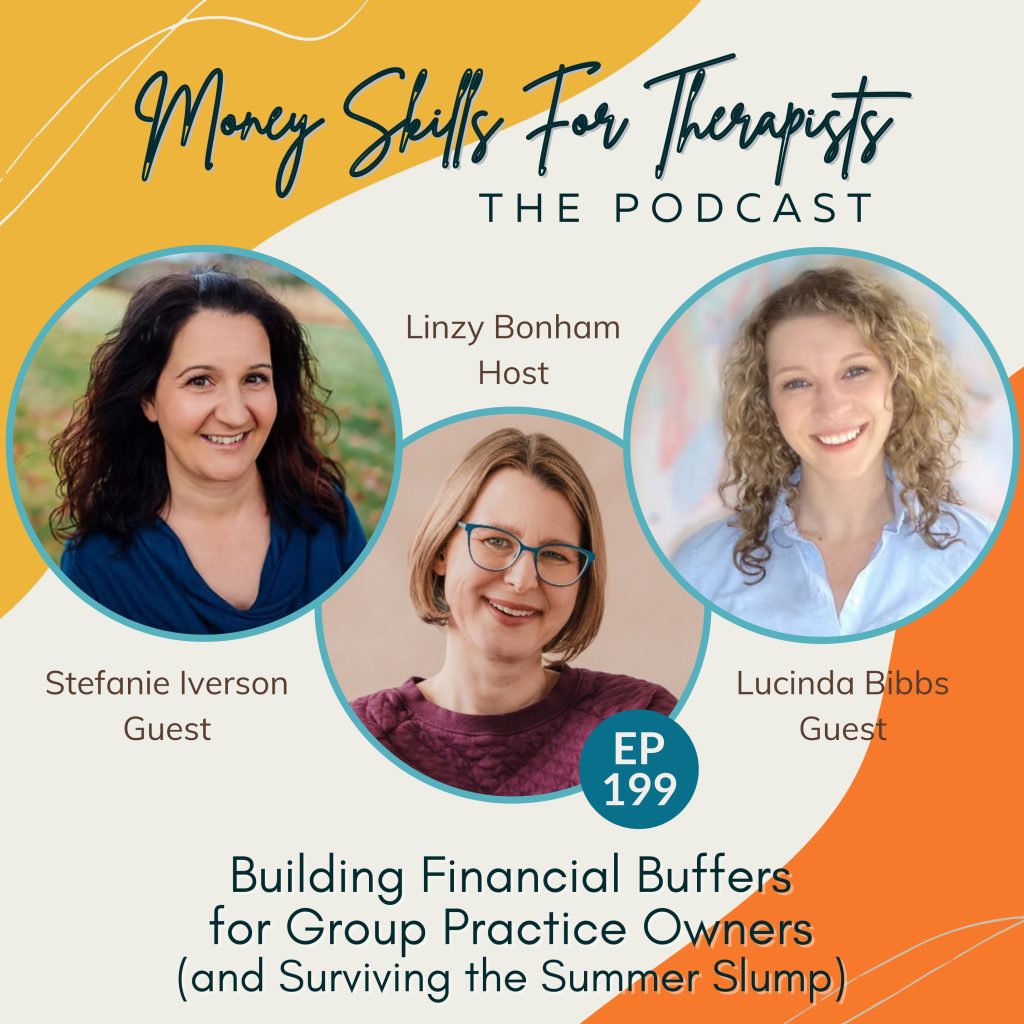
Seasonal slowdowns can shake even the most well-run therapy practices—especially group practices navigating payroll, profit, and growth at the same time. This week, I sat down with Stef Iverson and Lucinda Bibbs, business partners and recent graduates of Money Skills for Group Practice Owners, to talk through what it really looks like to manage cash flow during a summer slump while still honoring long-term vision, wellness, and expansion.
“I think it’s just that the clarity and the reassurance, right? That we’re on the right track…knowing the numbers has really helped us make non-emotional decisions. And just having clarity on what’s actually on the paper and what are those numbers actually telling us? They’re telling us a story and they’re holding up a mirror and they’re allowing us to make changes and pivots as we, as we need to.” – Stefanie Iverson
Stef and Lucinda came into this conversation fresh off their first slower season since implementing Profit First—and instead of panic, they brought curiosity. We talked through how their profit account temporarily buffered operating expenses, what that revealed about their numbers, and how to proactively plan for next summer so slow seasons don’t feel scary or reactive.
What stood out most to me was how empowering it can be to replace “scrambling” with structure. When you know your numbers and intentionally build safety into your business, you give yourself permission to rest, plan, and make thoughtful decisions—even when revenue temporarily dips.
(00:03:34) Navigating Profit Slumps & Business Growth Effectively
(00:07:12) Savings Buffer Analysis to Prevent Pulling from Profit
(00:12:29) Consistent Owner Draws and Keeping Profit Separate
(00:16:06) Preparing for Economic Uncertainty and Anticipated Slow Seasons
(00:20:58) Balancing Leadership and Growth with Work, Delegation, and Passions
(00:26:45) Prioritizing Your Energy and Your Relationships
(00:30:54) A Successful Partnership Built on Transparency
(00:34:10) Evaluating and Expanding Services Offered
(00:38:18) Tree Metaphor for Growth – With a Stable Trunk, Your Branches Can Reach
We talked through how to experiment with offering new wellness services without neglecting the “main ship” of the group practice—and how to tell the difference between an idea that needs more time versus one that isn’t financially aligned right now.
Key Takeaways for Therapists Navigating Slow Seasons or Growth
Slow seasons don’t mean you’re doing something wrong—they’re part of running a real business. With clear numbers, intentional buffers, and honest conversations, you can build a practice that feels both secure and flexible enough to grow in the directions that matter most to you.
Stefanie Iverson and Lucinda Bibbs are the co-owners of New Ground Wellness Collective (formerly South Okanagan Counselling), a group therapy practice based in Penticton, British Columbia, which they founded in 2022. As their practice grew, they recognized that strong clinical care alone wasn’t enough—they needed a deeper, more confident understanding of the financial side of group practice ownership.
After completing Money Skills for Group Practice Owners, they began implementing clearer financial systems, Profit First principles, and more intentional decision-making across their business. Stefanie and Lucinda are now focused on systemization, metrics tracking, and exploring a potential shift from an independent contractor model to an employee-based structure, including future leadership roles within the practice. Their work reflects a thoughtful, values-driven approach to growth—balancing sustainability, collaboration, and long-term stability for both their team and community.
Follow New Ground Wellness (formerly South Okanagan Counselling):
Do you feel confused, ashamed, or uncertain about your finances?
Are you craving support to help shift your money mindset and transform your relationship with money?
Are you ready to gain practical tools and the confidence you need to finally take control of your business finances?
If so, I’d love for you to join me for one of my online workshops, designed specifically for private practice owners who feel stuck—whether it’s mindset blocks, avoidance, or the technical side of managing money.
In just one hour together, you’ll gain clarity, practical strategies, and next steps to move forward with intention.
Click here to explore upcoming workshops and save your spot or register to get the replay.
Doors are open for the Fall 2026 cohort of Money Skills for Group Practice Owners, which starts in October.
This comprehensive six-month program takes you from feeling like an overworked, stressed and underpaid group practice owner, to being the confident and empowered financial leader of your group practice.
Click here to learn more or register today to save your spot in the Monday or Thursday session.
Join the waitlist for Money Skills for Therapists. Our signature course has been carefully designed to take therapists in private practice from money confusion, worry, shame, and uncertainty – to confidence and peace.
Click here to learn more and be the first to know when enrollment opens for our January 2027 Cohort of Money Skills for Therapists.
Linzy Bonham [00:00:00]:
You’ve put all this work into building these roots. You’ve built out systems, you’ve built out your own relationship, you’ve built out your reputation, you’ve built out your skills in managing your team and your marketing. You’ve built out so much which gives you that stability. So now you can reach your branches, can reach, and you can reach and bend and be like, what about this? What about this? And if one of those things doesn’t work, you’re still totally stable because you’ve built that right? So you’ve now built this foundation upon which you can experiment and play. Welcome to Money Skills for Therapists, the podcast that helps therapists and health practitioners in private practice go from money confusion and shame to calm clarity and confidence with their finances. If you’ve ever felt overwhelmed by numbers or avoided looking at your business money, you’re in the right place. I’m Linzy Bonham, therapist turned money coach and creator of Money Skills for Therapists. Before we jump in, check out my free On Demand masterclass.
Linzy Bonham [00:00:53]:
You’ll find the link in the show notes or@moneynutsandbolts.com under masterclass. It’s the best first step to finally feeling empowered with money in your private practice. Let’s get started. Hello and welcome back to the podcast. Today’s episode is a coaching episode with business partners Stef Iverson and Lucinda Bibbs. They are the owner of South Okanagan Counseling, although as they share today in the middle of a rebrand in British Columbia, Stef and Lucinda are graduates of Money Skills Group Practice Owners. At this time of this recording, they are about four months out of the course, maybe only three months out of the course. So fresh graduates from Money Skills Free Practice owners.
Linzy Bonham [00:01:34]:
And today we talk about two separate questions. We talk about how to use profit first when the amounts aren’t working for you. Basically profit first through the summer slump. What do you do when you’ve had to take money from different accounts when money is low? How do you improve your system so that you don’t have to do that in the future? So we talk about profit first and weathering that summer slump that comes for almost all of us. And we also talk about balancing some new exciting projects that they’re working on and new offerings that they have within their business with running the group practice and their own balance with service delivery and working on the business. So how do you balance taking care of the business that you already have with building new things into that business that are exciting and fun but that might also end up pulling your attention away or end up being too much. Lucinda and Stef are so lovely and their respect and love for each other is so commendable. You hear it come through in this episode of just how much they appreciate each other and their openness of communication as business partners.
Linzy Bonham [00:02:43]:
I wish all business partners had this strength of relationship because it has certainly allowed them to go so, so far in their business. Here is my coaching episode with Stef and Lucinda. Stef and Lucinda, welcome to the podcast.
Lucinda Bibbs [00:03:03]:
Thank you.
Linzy Bonham [00:03:04]:
Yeah, I’m so excited to have you. Doing these podcast recordings for me is also a nice excuse to just see people who I like, who I’ve gotten to work with, but haven’t had a reason to see recently. So it’s also just such a treat to see the two of you and have an excuse to hang out and talk and work through something together.
Lucinda Bibbs [00:03:21]:
Oh, we can share that. Most definitely.
Stefanie Iverson [00:03:24]:
Absolutely.
Linzy Bonham [00:03:26]:
So for our time together today, what would be helpful for us to focus on? What do you want to bring forward for this coaching conversation?
Stefanie Iverson [00:03:34]:
Well, I think to start off with just to talk a little bit about the profit first fundamentals that we learned during the course with you and how that’s been going and some of the hiccups that we have experienced in the last few months. I guess we started really implementing the ideas behind that method back in March of this year, and it went really smoothly, honestly. I mean, for me, it took a little bit of time to trust that the process was actually going to work. And once I felt comfortable, it was a huge relief to just know that the numbers are there and everything was working really well. And then we hit the summer, which traditionally, you know, in private practice, there is a bit of a slump that does occur between clinicians taking time off and just the general trend of the industry. And so we noticed that we had to start. Well, yeah, we started pulling from the profit account to balance some of the other accounts. And I guess my biggest question or the area that I’m hoping to get some support and guidance on is what do we need to do or really focus on moving forward so that this doesn’t necessarily happen again next summer when the next anticipated slump hits us?
Linzy Bonham [00:05:02]:
Yes.
Stefanie Iverson [00:05:03]:
Yeah.
Linzy Bonham [00:05:03]:
Because I think often it can feel like a terrible surprise when there’s that summer slump. But as you say, you know it’s coming. Like, we know that there’s going to be these ups and downs times time. Summer is one of them. Winter holidays can be another one. So, yeah, in terms of that anticipating, I’m hearing that the way that you ended up making the money work is you had money in your profit account that you could redistribute. I am curious just about your percentages. How much is going into profit? Like, what percentage was set of going towards your profit account?
Stefanie Iverson [00:05:33]:
Currently, we had it set at 9.9%.
Lucinda Bibbs [00:05:37]:
Based on.
Stefanie Iverson [00:05:39]:
Based on the spreadsheets that we were using. That is kind of where the profit number was. And so, yeah, we were operating off of that.
Linzy Bonham [00:05:47]:
Yes. Which makes sense to me that there would have been extra money there. I was just curious about, like, what kind of buffer we’re talking about, because it’s a fairly high profit number. Right. Like, that’s higher than kind of the traditional profit first. But I’m sure there’s a lot of thought that went into that number for you, too. And I would guess that that’s where your personal profit draws are coming from for the two of you, for the extra money.
Lucinda Bibbs [00:06:06]:
Yes.
Linzy Bonham [00:06:07]:
So, yeah, so what I’m hearing is that that profit account ended up basically buffering the other accounts over the course of the summer. That 9% in profit.
Lucinda Bibbs [00:06:15]:
Yeah.
Linzy Bonham [00:06:16]:
Coming into the summer, how many months of money did you have in, let’s say, your operating expenses account? Do you have a. A sense or a memory of how much was in that account before the slump hit?
Stefanie Iverson [00:06:28]:
Again, we were operating off. We. I think we were maybe 1 or 2% higher than what was actually needed. So there was a little bit of a. Yes, a buffer that was. Yeah, added in. Added in there.
Linzy Bonham [00:06:44]:
Okay.
Lucinda Bibbs [00:06:45]:
Yes.
Stefanie Iverson [00:06:45]:
And the other big change, I think that happened over the summer, too, is that Lucinda and I had really started to pull back on our client. Ours too. A bit more maybe aggressively than we were previously used to. Right. So again, it’s not to say that we should again, increase her. It’s just this. The perfect storm.
Linzy Bonham [00:07:08]:
There’s a combination of factors. Yes, I hear that.
Stefanie Iverson [00:07:11]:
Yeah.
Linzy Bonham [00:07:12]:
Because that 1 to 2% buffer, if we just think about the math on that, if you’re putting Aside, let’s say 2% extra each month above what you’ve identified, kind of your average operating expenses cost over the course of the year, we’re looking at like 2%. I’m just trying to think if percentage would be cumulative. Let me think about this for a second. Because like 2% per month times 12 months is 24% that you would be saving of one month’s worth of money. So the savings there are not very large. Right. Like, it’s kind of like with that extra buffer that you’re building, you’re building like a Quarter of a month’s worth of buffer, which what I’m hearing is it didn’t end up being enough when the time came. Especially since, you know, to put this into context, you just started profit first the spring before.
Stefanie Iverson [00:08:00]:
Yeah.
Linzy Bonham [00:08:00]:
Like we had three months. So you really were three months in, which is.
Lucinda Bibbs [00:08:04]:
Yes.
Linzy Bonham [00:08:05]:
No time to build a buffer. So what I’m immediately noticing is it seems like that buffer amount that has been allocated isn’t enough to get you to the buffer numbers you actually need to see. Do you have a goal on what you want your buffer amount, like how many months of operating expense money you want to have in your bank account as kind of just your safety buffer there?
Stefanie Iverson [00:08:27]:
Well, I think traditionally people say to have at least three months is kind of the ultimate two to three goal.
Linzy Bonham [00:08:33]:
Yep.
Lucinda Bibbs [00:08:33]:
But.
Linzy Bonham [00:08:33]:
Yep, that would be the ultimate goal.
Stefanie Iverson [00:08:34]:
Yeah, at least two. I mean, just to get us in terms of like a summer. Summer slumps typically start.
Lucinda Bibbs [00:08:41]:
Yeah.
Stefanie Iverson [00:08:42]:
Like July, August. So even just to get us through two months worth of a dip would be good for next year at least. Yeah, yeah.
Linzy Bonham [00:08:51]:
So there’s some math here to do then, because right now we are, you know, we’re into the fall now, so the next summer season is nine months away. Right. So there would be some math here that you two could explore of. Okay, what is the amount you would actually need to save onto your operating expense account to get you to that two months of money? Right. And then we can reverse engineer that of like. Okay, let’s say I’m just going to throw out numbers to make it simple. Let’s say you identify, you need to save $9,000. It’s going to be more than that probably, but I’m going to say 9,000 for super easy math.
Linzy Bonham [00:09:22]:
Okay, let’s say $18,000. We’re going to get closer. Let’s say you identify, you need to save $18,000 because your opex is like 9,000amonth you want to have. So it’s like whenever you come into a new month, we want like the zero on that bank account to be 18,000 right. Before new money comes in, all the money is spent from the previous month. You’re coming to the first of the month, there’s 18,000. Then if that’s nine months away, we know that each month between now and next summer you want to be saving $2,000 into that OPEX account to give you that nice two month buffer the next time June, July comes around. How does it sit with you to think about it like that?
Stefanie Iverson [00:10:00]:
Yeah, I think that’s doable.
Linzy Bonham [00:10:05]:
Or at.
Stefanie Iverson [00:10:05]:
Least to look at it in that sense, just to start slowly building that up.
Linzy Bonham [00:10:14]:
Because building a buffer is a new habit that you’re developing. So to stop and give credit where credit is due, you were building a buffer. You have built a system that’s going to allow you to build buffers and stability. And that system was working well until the slump came and suddenly you needed one more money because revenue dropped. Right. So you’ve already built a system that is working. But what I’m hearing is there’s room for improvement to that system to prioritize this OPEX buffer a little bit more.
Stefanie Iverson [00:10:41]:
Yeah.
Linzy Bonham [00:10:42]:
And I’m curious as you think about where other money is, you know, if you think about your bank accounts, the lay of the land, intuitively, where do you think you could maybe fund a little bit less to put more into OPEX to get towards this 2000 extra a month goal? What’s being overfunded now that you could adjust?
Stefanie Iverson [00:11:02]:
Well, I guess that’s a follow up question is which area do we pull from? Right. And I think it’s really a decision between it coming from the owners, our own salaries, if we need to adjust any numbers there potentially, and potentially even the profit draw as put in a more realistic percentage into that profit account. Right. In order to allow those buffers to build up in those other accounts.
Linzy Bonham [00:11:32]:
Because once you have the buffers built up, you’re not going to have to keep building buffers. Right. Like they’ll be there and they’ll do their job. So when the summer comes, you know, revenue is going to drop, but there’s two months of money of OPEX sitting there. You’re going to dig into that a little bit during the summer, but you’re never going to get to the point where you have to take money from a different account. Right. Because you’ve built enough breathing room and at that point you can reallocate the money so that more is going towards profit. And my general gut would be towards taking money out of profit rather than like your set paychecks.
Linzy Bonham [00:12:05]:
Because are you two, if I recall, do you have like an owner’s pay model where owner’s pay is coming out over here that’s like your, you know, salaries. Yeah. And then you have your.
Lucinda Bibbs [00:12:13]:
Yeah.
Linzy Bonham [00:12:14]:
So I’m curious for the two of you just to see if this resonates. Would it be a priority to give yourselves still that good regular paycheck each month or is it more important to be able to have these like big draws once in a While for the two of you, what is more important?
Lucinda Bibbs [00:12:29]:
Yeah, I think it’s definitely having that consistent paycheck because then that aligns with even personal budgets, even just like not falling into lifestyle and spending habits. Sometimes when you know that profit draw is coming, you start looking at the vacations and house Renault and things like that. So. And obviously that’s going to ebb and flow and just going back a little bit. So with my understanding, say, for example, over the next nine months we’re going to adjust our numbers so that we can meet that 18,000 buffer in the OPEX account. And come July next year we will reallocate the numbers again because we already have the 18,000. So we would kind of be able to increase some numbers in terms of whether we’re taking it from profit. Profit.
Lucinda Bibbs [00:13:25]:
And then come the end of summer next year, we’re really only having to build back what we lost from the 18,000 in the buffer we used. Yeah.
Linzy Bonham [00:13:35]:
And I think the order of operations there is up to you in terms of what feels like a priority. My instinct, a more maybe conservative or stability focused way to do it would be to use your buffers over next summer, have that dip, then rebuild them again in the fall. Maybe you have to rebuild like $6,000 or something. Right. You’re not going to use the whole 18, but you’re going to dip into it somewhat once you rebuild up to that 18,000. And for a few months, 18,000 is now the new floor. You know, that’s very solid after that point, reallocate so that you are allocating more to profit or, or other areas where you need it. So what that’s doing is you’re really prioritizing the stability of the business.
Linzy Bonham [00:14:15]:
Right. And what prioritizing the stability of the business does is makes the business keep being there to keep giving you profit into the future. So yeah, as you think about that, I mean in your terms of your own priorities too, how important is that stability piece? Like how is important to you personally to see that $18,000 in that account compared to being able to like draw some extra money during the summer, like values emotionally, how does that sit with you?
Stefanie Iverson [00:14:39]:
Yeah, I think stability is a really important thing for us to have, just not to have that extra stress added into the mix when there’s other things that we need to be focusing our attention on. And yeah, so I think it’s having that knowing what that number is again, I think that’s always really helpful is leaning into that and knowing like, okay, that’s what we Need. That’s what we’re striving for. Once we achieve it, then we can reallocate it back into other places. For example.
Lucinda Bibbs [00:15:10]:
Yes.
Stefanie Iverson [00:15:10]:
Yeah.
Linzy Bonham [00:15:11]:
And your tool that you have, which we’re not going to get into in the podcast, because spreadsheets and podcasts, not really friends, but the tool that you have from money skills through practice owners, that big picture tool that does have that section with those buffers where you can set the goal and track how close you are to the goal. So that is a way to like have that front and center. And then when you see we’re stable, we’ve been hitting 18,000 as our, like, baseline or more for three or four months now. We’re going to play with allocating a bit differently. So that is a way to just have that goal very clear and make it very clear when you’ve accomplished it. And then you can always tweak to whatever is going to make sense at that time.
Stefanie Iverson [00:15:46]:
Yeah, that makes a lot of sense.
Lucinda Bibbs [00:15:48]:
Yeah. And especially being in such a stage of growth right now, those opex are only going to be increasing over the next year as well in multiple different areas, whether it comes from marketing to accounting. So, yeah, I think it’s. It’s great that we’re.
Linzy Bonham [00:16:06]:
Yeah. And I will also say as well, like, given where we are right now in just world events, the economy, it’s not necessarily a boom time right now for our field. So also, just as we think about setting yourself up, stability to kind of weather times that are not going to be quite as abundant as what we’ve had the pleasure to experience so far, it’s also really wise so that if we have a couple rougher years while politics are roiling and tariffs and all these things are kind of wrecking a little bit of havoc and chaos, you will still have that stability to get paid regularly, have the marketing budget to market differently. If you start to need to find clients in different ways, it just allows you to have that stable. While there might be a little bit of chaos that’s out of your control, swirling around.
Stefanie Iverson [00:16:53]:
Yeah, absolutely. And I think that’s exactly what we’ve experienced this past year, is it’s been a very unusual year. Right. And it’s very much been tied to economic and political climates. So, yeah, it’s good to have those safety nets and.
Linzy Bonham [00:17:10]:
Yes, for sure.
Stefanie Iverson [00:17:11]:
Yeah.
Linzy Bonham [00:17:12]:
So let’s talk a little bit then about that piece that you just mentioned about expanding and growing. I know that both of you have been excited about some. Some new exciting things professionally, and we had chatted before about digging in a little bit to how you, how you work with these, how you balance these. So tell me about what’s happening in terms of your practice expansion.
Lucinda Bibbs [00:17:32]:
Yeah. So our practice name, South Okanagan Counseling, was really founded on practicing south in the South Okanagan Clinical Counseling. And over the last few years, we’ve had quite an organic growth in having several clinicians based out of Vancou and a few other areas in B.C. in addition to our services, diversifying. So we do a lot of workplace wellness presentations, whether it be online or in person. We offer a number of series and groups. I myself offer a number of breathwork classes and other sort of holistic avenues of aiding with mental health, in addition to Stephanie transitioning a little bit into more of the coaching realm and so forth. So needless to say, south again, counseling.
Lucinda Bibbs [00:18:21]:
We’ve really wanted to explore what a new rebrand or name could be, which we’ve come up on new ground wellness. One of the big shifts that we mentioned earlier with our roles within the business was really starting to pull away our individual client hours and start to work on the business as opposed to in the business. And that’s been a really wonderful transition. I think just in terms of the health of the business, the stability of the business, Stephanie and I really being able to put our strengths forward as it comes to running a business, in addition to both of us really being able to kind of dip our toes into or dig into what we really love to do and to do with our time. And so with that has also come with this expansion, come with us going back to working a little bit in the business as well, so offering a number of these different services. And I guess our question is knowing that in the long term we really want this business to run itself. Stephanie and I can take a month, maybe even three months off, maybe at the same time. And we have a really steady, steady flow and sustainable flow happening.
Lucinda Bibbs [00:19:37]:
So as we start to offer more services, more diverse services, I’m just curious to know what you found with other group practice owners that are poor away client hours, balancing the time with working on within the business and potentially diversifying services a little bit too, whether it’s wise to keep that more minimal, less dependable, separate, or whether it’s okay to just kind of have this as another arm to the business and the income of the business and the wealth of the business and so forth.
Linzy Bonham [00:20:12]:
Yeah, what I have observed from friends and colleagues who have, you know, built a successful group specifically and then decided they wanted to do other things. There is this real ladder from, like, therapy to group practice to coaching, which is interesting. And I feel like there’s. There could be lots for us to explore of, like, what is that? But it’s certainly, you know, a path that I’ve seen folks take before. And what I have really observed is essential in that is making sure that any on the side, you know, like, fun, exciting, new, sparky things that you’re doing, you’re not doing so to the detriment of the main ship. Right? Like your bread and butter. The group practice is your bread and butter. It’s also your team’s bread and butter.
Linzy Bonham [00:20:58]:
Right. It’s what’s paying everybody’s bills. And so the balance, I think, is how do you make sure that the group practice is getting enough care and leadership and attention? You know, on those leadership pieces, mostly, if you’ve already gotten to a point where you’re not seeing as many clients and have been able to maintain profitability, then that’s a model that could be sustainable. But it’s making sure that you’re both still showing up and leading in the ways that you need to to keep that practice healthy and cared for while you’re off. Also kind of doing some other exciting things. Like, it makes me think about a metaphor once that my friend Megan Megginson talked about when we were talking about our businesses at a time where I was also, like, building a new garden and. And she was like, well, you want to make sure that you don’t start neglecting the backyard garden that was already there because you’ve built a new front yard garden. Right? It’s, like, very easy for us to put all our energy into that thing that’s sparky and new and yummy.
Linzy Bonham [00:21:47]:
And I think if we have that entrepreneurial spirit, we’re generally drawn that way into the potential. But this thing over here still needs the same amount of care, right? It might be a different kind of care than what it was when you first started, but. But your team still needs to be taken care of, and there still needs to be strategic decisions. And as we just chatted about, with the economy kind of doing whatever it is that it’s doing, being able to adapt and pivot and make maybe some decisions that you didn’t think you were going to make, that still needs to happen. So I’m curious about that balance for the two of you. How available is it for you to really show up the way that you have been showing up that has been working? We know that what you’ve been doing the group practice has been working. Can you do that and also grow these other exciting things on the side or what is the balance between those things for the two of you?
Lucinda Bibbs [00:22:35]:
Yeah, I think that’s such a great, great question. And also, yeah, to be a really honest one too. So in the way in which Newground’s been building, it has been with not just ourselves and our sparky fashion products and so forth, but really in the way that actually mental health is transitioning during these times, the services in demand and a number of our contractors that might also be eager to deliver some of those services alongside us. So it’s definitely been, there’s definitely been a deep consciousness to that and also something that I think needs to be carried with every decision, you know. Yeah, I would say. Do you have anything on that, Steph, to be my.
Stefanie Iverson [00:23:27]:
Yeah, I mean, I think for myself it comes down to how many hours do I want to be working every week. Right. And in the past, I’d say year and a half, I’ve really worked on delegating a lot of my administrative roles so that I can focus a lot more on, on the business. And even with my, with my client hours, reducing those down quite significantly, again, just to open up space and time for other things that are important to myself, such as, you know, my own self care, my like time with family. And I think it’s, it’s also opening up opportunity to be able to add in some of these passion projects too. So it’s not, at least for myself. And I think I could speak to Lucinda as well because we’re very, we communicate a lot about what the other person is doing in any particular week, that we’re still very much fully invested in the counseling, basically the mothership of this business. And we’re just really allowing ourselves just to add on a couple extra hours again every single week in a sustainable way, I think as well.
Stefanie Iverson [00:24:40]:
Right. And I think that’s that balance piece of, you know, if I was working 40 hours plus another 15 hours, I think that would not be sustainable. But if I’ve pulled back from seeing 10, 12 clients a week, I could maybe add those a little bit, that little bit of time back in, back into that. Right. But again, yeah, like you said, being very mindful of that because the business does need care.
Linzy Bonham [00:25:03]:
It needs care. It really does. Yeah. And I think sometimes, depending on just how much entrepreneurial spirit we have, sometimes the spark can be like, oh, I built that thing, now I get to leave it. It’ll take care of itself. And I’m going to go over here. And that’s what I’m kind of cautioning against, you know, is making sure that it’s getting the care. And I’m hearing that there is still spark and alignment for you two of very much being into the group.
Linzy Bonham [00:25:26]:
Because the other thing to be mindful of for the future, and Maybe this is 10 or 20 years down the road, is there may also come a point where one of you is drawn enough to this other thing that you don’t want to run a group practice anymore.
Stefanie Iverson [00:25:38]:
Right.
Linzy Bonham [00:25:38]:
So also having conversations about that now, like building the. Building the end into the middle. So it’s like, what happens if Steph, you become a very sought after business coach and you’re like, actually I’m going to run retreats for business owners in Italy. And that’s where my passion is. And I actually am not going to be practicing anymore. And I don’t, you know, just being honest about where you are because I think too, it makes me think about. Two books come to mind. One is 4,000 weeks.
Linzy Bonham [00:26:04]:
Oliver Berkman, I believe, is the author. And the second one is Die with Zero. And those two books together for me inform some of the ways that I think about time and how we spend our time and even what time we have and what time is and in 4,000 weeks. Have you two read that book? Have either of you checked out that book?
Stefanie Iverson [00:26:22]:
In part, yes. Yeah, I know which one you read in part.
Linzy Bonham [00:26:24]:
Okay.
Stefanie Iverson [00:26:24]:
Yeah, it’s a great book. Yeah. Yes. Yeah.
Linzy Bonham [00:26:27]:
Basically his core thesis is you only get to live one life and you’re gonna die. So in that one life that you’re gonna live and you’re gonna die, what do you wanna do with your one and only human life so that you’re not trying to live five lives at once and actually just exhausting yourself and feeling like tired and overwhelmed at all times.
Lucinda Bibbs [00:26:44]:
Right.
Linzy Bonham [00:26:45]:
Cause I think too when we are people who are capable and excited about the world, it is also easy to overload ourselves to where the function becomes a bit of like a ball and chain, you know, like we tie ourselves to just too many things and then we’re not maybe like showing up for our kids the way that we want to or we’re not having quality time with our partner or all those things that actually matter at the end of our life. You know, when we look back and we think about our relationships mostly is what people reflect on and value at the end. Business success is fun, but like these folks aren’t coming to our Funeral. So it makes me think about that too of like for both of you, really taking the time to really connect with like. Yeah. What is really sparky for you right now? What do you want to follow? Is this like a wonderful balance that you could maintain for 20 years, like taking care of the group and then also doing these other fun things? Is it possible to be a time when one of these will rise up and the other one needs to kind of come down? So just being cognizant that we only have so much energy and really like treating that energy with reverence and respect?
Stefanie Iverson [00:27:44]:
Yeah, absolutely. And as Lucinda mentioned too, is that in part of what we’re trying to establish with new ground is that we are. We are integrating our existing team and their interests into these different hubs essentially and ideally creating the curriculum for these particular passion projects. But that as again, Lucy says, being able to step out of it again. So stepping in, doing the work. Right. Being in the work again for a period of time, but then also being cognizant around like, can we still then in the end pull ourselves back out and have someone else do that? Because I think that’s what adds value to the actual business itself in terms of us from a sellability perspective. It doesn’t do any good if Lucy and I are bringing in an extra hundreds of thousands of dollars a year into the business.
Stefanie Iverson [00:28:37]:
If we aren’t there and that that money isn’t there.
Lucinda Bibbs [00:28:40]:
It’s not.
Stefanie Iverson [00:28:40]:
It can’t be attached to the business value, right? Yes.
Linzy Bonham [00:28:43]:
If nobody else is able to deliver that value, if it’s just the two of you, then it.
Stefanie Iverson [00:28:47]:
Yeah.
Linzy Bonham [00:28:47]:
It doesn’t add to the value of your business.
Stefanie Iverson [00:28:48]:
Linzy Bonham [00:28:49]:
What I’m hearing here, you’re using the frame like the phrase passion project, which I almost think maybe we’re misusing in this sense. Because what I’m actually hearing is you’re expanding the offerings of your group practice into these non traditional counseling spaces. Am I understanding correctly that that’s really the overall project?
Lucinda Bibbs [00:29:09]:
Yeah, absolutely. That’s exactly what it is. And it’s something. It’s these services that have actually been kind of birthed organically with some part our own interests and approaches to optimizing to finding the optimal well being. And also what we’ve been approached as, what we’ve been approached with from whether it be organizations, individual clients, groups and so forth.
Stefanie Iverson [00:29:32]:
Yes.
Lucinda Bibbs [00:29:33]:
And so zooming out and looking at the field as a whole.
Stefanie Iverson [00:29:36]:
Yeah.
Lucinda Bibbs [00:29:37]:
And another thing I would just love to speak to, as you were speaking to it on really kind of things like that, beginning with the end. And one of the huge gifts I think we have in being able to have a bit of an elevated consciousness, too, that is that we’re in a partnership. So, yeah, we’re almost like a mirror to one another in terms of. We can see when one’s kind of got really excited about something, but then the family, the kids, I was gonna say, forgotten to be picked up from school. That’s never happened. Yeah.
Linzy Bonham [00:30:17]:
Definitely not. Definitely not.
Lucinda Bibbs [00:30:18]:
Like, we can see when one another might be. Yeah. Falling back or feeling pressured for time in the things that really matter. Which really, again, comes back to why group practice. Right. It’s like, so you can have more time with family. So you can. We can offer more to the community in terms of diversity and services.
Lucinda Bibbs [00:30:38]:
So we can create jobs. Right. So that is one thing that I feel so deeply grateful for, to be in partnership, because I think it’s. So it can be observed that bit quicker and easier.
Linzy Bonham [00:30:54]:
Yes. And I will say that is a feature of your partnership, which is unfortunately not terribly common. You know, you two are colleagues and friends with Stef and Laura, who’ve been on this podcast before, who are another amazing BC practice owning duo. Yes, they are. And I think the transparency that you two have and that the two of them have, like, just the depth of relationship that you’ve built with each other and the honesty and the ability to have hard conversations and as you say, mirror to each other is how partnerships should be. And many partnerships don’t kind of get to that ideal, but the two of yours certainly is. And so I’m hearing, you know, that’s a tremendous gift that you have, that you can also reflect to each other. Hey, what’s happening here? I’m noticing this.
Linzy Bonham [00:31:38]:
I’m noticing you’re tapped out of energy. I think if all entrepreneurs had that, we would all be better off if we had somebody being like, I’ve noticed you’re not eating your lunch. That’s very, very helpful to have.
Lucinda Bibbs [00:31:48]:
Feedback’s not always received as welcome from the husband or the partner. Sometimes defenses can come up more than it is from the business partner. So.
Linzy Bonham [00:32:03]:
Yes.
Lucinda Bibbs [00:32:03]:
So true. So true.
Stefanie Iverson [00:32:04]:
And I mean, our business partnership really is. Is like a marriage, right? We definitely work on it. We communicate tons. We’re always in. Checking in with. With each other. And just to come back to that, that comment about misusing or maybe incorrectly using the term passion project, I think. I agree.
Stefanie Iverson [00:32:26]:
I think it’s more about our evolution in what. Where we see ourselves. We started off as individual clinicians owning individual practices, both had a drive and a desire to own and operate a group practice, chose to do so together. And working up the rungs into these different areas that we didn’t even know were possible. Didn’t even know that. Yeah. We would have an interest in. And then just through the various learnings, having worked with like multiple different coaches.
Linzy Bonham [00:32:59]:
Yeah.
Stefanie Iverson [00:32:59]:
And now I think it’s just an elevation of that next stage of our entrepreneurial lives, essentially. Right. And for myself, I do not want to sacrifice too much of my time because I can personally say how amazing it was to be able to guilt free, step back this summer and enjoy time with family in a way that I’ve never been able to do before. Right. And yeah. So I think it’s a fine balance of during periods of the year we can dive more in, be more in and on the business. And then having the reward of time. Right.
Stefanie Iverson [00:33:39]:
That we can do other things with that really fuel us again then just to again do better within our business world realm as well.
Linzy Bonham [00:33:51]:
Yes.
Stefanie Iverson [00:33:51]:
Right.
Linzy Bonham [00:33:53]:
Yeah. And that ability to focus, like work on the things that really matter during the seasons where that’s available and makes sense. Like for instance, I’m very happy to work during the fall. Fall. I’m like, oh, back to my desk. Yep, let’s go. I get to have adult conversations. I love my kid.
Linzy Bonham [00:34:10]:
He’s also at school. That’s amazing. So really, I think harnessing the energy of those seasons where you are ready to dig in and do more and build. And something that I’m thinking about too is I’m thinking about your service offering and having new services that you bring on board that have been there organically. Something else to keep your eye on and be really clear about is are you getting the kind of financial feedback that these are really valuable to people and are worth putting your time into building? Because we know that counseling is valuable to people. We know that people are willing to pay for it. You’ve got a business that has been healthy and steady for a long time and it’s a proven business model. We know counseling agencies work the other offers as you put them out there, taking time to really assess the feedback that you get.
Linzy Bonham [00:34:54]:
Are people willing to pay for it? How much are they willing to pay? And think about how that fits in your ecosystem because sometimes too we get really excited about something because it’s awesome and cool, but the market’s not quite ready for it and people aren’t really ready to pay, I don’t know, like $4,000 for a retreat that will literally change their whole life, but they’re just not there yet. So putting too much time and energy into that to the detriment of the thing that is proven to work, is not to your advantage. So also thinking about that, too, of just letting those services grow gradually, and as you get the actual feedback that this is really financially valuable, people are really willing to pay for this, then it’s also going to warrant more and more of your time and energy and the energy of your team.
Stefanie Iverson [00:35:31]:
Yeah, I guess to that point as well, is I think one of the strengths that Lucy and I have in running our business is that we don’t get too attached to any particular idea or goal or outcome. And I think I’ve grown personally as a. As in partnership with Lucinda. She’s really helped me let go of a lot of things. I don’t know. Lucinda, do you want to speak to that as well? Because I think that’s an important part of it.
Lucinda Bibbs [00:35:59]:
Yeah, I love that you mentioned that, Linzy, because it’s exactly that. Right. It’s like these feel really good, they feel aligned. There is people asking for the services, but one or two can feel like a lot in one week. And then over the bigger stream of things. Yeah, we could talk about breath work, other avenues of holistic health. Like, some things are trends, you know, at the peak and dip and different things like that. So.
Lucinda Bibbs [00:36:26]:
And as you’re saying that, I think it’s a good cue for us over the next few months, as we do have a big focus on marketing, is to also really have a big focus on looking at the numbers as we start to really solidify some of these services. And like Stef said, like, just we can get excited and we can also put a lot of work in, and we can also be really okay with letting. Letting it go. Like, it was fun and it didn’t work. We just let it go. That’s all good. Yes.
Linzy Bonham [00:37:00]:
Yes. And sometimes, too, it’s a. It’s a not now thing. Like, I know myself, I’ve been planning to run a retreat for group practice owners. Was feeling, like, so excited about it. Had a team member do all this research, was feeling so good. And I sat down with her last night and I looked at the numbers and I said, like, this just doesn’t make sense for us right now. Like, we need to be focusing on our other more profitable offers.
Linzy Bonham [00:37:18]:
Like, this is something I can offer when it’s almost like extra because everything else is taken care of. But given how the economy is, this isn’t actually something that makes sense for our business right now. So I have to say not right now. Even though it would be so fun and so great and, like, great memories. Great memories don’t pay the bills. Right. So it’s. It’s like, right thing, right time.
Stefanie Iverson [00:37:36]:
Yeah. And I like that. Not now always having that in brackets, potentially. It’s not that it’s never going to be possible, but being able to just, yeah. Take everything in stride. And I think, again, it’s a gift that we have established a business model that is currently able to allow us to explore this. Right. Without significant consequence, as long as we manage it properly.
Stefanie Iverson [00:38:02]:
But, yeah, that it’s this. We have a very strong foundation. Right. And if, you know, if there’s any failure to launch on any of this, then again we have something to fall back on that is going to just be there and that consistent flow. Right.
Linzy Bonham [00:38:18]:
So, yeah, the image that comes to mind for me when I think about stability and expansion is popping into my brain right now, which is a tree. Right. Like, you’ve built out this root system, you’ve put all this work into building these roots. You’ve built out systems, you’ve built out your own relationship, you’ve built out your reputation, you’ve built out your skills in managing your team and your marketing. You’ve built out so much, which gives you that stability. So now you can reach your branches, can reach, and you can reach and bend and be like, what about this? What about this? And if one of those things doesn’t work, you’re still totally stable because you’ve built that. Right. So you’ve now built this foundation upon which you can experiment and play because of all the work you’ve done before.
Linzy Bonham [00:38:55]:
So, Stef and Lucinda, coming to the end of our time, what are you taking away from our conversation today?
Lucinda Bibbs [00:39:01]:
Honestly, I feel for the most part like we’re just really in a good place. And I think that a lot of that speaks to us continually having a very transparent, open dialogue with each other as partners, but also with ourselves within the business. And also speaks to the incredible coaching yourself, Linzy, that we’ve been very conscious to invest in and trust over the last few years. I love that. I think normally this would have scared the heck out of me. I’m actually excited to sit with Stef and follow her leadership. Steph’s another partner on creating those buffers. I think that actually feels exciting and that we get to do that.
Lucinda Bibbs [00:39:50]:
Yeah, that’s the two big ones for sure.
Stefanie Iverson [00:39:54]:
Yeah. And for myself, I think it’s just that the clarity and the reassurance, Right. That we’re on the right track. We’ve got the tools where our business was not even a full year ago, yet to where it is today in very large part due to your financial coaching course, which again, I will rave for that course and recommend it to anyone who, who is ready to invest in themselves and in their business. Because I think it’s the, you know, knowing the numbers has really helped us make non emotional decisions. Right. And just, yeah. Having clarity on like what’s actually on the paper and what are those numbers actually telling us? Those.
Stefanie Iverson [00:40:39]:
They’re telling us a story and they’re holding up a mirror and they’re allowing us to make changes and pivots as we, as we need to. Right. And then I think also, I think just that, and I don’t know if caution is the right word, but I think just that heeding your advice around being careful and being conscientious, maybe that’s more of what I’m. The word that I’m looking for is being conscientious about these next. As we build this new business or, you know, and we’re adding on just being conscientious of our own time, what we want our day to day and week to week lives to look like, are they aligned with our values, et cetera, et cetera. Yeah. And again, I will always lean back on and I will always express gratitude for my partnership with Lucinda because it is a very, very special partnership. And I could not be doing this on my own, nor would I ever want to do this on my own.
Stefanie Iverson [00:41:33]:
And so I feel like together we have the best interests in mind for the business and each other. And we will always come out of conversations feeling very good and very aligned with where the direction of the business is going. So, yeah, always grateful.
Linzy Bonham [00:41:52]:
Wonderful. Thank you so much to both of you for joining me today and for your kind words and like, for sharing your love for each other. I think that that’s such a beautiful model for folks who, you know, are considering. Yeah. A business partnership, build one like this. This is good. Thank you so much to both of you for joining me on the podcast today. I really appreciate it.
Stefanie Iverson [00:42:10]:
Thanks for having us, Linzy.
Lucinda Bibbs [00:42:11]:
Thanks for. Thank you.
Linzy Bonham [00:42:20]:
I really appreciate Stef and Lucinda coming on the podcast today and talking about what’s happening in their business. I so appreciate all the therapists that come on the podcast to do coaching episodes. It’s a vulnerable thing to do, to come on a podcast and talk about what’s coming up for you and also to not know what you’re going to end up talking about or, or say. It’s such a gift that the therapists who come on this podcast give us by sharing their questions and doing coaching in a way that allows hundreds or thousands of other therapists benefit in the future. So my gratitude to Stef and Lucinda, as well as the other amazing listeners and graduates that we’ve had on this podcast over the years doing these coaching episodes. As I’m coming to the end of this episode with Stef and Lucinda, the word that’s coming to mind for me, me is really balance. You know, there’s that balance piece that we talked about with that first question about buffers versus profit. You know, that balance of building stability in the business so that profit can be there in the future.
Linzy Bonham [00:43:14]:
Not prioritizing the buffer so much that there isn’t, you know, some extra breathing room, we wouldn’t want that to happen, but at the same time not taking so much from the business before it’s really able to give it to you. So by building stability by building those buffers and prioritizing that this coming year as they’re implementing profit first, they will have the stability coming into next summer, that inevitable summer slump, to weather the summer slump and then be able to reallocate that money towards profit and have more, more fun money in the future. Right? So balancing these two things now is going to give them that long term sustainability and that play money down the road. And then also the balance between taking care of the business you already have have and the exciting new things that you’re building into this business, or sometimes for some folks, the passion project is something kind of totally different that you’re doing outside of the business. Balancing those two so that the new things don’t come at expense of the old thing that is working and taking care of you. It’s so easy for us to get so excited about the new things that we neglect the old things when it is really these old long standing offers that we have, counseling services, the group practice itself, that are proven to work and are, as I said, not just paying our bills as the owners, but also paying the bills of all of our team members. Right? So giving respect and reverence to the business that you’ve already built to what’s already working while giving yourself some time to play and explore and build new things and follow that, that sparky, yummy newness. If you are a good practice owner like Stef and Lucinda and you are curious about the support that I give you to Group Practice Owners.
Linzy Bonham [00:44:46]:
If you want to learn more about Money Skills for Group Practice Owners, you can find that on my website. If you go to moneynutsandbolts.com you’ll see the bar at the top. We’ve got courses and you can click on Money Skills for Group Practice Owners. That is my second course. I have two courses that I teach. Money Skills for Therapists for folks in solo practice. Money Skills for Group Practice Owners For Group Practice Owners. It says what it is and learning about Money Skills for Practice Owners will give you a sense of whether that course could be helpful for you.
Linzy Bonham [00:45:13]:
There’s a spot for you to sign up for the waitlist so you hear about it. The next time I open the doors to that course, you can check that out on moneynutsandbolts.com thank you so much for joining me today. I’m Linzy Bonham, therapist turned Money Coach and the creator of Money Skills for Therapists. If you are ready to go from money confusion and fear to feeling clear and empowered, my Free On Demand Masterclass is the best place for you to start. You’re going to learn my four Steps framework to get your private practice finances working for you. Register today using the link in the show notes or go to moneynutsimples.com under masterclass. I look forward to supporting you.


I’m a therapist in private practice turned money coach, and the creator of Money Skills for Therapists. I help therapists and health practitioners in private practice feel calm and in control of their finances.
In this episode, Linzy is joined by accountant and recurring guest Julie Herres for a thoughtful conversation about artificial intelligence and its growing presence in both the therapy and financial spaces.
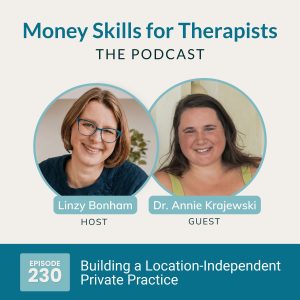
In this episode, Linzy is joined by Dr. Annie Krajewski — a licensed psychologist from America who is currently in Brazil — for a fun conversation about building a location-independent private practice and creating the freedom to live and work abroad. Together, they dig into the common misconceptions about being a nomadic therapist and what holds therapists back from making these kinds of big moves.

In this coaching conversation, Linzy sits down with Talisa Haskins, a group practice owner and new student in Money Skills for Group Practice Owners, to tackle a common challenge that entrepreneurs struggle with: having so much on your plate — and even more that you want to be doing — with no real direction on what to do, and when.