
In this episode, Linzy is joined by accountant and recurring guest Julie Herres for a thoughtful conversation about artificial intelligence and its growing presence in both the therapy and financial spaces.
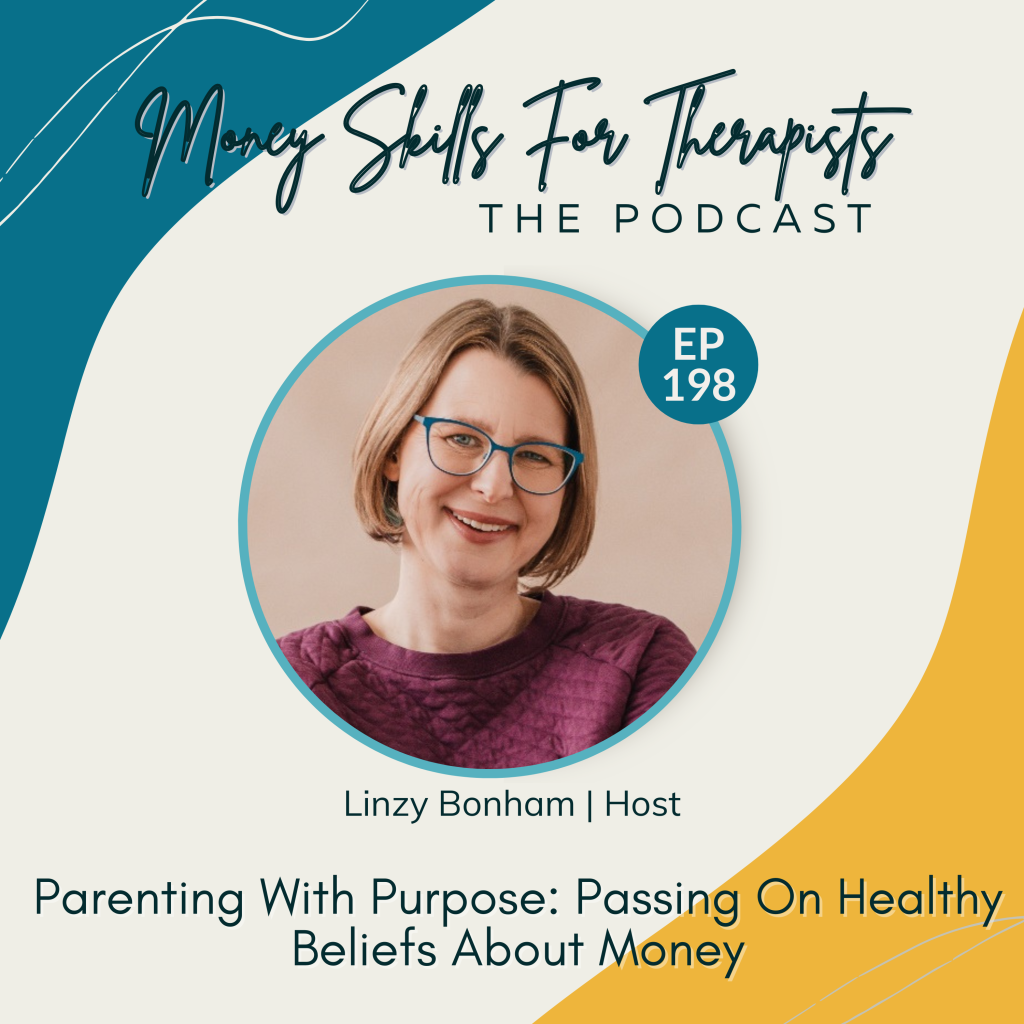
198: Parenting With Purpose: Passing on Healthy Beliefs About Money
One of the most powerful (and often unspoken) ways we shape our kids’ relationship with money is through our own financial values and beliefs. The way we talk about money, how we feel about money and the habits we build around money ultimately become inherited by our children.
In this solo episode, I reflect on the big hand we play as parents in creating our kids’ money stories. I also explore what it looks like to model healthier financial skills with intention, clarity, and compassion—and why this work is as much a gift to ourselves as it is to the next generation.
Our kids look to us for guidance. They’re always watching us, listening to us and absorbing everything we say and do, and it’s no different when it comes to money. We’re the ones teaching them and planting those seeds—whether we mean to be or not.
The way we talk about money, react to stress, or make everyday decisions becomes the foundation of their financial narrative, shaping what they believe is normal, possible, or scary. That’s why it’s really important to stop and think about what we want to be modeling to our kids about money.
Start by getting clear on your own values around money, including:
When you become more intentional with both your beliefs and your emotions, you create space for open conversations, skill-building, and confidence—helping your children develop a relationship with money that feels grounded, empowered, and aligned with the life you want for them.
Look for moments where everyday language and emotional reactions become powerful teaching tools. You’ll notice how small shifts in awareness can transform money from a source of stress or silence into something you and your kids can talk about with honesty, clarity, and care.
(00:06:45) Modeling Healthy Money Habits
(00:08:01) Teaching Kids to Talk About Money
(00:11:16) Navigating Emotional Reactions Around Finances
Your words, reactions, and everyday habits quietly shape the money stories your kids carry into adulthood. By getting honest with your own values around money, you can model what you actually want to pass on to them, instead of defaulting to inherited beliefs or unconscious patterns. You’ll also start to notice how emotional responses like stress, avoidance, or openness become powerful teachers, often more impactful than any formal lesson.
This creates space to rethink money as a tool and a form of power that can be used responsibly and in alignment with your values. Ultimately, it’s about giving your kids practical skills, emotional confidence, and a healthier relationship with money than many of us were ever taught.
Linzy Bonham is a private practice therapist turned money coach who helps private practice owners and health professionals feel calm and in control of their finances through her coaching at Money Nuts & Bolts and her podcast Money Skills for Therapists.
It all started when she saw her extremely skilled colleagues struggle with the money side of business. Some had even left private practice, or were avoiding starting one, because the financial side was too stressful.
So Linzy decided to help therapists and health professionals develop peace of mind about their money. Since so many were never taught these skills, she focuses on the “how” of making the business side of private practice doable, and even super satisfying.
Follow Linzy Bonham:
About Page: https://moneyskillsfortherapists.com/about/
LinkedIn: https://www.linkedin.com/in/linzybonham/
Instagram: https://www.instagram.com/moneynutsandbolts/
Do you feel confused, ashamed, or uncertain about your finances?
Are you craving support to help shift your money mindset and transform your relationship with money?
Are you ready to gain practical tools and the confidence you need to finally take control of your business finances?
If so, I’d love for you to join me for one of my online workshops, designed specifically for private practice owners who feel stuck—whether it’s mindset blocks, avoidance, or the technical side of managing money.
In just one hour together, you’ll gain clarity, practical strategies, and next steps to move forward with intention.
Click here to explore upcoming workshops and save your spot or register to get the replay.
Doors are open for the Fall 2026 cohort of Money Skills for Group Practice Owners, which starts in October.
This comprehensive six-month program takes you from feeling like an overworked, stressed and underpaid group practice owner, to being the confident and empowered financial leader of your group practice.
Click here to learn more or register today to save your spot in the Monday or Thursday session.
Join the waitlist for Money Skills for Therapists. Our signature course has been carefully designed to take therapists in private practice from money confusion, worry, shame, and uncertainty – to confidence and peace.
Click here to learn more and be the first to know when enrollment opens for our January 2027 Cohort of Money Skills for Therapists.
Linzy Bonham [00:00:00]:
So, thinking about kids and money, today, I’m going to be covering three main ideas. First of all, why is it important to model to kids about money? Why does this even matter? With all the things on our to do list, why should we be worried about modeling to our kids about money? The second piece is the importance of clarifying our own values and beliefs as we’re thinking about what we want our kids to be inheriting from us about money. And the last piece is why this is such a gift to your future kids and by extension, your future self to be doing this work now. Welcome to Money Skills for Therapists, the podcast that helps therapists and health practitioners in private practice go from money confusion and shame to calm clarity and confidence with their finances. If you’ve ever felt overwhelmed by numbers or avoided looking at your business money, you’re in the right place. I’m Linzy Bonham, therapist turned money coach and creator of Money Skills for Therapists. Before we jump in, check out my free On Demand masterclass. You’ll find the link in the show notes or@moneynutsandbolts.com under masterclass.
Linzy Bonham [00:01:13]:
It’s the best first step to finally feeling empowered with money in your private practice. Let’s get started. Hello and welcome back to the podcast. Today’s episode is a solo episode where I’m going to be talking about money and kids, specifically modeling about money to kids. So, so, so, so many folks who come into Money Skills for therapists ended up spending time being with the stories that they inherited as kids about money. Right? Like the stories that we all heard from our parents really shape our relationship with money. And this is why we’re going to start by talking about why it’s really important to think about what we want to be modeling to our kids and the young people in our lives about money. The ways that adults talk about money really shapes, like, the underlying narrative for their kids, right? So sometimes things that we might say when we’re, like, talking to our partner or when we’re kind of like just airing a thought, our kids, as we know, hear everything.
Linzy Bonham [00:02:20]:
So some of the things that we might not even register that we have said about money or said, you know, whether it’s. Yeah, again, to ourself, to somebody else, our kids are just like, hearing all of that. Right? So this is the first piece to think about as we think about our relationship with money is you might not be where you want to be in your relationship with money, but also you. You are now also creating the landscape for your children’s relationship with money, right? This is why it’s important for us to start to think about money and kids is because sometimes, even before we’ve got our own shit figured out, our kids are looking to us for guidance and they’re learning from everything that we say. So this is the first thing to think about is what are the words, you know, that we’re saying around money? The other thing that we are creating for our kids is we’re creating their emotional landscape around money. As parents, right? When discussions about money come up, are they charged? Is there tension because we’re avoiding talking about money with our partner? Or when our kids ask for something, what is the emotions that we’re reacting with? Are we reacting with stress? Like, we don’t have money for that? Are we reacting with anger? Like, why would you think I can afford that? Are we reacting with maybe like a little bit of mania? Of like, sure, whatever. Yeah, let’s get that. We can figure it out, right? All of these reactions that we have shape our kids emotional landscapes around money, right? Like we are creating the emotional and narrative foundation upon which they are building their financial beliefs.
Linzy Bonham [00:03:47]:
Right? And building their financial lives. It’s not fun to think about. But the reality is, is that as parents, we are playing a big hand in creating our kids money stories, right? We can think back to our own parents and the things that they did and said that still come into our own heads. You, it might be that your parents said certain things like money doesn’t grow on trees or like, we can’t afford that. They still pop into your own head, you know, years and years later. We are actually the ones who are planting those seeds for our kids now, right? They are absorbing everything that we say and do, which is why it’s so important for us to stop and think about what we want our kids to believe about money. So once we notice and acknowledge that we’re having quite a bit of impact on the little people around us when it comes to their relationship with money, then the good news is we get to stop and think about what we want to do differently, right? What do we want our kids to believe about money? How do we want them to feel around money? And I’m actually not going to tell you what that is for you because money is so personal. So it might be for you that you want your kids to believe that money is about helping others.
Linzy Bonham [00:05:00]:
You know, that charity and justice are really important. Those might be things that you want to have your kids associating with money. You might want to have them seeing you do things that shows that money can help others who have not been as fortunate of you folks who are marginalized by systems that might be a big value for you. Money for you might also be about self sufficiency. It might be about creating your own stability and foundation so you don’t have to rely on other people. Right? Maybe that is what you want to model to your kids. There is no right answer to what money is, right. Generally speaking, I like to talk and think about money as a resource or a tool, but what you do with it, right? Like what should tools be used for is up to you.
Linzy Bonham [00:05:42]:
And this is where money is so, so powerful. Because it’s the way that we talk about it and what we do with it that actually shapes the meaning of it. Money in itself doesn’t actually have a lot of meaning, right. Which gives us a lot of room to be creative, but it also gives us a lot of responsibility as we’re thinking about it. So as we’re thinking about modeling to the kids, the first question is, yeah, what are your values around money? You know, what do you think money is for? What do you want your kids to believe about money? And then how do you want them to feel about money? Right. Is money about being sober and clear minded, making very like, clear decisions? Is money about fun and joy and seizing, you know, seizing life, seizing the day? Is money about responsibility and teaching them to be responsible and thoughtful? Right. Do we want money to be something that is very serious or is money neutral? Right. Again, thinking about what it is that we want our kids to be getting from us when it comes to money.
Linzy Bonham [00:06:45]:
Thinking about these things and being intentional about what we model is a gift for future kids. And this is something that I’ve talked with therapists about over the years as folks are coming into money skills for therapists specifically, and they’re thinking about changing their own relationship with money. It is so powerful to be able to stop and be intentional and give our kids a different experience than we had. If you grew up in a household where money was never talked about and there’s this like silence, just you starting to talk openly about money with your kids, right? To help them actually build skills around money and talk about like, okay, you have allowance, you know, are you going to use it on this or this? What’s important to you, helping them build those skills that maybe you were never taught is in itself so, so powerful, right? So when we are starting to improve our relationship with money, there’s a positive ripple effect that invariably is going to happen with Our kids. But when we’re also aware of that and intentional around that, we have so much opportunity to have this huge positive impact on our kids when it comes to their relationship with money. Right. And make it so that they don’t grow up and are like, well, I don’t know what to do because my parents never talked about money. I don’t know how things were done, you know, And I’ve seen this over the years, even with folks who had parents who were very financially skilled, parents who were accountants.
Linzy Bonham [00:08:01]:
If money wasn’t talked about at home, the knowledge and skills weren’t passed on. Right. Like, holding that knowledge to yourself doesn’t actually help your kids. Money is an area that we all need skills. And you helping to have your kids develop, like language around money, skills around money, the ability to just talk about money really, really early on is preventing them from maybe getting into some of the situations that you’ve got into over the years where you don’t know how to do something. And you’re assuming everybody else does, but they also don’t know, but you’re stuck in silence, right? When your kids can talk openly about money and come to you in the future and say, I want to buy a car, but I’m not sure is this a good idea and you’re able to actually be with them in that question and help them look at numbers is an enormous gift that will save your kids some of the financial stress that maybe you’ve experience experienced in your life by giving them the foundation to be able to actually talk about money. Money in itself is also a form of power. And that’s something that I know.
Linzy Bonham [00:09:01]:
As helpers and healers, we can often feel kind of icky about. I find as helpers and healers, we can sometimes have a bit of a not black and white thinking around power. We could say where it’s like, power is bad. We don’t want to have that. Power hurts people. Whereas I think that’s where we struggle sometimes to really charge for our work because we know that not everybody has equal access to power, but we are all in skilled professions where we get paid well for what we do. And we can use that privilege and that value that we’ve created by getting great educations, by making sure money does good things, and we can model that to our kids. So when we model to our kids, yep, we make money and we use that money to take care of our debt.
Linzy Bonham [00:09:50]:
We’re saving for your education, we’re saving for our future. We’re also supporting these causes that is your kids seeing how money is a powerful tool that can do many positive things at the same time. Right? So when we avoid the power of money, when we don’t look at it ourselves, when we’re not talking about it, first of all, our kids are just inheriting whatever unconscious stories are flying around, but also not. They’re not then getting the education and language to be able to powerfully use money themselves. Right? So when we can start having these conversations with our kids, whether your kid is three, that’s when I started giving my own son allowance. It was a little early, honestly, but I was keen. Whether your child is 3 or whether your child is 23. And maybe you didn’t talk about money when they were growing up.
Linzy Bonham [00:10:34]:
There’s still the opportunity now to start to have these conversations with them and share your own growth. I have one duo who’ve gone through Money skills for therapists. First a mother came through and then a daughter. Both lovely, lovely, lovely therapists. And it was like, it makes me so immensely happy to see folks doing their work, their kids doing their work like families healing themselves in terms of their financial narratives, in terms of their feelings and building skills. It’s never too late for us to learn how to have a better relationship with money. And it’s never too late to model that who our kids. So these are my thoughts for you today about kids and money.
Linzy Bonham [00:11:16]:
Just remembering that everything we do, our kids are absorbing whether we want them to or not. So we might as well be intentional and think about what we want them to think and believe about money and what skills we want them to have. And by stopping and being clear about that and doing some active modeling and opening the space to talk about money, you are equipping your kids to have a way better head start on building a healthy relationship with money than maybe you ever did. So set aside some time to talk to your kiddos about money. You will not regret it. Thank you so much for joining me today. I am Linzy Bonham, therapist turned money coach and the creator of Money Skills for Therapists. If you are ready to go from money confusion and fear to feeling clear and empowered, my Free on Demand masterclass is the best place for you to start.
Linzy Bonham [00:12:06]:
You’re going to learn my four step framework to get your private practice finances working for you. Register today using the link in the show notes or go to moneynutsandbolts.com under masterclass. I look forward to supporting you.


I’m a therapist in private practice turned money coach, and the creator of Money Skills for Therapists. I help therapists and health practitioners in private practice feel calm and in control of their finances.
In this episode, Linzy is joined by accountant and recurring guest Julie Herres for a thoughtful conversation about artificial intelligence and its growing presence in both the therapy and financial spaces.

In this episode, Linzy is joined by Dr. Annie Krajewski — a licensed psychologist from America who is currently in Brazil — for a fun conversation about building a location-independent private practice and creating the freedom to live and work abroad. Together, they dig into the common misconceptions about being a nomadic therapist and what holds therapists back from making these kinds of big moves.

In this coaching conversation, Linzy sits down with Talisa Haskins, a group practice owner and new student in Money Skills for Group Practice Owners, to tackle a common challenge that entrepreneurs struggle with: having so much on your plate — and even more that you want to be doing — with no real direction on what to do, and when.