Julie Herres 00:00
I think the train has left the station, and the time to dig our heels in has passed, in my opinion, right?
Julie Herres 00:07
In the sense of, like, if you can’t beat them, join them. So I think we can then automate a lot of the crap in our life.
Julie Herres 00:16
Mm-hmm. The things that are not fun, and that’s what I’m trying to do internally with my team. So it’s funny ’cause the team always wants to, like, “Let’s automate this big, hairy, difficult project.”
Julie Herres 00:26
And my perspective is, no, let’s automate all the easy stuff so that we, the humans, can work on the big, hairy project, because we are actually much better suited to do that,
Linzy Bonham 00:44
Welcome to Money Skills for Therapists, the podcast that helps therapists and health practitioners in private practice go from money confusion and shame to calm, clarity, and confidence with their finances.
Linzy Bonham 00:54
If you’ve ever felt overwhelmed by numbers or avoided looking at your business money, you’re in the right place. I’m Linzy Bonham, therapist turned money coach and creator of Money Skills for Therapists.
Linzy Bonham 01:04
Before we jump in, I want to remind you of something really important. Most of us highly skilled and competent therapists and health practitioners were never taught about money, not in grad school, not in supervision, not anywhere.
Linzy Bonham 01:16
And yet, here we are running businesses that need to take care of us while we’re busy taking care of others.
Linzy Bonham 01:22
It is a lot of pressure. So if part of you feels anxious about money, avoidant, or like a bit of a hot mess financially, I want you to know that you are not alone and I am here to help.
Linzy Bonham 01:32
Through my workshops each month, I teach practical financial skills to help you feel more grounded, calm, and confident with your private practice money.
Linzy Bonham 01:39
You can see what’s coming up and save your spot to join live or register for the replay at moneyskillsfortherapists.com/workshops.
Linzy Bonham 01:46
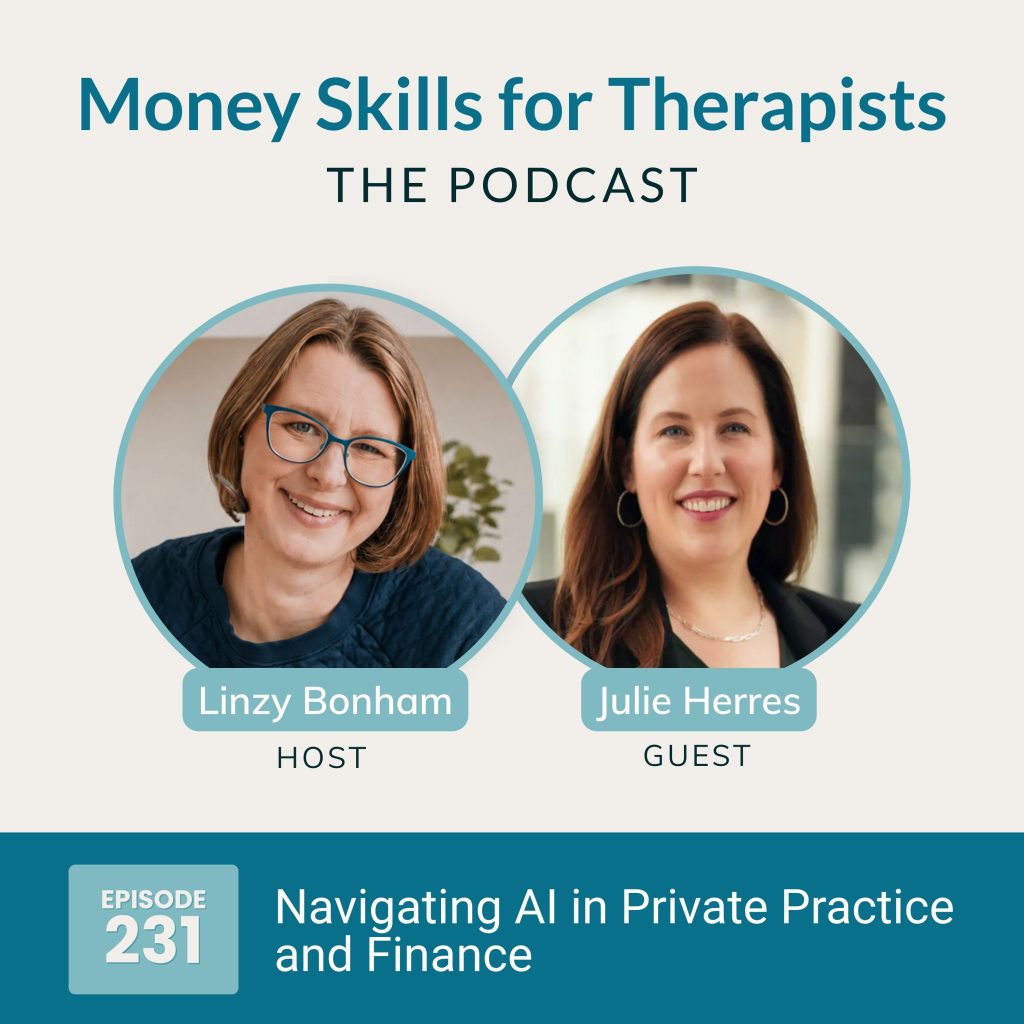
Let’s get started. Hello and welcome back to the podcast. Today’s podcast guest is A Money Skills for Therapists podcast regular, Julie Herres. Julie is the owner of Green Oak Accounting.
Linzy Bonham 01:59
She is the author of Profit First for Therapists. And today Julie and I talk about AI, artificial intelligence, and finances.
Linzy Bonham 02:09
We talk about when is a great time to use AI, what are great tasks that AI can do for you, when are the times that you should definitely talk to a professional, and we explore AI both in the accounting space and also the therapy space, right?
Linzy Bonham 02:22
We talk about kind of this idea, is AI coming for our jobs?
Linzy Bonham 02:26
We talk about the importance of human relationship and context and as therapists and health practitioners, the things that we can give our clients that AI absolutely cannot, but also the things that we can get from other professionals like lawyers and accountants that AI cannot give to us.
Linzy Bonham 02:41
Here is my conversation with Julie Herres. So Julie Herres, welcome back to the podcast.
Julie Herres 02:52
Good to be here. Thanks for having me.
Linzy Bonham 02:54
Yes, I’m very excited. It’s been a minute, I think, since we had you
Julie Herres 02:56
On. It’s been a little while, yeah.
Linzy Bonham 02:57
Yeah. Yeah, between seasons, last season we actually did have a throwback episode from you. So folks listening have actually kind of heard an episode from you Okay more recently than you and I have actually been able to talk.
Julie Herres 03:08
Okay.
Linzy Bonham 03:09
So this is my chance to actually talk to you live again, which I much prefer.
Julie Herres 03:12
Which I, I like, and we need to do a better job about Mm-hmm… like actually answering each other’s texts as well.
Julie Herres 03:19
Yeah.
Linzy Bonham 03:19
We need to get off Voxer. That’s what we need to do. That’s a different conversation, though. Julie, I’m really excited to have you here today.
Linzy Bonham 03:24
We were just chatting off mic beforehand for a solid half an hour, by the way. I was like…
Linzy Bonham 03:27
We just had a half-hour pre-chat, uh, before recording, and you were mentioning to me that you have been spending a lot of focus right now in your business on AI, like what’s happening in the AI space with accounting.
Linzy Bonham 03:42
You’ve got some team members looking at it. And I know AI is something that I see come up with my students quite a bit now, of them trying to figure out what to use in terms of AI tools, how to use it.
Linzy Bonham 03:55
You know, I’ve got a lot of folks, um, who work with us, especially in the Financial Leader Circle, who are big fans of Claude.
Linzy Bonham 04:00
They consider Claude their personal boyfriend. That’s a whole different conversation about AI and relationships. But, some folks really, really loving using it.
Linzy Bonham 04:09
Other folks feeling quite tentative and worried about it, that AI’s gonna take our jobs as therapists. People are just gonna talk to ChatGPT rather than seeking professional help.
Linzy Bonham 04:19
So I wanted to get your perspective on what you’re seeing in the financial space, ’cause for folks listening, they might be already starting to explore what are the alternatives to maybe paying a bookkeeper or, like, are there tools out there that can be keeping track of their numbers.
Linzy Bonham 04:32
Certainly that has to be coming sometime soon if it’s not here yet. Yeah. What is happening with AI in the financial space?
Julie Herres 04:39
In the financial space, yeah. And so I will preface that by saying I’m not an AI expert. I am an accountant, right?
Julie Herres 04:44
So I think in general, my philosophy when it comes to AI is whether we want it to or not, it is going to disrupt professional services.
Julie Herres 04:54
It already is, and I think that is coming, right? And so when we think of a clinician, a practice owner, like, the, the game has changed, right?
Julie Herres 05:06
Where, a client might come in and have already maybe used Claude or Gemini or ChatGPT to, like, talk through their symptoms or how they’re feeling or they have some ideas.
Julie Herres 05:17
But also, like, just, just from a funnel perspective, where five years ago people were just going to Google and you could run some Google ads and, like, you’re getting clients in that way.
Julie Herres 05:26
Like, the funnel has been disrupted. A lot of clients are going first to AI before going maybe then to a local Google search, right?
Julie Herres 05:35
But sometimes just finding clinicians through AI as well. Mm-hmm. So the same is happening across most professional services, accounting, legal, marketing, right?
Julie Herres 05:47
Like, who have you heard recently say, “Oh, I don’t need to pay a website designer. Like, I’m just gonna-” Okay…
Julie Herres 05:50
“use Claude to design my own.” Like, it feels like that’s every other day.
Julie Herres 05:55
So there’s a lot of things that you can do faster on your own, and yet there’s still, in my opinion, always gonna be a time where you still need a real human and a real professional that has experience and that has context from just years of doing that in a very specialized way.
Julie Herres 06:14
So Mm-hmm… that’s my position. I think the work is changing. Yeah… in professional services, and we shouldn’t try to maybe stop it or avoid it.
Julie Herres 06:22
Like, it’s going to change, and I think we just need to adapt with it, and that the work that we get to do on the other side of this is probably going to be the meaningful work that we love anyways instead of Mm being like, “Oh, let me just do the, this administrative, like, bookkeeping or receipt finding,” or whatever it may be.
Linzy Bonham 06:44
Right, ’cause that is one of the concerns, right? Is that this is going to replace the therapy industry, right?
Linzy Bonham 06:50
But what I’m hearing from you is, like, you see it as it’s a different entry point now. As you said, it’s like folks used to only use Google to search, like, you know, I don’t know, depression, therapist, Toronto.
Linzy Bonham 06:59
And now even if you’re not actively seeking AI, Google tops an AI summary up at the top of searches now Yeah…
Linzy Bonham 07:05
Automatically. So even just going to Google now, you’re getting this more, like, synthesized, processed information. But I’m hearing you say, like you still see on the other side of kind of the middle changing, the middle changes in how folks find us, but still you see a place for the work that therapists do.
Linzy Bonham 07:24
We’ll start with that on the other side of it.
Julie Herres 07:26
Yes. Yes. The work that therapists do, the work that all professional services do, right? I’m thinking of an example, just a friend from recently where they are in a current legal battle, right?
Julie Herres 07:36
Mm-hmm. And so usually if you think 10 years ago, the attorney was preparing all of the documents, and really now there’s no reason to save yourself a few thousand dollars and organize the information much better for them, right?
Julie Herres 07:52
So instead of giving the lawyer a pile of papers that they then have to, like, their paralegal has to organize and figure out, like, what means what, I mean, you can throw that into AI and just have a really organized packet to give them.
Julie Herres 08:05
Mm-hmm. But also really a nice summary. Like, really quickly you can make their life way easier and save yourself a lot of money.
Julie Herres 08:13
Like, I can’t imagine that an attorney’s favorite job is to organize, like, the random slop that someone sent you, right?
Julie Herres 08:21
Just like in accounting, if you think of
Linzy Bonham 08:22
Sure
Julie Herres 08:23
One of the most annoying parts of accounting is not the actual accounting work, right? If we think of tax prep, it’s the gathering of documents.
Julie Herres 08:31
Like Mm-hmm… just how many times do we have to go back and say, like, “Hey, you forgot to send us this thing.”
Julie Herres 08:35
And then the client will invariably say, “Oh, are you sure?” Like, “Yes, I’m sure. If I’m asking you, I am sure that it’s not there,” right?
Julie Herres 08:41
And so there’s all this back and forth of follow-up of like, “Hey, we’re still waiting on this. Hey, we can’t do your tax prep until this.”
Julie Herres 08:47
Like, sometimes that is more time than the actual preparation
Linzy Bonham 08:52
Oh, for
Julie Herres 08:53
Sure… itself, right? Yes. And so if we can eliminate some of that on the accounting side, like, I think we can actually serve our clients better.
Julie Herres 09:02
That doesn’t necessarily mean that we’re charging less, but can we do better work and be more proactive and spend our time instead of doing eight follow-ups by email, like, doing the actual tax work and then spending some time on strategy.
Julie Herres 09:15
Like, I think Right… everyone wins in that Yes… situation, right? So what I think and I hope is that we are gonna be able to automate even more of the low-hanging fruit, the ankle biter tasks that no one likes.
Julie Herres 09:28
And maybe for a therapist that is, like, the following up on the intake paperwork of like, “Hey, I still don’t have it.
Julie Herres 09:33
Hey, you’re still missing this-” Mm-hmm… you know, one thing or whatever Yeah… it may be, right? Like, there’s a lot of pieces that we might have an opportunity to eliminate, and they were never the things that we loved anyways.
Linzy Bonham 09:44
Yeah, ’cause I’m hearing AI now is at the place where it can take on that grunt work Yeah that we all professionals have to do, and sometimes that’s the work that we hire an administrator for, right?
Linzy Bonham 09:54
So really what we’re talking about is kind of what I would call the $15 an hour administrative tasks, which is like seeing if this thing is here, putting a file in order, following up on information.
Linzy Bonham 10:04
So things that don’t take skill, but they do take, presence and attention and so AI is replacing or taking on some of those kinds of tasks so professionals don’t have to do those things.
Julie Herres 10:15
Yeah. Yeah, and I think it’s also making accessible tasks that you just weren’t going to do anyways. Right.
Linzy Bonham 10:21
Right? Right.
Julie Herres 10:21
I’ve seen a lot of therapist websites in my day. Some of them are just not pretty, right? Like they just aren’t.
Julie Herres 10:27
And they probably should be updated but the therapist is busy enough that they just have not gotten around to it, I don’t wanna pay for it, right?
Julie Herres 10:34
Whatever that may be. So like it’s something that you maybe weren’t even gonna spend any money on anyways. Mm-hmm.
Julie Herres 10:38
Yes. But now like can you stand up something in a weekend that looks better than what you had? It might not be perfect, but it’s better?
Julie Herres 10:45
Then great, right? I think that’s a good thing. That doesn’t mean that no one will ever spend money on a website ever again.
Julie Herres 10:51
I think there’s plenty of people out there who say like, “I just have really complex needs. I don’t wanna deal with it.
Julie Herres 10:55
I want an expert to handle that,” and is still willing to pay for those services, right? It just, it probably just changes the market a little bit.
Linzy Bonham 11:05
Yeah, ’cause what you’re saying is on the other side, if those little tasks are taking off of professionals’ plates, they have more time to actually do the parts that require their professional education.
Julie Herres 11:15
Yes.
Linzy Bonham 11:16
Right? So with taxes it could be spending more time on some tax strategy than you might have had otherwise if you’re spending all your time instead organizing a file.
Julie Herres 11:24
Exactly. Exactly.
Linzy Bonham 11:25
Yeah.
Julie Herres 11:25
Yeah,
Linzy Bonham 11:26
Yeah. So with AI then I’m curious, for folks listening, when would you suggest they draw the line? Like what are the kinds of things that like yes, absolutely you can get ChatGPT, Claude, any of these agents, or maybe some sort of specialized tool to do it for them, right?
Linzy Bonham 12:44
Like when is it really wise to use AI? And as an accountant, where do you see the line where now it’s really time to bring in a human and a professional and get somebody’s actual eyes on their situation?
Julie Herres 12:55
I don’t know that the line is perfectly clear.
Julie Herres 12:58
It’s maybe gonna be a little bit blurry, but I think there are plenty of situations where small business owners, right, like maybe a solo practitioner, really simple business, and, and certainly for a therapist, but other small businesses as well, where they’re just not getting- they’re not paying for bookkeeping, right?
Julie Herres 13:13
Maybe they’re bringing their bank statements to their tax accountant at the end, end of the year, and so that’s just happening in one fell swoop at the end of the year.
Julie Herres 13:22
Is there value to throwing your bank statements for last quarter in Claude? and I would asterisk that into a paid Claude, uh Mm-hmm plan, right?
Julie Herres 13:32
Yeah. Paid, uh, not the free one that trains the model, but the, you know, the paid one that does not.
Julie Herres 13:38
Asking a couple of questions on like how much money did I make? What was my profit? What are some trends that you’re seeing?
Julie Herres 13:42
Like great, I think that can be really valuable because the insight that you otherwise wouldn’t get until the very end of the year, you might be able to get a little bit faster.
Julie Herres 13:52
Mm-hmm. Um, but that being said, like when you’re doing it that way, there’s not necessarily a lot of continuity, right?
Julie Herres 13:58
So I think there still very much is a role for an accounting software where you can see like this year versus last year, right?
Julie Herres 14:06
Like you can run a lot of different combinations of reports. You can download all the data in one fell swoop.
Julie Herres 14:12
You can look at it by quarter or by month or by year, right? Like that is still really, really valuable, and so I think there is still a need for softwares like that.
Julie Herres 14:21
I do think the big players in this space will likely change in the next two to four years.
Linzy Bonham 14:27
Okay.
Julie Herres 14:27
That is my suspicion. and I also still think like there is still a great role for an accountant out there, right?
Julie Herres 14:34
And, and that’s where I am not in despair because AI is coming and the role is changing. I just think There’s a lot of times where you need a human to help you talk through the challenging decisions Yeah that you’re about to make, right?
Julie Herres 14:47
Yes. Claude or ChatGPT might tell you like, “Hey, your profit margin is, 6%.” Okay, does it know what to do with that information?
Julie Herres 14:55
Mm-hmm. Mm-hmm. Like, does it have any suggestions on how you can change it? How have others made that change?
Julie Herres 15:01
What’s a way that you could have a conversation with your team member, right?
Julie Herres 15:04
Like, it doesn’t necessarily have that context or that information, so I still think there’s a lot of value in kind of that relational advisory work in the same way that, do I think people are going to ditch their therapist and just work with ChatGPT?
Julie Herres 15:19
No, I don’t think that’s, what’s going to happen. I think people still want to work with a therapist. Mm-hmm.
Julie Herres 15:25
It might just look a little bit different, and people who possibly weren’t getting access to therapy, because in the US, like, they don’t have healthcare access Yes…
Julie Herres 15:32
Or whatever it may be, like, okay, then they’re at least getting something, right? And that, I think that’s a win.
Julie Herres 15:39
Yes. But then people who have access I think are still gonna want that.
Linzy Bonham 15:43
There was a book that came out a few years ago called The Future is Analog, and I, I’ve read some of it.
Linzy Bonham 15:48
I haven’t read all of it. But he was essentially making the argument, you know, during COVID, here’s this time when we’re all stuck at home, but we have access to the full Internet, the entire Internet’s at our fingertips.
Linzy Bonham 16:00
You can watch any movie that’s ever existed. You can do your exercise classes online. You can talk to your friend on Zoom.
Linzy Bonham 16:06
Theoretically, we should have all been able to be fulfilled, right? It’s like everything is there, and yet people were deeply miserable and stressed during COVID, right?
Linzy Bonham 16:14
Despite the fact that many, many people had access to the whole Internet. and his argument is, cause we need other humans, right?
Linzy Bonham 16:21
And I think about this with AI. You know, I see AI as an easy first place to go. So for instance Yeah…
Linzy Bonham 16:25
I, um, was chatting with you beforehand.
Linzy Bonham 16:27
I’m kind of like hopefully getting to the other side of like some, some chronic pain issues and migraine, and that’s been very, very consuming for me the last year and a half, and I’ve started working with a therapist who’s great, and she’s given me more ideas and languaging, and I’m noticing some things.
Linzy Bonham 16:40
And the other day I asked Gemini, “Hey, I noticed when I move my jaw into this specific position, it stops a migraine from coming on.
Linzy Bonham 16:48
What would explain that physiologically?” And like ba-ba-ba-ba-ba-ba-ba, it spit out this answer, and then when I saw my osteopath yesterday, I started telling him about it, and he’s like, “Oh yeah, ’cause this nerve layers this nerve.”
Linzy Bonham 16:56
I’m like, “I know.” But it’s like I don’t really know. Yeah. I know nothing about physiology. But it gave me enough information that then I can have a conversation with somebody who can tell me what to really do with that, or if it even applies to me, right?
Linzy Bonham 17:07
Yes. ‘Cause it gave me information at 10:30 at night when my brain is like, “Hey, what is this thing?”
Linzy Bonham 17:12
But ultimately, I’m still not really qualified to do anything with it, and it feels much better to tell my osteo and then make a plan with him that I know I is actually gonna go somewhere ’cause he actually has knowledge of me and my body and my life and what drives me.
Linzy Bonham 17:26
Yes. ‘Cause I’ve known him for 12 years. but also he’s… There’s that co-regulation piece to like sharing with somebody and feeling less alone.
Linzy Bonham 17:34
And I don’t Yeah, and like feeling heard… think AI can give that to people.
Julie Herres 17:37
Yeah. Absolutely.
Linzy Bonham 17:39
It, it’s an illusion of it. I think that people get a taste of that, but it’s not the real thing.
Linzy Bonham 17:44
I don’t think It’s not the real thing folks actually get satisfaction from And
Julie Herres 17:47
That’s the thing. The context Yeah… is so important, right? Yes. Like, we, we know with AI, like garbage in, garbage out.
Julie Herres 17:52
It only has a certain amount of information about you, about your business, about everything, and like yes, you can, you can kind of give it more, but
Linzy Bonham 17:59
Right. You can train it
Julie Herres 17:59
It doesn’t have all the context. Like then It might not be answering the question. And I think what you said is so interesting, where you took that information then went to your professional.
Julie Herres 18:09
Mm-hmm. Yep. And I think that’s, that’s the key here, and I think that’s the reason to not be afraid ’cause, like, I just went through something like that looking for a new professional for one of my kids, right?
Julie Herres 18:17
And so I started with AI of like, this is the specific problem that we’re having. This is the situation.
Julie Herres 18:22
This is the kid’s likes and dislikes. And so instead of having to call like 12 different doctors, I could call three.
Julie Herres 18:28
Mm-hmm. And for me, that’s a win, right? So it’s not that I wouldn’t have ended up at the same place, but like it’s exponentially less work on me, and we get to the right specialist much faster.
Linzy Bonham 18:39
Yes.
Julie Herres 18:40
And I think that’s a really great thing. Instead of trying multiple different types of doctors, and you go and you wait in the waiting room, and the appointment.
Julie Herres 18:47
You’re like, “Oh, it’s not quite… You know, we can’t really help you. You should try the… ” Like, that’s just frustrating, so we’re Yes…
Julie Herres 18:50
Reducing a lot of the frustration, but also a lot of the drop-off points. Like, we could have dropped off at any one of those points that said like Mm-hmm…
Julie Herres 18:58
“Okay, this cannot be fixed. We’re just… ” Yes. “This is how it is.”
Linzy Bonham 19:02
Yes.
Julie Herres 19:02
And I think you get in the end, like something better.
Linzy Bonham 19:05
Right. Right. It kind of cuts out some of that, um, what’s the word? I’m thinking of the, you know, when you’re in the water and you’re like splashing, floundering, um Mm.
Linzy Bonham 19:14
Flailing? Mm. Flailing? That can happen… beginning. Flailing. Thank you. That’s the word. It cuts out some of the flailing ’cause we know too, uh, you know, we see this with mental health therapy.
Linzy Bonham 19:23
I see this with accounting. It’s like you know you have a problem. You know you need help. You look around.
Linzy Bonham 19:28
There’s so many people. You’re like, “Ugh, I don’t know. I don’t know who’s for me.” let’s think about therapy specifically.
Linzy Bonham 19:32
You reach out to somebody. They don’t get back to you very quickly, or they get back Mm-hmm… to you and it feels like, oh, that was…
Linzy Bonham 19:36
They don’t feel like the right person for me, but three days has already passed. And as you said, there’s so many points when we are seeking help where we can drop off.
Linzy Bonham 19:44
Yeah. Right? And I see that with accountants too ’cause, like something that I support folks with often in Money Skills for Group Practice Owners is people will come in and be like, “I think my accountant sucks.”
Linzy Bonham 19:51
I’m like, “Well, okay. Let’s talk about it. Let’s see.” but if they do identify eventually they need to switch accountants, it’s a huge thing to try to find somebody new.
Linzy Bonham 19:58
And there’s so many opportunities just to be like, “Ugh, never mind. I’ll just leave it till tax time or avoid this indefinitely.”
Linzy Bonham 20:03
And so I’m hearing, you know, again, it’s kind of AI can front-load some of that work for us. It can take care of the beginning process.
Linzy Bonham 20:13
Yeah. But ultimately, we still need humans.
Julie Herres 20:17
Yes. AI is one of the ways that a lot of people are finding my team at Green Oak Accounting Yes…
Julie Herres 20:22
Recently, right? Because they’re, you know, it might be 11:00 PM, and they’re in Gemini saying like, “I need help with this specific thing.
Julie Herres 20:29
I think I’m paying my team members too much,” or like, “Here’s my P&L,” whatever they’re doing. And guess what?
Julie Herres 20:35
Gemini’s then going to my blog or the podcast or some resource and saying like, “Well, according to this, like, this is about how much you should be spending.”
Julie Herres 20:43
Mm-hmm. Right? But it still doesn’t tell you, like, how are you going to get from point A to point B?
Julie Herres 20:48
Yes. Yes. But then magically, this practice owner has now found us. They did not know that there was such a thing as Yes…
Julie Herres 20:55
Specialized accountant. And then all of a sudden they’re on our calendar to see if services make sense for them.
Julie Herres 21:01
Mm-hmm. Mm-hmm. And, you know, so, I think that’s a, a interesting new path that didn’t exist a couple of years ago.
Julie Herres 21:07
Right. Where someone who maybe never would’ve found you anyways now has the opportunity to find you because of something that you, you’ve, some content that you have online.
Linzy Bonham 21:16
Right. ‘Cause really for professionals like us, AI is mostly a marketing channel.
Julie Herres 21:22
Yeah.
Linzy Bonham 21:22
Right? Folks are gonna ask it questions, and if your website is findable, if you’ve got blogs posted, podcasts, whatever, you know, AI, something like Gemini is just scouring the internet.
Linzy Bonham 21:31
That’s all it’s doing. Yeah. And it is presenting the information in a much more palatable, personable way than just the search results.
Linzy Bonham 21:38
But ultimately, it is a marketing tool. it’s the thing that is going to bring you onto somebody’s radar who didn’t know about you before.
Julie Herres 21:46
Yeah. And people are finding us a lot more through AI today. Yeah. That’s something that we only just started tracking, like, maybe middle of last year.
Julie Herres 21:53
Interesting. So it’s only been about a year, but they, it’s, like, increasing quickly. Like, are you, is that something you’re tracking?
Linzy Bonham 21:58
No. I’m not tracking it because I feel like we’ve gone the other way, where so many of my new students now, especially if I think about the new cohort of Money Skills For Practice Owners, are through word of mouth.
Julie Herres 22:10
Interesting.
Linzy Bonham 22:10
So I think we are starting to lean much more into the relational side of business Okay… and marketing.
Linzy Bonham 22:14
Especially since what I do is not cheap, right? Like, it’s like my courses are not 100 bucks. Um, it’s like we tend to be attracting folks who have, like, been thinking about these things for a while, struggled with it a while.
Linzy Bonham 22:25
There’s a lot of vulnerability in working with money.
Julie Herres 22:27
Mm-hmm.
Linzy Bonham 22:27
You know, like, they’re people who are used to really being polished and professional and perfect, perfect, perfect. So it’s hugely vulnerable to admit, like, “This part of my business is a mess,” or, “This is really hard,” or…
Linzy Bonham 22:35
I’m just thinking about, you know, MSGPO calls that we had this week. We just had a new cohort start this week.
Linzy Bonham 22:41
People being like, “I grew up in poverty, and money still stresses me out even though I have a successful business.
Linzy Bonham 22:44
You know, there’s still this part of me inside that feels like that poor child.” Right? So I find for us right now, our marketing is much more just, like, our students bothering their friends so much that their friends are finally like, “Fine, I’ll take her course.”
Julie Herres 22:59
Fine, I’ll do it.
Linzy Bonham 23:00
I hear you. Um, which is much more that relational piece, right? It’s like if we have really positive relational impact on somebody, they’re going to really want us to then have positive impact on the people that they love because they want to have that, like, positive ripple effect go through their own life.
Linzy Bonham 23:13
So interestingly, we don’t get a lot of folks coming through AI. I have had people quote what AI said that I would say back to them.
Linzy Bonham 23:21
They’re like, “Well Really?… Linzy Bonham would say this.” And I’m like, “Would I?”
Julie Herres 23:26
Yeah.
Linzy Bonham 23:26
So that’s interesting to see how AI is trying to replicate the way that I think Yeah… and what I would say.
Linzy Bonham 23:34
And the, the one person who shared those results with me, I think she thought it was, like, pretty, like, yeah.
Linzy Bonham 23:37
Like, this… I, I didn’t think it was… I was like, “I don’t think I would ever say that.”
Linzy Bonham 23:39
But that I do see, is that AI is kind of trying to eat my voice a little bit and regurgitate Yeah…
Linzy Bonham 23:43
It to people with not a great amount of success, I have to say.
Julie Herres 23:48
Okay. I think the other interesting part of that is I think it weighs recent content at just as much as older content, right?
Julie Herres 23:57
Yes. And, like, you and I have been around Right… for a long time. Like We
Linzy Bonham 23:59
Have
Julie Herres 23:59
What I was saying eight years ago
Linzy Bonham 24:02
Yes
Julie Herres 24:03
Was true then, and it Yes… was what I believed then, but it also might not apply. Like, the market is completely different
Linzy Bonham 24:09
Yes,
Julie Herres 24:09
Totally… now. And so what I, you know, recommendations I made eight years ago just might not apply today because And that’s the context piece…
Julie Herres 24:15
Everything has changed. Yeah.
Linzy Bonham 24:19
It doesn’t have the context. Like, it’s not able to contextualize, like, oh, this is Julie eight years ago. Eight years ago was before COVID.
Linzy Bonham 24:23
It’s before her kids were in high school. It’s before she came… Like, it doesn’t actually know anything about us.
Julie Herres 24:27
Yeah, yeah.
Linzy Bonham 24:27
It’s just serving up information that’s available on the internet in a much more palatable way Yeah, yeah… for people to consume.
Linzy Bonham 24:33
And I think this is the other piece when we think about AI, is, it can be wrong a lot.
Julie Herres 24:38
Mm-hmm.
Linzy Bonham 24:39
And I think that’s Yeah… something that is easy to forget because it’s presented relationally, right? Yes. So when I hear my students talk about Claude, I’m like, “I’m never gonna use Claude,” ’cause I think it’s weird how much people have feelings about Claude.
Linzy Bonham 24:51
Just because of the way that it presents, it’s like a false relationship which can engender trust that isn’t necessarily actually warranted.
Julie Herres 25:00
Well, and it can also be confidently wrong, right?
Linzy Bonham 25:03
Yes, totally.
Julie Herres 25:03
Yes. Confidently spout out something. Like, people go to it for tax advice all the time.
Linzy Bonham 25:09
Yes.
Julie Herres 25:09
Normal. I totally get it. And yet Claude does not have your context, right? Mm-hmm. And so it might give recommendations that do make a lot of sense for a very specific situation that is not yours.
Linzy Bonham 25:21
That’s not yours.
Julie Herres 25:21
And it doesn’t know that, and you don’t know enough to ask
Linzy Bonham 25:25
No, no
Julie Herres 25:25
About that follow-up question, right? Like, “Oh, but what about this? But I also have this situation. This is the entity,” right?
Julie Herres 25:31
Mm-hmm. Like, you don’t think that’s important. Mm-hmm. I, as the accountant, know that it’s important. So, definitely it’s something that must be verified, right?
Julie Herres 25:38
Like, I don’t think you should do anything financial, legal, otherwise in your business without double-checking with someone Yes…
Julie Herres 25:45
That it actually does make sense. But I think it’s great discussion points, right? Agreed. that could be really useful.
Julie Herres 25:52
Or, like, if you’re meeting with your bookkeeper or your accountant, just say, like, “What questions should I be asking?”
Julie Herres 25:55
Mm. Amazing. Like, great. Come ready to engage. Perfect. We love that. Exactly. We love that. Yes. Certainly. Um, yeah, like, I think that’s a great place to use it.
Linzy Bonham 26:08
Well, I was just thinking, there used to be this T-shirt that I would see. It was, like, a feminist T-shirt, which is, like, carry yourself with the confidence of a mediocre white man, and I think that AI is, like, the mediocre white man of our time.
Linzy Bonham 26:18
Like, it just says shit confidently, but it doesn’t know what it doesn’t know. And if you’re using it for an area where you’re not a trained professional, you also don’t know what it doesn’t know.
Linzy Bonham 26:27
Right. Like, the stuff that it said to me with that nerve the other night, that nerve might not exist.
Linzy Bonham 26:30
I don’t know that. I’m not trained Yeah… in physiology, right? But then I can take it to a professional who’s like, “Oh, yes, that does make sense,” because he’s really nerdy about nerves.
Linzy Bonham 26:38
My osteopath thinks about nerves a lot. I’ve never thought about nerves in my life. Which you
Julie Herres 26:41
Don’t, right?
Linzy Bonham 26:42
Absolutely, right? So that’s, I think, another important piece of this, is, it’s a starting point. Yeah. But I think when we’re dealing with issues that require professionals, like you say, like law, accounting, mental health
Julie Herres 26:54
Absolutely
Linzy Bonham 26:56
We still need professionals ’cause professionals know what you don’t know. Yeah. You don’t know what you don’t know.
Julie Herres 27:02
Like pharmacy, right? Like, there’s so, there’s just so many examples of this, so, like, please, please don’t take this thing because ChatGPT said.
Julie Herres 27:09
Like, please double Yes… you know, check with your doctor. Like, there’s just so many, so many examples. Probably car repair is another one Yes…
Julie Herres 27:14
That it’s, like, I don’t Yeah… I don’t know. I trust a good YouTube video Yeah… but, like
Linzy Bonham 27:21
Yeah
Julie Herres 27:21
Yeah.
Linzy Bonham 27:22
Flying an airplane, don’t, don’t trust AI for that. yeah, ’cause as you say, AI is confident, but that doesn’t mean it’s accurate.
Linzy Bonham 27:28
Yeah. Right? Yeah. And I think we really need to remember this.
Linzy Bonham 27:30
And this is where the faux relational aspect of it really grates me, because I feel, like, that is the part where I’m like, the ethics of that are real sketchy to me, you know, of, of information being presented that might be completely Yeah wrong.
Julie Herres 27:43
Okay, so, like, are you anti-AI? ‘Cause we kind of I guess… started this from a, like, where, where do you stand, what do you think is coming?
Julie Herres 27:49
Yes. But, like, are Great question… so what is your position? Yeah.
Linzy Bonham 27:52
Well, thank you so much for asking, Julie Herres. I consider myself an AI centrist. you know, Mentioned on this podcast fairly often, Cal Newport, as a thinker that I really respect.
Linzy Bonham 28:04
Um, and Cal Newport is a computer scientist, so I always look to him for AI stuff, ’cause I’m like, “This is literally…
Linzy Bonham 28:06
” Again, he knows the stuff that I don’t know. Yes. Like, I don’t even understand the lay of the land of that world at all.
Linzy Bonham 28:13
And I listened to a great episode on his, podcast, Excellent podcast, um, if you really like pedantic men, which I do.
Linzy Bonham 28:20
And he was talking about we need to understand, like, the lay of the land in terms of the different voices in the AI debate, because people are coming from very specific philosophical positions that they’re not necessarily presenting, but that the way that they talk has all these assumptions baked in to them.
Linzy Bonham 28:35
So, I do not believe that AI is gonna take over the world. I don’t actually think that. I think that it’s smart, but dumb smart.
Linzy Bonham 28:41
I think that AI needs to be regulated like any technology. Yeah. Right? Like, you shouldn’t have cars that go 300 kilometers an hour, with no seat belts.
Linzy Bonham 28:48
That’s not safe. That’s very obvious. And I think that the same thing goes for these kind of more malicious, ways that AI are being trained to, like, just do scary, illegal, dangerous shit.
Linzy Bonham 28:58
I’m like, they should not be allowed to do that. Like, I think it needs to be regulated like any technology, just like therapy needs to be regulated.
Linzy Bonham 29:04
You can’t do anything you want ’cause you’re a therapist.
Julie Herres 29:06
Yeah.
Linzy Bonham 29:06
Same thing with people who are creating these technologies. and I’m more and more just coming to think about it, like, as a technology that, can be used for good, it can be used for harm.
Linzy Bonham 29:14
It’s a tool. It needs to be regulated. But the thing that bothers me about it is, is, as I was just saying I see it more parallel to social media, where it gives you a feeling of connection that is not real, right?
Linzy Bonham 29:26
Mm-hmm. Which is why, again, during COVID, we all were connected to social media, you could talk to people 24/7, and yet we all felt sad and alone, ’cause at the end of the day, we need real relationships.
Linzy Bonham 29:36
Mm-hmm.
Linzy Bonham 29:36
So I think that’s always my concern with, like, a technology like AI, but the same goes for, like, TikTok or Instagram, or YouTube videos, where it’s like it needs to be used properly, but at the end of the day, I think people really need other people, and we need that co-regulation and community and nuance and context.
Linzy Bonham 29:52
And, like, we need to be friends with the person next door just ’cause they live next door and we live in the same city, and that’s really cool.
Linzy Bonham 29:57
And it makes me sad and concerned when I feel like people are replacing real relationships with just really what is just a computer, algorithm spitting stuff at you.
Linzy Bonham 30:09
Yeah. That’s my, that’s my take on AI. What, what… Like, where do you stand with this, Julie?
Julie Herres 30:12
Yeah. So I think there’s definitely an ethics piece to it. but is it right that everything I ever put out on the internet now ChatGPT has consumed and, like, can regurgitate to someone?
Julie Herres 30:22
I think that’s not cool, and yet, like, yet, here we are, right? Yeah. That is, that was always the point of, of Google in, in a way.
Julie Herres 30:29
Like, it helps the business, it helps them find you, right? but there is certainly something to be said for, like, it can quote a book that I wrote, that I spent two years pouring my blood, sweat, and tears into, and it has never bought a single copy of it, right?
Julie Herres 30:44
Like, so there, there’s definitely something to be, said there. However, I think the train has left the station, and the time to dig our heels in has passed, in my opinion, right?
Julie Herres 30:55
In the sense of, like, if you can’t beat them, join them. So in that sense, I think we can then automate a lot of the, just the crap in our life.
Julie Herres 31:05
Mm-hmm. The things that are not fun, and that’s what I’m trying to do you know, internally with my team.
Julie Herres 31:11
So it’s funny ’cause the team always wants to, like, “Let’s automate this big, hairy, difficult project.” And my perspective is, no, let’s automate all the easy stuff so that we, the humans, can work on the big, hairy project, because we are actually much better suited to do that, right?
Julie Herres 31:28
As an example, like, I use Claude to, Do meal, planning. Like, on Saturday it sends me a list of Oh, that’s smart…
Julie Herres 31:34
Here are two, different options per day that you can pick from, right? ‘Cause, like, I wanna pick, but I don’t want too many options.
Julie Herres 31:42
Like, I don’t want a blank slate either, right? Right. So it knows my preferences, it knows how many people are in my household, what nights we eat at home, right, all of that.
Julie Herres 31:51
Like, so it knows just a good, like, here are the recipes I like, that I don’t like. What do we eat, what do we not eat, and it sends me options.
Julie Herres 31:58
And then I reply, and I, I pick one, and then, I mean, it’s connected to my Instacart. It puts all the ingredients in my Instacart.
Linzy Bonham 32:07
Dang. Right?
Julie Herres 32:08
Yeah. Oh, I… So that’s an example of, like, listen, these are things that I have to do, that I’m doing manually, that is taking time, that is, to me, not productive time, right?
Julie Herres 32:17
Like, do I want to feed my family? Yes. Do I wanna make sure that we have all the groceries that we need for the week?
Julie Herres 32:22
Yes. does it matter whether I spend two hours doing this on Sunday or 15 minutes? Absolutely not, right? Mm-hmm.
Julie Herres 32:29
And so I think that’s a nice value add that is giving me time back, right? So that’s, that’s what I would call, like, an ankle-biter thing, of it has to be done, and someone has to do it.
Linzy Bonham 32:40
Yeah.
Julie Herres 32:40
Yes. But, like, is there really value to me doing it versus Claude? No, right?
Julie Herres 32:45
So, like, that’s just a personal example, but there’s just a lot of things like that in most businesses that, like, it is not adding value for a human to be clicking here and doing this and, like, copying this text from here to there.
Julie Herres 32:57
That is absolutely not valuable. There’s room for error. Like, let’s not do that anymore. Yes. Yes. I think that’s amazing.
Julie Herres 33:05
So, and, and my hope is that then we get to do the things that we are really good at, like have conversations like this, right?
Julie Herres 33:13
Do the thing, like, have relationships with our clients and actually help them. Like, find things that otherwise are really easy to miss.
Julie Herres 33:21
Those are great use cases, so I’m embracing that.
Linzy Bonham 33:26
Yes. Yeah, and I agree. Like, let’s get the robots to do the shitty tasks that we don’t wanna do.
Julie Herres 33:31
Yeah. Like, I can’t wait for the robots to do the laundry. Like
Linzy Bonham 33:34
Oh, me too. Me
Julie Herres 33:35
Too… why, why is AI not doing that yet?
Linzy Bonham 33:39
If you do see the, um, videos of, like, house robots and stuff that they have Yeah… they, they have a long way to go.
Linzy Bonham 33:44
We’re not even close Yeah
Julie Herres 33:46
If they’re good, though, if they get good, like, I’m here for it.
Linzy Bonham 33:48
Oh, for
Julie Herres 33:49
Sure. Why does a human need to vacuum the floors? It does not. No. Like, yeah.
Linzy Bonham 33:52
Well, you’ve, you’ve heard of Roombas, right? That, that, that problem’s been solved.
Julie Herres 33:55
Well, okay, fair, but my Roomba gets stuck on the edge of a cliff all the time. Oh. There are no cliffs in my house.
Linzy Bonham 34:01
Poor
Julie Herres 34:01
Buddy. Like, you know, it just gets stuck. I have three children and three dogs, and, Okay it’s always getting stuck on like, oh, there’s a dog toy, and it ate it, and now it’s stuck.
Julie Herres 34:11
And, like, it just… I, you know. So do I have a Roomba? Yes. Does it consistently clean the floors?
Julie Herres 34:16
No.
Linzy Bonham 34:16
Yeah, and, you know, if I think about AI and these technologies coming up, I think there are folks who are rightly concerned about their jobs, but I don’t think it’s us.
Julie Herres 34:27
Yeah.
Linzy Bonham 34:27
Right? Yeah. Like, it’s, there, you know, we, we see this now even just with, like, grocery stores, like self-checkouts are so much more of a thing now, and when they first came out, it was like, “I will never use a self-checkout.”
Linzy Bonham 34:33
Um, and then eventually they make it so you basically have to use the self-checkout. and so these, I see a lot of those kinds of jobs being under peril from not just AI, but just rising technology.
Julie Herres 34:45
Yeah.
Linzy Bonham 34:45
But I think there’s other things, again, these professional spaces that we occupy, like, you know, therapy or, or accounting, or I’d even count myself.
Linzy Bonham 34:53
Like, I don’t see myself as a, as a professional in the way that you’re a professional, but I have all this professional training, and I bring all this nuance into relationship building because the only way that my folks tend to learn and thrive is through healthy, supportive relationship.
Linzy Bonham 35:07
Yeah. And technology cannot give that to them. So I think that’s also something for, for folks to think about, you know, listening, is how do we become just, like, so good at what we’re doing, that AI can never replace us, right?
Linzy Bonham 35:18
Like, just be really great professionals. We’re just really good at what we do. AI will never be able to replace that.
Julie Herres 35:24
Yeah, and I, I agree with you. I do think there are some jobs that are going away, just like cashiers have mostly gone away at this point.
Julie Herres 35:30
Like, typists from the 1950s. Yes. Like, there’s no one typing letters anymore, right? It, that doesn’t mean that everyone’s just living in the streets.
Julie Herres 35:38
Like Mm-hmm… the job has changed. So, like, I personally think the job of a bookkeeper probably won’t exist in five years.
Julie Herres 35:45
Mm-hmm. Yes. Because that will be fully automated. Yes. There are multiple competitors to QuickBooks that are working really hard to just do almost all that work, and then the, the role becomes reviewing.
Julie Herres 35:54
Yeah. Right? So it’s not that there’s nothing, nothing to be done, it’s just you are reviewing the work that has already been done, double-checking it, and then providing insight probably on top of that, right?
Julie Herres 36:05
And so I think it’s different, and it’s evolving. But it’s not just, it’s not data entry, just like you really don’t see data entry positions anymore.
Julie Herres 36:15
Yes. That doesn’t really exist. There’s probably gonna be less administrative assistants, but the good news is that people who could not afford or have an administrative assistant before, like, they have access to a lot of tools that will give them a, not quite exact human experience, but, like
Linzy Bonham 36:31
No
Julie Herres 36:31
If they can get 60% there
Linzy Bonham 36:34
Yes
Julie Herres 36:34
Then great. Yeah. Great. They weren’t gonna pay for that anyways.
Linzy Bonham 36:37
Right. Right. Tasks can get done Yeah… that would not have been done otherwise.
Julie Herres 36:40
Yeah.
Linzy Bonham 36:41
Yeah, yeah. Uh, so Julie, I’m thinking about some… Let’s give some parting thoughts.
Julie Herres 36:46
Okay.
Linzy Bonham 36:47
I feel like we, we’ve covered some, we’ve strolled through the AI landscape today together.
Linzy Bonham 36:51
For folks listening, I would love to hear your parting thought of, if we even just think about tasks, what are the tasks that you would be totally confident telling somebody, “Yeah, you can get an AI bot to do that for you or an AI software”?
Linzy Bonham 37:04
And what are the tasks when it comes to accounting where you definitely suggest they need a trained human to support
Julie Herres 37:10
Them? Um, yeah. I do think if you’re not doing your books on a regular basis, can you get a basic profit and loss from an AI?
Julie Herres 37:24
Yes. Yes, you can, and I think that’s better than not doing it at all, right? So that, that’s where I will stand.
Julie Herres 37:30
If there’s something that you don’t understand, throwing that email into AI to like, and ask it infinite questions, right?
Julie Herres 37:40
I think that’s a great use of AI. where I think maybe is not a great use of AI is we’re, we’re seeing a lot of, like, “Oh, well, we sent an an email explaining this thing,” and, you know, you’ll come back with a list of 20 questions about the thing.
Julie Herres 37:54
Like, obviously you went to ChatGPT And like maybe more kind of thought needs to go into, like, do you actually want the answer to all 20 of these questions?
Julie Herres 38:04
Yes. Like, we… I mean, we can go all day, but, like, are… do you really want this, or is this what you think that you should because ChatGPT gave you a really, really long email?
Linzy Bonham 38:14
Mm-hmm.
Julie Herres 38:14
Um, so that may be, a less, good use of it. I, I would not drop your tax return in AI at this point.
Julie Herres 38:21
Like, that… I, I don’t think you should put any kind of, in accounting we call it PII, which is very similar to PHI, right?
Julie Herres 38:27
Like, uh Yeah… you shouldn’t put health information. you shouldn’t put your client’s information in there, although Claude will sign a BAA, so that is an option, available.
Julie Herres 38:37
But I would just be, be cautious about, that piece. But I think you can get a lot more insight, right?
Julie Herres 38:41
Because it’s just never gonna be tired of answering your questions. And depending on the time of year, like, there are some times of year where if you’re emailing an accountant on, April 14th asking a question about your tax return, like, guess what?
Julie Herres 38:55
There’s probably not gonna be time for that to get answered, like Right… until after the deadline, right? Our, our deadline in the US is on April 15th.
Julie Herres 39:02
And so, you know, can it be a good temporary replacement for that so that you understand enough to decide, like, am I signing or do I need to go on an extension, right?
Julie Herres 39:11
Like, I think that’s a great, a great use, uh, when, you know, there’s just… you’re just out of time.
Julie Herres 39:18
But also I would just look at a lot of small tasks, right, that I think you, you… This is the word that you used, like, tasks versus maybe bigger projects.
Julie Herres 39:27
Mm-hmm. And, like, what are the small things that you could really use help with or that you don’t enjoy doing?
Julie Herres 39:34
Like, what could it help you with? I think that is a good use of it.
Linzy Bonham 39:37
Mm-hmm. Yes.
Julie Herres 39:39
Yeah. When you’re looking for insight of, what is happening in my company? Why am I not making the profit that I think I should?
Julie Herres 39:45
Why am I not taking… like, able to pay myself what I’m worth? like, those are questions that, yeah, AI can give you a confidently potentially correct or incorrect answer.
Julie Herres 39:56
Mm-hmm. But I… If you’re having those questions and struggling with, like, what do I do strategically
Linzy Bonham 40:01
Yes
Julie Herres 40:01
Infrastructure-wise with my business, you probably wanna talk to real humans to make that decision and kind of talk it through to know what’s going to make sense for you or not.
Linzy Bonham 40:13
Our businesses really need to reflect our values and our context and, you know, so I think about that, like, but if I think about conversations that I have with folks in Money Skills for Group Practice Owners, sometimes it’s like, you know, we’ll be looking at a position in their team tool, and it’s like, okay, so this is what the full-time wage is for this position.
Linzy Bonham 40:27
If somebody’s working for you full-time, is this a livable wage where you live? Like, how do these numbers compare?
Linzy Bonham 40:32
And like, there’s gonna be very different answers in rural Kentucky than there are in New York City.
Julie Herres 40:36
Yeah.
Linzy Bonham 40:36
All right? And then it’s like, but like if I think about all the context that a person can elicit from you, and the nuance and the, the pieces about values, AI cannot do that.
Linzy Bonham 40:46
And AI also can’t read your body language and ask you just the right question at the right time like a human can.
Julie Herres 40:50
And AI doesn’t know that you said, you know, six months ago, like, “The most important thing for me is this.”
Julie Herres 40:53
Yeah. Like, this is the number one goal.
Linzy Bonham 40:57
Yes.
Julie Herres 40:58
And like, okay, well, are you making decisions that are in line with that
Linzy Bonham 41:02
Mm-hmm. Yes
Julie Herres 41:02
With that goal, right? Yeah. It will tell you kind of based on the context, the bias that you put in it today, what to do.
Linzy Bonham 41:09
Mm-hmm.
Julie Herres 41:09
But does it remember, like six months ago you said this was the most important thing. It’s okay if that has changed, but like, is that still
Linzy Bonham 41:15
That’s it, yeah
Julie Herres 41:16
The most important thing?
Linzy Bonham 41:17
Mm-hmm, mm-hmm.
Julie Herres 41:18
Is that… That might change the answer pretty significantly. Yes.
Linzy Bonham 41:21
And those are the very human elements of business, which I think is the most important part, is that our businesses actually have heart Yeah…
Linzy Bonham 41:27
And reflect what really matters to us.
Julie Herres 41:29
And I mean, honestly, business would be easy if you didn’t have to talk to people, right? Like, if you didn’t have to interact with clients or team members, like that…
Julie Herres 41:36
It would be much easier, and yet, like this is the part that makes it good.
Linzy Bonham 41:40
Yes.
Julie Herres 41:41
Yeah. You know? We, we need each other.
Linzy Bonham 41:43
Yeah. Yeah. The messy humanness is Mm-hmm… is also what makes it all worthwhile.
Julie Herres 41:47
Yeah.
Linzy Bonham 41:48
Julie, thank you so much. this was fun. Thank you so much for joining me today.
Julie Herres 41:52
Great conversation. Thank you for having me.
Linzy Bonham 41:58
I really appreciate Julie coming on the podcast to talk to us about AI today. She had mentioned to me before that she actually has a couple team members on her team at Green Oak who are just focusing on AI, and how do we use these tools, and how do we stay ahead of them.
Linzy Bonham 42:11
And I think there’s so much wisdom to that. Like, we know that AI is changing the landscape. We know that it’s changing the way that people are seeking health information, mental health information.
Linzy Bonham 42:21
We know it’s changing the way that we, as users, seek information and answers to our questions. So knowing that, you know, how do we work with it?
Linzy Bonham 42:30
How do we make it so that AI suggests us as a great local therapist or health practitioner? And how do we use it productively to answer little questions or take care of little tasks, but then take that information to a professional?
Linzy Bonham 42:45
I really do believe at the end of the day, people need other people. Uh, we are social creatures. Um, we need that co-regulation of somebody else having eyes on our situation.
Linzy Bonham 42:55
We need the connection of being known. AI cannot give us those things. But it certainly can, organize your profit and loss statement if you don’t have that, as Julie said.
Linzy Bonham 43:03
If that’s not something that you’re getting already, Just try feeding your bank statements into an AI tool like Claude, paid version, as Julie said, and see if it can produce something for you.
Linzy Bonham 43:13
It’s gonna put you way ahead of where you’ve been otherwise.
Linzy Bonham 43:16
But at the end of the day, when you want strategy and somebody to really look at your situation and give you guidance, we still need humans for that, and our clients still need us for that nuanced professional service that only we can provide.
Linzy Bonham 43:30
If you are enjoying the podcast, you are welcome to join us in our private WhatsApp community. In that community, we chat about the podcast episodes that have come out that week.
Linzy Bonham 43:38
We have channels for solo practice owners, group practice owners, and we also have private community calls that we just do inside the WhatsApp community that are free.
Linzy Bonham 43:46
They happen about once a month, often with wonderful guests that we’ve had on the podcast. So if you wanna have more of this kind of vibe and conversation in your life, you’re welcome to join us in the WhatsApp community.
Linzy Bonham 43:56
You can just email us at hello@moneynutsandbolts.com to get your link to join. And thank you for joining me today.