







Money Skills for Therapists Podcast

Money can be stressful and confusing for therapists and health practitioners in private practice – dealing with all of our feelings and stories about it, understanding how to actually manage our business finances, and making money work for us in our lives can feel so daunting that many therapists just avoid dealing with money altogether. Join Linzy Bonham, therapist and creator of Money Skills for Therapists, as she demystifies all things private practice finances through short and sweet solo episodes, conversations with therapists who have transformed their relationships with money, and live coaching calls with Money Skills for Therapists students.

Listen to the Money Skills for Therapists podcast in your favourite app!

Want to hear from me?

Get money skills tips right in your inbox!

    We value your privacy and will never share your contact information. By submitting this form, you are consenting to receive tips and advice on private practice and group practice finances.

    Picture of Hi I'm Linzy

    Hi I'm Linzy

    I’m a private practice therapist turned money coach, and the creator of Money Skills for Therapists. I help therapists and health practitioners in private practice feel calm and in control of their finances.

    Do you have a question for Linzy?

    Record your message below, and we’ll do our best to answer it on an upcoming podcast episode!

    Please say your first name and then share your question. We do edit these questions, so don’t worry if you make a mistake! Just start your sentence again if needed.

    And be sure to tune in to our new Q&A episodes to hear thoughtful questions and insightful answers about money.

    Check out our latest episodes....

    As therapists, many of us feel a deep tension when it comes to pricing—especially when we’re creating group offers, workshops, or professional-facing experiences during uncertain social, political, and economic times.

    In this coaching episode, I sit down with trauma therapist Kim Torrence to explore what really comes up when we try to assign value to our work: fears about accessibility, old beliefs about service and self-sacrifice, money shame, and the pressure to “get it right” before we ever put an offer out into the world.

    Go to this episode »

    As we begin to take our financial needs seriously—raising fees, setting boundaries, and valuing our work—those shifts don’t stay contained to our businesses. They often ripple into our personal lives, especially our friendships. In this episode, I talk about what can happen when we move from self-sacrifice to self-advocacy, and how that transition can quietly (or painfully) change the dynamics of the relationships we’ve built.

    Go to this episode »

    In this coaching-style episode, I sit down with Colleen Barrows, a perinatal mental health therapist, mom of two young children, and graduate of Money Skills for Therapists. Together, we walk through the very real tension Colleen is feeling between maintaining financial stability as the primary breadwinner, managing most of the household responsibilities, and wanting more meaningful one-on-one time with her kids—while also nurturing a creative passion project, which will help therapists and postpartum women, that she hopes may one day provide her with passive income.

    Go to this episode »

    Most of us only hear the word sabbatical in academic circles, but as Maegan reminds us, its root is “Sabbath”—rest. Somewhere along the way, rest became another productivity tool, something to “use well” rather than simply experience. As therapists and practice owners, we need something different. A true sabbatical isn’t for catching up on house projects or writing endless to-do lists—it’s about completely reimagining your relationship with time, worth, and spaciousness.

    Go to this episode »

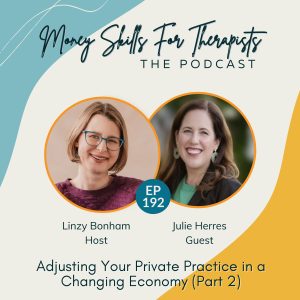
    In this episode, you’ll hear about the shift we’re all feeling in the therapy world—from years of burnout and endless demand to today’s reality of fewer calls, more price sensitivity, and a need for smart adjustments. Together, we walk through mindset shifts, flexible scheduling, fee strategy, and practical marketing ideas that help you stay grounded and profitable when the numbers feel uncertain. Sometimes that means rolling up your sleeves and stepping back in to see more clients, so your practice stays healthy. Other times it means experimenting with new marketing, reconnecting with referral sources, or gently adjusting your fees based on what your community can sustain right now.

    Go to this episode »

    Julie and I talk through why everything feels “tighter” right now—and why so many therapists are questioning their next steps.
    We explore how inflation, stagnant insurance reimbursement, and economic fear are impacting your practice, your income, and the clients you care for.

    Go to this episode »

    Emily shares what she sees in her work with clients recovering from religious trauma: the body’s lingering responses to old patterns, even years after intellectually moving on. We also explore how healing involves learning to make your own choices, rewriting your “job description” in private practice, and creating boundaries that allow sustainability without guilt.

    Go to this episode »

    Have you ever caught yourself living in constant hustle mode — pushing for the next milestone in your therapy practice but rarely pausing to breathe, to celebrate, or to simply be?

    I sit down with Jenny Jonker, a therapist, practice owner, and graduate of both my Money Skills for Therapists and Money Skills for Practice Owners programs. Jenny’s story is powerful — she shares how her immigrant background, her family’s experience fleeing war, and the survival mindset that shaped her early years carried into her life as a business owner. Together, we explore what it looks like to shift from fear and scarcity into calm, trust, and true presence.

    Go to this episode »

    If you’ve ever felt like marketing your therapy practice is confusing, intimidating, or just not your zone of genius, you’re not alone. In this episode, I want to help you breathe a little easier about it. Marketing doesn’t have to be reactive or overwhelming. It can be intentional, sustainable, and rooted in long-term success for your business and your peace of mind.

    Whether you’re just opening your solo practice, looking to welcome more clients, or scaling into a group practice, my guest Kristie Plantinga and I talk honestly about what actually works when it comes to digital marketing for therapists. You’ll hear how to keep your practice visible online, how to think about your return on investment, and which tools can help you track whether your efforts are truly bringing new clients your way.

    Go to this episode »

    As therapists and health practitioners, we’re used to holding space for others—even when our own capacity is changing. If you’re noticing changes in your energy, focus, or mood and wondering how to keep your practice (and your finances) healthy, this episode might be just what you need.

    In this episode, I break down the real impact of perimenopause on therapists, from brain fog and fatigue to the tough decisions about reducing your caseload or raising your fees.

    I share some practical ways to adjust your schedule, automate your money systems, and, most importantly, ask for support so your business and finances work with your new reality. Remember—your practice can and should support you through every season of life!

    Go to this episode »

    During this coaching episode, I help Kellie explore what life can look like now that she has moved out of survival mode, built stability in her private practice, and shifted into a space where she’s actually living and beginning to thrive.
    Kellie reflects on her upbringing, which focused on doing the right thing and being perfect rather than exploring what truly brought her happiness, and recognizes she’s now at a place where she’s giving herself space to explore and discover what it is she loves and actually wants to do.

    Go to this episode »

    So many of the messages we receive about money come from this space — either from what we witnessed growing up in a faith community or from experiences within our current community. And sometimes these beliefs are ones that folks don’t want to hold anymore, but they’ve already shaped how they think about money and the world.

    Go to this episode »

    Want to stay
    in Touch?