Talisa Haskins 00:00
I think as a business owner, one of my big goals is to have a team that, values the place that they work, whether that is they feel seen as an individual or they feel like this is, you know, the place for them to be.
Talisa Haskins 00:14
And so I put a lot of pressure on myself to be deserving of the respect that I want to give to others and I want them to give to me in our larger environment. And, and so if I say I’m gonna do something, I wanna do it.
Talisa Haskins 00:28
I don’t want you to think, “Oh, well, you know, she can’t get that done,” or, “She’s overcommitted,” or, “She doesn’t know what she’s doing.” so those… I guess it’s the fear of hearing that from other people that I would say is probably part of the fawning response.
Linzy Bonham 00:47
Welcome to Money Skills for Therapists, the podcast that helps therapists and health practitioners in private practice go from money confusion and shame to calm, clarity, and confidence with their finances. If you’ve ever felt overwhelmed by numbers or avoided looking at your business money, you’re in the right place.
Linzy Bonham 01:03
I’m Linzy Bonham, therapist turned money coach and creator of Money Skills for Therapists. Before we jump in, I want to remind you of something really important. Most of us highly skilled and competent therapists and health practitioners were never taught about money, not in grad school, not in supervision, not anywhere.
Linzy Bonham 01:19
And yet, here we are running businesses that need to take care of us while we’re busy taking care of others. It is a lot of pressure.
Linzy Bonham 01:27
So if part of you feels anxious about money, avoidant, or like a bit of a hot mess financially, I want you to know that you are not alone and I am here to help. Through my workshops each month, I teach practical financial skills to help you feel more grounded, calm, and confident with your private practice money.
Linzy Bonham 01:42
You can see what’s coming up and save your spot to join live or register for the replay at moneyskillsfortherapists.com/workshops. Let’s get started.
Linzy Bonham 01:51
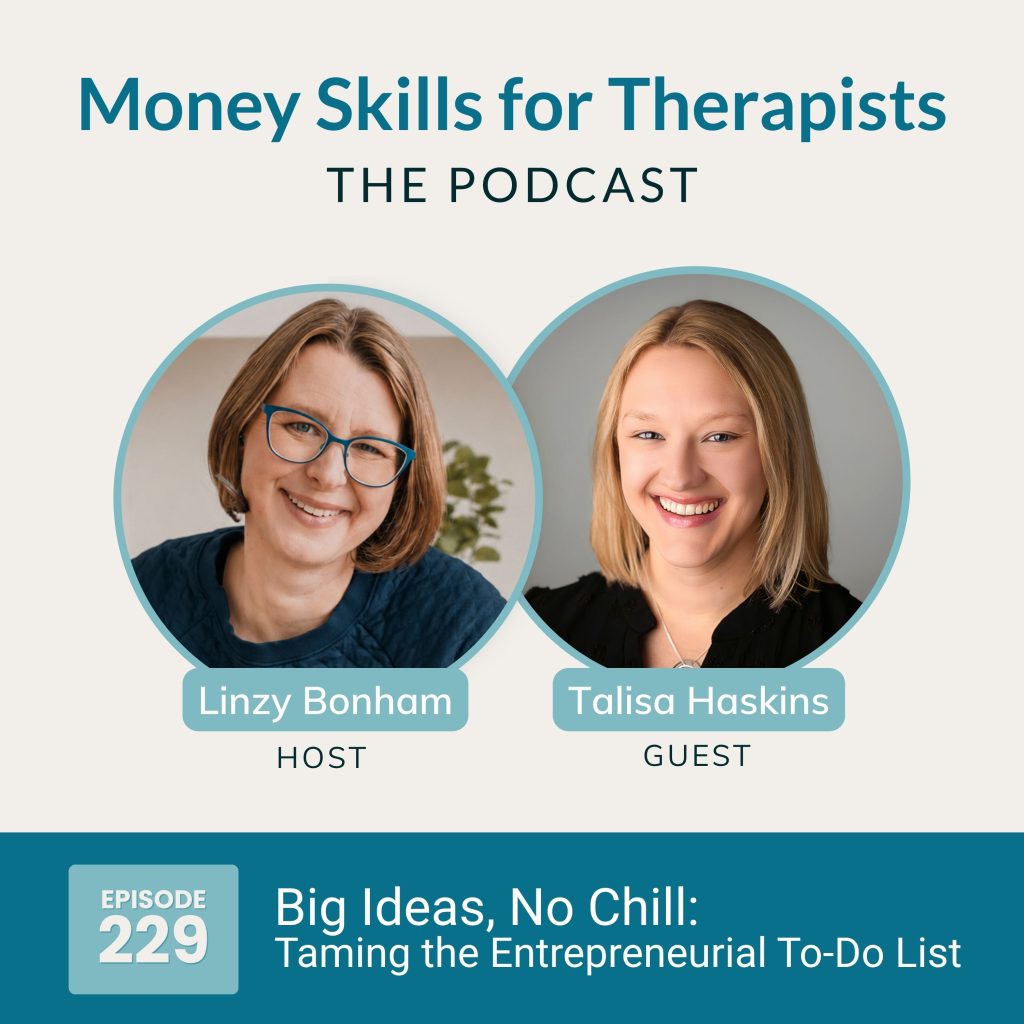
Hello and welcome back to the podcast. Today’s episode is a coaching conversation with Talisa Haskins. She is a group practice owner.
Linzy Bonham 02:00
She also, I just discovered, specializes in aviation mental health, which is one of the coolest niches I’ve heard of in a long time. Today, Talisa and I talk about what she describes as big ideas, no chill.
Linzy Bonham 02:14
The experience of just always having so much that you wanna do, so much on your plate, Having things come across your path and just committing to them right away, and we dig into some aspects of it.
Linzy Bonham 02:26
I feel like there’s so many more with this as there are for so many things that we experience. We talk about a fawning response, we talk about how do you organize tasks, how do you think about what is important in your business, what season of your business you’re in.
Linzy Bonham 02:42
This is such a common challenge for those of us in entrepreneurship ’cause there’s always so much to do as entrepreneurs and there’s nobody who’s telling us what to do when.
Linzy Bonham 02:51
We have to make these decisions. So if you ever feel overwhelmed as a private practice owner, as a business owner, or if you find yourself giving in to what other people want you to do, kind of making other people’s priorities your priorities, there’s gonna be something for you in this episode.
Linzy Bonham 03:07
Here is my coaching conversation with Talisa Haskins So Talisa, welcome to the podcast.
Talisa Haskins 03:17
Thank you. I’m excited to be here.
Linzy Bonham 03:19
I’m excited to have you here. And we got to chat last week. We had like a pre-chat almost, ’cause we, we were chatting about Money Skills Group for Group Practice Owners.
Linzy Bonham 03:27
So I feel like I, I already have like a little bit of a sense of what you wanna talk about today, maybe more than I usually do when we do a recording. But tell me what you want to dig into today.
Linzy Bonham 03:37
What would be helpful for us to focus on?
Talisa Haskins 03:39
Yeah, well, so I have a laundry list, but I’ve narrowed it down to one thing. And this concept is what we were talking about last week, which is that I have so many ideas and so many things that come up, and I have no, break, no chill, I think is what we said.
Linzy Bonham 03:56
Yes. Big ideas, no…
Talisa Haskins 03:57
Yeah, I just wanna do it all, all at once right now, and then I end up getting myself into situations where it’s like, “Oh, maybe I didn’t actually have the funds for this,” or I am making it work, but it’s way more stressful than it needs to be.
Linzy Bonham 04:12
Right. Okay. Okay. Yeah, yeah, let’s dig into that side of it first. Yeah, so tell me what this tends to look like for you and like what is the cost for you of this big ideas no chill?
Talisa Haskins 04:21
It looks like, I guess, exactly what it sounds like, is I have an idea, and then there’s no pause, and I just jump right into it. In practice, it probably looks like, Immediate decisions sometimes.
Talisa Haskins 04:35
Sometimes there’s a little bit of breathing room, but I’ll say yes to something, and there’s implications to that schedule-wise, time-wise, money-wise, et cetera.
Talisa Haskins 04:45
And then what it ends up looking like on the financial side is I have a bill that’s due, and I’m waiting for money to come in to get that bill to clear. And sometimes there’s a bit of a panic of like, “Am I gonna have the money come in before I have to do that?” so more recently, I, I committed to something, and I was all in when I committed to it.
Talisa Haskins 05:04
But it was a commitment that I made eight months ago, and I had time, and I thought, “Okay, I’m gonna be at a place where absolutely I can make this work.” And then the payment came due, and I did not have money set aside for it, and I had to pay for it.
Talisa Haskins 05:20
And then it’s like, okay, I… What am I, you know, gonna miss out on, or what do I have to push back to make this happen?
Linzy Bonham 05:29
Yes. Okay. So it’s something that you were really excited and clear about eight months ago?
Talisa Haskins 05:34
Yes. This particular thing. Sometimes it’s a big gap, and sometimes it’s just right away. Like, I had a meeting this morning, and I’m like, “This needs to happen. Let’s do it. I’ll figure it out later.”
Linzy Bonham 05:44
Mm-hmm. Okay. So that’s kind of the thinking then is like, you know, let’s just do it, I’ll figure it out later.
Talisa Haskins 05:49
Exactly.
Linzy Bonham 05:50
So future Talisa, she’s, like, gonna figure out a lot of shit.
Talisa Haskins 05:53
Oh, yeah. Yeah, like way too much unnecessarily. I often say that, “Oh, that’s a future problem. I’ll get to that,” and then my future self really is, is frustrated with my past.
Linzy Bonham 06:05
I’m sure.
Talisa Haskins 06:06
Mm-hmm.
Linzy Bonham 06:11
I’m sure. Yeah, ’cause tell me then from the perspective of your future self, which of course is your, your present self for these decisions that were made in the past, what is it like for you when you see, yeah, that bill come due, that like you don’t… I’m hearing there’s like a cash flow crunch that gets created, right?
Linzy Bonham 06:20
‘Cause you’re committing to these big investments, and n- the money’s not necessarily there. What is that like for you when you find yourself in that crunch?
Talisa Haskins 06:27
Well, it ends up being a panic. So any, any schedule that you thought you had has to go out the window when you realize, oh, there’s a bill due this afternoon, or there’s a payment that’s gonna come out overnight tonight, and you’ve gotta rearrange money.
Talisa Haskins 06:40
So in my ideal world, I’d love to just sit down once a week and I think I heard on the podcast once, enjoy a cup of coffee, sit with your numbers.
Talisa Haskins 06:49
I’m like, I, I am not doing that. There’s a panic. So it, it messes with the whole flow of…
Linzy Bonham 06:55
Yeah. Okay.
Talisa Haskins 06:57
And, and then yeah, it’s definitely what has to be prioritized. Does something have to be missed? Does something have to be cut?
Talisa Haskins 07:05
And sometimes it results in like big tears and questions of, should I actually be doing…
Linzy Bonham 07:09
Okay.
Talisa Haskins 07:10
Yeah. So it’s a, there’s a whole spectrum, and it c- I guess it just kinda depends on what is due immediately, uh, when I put myself in this situation. Or, you know, is it, can I kick the can down the, the road a little bit.
Linzy Bonham 07:23
Yes. And how often is this happening that you’re making these big commitments and then having to figure it out later?
Talisa Haskins 07:29
Hmm. Big, big ones, not very much. But some of the smaller ones, they add up, obviously. So I would say I’ve been probably functioning like this for a couple of years at various stages.
Talisa Haskins 07:42
The last month or so coming out of the summer slump, definitely harder. Aug- Aug- the end of August was really, really rough.
Talisa Haskins 07:51
But yeah, probably, maybe even if I had to go back and say since the start of my practice, I’ve had no clear plan, and all these dreams, and all these goals. And love a good podcast, but sometimes I hear things, I’m like, “Oh, I gotta do that now.” Um, or it’s a, a training or a business coaching or, yeah, anything.
Linzy Bonham 08:14
Yeah. Yeah, and what I just heard you say is there’s no clear plan, but there’s lots of dreams and goals.
Talisa Haskins 08:21
Yes.
Linzy Bonham 08:21
Okay, okay. So I mean, let’s focus on this piece ’cause first of all, what I wanna say first is, natural entrepreneur, welcome to the club. It’s like the, like, “Oh, that’s fun. I’m gonna do it.” you know, and, and people like us are a very small slice of the population, right?
Linzy Bonham 08:37
So like there’s, you know, you, you’re a very specific kind of person, and you’ve found yourself in the right place to be in a space where you can be building and learning and doing stuff like this all the time. ‘Cause in most jobs, at a certain point you kinda know the job and there’s not a lot of new and crunchiness.
Linzy Bonham 08:50
With entrepreneurship, there’s never-ending new and crunchiness. There’s…
Talisa Haskins 08:53
Mm-hmm.
Linzy Bonham 08:53
Stuff like this. So tell me then about your dreams and goals for your practice.
Talisa Haskins 08:59
I will also say something that just popped into my head, which we can put on a shelf, is I think that I also… When I get an idea and I say it out loud, then sometimes my fawning response comes in to, “Oh, I’ve said it out loud, I have to do it now.
Linzy Bonham 09:16
Okay, so there’s another part in the mix here then. There’s a fawning part.
Talisa Haskins 09:19
So let’s just, yeah.
Linzy Bonham 09:21
Don’t need to put that on the shelf. That’s pretty important. But let’s talk about dreams and goals first, and then we’re gonna come back to the…
Talisa Haskins 09:25
Come back to it. Circle back, it’s my favorite therapist saying. So dreams and goals. I am in a, a group practice. I’m a group practice owner, so that is kind of the forefront is this is something that I want to have.
Talisa Haskins 09:37
I love the element of having folks come in and learn for an internship stay to be an associate, whatever that cycle is for each person. So I want to have a practice that can support that community that I am building with the rest of my team.
Talisa Haskins 09:56
With that, I have got ideas. Having a manager, having another supervisor, the ability for me to work more efficiently, more sustainably.
Talisa Haskins 10:06
I also have smaller projects that, well, they’re probably big projects, but to me, smaller because they’re just me doing them and not necessarily impacting a larger team.
Talisa Haskins 10:17
Um, like speaking at conferences or, or doing, consulting or teaching or other things that I’d like to explore. Honestly, the… Somebody jokingly said the other day, “Maybe you should write a book.” I’m like, “That is the only thing on my list that doesn’t interest me right now.” I just, there’s so much that I would love to do…
Linzy Bonham 10:36
And there was an interesting thing you just said there. You said, “A project is smaller if it only involves your time.” Can you, can you tell me more about that?
Talisa Haskins 10:46
Yeah, it just feels less, like lower stakes, I guess. If it’s, if it doesn’t…
Linzy Bonham 10:52
Committing yourself?
Talisa Haskins 10:53
Yeah, if it’s not… If I don’t have to pay somebody else, if I don’t have to rely on somebody else, I can do it whenever I want to do it. I can set my own deadlines.
Talisa Haskins 11:02
Maybe that is part of that fawning response is if I’m not saying it out loud or I’m not, involving somebody else, then there is less pressure.
Linzy Bonham 12:10
Yes. Okay. Okay. Okay, I’m gonna put that one on the shelf, and it’s not coming back because I wanna get to this fawning response piece.
Linzy Bonham 12:18
So tell me about the fawning response when you say an idea out loud. What i- what happens with this fawning part of you?
Talisa Haskins 12:27
I think as a business owner, one of my big goals is to have a team that, values the place that they work, whether that is they feel seen as an individual or they feel like this is, you know, the place for them to be.
Talisa Haskins 12:41
And so I put a lot of pressure on myself to, To be deserving of the respect that I want to give to others and I want them to give to me in our larger environment.
Talisa Haskins 12:53
And, and so if I say I’m gonna do something, I wanna do it. I don’t want you to think, “Oh, well, you know, she can’t get that done,” or, “She’s overcommitted,” or, “She doesn’t know what she’s doing.” so those… I guess it’s the fear of hearing that from other people that I would say is probably part of the fawning response.
Talisa Haskins 13:10
Yeah.
Linzy Bonham 13:10
You said something out loud to your team and then you end up not doing it,
Talisa Haskins 13:16
Mm-hmm.
Linzy Bonham 13:17
What would that mean?
Talisa Haskins 13:19
I think you just lose credibility.
Linzy Bonham 13:21
Okay.
Talisa Haskins 13:22
Yeah. And, and it would be totally okay for me to circle back and say, “You know what? I’ve changed my mind on this,” or, “I’m gonna pivot direction,” or something like that.
Talisa Haskins 13:30
But if it is still something that I want to do and I’m not changing direction, then I’m not saying that I’m changing direction, and there’s an expectation that it will still be done at some point.
Talisa Haskins 13:42
Mm-hmm.
Linzy Bonham 13:44
Right. Okay. Okay. So if you say it out loud, it needs to be done. You’re allowed to change your mind, I’m hearing, ’cause I was wondering that. I was like, “Are you allowed to change your mind?” So you’re allowed to change your mind, but if you set an intention out loud,
Talisa Haskins 13:55
Mm-hmm.
Linzy Bonham 13:56
You need to do it.
Talisa Haskins 13:58
Yeah.
Linzy Bonham 13:59
Do you need to do it now?
Talisa Haskins 14:01
That’s the pressure I put on myself, for…
Linzy Bonham 14:03
Okay, so tell me about now. Why, why now? Not, why not in six months? Why not a…
Talisa Haskins 14:07
Oh. Because there’s more things I wanna be doing in six months or a year. I think that’s part of it, is I have such a long list of things that I would like to get done.
Talisa Haskins 14:17
And there’s definitely a sense of urgency to some projects, because if it’s marketing, for example, it needs to be put in place so that the clients come through the door.
Talisa Haskins 14:26
And if there’s, if there’s a deficit of clients coming through the door, then there’s just, whether it’s real or perceived, I’m seeing that as real pressure on myself of, you know, get the systems in place, get these things done, et cetera.
Talisa Haskins 14:40
I also think in the past I have felt, I guess I would say a founding response come up when I, don’t feel like I have the systems in place to back up my leadership. So if I say, “Okay, this needs to be done,” or, “We’re gonna do it this way,” and then I panic to get the system in place to support what I’ve done, even though we need it to be there, then I feel the urgency to get it done right in that moment instead of just going through the motions and putting it in place later.
Linzy Bonham 15:11
Yes. Yes. So this now, it has to be now. Okay. So I’m curious, in your business right now, in this moment, what has to be done now?
Linzy Bonham 15:21
What’s on your list right now?
Talisa Haskins 15:23
Definitely marketing stuff. So there’s marketing stuff, there’s general th- I have so many emails in my inbox that I feel are urgent that people are waiting on answers for.
Talisa Haskins 15:34
So getting caught up on admin stuff, supporting my current interns to finish their practicum and all the things that come with meeting and supervision and all of that kind of stuff.
Talisa Haskins 15:45
I also am presenting at a conference next week, which probably will be after this episode comes out, and so I’m feeling some pressure to get some marketing things in place so after I speak and peop- I’m out there, my website, our platform represents, and I don’t end up looking like a bit of an imposter who says they do what they do, but the, the service pages are not there, for example.
Talisa Haskins 16:10
Which is, yeah, still kind of surrounding marketing, but just in a different vein. And I have some other, business operation things that are pressing that require some time.
Linzy Bonham 16:22
Okay. Okay. So I’m hearing here, like, you know, the different areas of business, right? Like we’ve got marketing, of course. We’ve got email.
Linzy Bonham 16:30
So we’ve got marketing, we’ve got admin, we’ve got interns, which is really about kind of like your service, your leadership part, like basically HR. There’s the conference, which is kind of like your service, your education, and then having some marketing to back up.
Linzy Bonham 16:42
You know, when you get up there, as you say, if they go to the website, you want to make sure that they see what they expect to…
Talisa Haskins 16:46
Yes, exactly.
Linzy Bonham 16:47
I’m hearing, the various different areas of business, that need to be attended to. What, what are the emotions that go with that list when you think about this? You’ve got marketing stuff, you’ve got email, you’ve got interns, you’ve got a conference, you’ve got the service page for the conference.
Linzy Bonham 16:59
What’s the emotional signature of this for you?
Talisa Haskins 17:02
I am balancing, complete overwhelm and a deep sense of gratitude for some of the opportunities that have come up.
Talisa Haskins 17:12
And so the conference, for example, was not something that I saw coming when, when I was, asked to participate. It was a 1,000% yes, and then things have to shuffle because of it.
Talisa Haskins 17:25
But it was, you know, certainly not an opportunity you would say No to. So there’s gratitude in that. And then like with anything in business, there’s kind of a ripple effect of, oh gosh, how am I actually gonna get this done?
Linzy Bonham 17:39
Yes, there’s tasks associated now.
Talisa Haskins 17:41
Yeah.
Linzy Bonham 17:42
I’m curious, Talisa, do you identify as like neurotypical? Do you identify as any kind of neurodivergent? How do you think about your brain and how it works?
Talisa Haskins 17:50
I definitely think I’m a little bit neurodivergent, but I’ve never backed that up. So, yeah, I definitely resonate with…
Linzy Bonham 17:57
Curious. Uh-huh, uh-huh, yeah. I’m just, I’m getting a vibe, and I am in zero ways qualified, but I do say, I will say that, people with ADHD are, basically the people I spend 90% of my time with.
Linzy Bonham 18:08
And you’re giving me a vibe. And that vibe is like the like creative, sparky, but also the like everything is swirling around your head, everything needs to happen right now in this very second, right?
Linzy Bonham 18:19
Which which is, m- you know, very typical of folks with, with ADHD, which is why they can make great entrepreneurs, but also why it can be so taxing for people with ADHD to be entrepreneurs is like the overwhelm that you’re describing, is exhausting.
Linzy Bonham 18:33
And you actually… Yeah, no chill. No chill. And your, your body actually can’t sustain you being in overwhelm indefinitely, right?
Linzy Bonham 18:41
Like there’s gonna be costs to this. I mean, I am curious, Tulisa, what are the costs that you’ve seen associated with overwhelm?
Linzy Bonham 18:50
What does this mean for your life that you have this overwhelm around the business?
Talisa Haskins 18:55
No rest, no freedom. Yeah, I would say that, I’ve just come out of my first kind of five years, and everybody says the first five years is gonna be the hardest, and then you’ll know what you’re doing.
Talisa Haskins 19:08
I still don’t know what I’m doing. Or at least that’s what it feels like, is there’s n- there’s no rhythm yet. And, I definitely give myself a lot of grace for the fact that things have changed so much in five years.
Talisa Haskins 19:19
I’m not operating the same business that I was when I first started. But you… Or, I mean, I tend to. Maybe, maybe others do the same thing, but I tend to, make excuses of like, “Oh, I’m still b- building the business.
Talisa Haskins 19:32
I’ll work the weekends. It’s no problem.” So yeah, no time freedom, no rest. I shouldn’t say no.
Talisa Haskins 19:39
It’s just, it’s minimal, and it’s not replenishing. Yeah, and then you definitely feel it in your body. Absolutely.
Linzy Bonham 19:46
Yeah, what do you feel in your body?
Talisa Haskins 19:48
Ugh. I, did a lot of driving yesterday, so I’m feeling the effects of that. But I think, the average person who takes care of their body would not feel the same level of pain and exhaustion that I am feeling today, which I know is coming from that place of my body’s already overloaded.
Talisa Haskins 20:09
Mm-hmm.
Linzy Bonham 20:10
You’re already kind of running at high gear just by default before anything even happens.
Talisa Haskins 20:15
Yes. Yep.
Linzy Bonham 20:16
Okay. So I’m curious, you know, thinking about this from a practical perspective, what has been helpful for you so far in actually delineating what needs to happen first in your business?
Talisa Haskins 20:30
I love a good brain dump. I, I sleep with a notebook beside my bed so when I wake up, I don’t have to see the f- the light of my phone, and I can just scribble, scribble down the thought.
Linzy Bonham 20:41
Wise. I, I have that on my shopping list, by the way, to get one of those. But…
Talisa Haskins 20:44
Yes, I have notebooks in the car. They’re everywhere. So I love a good brain dump, and what I will do with the papers from that is I’ll just put them all in a pile, and I set aside time on Monday morning to just go through everything.
Talisa Haskins 20:57
And sometimes it ends up being at the end of every day, depending on how kind of crazy my brain has been throughout the day. So a, a brain dump, and then I organize it, and I do triage, like what is coming up today or tomorrow or this week that absolutely has to be done, and I keep my calendar and a to-do list kind of side by side.
Talisa Haskins 21:18
So it’s like, okay, these are the meetings that have to happen today. These are the tasks that absolutely have to be done, and then I keep kind of a rolling list at the end of that, that I will then schedule into the next week.
Linzy Bonham 21:29
Wow. Okay.
Talisa Haskins 21:30
So I’ve tried a whole bunch of different things of, of prioritizing, and this seems to work the best for me, of just taking things even in 10 minute, by 10-minute chunks sometimes.
Linzy Bonham 21:40
Okay. So you’re definitely doing a lot of task management. Like that’s that’s not missing. That’s probably one of the more thorough task management systems. That’s definitely way more than I do around task…
Talisa Haskins 21:49
Yes. I feel very organized. It’s just the, the slowing down and, and the not over-committing.
Linzy Bonham 21:59
Mm-hmm. Yes. Yes. Okay. Yeah. ‘Cause, I mean, there’s two things that come to mind for me. One is short term. With your task management system, how do you determine what is, like, urgent and important from what is something to do eventually but doesn’t actually need to be done now?
Linzy Bonham 22:17
How do you delineate that in your task system?
Talisa Haskins 22:20
Sometimes it’s a feeling that I have of just like, “I need to get this off my plate ’cause it’s, it’s weighing me down too much.” yeah, sometimes there’s, a deadline that needs to happen.
Talisa Haskins 22:31
And I think those are probably the two things. Like, what… And I do try to work in, like, a flow state where this feels good for me to do right now.
Talisa Haskins 22:41
I don’t wanna work from a place of stress, I wanna work from that place of abundance. So sometimes I organize that way of I’m just gonna do this now because I’m free and I feel like getting into… Like writing a blog, for example, that cannot be the last thing on my list for the day.
Talisa Haskins 22:58
So I kind of, I structure things like that sometimes, and then I definitely let other people manage my to-do list more than I should, of what feels urgent.
Linzy Bonham 23:07
Ooh. Okay. Oh, wow. This, this could be like eight podcast episodes, by the way. I’m like, there’s so many threads to follow here. Okay, so I’m hearing, again, this kind of like looking to other people guide what you need to be doing.
Talisa Haskins 23:20
Yes. Yeah, sometimes. And sometimes it’s, it’s… I’ll use my interns as an example, right? If they have an urgent question, that is part of my requirement as their supervisor to teach them, right?
Talisa Haskins 23:33
So that has to be urgent. Sometimes I, I heard a saying once that to measure your, level of resentment on your burnout barometer.
Talisa Haskins 23:44
And so I feel that sometimes when I have questions coming in that I don’t have time to answer, but I need to answer, then I feel that resentment come up, and that’s a good indicator for me that, yes, I have too much on my plate today.
Talisa Haskins 23:57
So sometimes it’s like they have to manage my to-do list because that’s the requirement. But sometimes, like an email sitting in my inbox, like that has to get done, but is not on my priority list.
Talisa Haskins 24:10
So I try to let that one slide. Yeah.
Linzy Bonham 24:14
Are you familiar with the Eisenhower Matrix?
Talisa Haskins 24:17
No.
Linzy Bonham 24:19
This is what I do after I brain dump. ‘Cause sometimes I’ll tell you, even with… I have a, quite a neurotypical brain. Even still, sometimes I feel like my brain is on fire and I wanna, like, scream.
Linzy Bonham 24:29
So the brain dump, great. Right, just get it all out of your head. We know that we waste cognitive energy trying to remember shit, and that’s not a good use of our talent.
Linzy Bonham 24:38
So you’ve already got that, like, pff, you know, in spades. You’ve got your notebooks. But after the brain dump, what I do is I draw… This is terrible for a podcast, by the way.
Linzy Bonham 24:47
This is, like, now let’s talk about a visual that nobody’s gonna ever see. So I draw a grid, and anybody listening to can look up the Eisenhower Matrix. This is, like, developed by Dwight Eisenhower, President of the United States of America at some point.
Linzy Bonham 24:59
I know nothing about history. And you have your brain dump, and then you take a piece of paper. I’m gonna draw it for you, Talisa, ’cause you can see me.
Linzy Bonham 25:08
And I do this probably at least twice a month that I find I need to do this. Now sometimes this is challenging for people with like really full-blown ADHD, so I’ll talk about that in a moment.
Linzy Bonham 25:17
But I’m suspecting you don’t have like off-the-wall ADHD since you’re able to organize shit a lot.
Linzy Bonham 25:26
You know, you clearly have the ability to, put like some good structures in place. Ta-da. Okay, so what we have here…
Talisa Haskins 25:33
Oh, I have heard of this.
Linzy Bonham 25:35
It’s a classic. It’s a classic. So, the idea, and again, not good at history, but my understanding is Dwight Eisenhower used to use this to organize his tasks as the President of the United States of America, which like if you think we have shit to do, world leaders have a lot more shit to do.
Linzy Bonham 25:51
So along the top there’s a grid that I’ve created, four quadrants, and along the top the quadrants are labeled urgent and then non-urgent or not urgent, and then they’re labeled important and non-important.
Linzy Bonham 26:04
So then you end up with four quadrants. One of the quadrants is where you put tasks that are both urgent and important. What are things that need to happen like literally today? Not tomorrow, today.
Linzy Bonham 26:14
Things that happen today and that are important. If it’s like, today I need to, pay my hydro bill or I’m about to have like my power shut off, that’s urgent and important, definitely belongs there.
Linzy Bonham 26:23
But then there’s like non-urgent, like what’s, you know, important to do but doesn’t need to happen tomorrow. Like, oh, right, I need to mail my mom a birthday card by like next Friday. I don’t actually have to do that today.
Linzy Bonham 26:32
I can do that next Thursday, right? So you take that brain dump that you’ve created, and you put them into these four quadrants.
Linzy Bonham 26:39
The very last quadrant is the non-urgent, non-important quadrant. That’s one where tasks that you find fall there can either be, just completely eliminated or like delegated to somebody else.
Linzy Bonham 26:50
And the idea here too is as you have a team, like things that are, for instance, urgent and non-important, maybe your administrator can do that task instead of you, right?
Linzy Bonham 26:57
Like if it’s not something that actually requires your specific talents, there’s like that quadrant is a, a clue as to where we can delegate. But what this lets you do is start to think about, okay, what actually needs to happen today, and what could happen tomorrow?
Linzy Bonham 27:12
‘Cause you’re also probably still gonna be alive tomorrow. And if you’re not alive tomorrow, then this is not a problem, right? But this helps you really think about what needs to happen now, what can happen later in the week, what feels really urgent but actually doesn’t matter, like if I don’t do it, literally nothing will happen.
Linzy Bonham 27:28
So I did one of these once, and I found like I had a bunch of important tasks that needed to happen right away, and then I also had like send my friend’s husband some coffee to thank him for the conversation we had.
Linzy Bonham 27:38
It’s like, okay, it’s nice to do, but he has no idea it’s happening. If it happens in a week, he’s not gonna know that I was thinking about it earlier. So even just having that in like the, “Okay, that’s like important.
Linzy Bonham 27:47
It’s important to me, but it’s not urgent,” allows me to see I’m gonna get to that later this week. An idea like this, how does this sit with you?
Talisa Haskins 27:57
So immediately I th- started to think about how I’ve done this in the past versus how I need to revisit the concept of it. I think that I need to ask myself a question of, who is this urgent for?
Linzy Bonham 28:15
Yes.
Talisa Haskins 28:16
To help me decipher, like, is this somebody else’s urgency or is this my own? And I don’t think that I’ve actually done this with having a team. I probably did this by myself at some point, and so that immediately gives me ideas of like, okay, I could reframe this.
Talisa Haskins 28:33
I could, I could delegate, and just see, yeah, order of importance. I, I love a good sticky note. Pr- when I did this before, I actually put it on a Bristol board, and I wrote everything on sticky notes, and then I could move them.
Linzy Bonham 28:45
Yes.
Talisa Haskins 28:46
Love it.
Linzy Bonham 28:47
Is also good for a Kanban board. You could also move them from there to a Kanban board of, like, doing to do done. Do you know that method?
Talisa Haskins 28:53
Yes. Yes. I…
Linzy Bonham 28:54
If you’re, if you have that kinesthetic intelligence, yeah, absolutely you could do that.
Talisa Haskins 29:00
I do, I love that, and then I also have to put it away because if I can see it, then it also brings some pressure in there. So that’s a, that’s a good strategy for me to use.
Talisa Haskins 29:09
But I think that, yeah, it’s resonating with me to try again and ask myself some, some qualifying questions as…
Linzy Bonham 29:16
‘Cause yeah, the urgent piece, ’cause this is another piece too, is as a leader, you are gonna have other people’s feelings coming at you,
Talisa Haskins 29:23
Mm-hmm.
Linzy Bonham 29:24
And something that I’ve talked with folks in money skills for group practice owners over the years is your team having a question for you is not an emergency.
Linzy Bonham 29:34
Your team member saying, “Holy shit, my client is in my office and I think he’s suicidal, and do I take him to the hospital?” That’s an emergency. But so many of the questions that our teams have for us are actually things that you could talk about tomorrow or that could wait till your team meeting with them on Friday, right?
Linzy Bonham 29:52
And so there’s this piece too of like what is the messaging that your team’s received about your availability? What is important and does require that they like come to you that day? What do they know they can bring to you in maybe another kind of space or container where they know they have access to you, like whether it’s a weekly supervision or a monthly team consult, to also give folks the space to know that they can access you and when, so they also don’t feel urgency.
Linzy Bonham 30:16
And this, this is an idea from Cal Newport, who talks a lot about time management, is when we don’t know something’s gonna happen, then people have a sense of urgency because they just like, they wanna get it to you now ’cause they don’t know when you’re gonna do it.
Linzy Bonham 30:27
But if they know, “Oh, I’m gonna see Talisa on Thursday, and she always addresses things right away when I have my one-on-one with her,” then they also don’t need to feel urgency and fear ’cause they know there’s actually a space to get their need met by you, and then you both win.
Linzy Bonham 30:39
‘Cause they’re not gonna ask you the question today, and you’re not gonna hear the question today, but you’re both gonna know that on Thursday there’s a space for you to have these conversations.
Talisa Haskins 30:48
And I think that’s just a really good reminder for me too, from an intern perspective, is everything feels urgent for them, right? It’s all new.
Talisa Haskins 30:55
Yes, exactly, and so I do have… We have structured supervision, we have huddles, we have team meetings. There’s so many different formats in, in how we meet, and we do operate virtually, so we have… It’s not like they can pop down and just knock on my door and ask a question, but we have some of those virtual spaces.
Talisa Haskins 31:15
And I think… So it’s a reframing for me in, in how I perceive the urgency of the messages and things like that. Like, I can leave it parked there, and I can get back to it.
Talisa Haskins 31:24
But it is also, I think I need to push back gently and respectfully from a place of leadership of, “This is not urgent.” you know, “Here’s, here’s urgent again, and here’s how we address those things.” and that will give me some freedom as well.
Linzy Bonham 31:42
Precisely. Yeah, and that’s strong leadership, right? To help them see, but also they know that they’re gonna get the support that they need. But then them having a question or a feeling does not take over your to-do list when you’re trying to run the business, right?
Linzy Bonham 31:55
And make sure that everybody has clients and, and make sure that, you know, this presentation is available, and it will help to grow your practice when you make the presentation, right?
Linzy Bonham 32:02
‘Cause your time is best spent in, in leadership tasks, right? In visionary tasks, and we wanna make sure that you’re also protecting that time to, like, build the practice and build the structures in the practice.
Linzy Bonham 32:14
‘Cause part of what I’m hearing here too is, like, there’s opportunity here for more kind of structures, for more clarity in your practice is needed. But, like, you’re the one who’s gonna have to vision out and decide what those will be, right?
Linzy Bonham 32:25
So the more time that you’re kind of running around doing these tiny things, then, then those things are not getting taken care of.
Talisa Haskins 32:32
Exactly. And I think using this, this idea, I’m gonna call it a vision board ’cause I’m gonna put it out on a big board. I think having that helps me solve the, the initial question that I had of like, I’ve got all these ideas and no chill on them, but if I have things laid out and I know exactly what I need to do in the next month or six months or year or whatever that might be, I know, can I say yes to this or does it have to be a no?
Linzy Bonham 33:03
Exactly. And that was exactly the next part I was gonna talk about. So the Eisenhower Matrix is great for the day-to-day, right? And I’m hearing some more structure and boundaries with your team around also what is urgent.
Linzy Bonham 33:13
Like, you need to clarify what is urgent, but also help them understand what is urgent. But also, yeah, this bigger vision, right? ‘Cause in business there are never-ending problems, never-ending things that we can be, like, improving or learning or doing or changing.
Linzy Bonham 33:27
And as I said at the beginning, like, I think that’s one of the amazing things about entrepreneurship is if you are somebody who likes to, like, learn and grow and be challenged, you got, like, 500 years of stuff, right, that you can learn here.
Linzy Bonham 33:37
But what actually needs to happen now, right? So I’m hearing this idea of these projects, and I’m curious Talisa, thinking about, you know, yourself and how you work, how can you create clarity for yourself of what actually is your focus now?
Linzy Bonham 33:51
Like, thinking about quarter four. You know, you’re, you’re in our WhatsApp community. Diane just posted a question this morning of, like, focus, right? Like, what are you proud of from quarter three?
Linzy Bonham 33:58
What are you focusing on in quarter four? And tell me, what did you put for your focus for quarter four?
Talisa Haskins 34:04
You had said on a podcast a while ago, that there’s different stages of business, and I wrote them down as, expand, gather, contract. And I said that I am in a, a gather stage for quarter four.
Talisa Haskins 34:16
I need to get some projects done. I need to stop saying yes to things and just tie up those loose ends. So how I’m kind of envisioning this strategy working for me is maybe breaking it down to, at least for now, to kinda get, put the fire out, is do, either by day or by week, what is urgent, what needs to be done.
Talisa Haskins 34:38
And then I think I’m gonna do one, by quarter or I generally work by terms. I schedule my, clients, my supervision in the same terms of, what my interns have ’cause it makes it easier to organize.
Talisa Haskins 34:52
So I might do, okay, this term this is gonna be the focus. And then we’re, we’re coming up on the end of the year, so I think I’m gonna do one for next year.
Talisa Haskins 35:02
What, what does the whole year look like? And there’s so many things that I’ve started and not finished, and I have kind of pushed myself to get them done in quarter four.
Talisa Haskins 35:16
But maybe I just say, “You know what? We’re gonna take next year. Next year is gonna be a, a gathering year, and tying up some loose ends, and putting some of those systems in place that I want.”
Talisa Haskins 35:29
Money Skills for Group Practice Owners, and…
Linzy Bonham 35:33
Well, and that’s what gathering is about, right? Like, gathering is about stabilizing, right? I’m, I’m hearing you’ve been building, building, building. There’s so much spark. You have so many fun things you wanna do, but we need the business to be a solid container for us to do that.
Linzy Bonham 35:46
So what I’m hearing is now you’re seeing this is the time to gather. This is the time to put systems in place. Like, yeah, you mentioned Money Sells for Group Practice Owners, which you’re, you’re thinking about joining, so that would be, like, the financial piece, right?
Linzy Bonham 35:55
And just, like, solidifying that much more, ’cause I’m also thinking about how much bandwidth you’re gonna get back as your systems improve, right? And as you’re not having to, like, make active decisions all the time or not know what’s happening or scramble financially.
Linzy Bonham 36:09
Like, how much stress does that put on you that once you improve those systems, that energy is gonna be able to be generative energy to build new shit, which is gonna be so fun.
Linzy Bonham 36:18
And, like, this is a podcast, so nobody can see you, but you’re smiling saying that, right? Like, just that idea, right? So you’re in a gathering season, and so this is a term. So when does this term go to?
Linzy Bonham 36:27
I’m, I’m out of step with the university.
Talisa Haskins 36:29
No, that’s okay. So I generally do September to December,
Linzy Bonham 36:33
September to December. Great.
Talisa Haskins 36:34
And then I start again January to April,
Linzy Bonham 36:37
Yes. Okay, so this is a time of gathering. And with the projects too, there’s that idea of the parking lot, right? If you’re thinking about your big picture, you can always have your parking lot where you’re like, “This is for the future.” But I’m also thinking about, I had a, a chat recently with somebody, who volunteers at the front desk.
Linzy Bonham 36:51
So I’m… As my home is under construction, we’re working out of like a co-working space in Guelph, Ontario. It’s very cute, 10C. And I was chatting with somebody at the front desk who used to be an audio editor for CBC Radio, um, which is, for Americans listening, that’s our national, radio station.
Linzy Bonham 37:05
And she said there’s a, there’s a term in editing which is kill your babies, which is so brutal. But it’s like we can get so precious about certain things and so attached to them, but you just can’t have all of it, right?
Linzy Bonham 37:17
Like if you’re taking 20 hours of interview footage and you have to make a half-hour special out of it, there’s so many things that we feel like precious about or attached to, but like they just don’t fit.
Linzy Bonham 37:26
There just isn’t room. And I’m thinking about in my business how many projects we’ve just killed ’cause we’re like, “You know what? Actually, that seemed like a good idea at the time,” but we haven’t picked it up either because like it’s, doesn’t actually make sense or I’m not excited or it doesn’t make… Like it just, that, that season has passed, and we just let it go, right?
Linzy Bonham 37:43
And how many things on your list maybe don’t even need to happen,
Talisa Haskins 37:47
Yes. I think that’s how I’m gonna do this. I’m gonna take two Bristol boards, and I’m gonna make one with my grid on it, and I’m going to write, use all my to-do lists, all my notebooks, everything, put them all in sticky notes, and put them on the second Bristol board.
Talisa Haskins 38:01
And I will sort in what is urgent, what is not, what is important, what is not. And whatever is left on that s- that original Bristol board will be the parking lot, and I either get there or, or not.
Talisa Haskins 38:15
It can go in the garbage.
Linzy Bonham 38:17
That’s it. That’s it. Yeah, and another thing that I will say, is that you have time.
Talisa Haskins 38:23
Mm-hmm. Mm-hmm.
Linzy Bonham 38:25
Right? And I think there’s a part of you that needs to hear that.
Talisa Haskins 38:28
Yes, absolutely.
Linzy Bonham 38:29
You know, you’re, you’re not retiring next year. This is not your swan song.
Talisa Haskins 38:33
Mm-hmm.
Linzy Bonham 38:34
You have probably a good another… What, what would you say? Like, hmm, 35 years of work in you?
Talisa Haskins 38:39
Yeah, I think so. Maybe.
Linzy Bonham 38:40
So think of what you’ve built in five years, right? You have another five years after that. You have another five years after that, right? And, and for different reasons, sometimes it’s neurodivergence, ADHD, sometimes it’s trauma history, sometimes it’s, um, from being first generation and, and not having come from stability.
Linzy Bonham 38:58
But we can have this like foreshortened sense of future, like everything needs to happen now, it’s all now. But you have so much time,
Talisa Haskins 39:04
Yes.
Linzy Bonham 39:05
Think of what you can build in all that time.
Talisa Haskins 39:08
The second piece of that message that I also am giving myself is that I don’t have time if it’s not sustainable.
Linzy Bonham 39:17
Dang. Yep, that’s true.
Talisa Haskins 39:20
So I need to, I need to create the space for myself to give myself the gift of time.
Linzy Bonham 39:25
So Talisa, what are you taking away from our conversations today?
Talisa Haskins 39:29
Oh, all of it. All of it. I am going to head out to the dollar store, buy myself some Bristol board,
Linzy Bonham 39:36
Love the dollar store.
Talisa Haskins 39:38
Yes, so good. Head over to Dollarama. And right beside our Dollarama is a coffee shop, so maybe I’ll grab a nice treat, and I am going to, I’m gonna brain dump, and I’m going to put it all on the Bristol board.
Talisa Haskins 39:51
I’m going to a business retreat this weekend actually, so it’s the perfect time.
Linzy Bonham 39:55
Oh, great.
Talisa Haskins 39:56
Yeah, get it all out there and, and it’s scheduled into my calendar for Thursday afternoon to do my annual look ahead. So here we go.
Talisa Haskins 40:05
Yeah.
Linzy Bonham 40:06
This timing could not be more perfect.
Talisa Haskins 40:08
Yes.
Linzy Bonham 40:09
Great. Well, thank you so much, Talisa, for joining us. I know what you’re talking about, what you’ve been talking about today is gonna be so resonant with folks listening, ’cause I know this is, this is such a challenge for us as entrepreneurs.
Linzy Bonham 40:20
And I really appreciate you sharing all this with us today.
Talisa Haskins 40:22
Well, thank you for giving me the space to do that.
Linzy Bonham 40:28
I really appreciate Talisa bringing this topic onto the podcast today. It’s something that so many of us can relate to, and I think it’s really the gift and the curse of owning our own businesses and being entrepreneurs is there is so much to do, and that can be so fun and exciting, but also it can be a lot to manage and balance.
Linzy Bonham 40:48
So there, there’s so many directions that we could have gone in today. The Eisenhower Matrix is one of my favorites, so it was nice to be able to, have a chance to share about that today, um, with Talisa and with all of you.
Linzy Bonham 40:58
It’s one that I definitely use. When I feel like my brain is on fire, I stop and do an Eisenhower Matrix, and it helps 100% of the time. I should say, I’ve heard some folks say that with their ADHD, the Eisenhower Matrix is difficult because with ADHD or anxiety, everything can feel urgent.
Linzy Bonham 41:15
So there may still be some extra steps for some of you when you’re playing with that tool to help you really discern, okay, what is actually urgent? And I loved how Talisa was already thinking about some clarifying questions to ask ourself, like urgent for who, right?
Linzy Bonham 41:28
Or maybe what makes something urgent. So there might be some modifications that may be helpful for those of you listening to making the Eisenhower Matrix work for you. But I know that for me, it’s been a really, really helpful tool, and I definitely encourage you to try it, especially on those mornings where it feels like you have a billion things to do.
Linzy Bonham 41:43
Doing that brain dump, just writing every task you can think of, getting it out of your head and onto paper, and then taking the five minutes to organize it can take a list of 30 tasks and turn them into the four tasks that you’re gonna do that day, and easily see the five tasks that you’re gonna do tomorrow, and that is an incredible change in terms of what you’re holding in your mind and holding in your body that day.
Linzy Bonham 42:05
If you’re enjoying the podcast, you may also, like Talisa, enjoy our WhatsApp community. In our WhatsApp community, there are channels for you to talk about the most recent podcast episode that comes out.
Linzy Bonham 42:16
We have rooms for group practice owners, solo practice owners, to talk about our workshops. What I like about our WhatsApp community is it’s not very loud but it’s thoughtful, which I think describes just the way that I teach and operate in general and the people around us is sometimes it’s busy, but it’s busy with people saying really thoughtful, introspective things, and then sometimes it’s quiet because there’s nothing to say, and that’s great.
Linzy Bonham 42:37
So if you are interested in being part of that community, you can just email my team. We will send you the form, where you can sign up for that WhatsApp community.
Linzy Bonham 42:47
Thank you so much for joining me today. Bye.