Linzy Bonham 00:01
Often sometimes people have money that’s also just, like, there.
Diane Webber 00:05
To work.
Linzy Bonham 00:06
Then you get to decide what the best job for that money is. And this is where I think we really get into the potential of money when we are connected with the meaning that we want to create.
Diane Webber 00:18
Yes.
Linzy Bonham 00:24
Welcome to Money Skills for Therapists, the podcast that helps therapists and health practitioners in private practice go from money confusion and shame to calm, clarity, and confidence with their finances.
Linzy Bonham 00:35
If you’ve ever felt overwhelmed by numbers or avoided looking at your business money, you’re in the right place. I’m Linzy Bonham, therapist turned money coach and creator of Money Skills for Therapists.
Linzy Bonham 00:45
Before we jump in, I want to remind you of something really important. Most of us highly skilled and competent therapists and health practitioners were never taught about money, not in grad school, not in supervision, not anywhere.
Linzy Bonham 00:57
And yet, here we are running businesses that need to take care of us while we’re busy taking care of others. It is a lot of pressure. So if part of you feels anxious about money, avoidant, or like a bit of a hot mess financially, I want you to know that you are not alone and I am here to help.
Linzy Bonham 01:13
Through my workshops each month, I teach practical financial skills to help you feel more grounded, calm, and confident with your private practice money. You can see what’s coming up and save your spot to join live or register for the replay at moneyskillsfortherapists.com/workshops.
Linzy Bonham 01:27
Let’s get started. Hello, and welcome back to the podcast.
Linzy Bonham 01:30
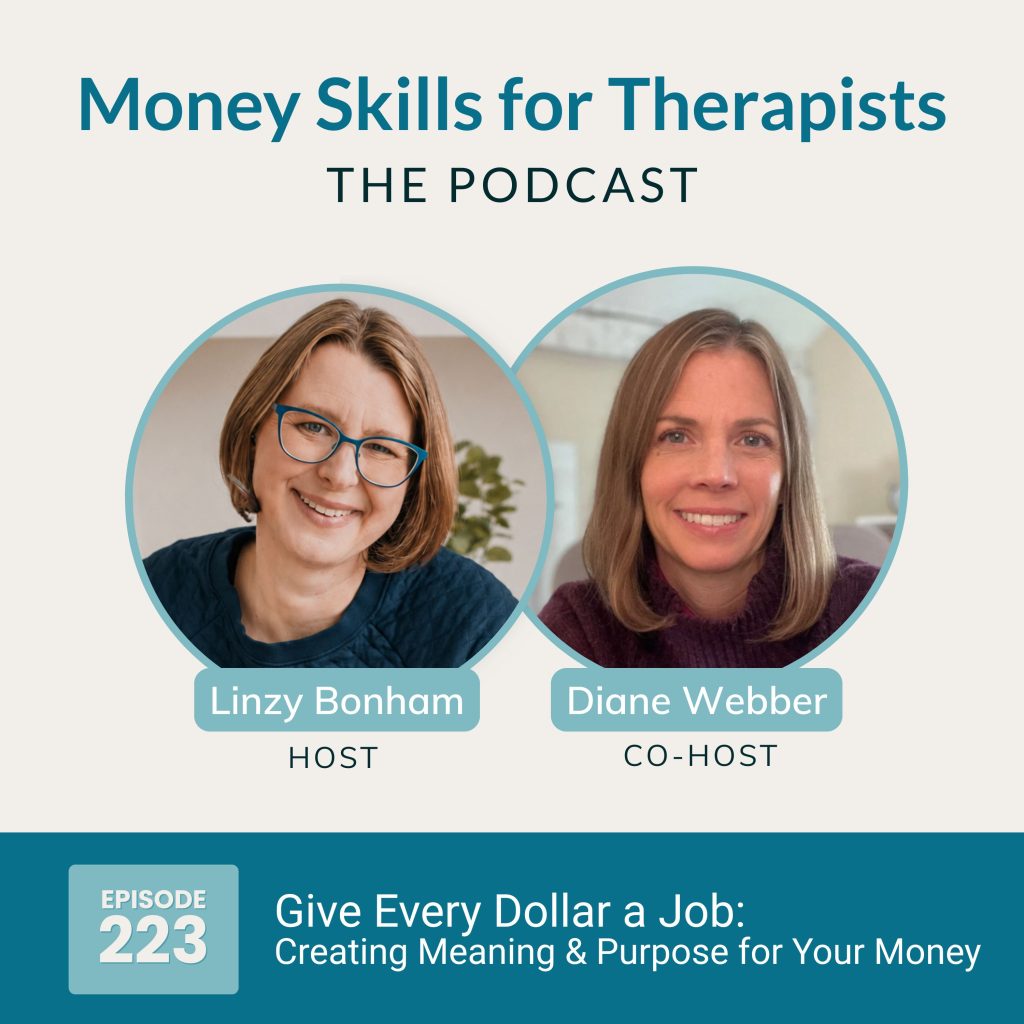
Today’s episode is a conversation between me and Diane Webber. Diane is a financial therapist, and she is my co-coach, I wanted to say.
Linzy Bonham 01:42
Kinda like a co-host, but a co-coach. She is my right-hand coaching woman inside Money Skills for Therapists, our program for, surprise, surprise, group practice owners.
Linzy Bonham 01:51
Today, Diane and I talk about the idea that money in itself doesn’t have much meaning, and we talk about how to bring money to life through investments, through ascribing meaning to it.
Linzy Bonham 02:04
We talk about this idea both philosophically… I was, I was feeling pretty philosophical when we recorded this episode.
Linzy Bonham 02:11
But we also talk practically about how do you actually make sure that your money is doing what you need it to do and not just sitting in a bank account, and you’re kind of feeling frozen, like it’s not really yours.
Linzy Bonham 02:23
Money can be so powerful when we know what we wanna have happen, and we make our money reach that goal, when we make money active and have purpose and meaning.
Linzy Bonham 02:34
But it can also be stressful and just bring a lot of haze and confusion when we have money, but we don’t actually know what it’s for.
Linzy Bonham 02:44
Here is my conversation with Diane Webber. Diane, welcome back to the podcast.
Diane Webber 02:56
Linzy. Great to be here.
Linzy Bonham 02:57
I’m thinking about this as, like, a new kind of segment that we’re doing on the “Money Skills for Therapists” podcast. As we were talking about earlier, it’s, uh, my, my joking title for right now is “Linzy and Diane Talk About Money.”
Linzy Bonham 03:07
Yeah, and that’s what we’re gonna do today. Thinking today about investment, purpose, meaning. Those are our words, I think, to anchor the things that we wanna jam on today.
Diane Webber 03:20
Okay.
Linzy Bonham 03:20
So the first thing that I was thinking of, and we chatted about this a little bit before we started recording, I think my starting concept for what I want to play with today, the ideas I want to play with is money doesn’t actually have meaning on its own.
Diane Webber 03:34
Mm-hmm.
Linzy Bonham 03:36
It’s, it’s almost, like, inert.
Diane Webber 03:38
It is, yeah. It’s a tool.
Linzy Bonham 03:40
It’s a
Diane Webber 03:41
It’s a tool.
Linzy Bonham 03:42
But a tool that you don’t use just sits there, collecting dust.
Diane Webber 03:47
Yep.
Linzy Bonham 03:47
And something that I see sometimes with our Money Skills for Therapists and Money Skills for Practice Owners students, and this is one of my favorite problems to help people solve,
Diane Webber 03:56
Mm-hmm, mm-hmm.
Linzy Bonham 03:58
We get on a coaching call, and maybe they, they’ve been in the program for a while.
Linzy Bonham 04:03
Often I have, it feels like they might be, like, struggling financially. I’m kind of, like, expecting to see a bank account that has, like, you know, $2,000 in it and bills are coming out.
Linzy Bonham 04:12
And then it turns out that they have, like, $50,000 in their bank
Diane Webber 04:17
Just hanging out.
Linzy Bonham 04:18
Just hanging out.
Diane Webber 04:19
Looking for a job.
Linzy Bonham 04:21
Exactly, exactly. And usually I have no idea that the $50,000 is there, and sometimes it’s 90, sometimes it’s 100,000. You know, like, you know, we’ve worked with lots of folks over the years.
Linzy Bonham 04:30
But I have no idea that it’s there because the therapist who has that money doesn’t really feel like it’s theirs.
Linzy Bonham 04:38
They don’t have any ownership over it.
Diane Webber 04:40
Right. Right.
Linzy Bonham 04:41
It’s just sitting there.
Diane Webber 04:42
It’s the business’ money.
Linzy Bonham 04:44
Yeah. And I think this is common for folks who have more of, like, a hoarding and freeze.
Diane Webber 04:49
Mm-hmm, mm-hmm.
Linzy Bonham 04:51
Around money, which is something that when we first started teaching, when I, when I created this course in 2018, I was really thinking about and first serving and meeting the folks who were spending all their money,
Diane Webber 05:02
Right. Yeah.
Linzy Bonham 05:03
Who had no money, right? The folks who were like, “I make all this money. Where does it go?” And a lot of our marketing materials at that time, and even up until just, like, a year ago, were geared more towards that pain point, which is like, “I don’t know where my money goes.
Linzy Bonham 05:14
You know, my money comes, my money goes. I’m making more money than ever, and I feel just as broke as I ever was.”
Diane Webber 05:19
Right. And I’m not paying myself. Like I don’t know where the money’s going. It’s coming in, it’s going out, and yet I’m not… I’m struggling at home.
Linzy Bonham 05:27
Yes. So it’s almost like money that’s velocitized.
Diane Webber 05:29
Right. Yeah.
Linzy Bonham 05:30
It’s money that moves so fast that it has no meaning, and the person is like, “I don’t know where it went.” And sometimes it is coming home to them, but it’s like they’re taking it in little bits and spurts.
Linzy Bonham 05:40
So it’s not actual paychecks. It doesn’t have intention. It’s just kind of like, oh shit, my mortgage is due. I’m gonna pull it from the business. I need to pay for groceries.
Linzy Bonham 05:48
I’m gonna pull it from the business. So often people will tell me, “I, I don’t have a paycheck. I don’t get paid from the business.” But then we look, and we’re like, “Well, you do get paid from the business,” but it’s in these little bits and spurts.
Linzy Bonham 05:58
So that’s kind of this money that’s like fast, fast-moving.
Diane Webber 06:00
And it’s coming to pay a bill, so it doesn’t feel like a paycheck. Yet if you worked for someone, you would get a paycheck and you would
Linzy Bonham 06:07
Yeah, they wouldn’t just pay your bill for you. Right.
Linzy Bonham 06:09
So that’s, that’s the kind of person that I feel like I, or the kind of problem, I should say, ’cause it’s not a kind of person, it’s just a kind of behavior or relationship with money that I was really thinking about when I first created Money Skills for Therapists.
Linzy Bonham 06:20
But more and more over the years, we see this, like, second kind of problem, which is all this money sitting, that the person, the therapist is scared to touch.
Linzy Bonham 06:29
They don’t know what to do with it.
Diane Webber 06:31
Yep.
Linzy Bonham 06:32
Right? And that’s where, yeah, this central idea that I wanna talk about is, yeah, money on its own has no meaning. We need to give it meaning for it to do anything, right?
Linzy Bonham 06:42
So like $90,000, for instance, I saw recently in somebody’s bank account, $90,000 sitting in a group practice, probably it’s a group practice where we see this more,
Diane Webber 06:50
Mm-hmm. Sure.
Linzy Bonham 06:51
That has no purpose, can feel almost like, a burden. It’s somebody else’s money.
Linzy Bonham 06:59
It’s confusing. It’s like, “That can’t be mine. That’s gonna be taken at any moment.” But what we help people do is create meaning with that money.
Diane Webber 07:08
Absolutely. Right, like what’s its function?
Linzy Bonham 07:11
Yes.
Diane Webber 07:11
What is it for?
Linzy Bonham 07:12
And I’m curious, for you, when you’re sitting with somebody and you see this kind of thing where the money doesn’t, money’s just there, what comes to mind for you first in terms of helping them start to shift their relationship with it?
Diane Webber 07:25
One of my favorite phrases that I picked up from the course was to give every dollar a job, and, um, so helpful for me personally, professionally, and in my coaching to remind our students that each dollar has a function, it has a purpose.
Diane Webber 07:40
Like, what is it for? And so when there’s a big chunk of money sitting in an account, it’s very hard for our students to say that, you know, that’s to cover my EHR system, or that’s to cover, um, my next payroll, or that’s PTO time, or… So to start to even, um, you know, have had conversations where I’ve suggested renaming an account.
Diane Webber 08:02
That’s where Profit First can be so beneficial to not only separate the dollars, but actually list their purpose, makes a big difference in being able to identify what it’s for and also maybe when it’s gonna go.
Diane Webber 08:16
You know, like quarterly taxes, for example. That money is set aside for taxes, and it’s going to go out in quarter three. Or this money is set aside for a new computer that I’m going to buy in December.
Diane Webber 08:28
All of a sudden, now the dollars have a function and they have a purpose, and they might even have a timeline.
Linzy Bonham 08:33
Yeah. Yeah. And that more granular kind of budgeting, I think that’s more how you budget too personally, right? Am I right about that?
Linzy Bonham 08:40
Yes. So yeah, tell me about how you create meaning and purpose for your dollars. What is your system?
Diane Webber 08:47
So I’m a huge fan of Profit First, and I use YNAB as well for budgeting to kind of delineate what, the dollars are for and what the accounts are for.
Diane Webber 08:56
And I think in my business, it’s a lot easier to name what the dollars, what their function will be.
Diane Webber 09:04
So operating expenses, salary, taxes, retirement, those are pretty easy to delineate. Where it’s been a lot harder is in my personal life in terms of, um, let’s say a family vacation.
Diane Webber 09:17
Um, if I, if I name an account family vacation and I put, let’s say, $50 a month into it, um, I don’t wanna spend it.
Diane Webber 09:25
But this summer we went to the Adirondacks, so I renamed it Adirondack Trip, and all of a sudden now that money has much more concrete purpose and function and timeline so that I feel much more comfortable with it leaving the account to buy the groceries that we’re gonna take with us on our camping trip, um, because that account was labeled in a very specific way.
Diane Webber 09:48
And it’s been amazing when I’ve made that suggestion to our students how they, it’s like a light bulb. They’re like, “Oh.” I said, “When you name the account for its very concrete purpose, it gives it a very different life.” And so I do that a lot in our, in our personal lives.
Diane Webber 10:05
Um, property taxes, oil, things like that that are harder for me to save for because they’re bills, and they’re bills that happen every so often, and they’re not necessarily fun to pay, but I know I have to pay them, and I have to have money available when it comes.
Diane Webber 10:19
Um, that helps me a lot in terms of our, our family finances.
Linzy Bonham 10:24
Yeah. And we also, we use YNAB in our family finances. I don’t use it in our business. So that, that gives me pause too, thinking about, I do agree that personal finances are harder than business finances.
Linzy Bonham 10:37
And I often say to our students now, when you’re building your financial skills, your business is actually a great place to start. ‘Cause your business is, first of all, it’s generally just yours.
Diane Webber 10:48
Right.
Linzy Bonham 10:49
That in itself is huge, right?
Linzy Bonham 10:51
So it’s like, it’s just, you know, I think of it as like a sandbox where you can learn and build skills, your business, because the money, there’s a more limited amount of purposes, there’s a more limited amount of interests, and it’s just you making that decision.
Diane Webber 11:04
And there’s one
Linzy Bonham 11:05
Yes. At home, if you’re making the decision with somebody else, then there’s somebody else’s emotions, money stories, priorities coming into the mix.
Linzy Bonham 11:15
And some couples have figured out how to talk about money, and some couples have not yet done that.
Linzy Bonham 11:21
Um, and this is where I love approach of like Ed Coambs, for instance, who thinks about, you know, all of the dynamics that are happening in a couple around money that make money hard.
Linzy Bonham 11:30
And, you know, with his, his knowledge of that couple work, he can like, you know, I feel like he almost like sees all the layers that are happening, um, around couples and money.
Linzy Bonham 11:38
But our business finances are simpler.
Diane Webber 11:42
Absolutely. Yeah. Yep. Yeah.
Linzy Bonham 11:43
Cleaner. So I find at home I have to do more granular budgeting ’cause there’s just more jobs for the money to do, and the jobs are not as fun.
Diane Webber 11:51
Right. Right.
Linzy Bonham 11:53
You know, my like $650 property tax bill that I pay each month, which is higher because, you know, we got a grant from the city to put in a, a heat pump at no interest, which all makes sense, but like all these bills add up.
Linzy Bonham 12:05
I don’t get much joy from paying that bill. I think I could. I think that, you know, I, I know with personal budgeting, I’m thinking of people I know who’ve named their bills like staying warm.
Diane Webber 12:15
Yeah, I like that.
Linzy Bonham 12:16
You know?
Diane Webber 12:18
Cozy couch time.
Linzy Bonham 12:19
Exactly. That’s it, right? So, and, and then again, I think that’s what the art of creating meaning around money.
Linzy Bonham 12:24
You know, when we ascribe a meaning that’s negative where I’m like, “Ugh, that goddamn property tax bill,” you know, it is joyless and kind of mechanical, and I can resent it.
Linzy Bonham 12:36
If I connect to the fact that I’m like, I live in a beautiful city that has incredible parks. I’ve been really noticing that this summer.
Linzy Bonham 12:42
I’ve been taking my son to different places in our city, just parks we haven’t been to, facilities, and I’m like, Guelph, Ontario has incredible facilities, and that’s what my property tax is paying for.
Linzy Bonham 12:52
If I could connect to that, where it’s like owning my little slice of paradise plus pump track, splash pads,
Diane Webber 13:00
Yes. Yeah.
Linzy Bonham 13:02
I think I would feel a lot more joy around paying that property tax bill, um, again, you know, because I’m focusing in on what actually gives it meaning to me.
Diane Webber 13:11
Yeah, and also if, if, if we sort of muscle through the, the less fun things, it means there’s room then for those fun things.
Diane Webber 13:20
So if I’m, a bit more conscientious about my property taxes, then I know how much I have for my next camping trip.
Linzy Bonham 13:25
Mm-hmm.
Diane Webber 13:26
Or our next trip to Europe, which we started talking about, and I was like,
Linzy Bonham 13:30
Family… Yes. I am not at the trip to Europe stage. I’m at the Great Wolf Lodge stage of parenting.
Diane Webber 13:36
Right.
Linzy Bonham 13:38
But I’m
Diane Webber 13:38
Yep.
Linzy Bonham 13:39
Will be probably about 10 years from now.
Diane Webber 13:41
And we’re, we’re at that we’re running out of time stage with a 20-year-old and a 15-year-old. It feels like we gotta try to squeeze in at
Linzy Bonham 13:47
Oh, I remember those years when my parents were… I could tell they were, like, squeezing in every trip they had before they lost our attention.
Diane Webber 13:54
Yep. Mm-hmm.
Linzy Bonham 13:55
Cause then the other piece of giving a dollar every job is it makes me think about the potential of every dollar. All right, we just talked about how sometimes, like, dollars become kind of inert, and they’re sitting there, and they have no purpose.
Linzy Bonham 14:06
And that problem or puzzle that we’re referencing where somebody has a lot of money, I love those coaching sessions because then, like, it makes me like, “Heh heh,” like rub my hands.
Linzy Bonham 14:18
I’m like, “Let’s go.” Because once we think about the jobs that dollars have to do, and in a business those jobs tend to be, you know, that buffer, you know, an operating expense buffer so that if you have to step out to, like, take care of your mom for a month, you know, your rent is just covered.
Linzy Bonham 14:33
You don’t have to, like, start drawing from your personal money to pay for those regular business expenses. A two to three-month operating expense buffer for most people is gonna be, like, maybe $10,000 max.
Linzy Bonham 14:45
If you’re working at home, it’ll be a lot less than that. So that’s kind of, like, one job the money does.
Linzy Bonham 14:51
Then having a payroll buffer. If you’re a solo practice owner, this is your PTO.
Linzy Bonham 14:54
Payroll buffer is where you can still pay yourself that beautiful regular paycheck that we talk about a lot when you’re off on vacation or you’re taking care of somebody, your kiddo is sick.
Linzy Bonham 15:03
But often what I find is once folks look at their business… Oh, and taxes of course.
Linzy Bonham 15:07
I think the category that gives people the least joy and can feel the least meaningful, especially during politically fraught times.
Diane Webber 15:14
Yes.
Linzy Bonham 15:15
That’s one that can certainly, um, bring up a lot of feelings for people, and I think where we have to really search for meaning and being able to connect with why paying taxes can be personally meaningful.
Diane Webber 15:26
Mm-hmm. Yes. Yep.
Linzy Bonham 15:27
And not burdensome. And I know for me, I just think about… I live in Canada, so I think about the public education system. I think that I can go to the hospital and have a baby and not have to pay for that.
Linzy Bonham 15:36
You know, I think about roads and all these kinds of things. Um, I have heard from a lot of Americans who struggle more with that paying taxes piece, with connecting with…
Diane Webber 15:46
Yes. Yep.
Linzy Bonham 15:48
How do you think about that as an
Diane Webber 15:50
Yeah. I really think of it as it’s not my money, like we often discuss in the programs, and that while I’m holding onto it to pay the government, I’ll put it in some sort of a container where it’ll earn interest, so I at least… You know, that sort of is a way that I can reconcile things.
Diane Webber 16:08
But I, I do think it’s very much informed by people’s political positioning, and so I think that’s just an important thing that I, I tend to keep in mind, both for myself and with people that I’m working with, that their position politically affects their practical pieces.
Diane Webber 16:25
And so then we just kinda lean in depending on where they are.
Linzy Bonham 16:28
Yeah. Yes. Yeah, ’cause I think when we have taxes, it’s basically like your tax money is going to whatever government is power at that time.
Linzy Bonham 16:32
So if you’re happy with the government at that time, you’re like, “Great, they’re doing great things.” And if you’re not happy with the government at that time, you’re like, “Yeah.”
Diane Webber 16:41
Right.
Linzy Bonham 16:41
But you know, I’ve, I’ve been trying to take more of a zoomed out view of history recently. Reading romantasy novels, I strongly suggest as a life choice.
Linzy Bonham 16:50
Something about romantasy novels, because they live in the fantasy realm, is often it’s about like kings and queens and kingdoms, and kind of like these bigger political forces.
Linzy Bonham 17:00
And that’s actually been helpful for me to just like zoom out and be like, yeah, power comes and goes. Different people are in the lead, but like countries and nations and peoples are much bigger than any leader at any given moment, right?
Linzy Bonham 17:13
Like there’s, these things are always shifting. So, you know, I’m, I’m starting to just feel this more like zoomed out, like I’m a tiny piece of history,
Diane Webber 17:19
Mm-hmm, mm-hmm.
Linzy Bonham 17:21
You know, I need to make my money meaningful for my life, do what I can to make the world a better place within my vision, but also not get too caught up in what’s happening at any given moment ’cause things are changing all the time.
Linzy Bonham 17:33
Um, that, that’s a little philosophical aside. Um, but I think about that with taxes.
Linzy Bonham 17:37
It’s like, you know, sometimes you’re gonna be paying into a government you love, sometimes you’re gonna be paying into a government that you don’t like, but ultimately you’re paying to live in this larger system that does all these incredible
Diane Webber 17:46
Absolutely. Yeah.
Linzy Bonham 17:47
That, you know, keeps us from all, you know, living under rocks. Uh, or like, uh, my cousin used the phrase the other day of like having to live in the rain.
Diane Webber 17:55
Ah, okay. Yeah.
Linzy Bonham 17:56
You know, when we don’t have these big restrictions, you just have to live in the rain, and that sucks.
Diane Webber 17:57
Yeah.
Linzy Bonham 17:58
Yeah.
Diane Webber 17:58
Yep. And you get through it. Well, and as employees, we just don’t see that part, so it’s like this has been going on all the time.
Diane Webber 18:11
It’s just as an employee, you just see your take-home pay, and you might see on the pay stub how much was pulled out for taxes, but you’re not intentionally doing it.
Linzy Bonham 18:15
Mm-hmm. As a business owner, you actually have to facilitate that handoff if you’re a solo practice owner. If you’re a W-2 or an employee in Canada, that’s actually just processed with your payroll and you don’t have to do it.
Linzy Bonham 18:26
But in solo practice you have to do it. So, okay, so after the taxes piece, we’ve delineated that in business the jobs are generally those two types of buffers that, you know, I encourage folks to work towards.
Linzy Bonham 18:35
Depending on your level of risk tolerance, maybe it’s two months, maybe it’s three for your personal paycheck, thinking about how much buffer you want to be able to take time off.
Linzy Bonham 18:42
But I don’t generally suggest leaving a ton in paycheck buffer for people.
Diane Webber 18:46
Yep.
Linzy Bonham 18:47
But then after that, if there’s more money, and after taxes, savings. Often sometimes people have money that’s also just, like, there.
Diane Webber 18:59
To put to work.
Linzy Bonham 19:01
Then you get to decide what the best job for that money is. And this is where I think we really get into the potential of money when we are connected with the meaning that we want to create.
Diane Webber 19:12
Yes.
Linzy Bonham 19:14
So in my own business, I know that money that I’ve had available, I love investing money in skills.
Diane Webber 19:21
Mm-hmm. Yep, yep.
Linzy Bonham 19:25
I love paying people to teach me something that would be so painful for me to learn and that is, like, not in my wheelhouse, and that will probably never be the thing that’ll bring me joy, but that I have to have as part of my business.
Linzy Bonham 19:36
Usually for me, that’s been like marketing or, you know, I’ve taken, I’ve taken programs about operations over the years. But I love paying people to save me three years of suffering and just teach me a system, an approach, and a way of thinking about something that solves a problem for me.
Linzy Bonham 19:53
That’s certainly an area that I love spending money.
Diane Webber 19:55
Same. Yeah. Yeah. If I were better at this skill, how would that mean my business runs more smoothly with more ease? Or where I can focus on the things that are more fun because I’ve gotten a skill that is normally kind of clunky or
Linzy Bonham 20:10
Yes. Yes.
Diane Webber 20:12
Sharper at that means all these other pieces can run.
Linzy Bonham 20:16
Yeah, exactly. ‘Cause I
Diane Webber 20:16
A more enjoyable way.
Linzy Bonham 20:18
Think business is really just a series of skills that you have to master, right? ‘Cause there’s, there’s a series of functions that have to happen. And if you’re a large corporation, then you have, like, somebody who is the finance department, and you have somebody who is the marketing department.
Linzy Bonham 20:30
Well, you have dozens of people in those departments. When we are a solo practice owner, we are all of those departments.
Diane Webber 20:36
Right.
Linzy Bonham 20:37
So there’s a lot of skills to learn. If you’re a group practice owner, you need to learn the skills enough that then you can bring the right people on to implement and know enough to know if they’re doing a good job or not or be able to work through and, and make sure that what’s happening is within the vision and values of your business.
Linzy Bonham 20:52
But when we think about business as just a series of skills to learn, you can at any time use your dollars and turn them into skills to solve a problem, and then you just get to move on.
Diane Webber 21:05
Yeah.
Linzy Bonham 21:06
And that’s really powerful. Like, I’m curious for you, what are some of the investments you’ve made in your business where you’ve taken money and turned it into a skill or learning that, like, you still are grateful for?
Diane Webber 21:18
I think the, the, the two best for my business were coaching experiences, six-month coaching experiences where I was in a small community and, um, learn, I really, I learned how to be more confident about my business.
Diane Webber 21:37
And how to, and within a community of other solo practice owners, to kind of just learn, like, to get grounded in what I do and why I do it.
Diane Webber 21:47
And how do I talk to people about it, and where do I need to focus on, practical skills, and where do I really need to focus on just, um, trusting myself.
Diane Webber 21:54
And that was your, your coaching program, Money Boss, was huge, and also Money Skills for Therapists, so both of those were huge in that capacity.
Diane Webber 22:03
And then I did another one with Lindsay Bryan-Podvin, which was also wonderful, um, just focusing on, you know, strengths as a solo practice owner and confidence in your fees and confidence in managing the business and in talking to people about it.
Linzy Bonham 22:17
Yeah, and I also, you know, at this point I’ve invested in so many programs that I’m like, you almost forget, like I almost forget that there were things I didn’t know how to do.
Linzy Bonham 22:27
But I invested… The first thing I did when I got back from my maternity leave and went full-time into this business, didn’t go back into therapy, was I invested in a program that helped me build out an automatic sales funnel.
Linzy Bonham 22:36
‘Cause I already had Money Skills for Therapists, and I was like, “I wanna do this full time. How do I make this work?” So I spent a ton of money in a program to teach me how to do that, and that, that funnel that I built, because I actually followed the investment with action, ’cause this is key to investments.
Linzy Bonham 22:54
Spending the money doesn’t actually solve the problem. Spending the money gives you access to the solution that you have to implement. So for that particular program, even though there were aspects of it that I didn’t like, like it wasn’t like I was like, “These are my people.” It wasn’t like that.
Linzy Bonham 23:07
Um, it’s like, you know, it’s hard for me to find people that I feel like are my people. But what I learned in that program, that funnel of being able to sell Money Skills for Therapists automatically, which is now a funnel that we’ve shut down, by the way, made more than a million dollars.
Diane Webber 23:23
Mm-hmm.
Linzy Bonham 23:23
A few years, which is incredible. So it’s like I spent $18,000 Canadian… No, no, sorry, $18,000 American, which is about 22 or 24 something thousand Canadian.
Linzy Bonham 23:35
And then Tiffany McLain and I were in that course together. We both upgraded to this like higher level, so then it was $2,000 American a month. Um, it feels so painful when you’re, when you’re paying it if you’re not implementing, ’cause it can, it feels, it can feel like you’re bleeding out, right?
Linzy Bonham 23:52
If you’re not actually participating. But when you do make an investment like that and you actually follow the money with action, and you show up, and you take it seriously, and you make it your job to implement everything you’re being told, it’s like my return on investment from that program… Can we do the math?
Linzy Bonham 24:08
Let’s do some math, friends. Yeah, okay, let’s, let’s just say that I paid 24,000 for that program, American dollars, so I’m gonna convert it to Canadian dollars. Okay, so it’s about $33,000 Canadian.
Linzy Bonham 24:19
If I take…
Diane Webber 24:20
Okay.
Linzy Bonham 24:21
And a million is… I, I know, I know we’ve hit a million. But if I… You know, it’s probably a little bit more than that. But if I divide it, it’s a 30 time return on investment.
Diane Webber 24:30
Wow.
Linzy Bonham 24:31
So for every dollar that I spent in that course, I got $30 back. Like, there’s nothing you can do in life that gives you that kind of return outside of business.
Linzy Bonham 24:41
And this is why I think business is so cool and exciting. Like, when I think about that investment and I think about myself coming out of mat leave hazy,
Diane Webber 24:50
Mm-hmm.
Linzy Bonham 24:51
Being like, “What is happening? What is life?” just getting back into doing the work and, like, betting on myself really is what I did. I had some money left in the business.
Linzy Bonham 25:00
I didn’t, I didn’t have income. I wasn’t even running Money Skills for Therapists at that time. I came back in January. Rodrigo and I worked together in this course, implemented it.
Linzy Bonham 25:10
I, like, bet on myself, and out of that, starting that investment, I’ve built this whole business that now allows me to work with incredible people like you, right?
Linzy Bonham 25:20
We have Linds doing full-time marketing. Now I’ve been able to bring in Clinton, who’s my, like, sees-the-matrix genius friend who, like, just brings us this completely different perspective.
Linzy Bonham 25:29
Rodrigo can work for us. We both get paid out of the business every two weeks. I’m building a house.
Diane Webber 25:37
Yeah.
Linzy Bonham 25:37
Which is insane by the way. But like, I never would’ve thought that possible. But, that money that I invested and taking it seriously and like identifying the problem and following it built what we have now.
Diane Webber 25:50
Mm-hmm, mm-hmm.
Linzy Bonham 25:52
And I think if I compare that money, if I had left that money inert in the bank account
Diane Webber 25:56
Right.
Linzy Bonham 25:57
And was like, “Ugh, I don’t know what to do. Money’s not coming in. Get tight, get small, don’t spend it,”
Diane Webber 26:03
Yeah.
Linzy Bonham 26:04
I think I would still be in solo practice, which wasn’t really a fit for me.
Diane Webber 26:08
Yeah.
Linzy Bonham 26:09
Right? So like that, that to me is really powerful to reflect on my own decision and growth and yeah.
Linzy Bonham 26:16
Like what those dollars have turned into.
Diane Webber 26:18
Yeah.
Linzy Bonham 26:18
Is phenomenal.
Diane Webber 26:20
And I’ll add to that, that when I was making my decisions, it wasn’t just the skill I wanted to build but who I wanted to learn from.
Diane Webber 26:29
And, that’s a really important piece because it’s like you find someone that you respect and admire who has something to offer and I could… I, you know, in every case it was like, “I wanna learn from this person.” And so there’s, there’s a couple big pieces there.
Diane Webber 26:44
There’s the, the what do I wanna learn? Who do I wanna learn it from? And also, what am I willing to put in? So in, in all of the, the three cases that I’m thinking of, they were big investments financially for me in a small business practice where I paused to ask myself like, “Are you… Yes, I wanna learn from this person.
Diane Webber 27:05
Yes, I wanna do this.” And what are you willing to put in because you’re paying a lot for it? And I’ve noticed the same thing now on the other side as a coach that our students who not only commit their dollars but they commit their time and attention and interest in the learning get so much out of it.
Diane Webber 27:27
And talking with our graduates is all evidence of that. You know, to learn from both Money Skills for Therapists and our group practice owners what they’ve taken away is like it gives me chills.
Linzy Bonham 27:38
I know. I know. And there, there’s always that classic thing of like you get out what you put into it. And we see that, right? Like we’ll see the folks who just like show up and they’re there and they come to every call and they just like commit, right?
Linzy Bonham 27:52
On multiple levels. They’ve financially committed but they’ve also committed their energy and they’ve committed, if they come across hard things, to keep going. And that’s not easy, right?
Linzy Bonham 28:00
Like I, I don’t want to understate how challenging it can be to learn certain skills, right? And like the things that we need to overcome internally to be able to do certain things.
Linzy Bonham 28:10
Like for me the challenge of, of being seen, like the fear around that coming from childhood trauma where being seen was not safe and being present on the internet and like all the fears I had of like trolls and, you know, and we have before had it because my husband is a politician.
Linzy Bonham 28:27
We have been doxxed before, you know, and had people like be threatening and come by our house and it’s fucking scary.
Diane Webber 28:37
Yeah.
Linzy Bonham 28:37
But what I’ve had to overcome to be able to do this has been probably like the greatest change I’ve made in my life to just get to be myself and be like, “Yeah, this is who I am.
Linzy Bonham 28:49
And, and you might like me, and if you like me, I probably like you too, and it’s probably gonna be amazing.” And I’m so excited and honored to work with the folks that we get to work with, ’cause they’re such fucking phenomenal
Diane Webber 29:00
They are. Yeah. Yeah.
Linzy Bonham 29:01
And then there’s other people who are gonna be like, “Nah, I don’t like her.”
Diane Webber 29:04
Yep.
Linzy Bonham 29:04
That’s fine.
Diane Webber 29:05
Okay. Yeah. Yep.
Linzy Bonham 29:06
To a party, not everybody there is gonna be somebody you wanna talk to. That’s just how humans work, right? If I think about the people I went to high school with, you know, there’s probably, like, 100 people in my grade, and probably, like, 12 of them I feel really positively about, and
Diane Webber 29:17
Right. Yep. The rest you’re like, yep.
Linzy Bonham 29:20
Yeah, you were there.
Diane Webber 29:21
You do things, I’ll do mine.
Linzy Bonham 29:22
Right? But for me, the personal growth I had to go through to be able to just take up space and be seen and realize that I can be big and be safe has been huge growth, and it has changed so much about my life beyond money.
Linzy Bonham 29:36
But money’s also been part of it, ’cause even if I think about this house, I’ve been thinking about the, the second story. We’re putting a second story on our house. We bought a cute little house.
Linzy Bonham 29:43
We had a… My dad, now that we’re rebuilding the house, is being more honest, and he’s like, “It was a cottage, not a house.” And it kinda was. It was, like, really awkward.
Linzy Bonham 29:49
Like, you came in the front door. The main bedroom was right to the right of the front door. It’s kinda weird. You know, like, it was a cute little quirky house, and that suited who we were when we got married and we first bought that house.
Linzy Bonham 30:01
And I was like, “Cute is good. Small is beautiful. This is who I am.” But I have noticed, like, as I’m bigger personally and taking up more space, like, I’m literally now taking up more space in the world.
Linzy Bonham 30:11
Like, I’ve make my house twice the size. And not everybody likes that, to be clear. Not all my neighbors are thrilled about these choices, right? Like, when you take up more space, people will have feelings about you.
Linzy Bonham 30:23
Um, but it’s been interesting for me to observe the almost, like, physically manifesting the emotional changes that I’ve made in this house construction project and be like, “We are gonna have space, and we’re gonna make it beautiful, and we’re gonna make it what we want, and we’re gonna live here for 30 years, and we’re gonna raise our son, and maybe we’ll raise some other kids too.
Linzy Bonham 30:39
Um, and we’ll be the house that hosts sleepovers,” you know, um, is really powerful, and I would not have ever thought that I would do that, and I wouldn’t have been able to do that, you know, 10 years ago
Diane Webber 30:51
Yeah.
Linzy Bonham 30:51
Building this business.
Diane Webber 30:53
Yeah, Yeah, it’s really interesting. What I’m hearing is that, like, allowing yourself to be courageous in your business has allowed you to be much more courageous in your life as
Linzy Bonham 31:01
Yeah. Yeah, that’s absolutely true. Yeah, I’m, I, like, I’m curious for you, what have you seen shift and change as you’ve made investments and, like, shown up and yeah, yeah, followed meaning in your life?
Diane Webber 31:15
I am so much less fearful. I trust the unknown, with a little less anxiety. I’m naturally an anxious person, so I just… Like, my brain’s always looking for something to worry about.
Diane Webber 31:25
And, um, we tend to joke about it a bit in our household, which is nice. But, you know, there’s a lot of like, “I don’t know, but I know I’ll figure it out,” because I have, and I have again and again.
Diane Webber 31:38
And so, like, I’m excited to, to, make some big investments into our home. I’m excited to support my spouse to be able to paint more.
Diane Webber 31:49
He’s an artist and a painter, and it’s very hard to do that work when you don’t have a big chunk of time. And you know, if… So when we have conversations, it’s much more I’m… I don’t feel burdened.
Diane Webber 32:00
Instead, I feel excited, and I feel curious, and I think, “Well, I don’t, I don’t quite know, um, but we’ve done, we’ve done a good job so far, and I trust that we will continue to do that.” Um, even when I look at my buffers, for example, I’ll stop and go, “Well, how much have you actually had to pull any given time?”
Diane Webber 32:19
You know, so how much do you… You know, it’s comfortable to have a certain amount. That’s good. But also, how much have you actually had to pull at any given time? And then when you pull it, then you replenish.
Diane Webber 32:29
And so it’s really allowed me to, to pull more out of the business to put into our household for things like new roofs on the, on our old farmhouse or, um, with confidence rather than like, “I hope, I hope we make it,” you know?
Diane Webber 32:44
Which has been so nice. Um, it’s just really allowed me to like show up in the day in a much nicer way.
Linzy Bonham 32:51
Yeah. Yeah. In my time that I’ve known you, ’cause like when, when did you do Money Skills and Money Boss? Where…
Diane Webber 32:57
Skills was 2022, and Money Boss was 2023. Or it might’ve been ’21, ’22.
Linzy Bonham 33:04
Okay, right. Yes. Yes. Okay, so it’s been four years, and what I’ve noticed about you is your energy is so much sparklier now. You sparkle.
Linzy Bonham 33:13
Diane sparkles, people who can’t see her, she does. And lighter.
Diane Webber 33:18
Yeah, yeah.
Linzy Bonham 33:19
You know, like I think when when I first met you, you were much more energetically contained,
Diane Webber 33:23
Yeah.
Linzy Bonham 33:24
Like smaller in terms of how much space you take up, and now you’re much sparkier.
Diane Webber 33:30
Mm-hmm. Yeah, I have, I feel like a lot more things are like, it’s gonna be fun. Like, that’s my… Like, I don’t know. We were talking about our retreat that’s coming up, and I was like, “I’m not even quite sure what we’re doing on Friday, but I think it’s gonna be great.”
Diane Webber 33:47
And Saturday, Saturday’s gonna be amazing, and I just, I know I’m gonna be there, and I’m gonna, I’m gonna be helpful.
Diane Webber 33:49
I’m just not quite sure how yet.
Linzy Bonham 33:51
And the trusting the unknown. Yeah.
Diane Webber 33:53
Yeah.
Linzy Bonham 33:53
About just like working for me.
Diane Webber 33:55
That’s, yeah.
Linzy Bonham 33:55
It’s like.
Diane Webber 33:58
I’m gonna
Linzy Bonham 33:59
Like, yeah. I’m like, “I’m gonna do, I’m gonna do mom camp and the cottage right before we go on a massive event that we’ve never done before.”
Linzy Bonham 34:09
But yeah, the trusting the unknown, that’s so what it is ’cause I, you know, as we’re recording this, we’re just on the eve of leaving for British Columbia.
Linzy Bonham 34:12
We’re doing a couple in-person events, which are so exciting. It’s the first time we’re doing in-person events, and a big part of why we’re starting in British Columbia is because British Columbia has this grant that covers 80% of the cost of Money Skills for Group Practice Owners.
Linzy Bonham 34:24
So for folks who are group practice owners in British Columbia, if they wanna join us in Money Skills for Group Practice Owner program, the, there’s a grant that covers 80% of the cost of that program, which is incredible.
Linzy Bonham 34:33
Um, and we don’t know how long that grant will be around. So we’re, we’re just really trying to like make group practice owners in British Columbia aware that like we exist, this program’s incredible, and you get it as a steal.
Linzy Bonham 34:42
Um, but yeah, the trusting the unknown ’cause it’s also trusting yourself, right? At the end of the day, it’s trusting that you can handle it, and I’m noticing that with the BC event.
Linzy Bonham 34:51
Like it’s been… You know, I’ve had lots of health issues this summer. I have chronic migraines. They’ve been getting worse, so it’s not like I’m like at my best. But I know that we’ve got the right container in place.
Linzy Bonham 35:02
I know we’ve got a team. Clinton’s been working logistics. There’s gonna be amazing food. There’s gonna be rentals. There’s gonna be this. And I just trust too that like we’re very competent, and we’ve laid out, you know, I’ve laid out a framework for what we’re gonna do, but I also know when we show up, we do great work.
Diane Webber 35:15
Yep. Yep. Mm-hmm.
Linzy Bonham 35:18
You know? Like, even though I don’t know exactly what it’s gonna look like down to the minute, um, although I will by the time we get there, by the way. Um, yeah, trusting ourselves.
Linzy Bonham 35:26
And I feel like the same thing, you know, going back to kind of that metaphor of the, the house that we’re building. You know, I was talking to my dad the other day. My parents are having feelings about the house, of course.
Linzy Bonham 35:34
Um, they’re like, you know, I just… My dad was like, “I just feel nervous,” like, “You’re really vulnerable.” And I was like, “Yeah, we are vulnerable right now. But also like we will figure it out.” Like if something comes up and there’s an extra $50,000 expense, we will figure it out.
Linzy Bonham 35:45
And like, and if we have to have a student live with us for a couple years to throw some extra money in the debt, we’re actually like totally open to that, and we will figure it out. So when you trust yourself.
Diane Webber 35:54
Yeah.
Linzy Bonham 35:54
Life just becomes so much more expansive and fun and so much easier.
Diane Webber 35:58
It does. Yep. Yep.
Linzy Bonham 36:01
We’ve walked a lot of
Diane Webber 36:02
Yeah. And this is, such a great example of you and your own business saying, “I’m gonna invest in something.”
Linzy Bonham 36:09
Yeah.
Diane Webber 36:09
There’s, you know, I’m gonna look at the buffers, I’m gonna make some conscientious decisions to shrink them with intention, with intention, and here’s why.
Diane Webber 36:18
So it’s where that letting the, letting the money leave the station.
Linzy Bonham 36:22
True. So true.
Diane Webber 36:23
Purpose comes back to that, yeah, it comes back to that meaning, purpose, and
Linzy Bonham 36:28
Yes. And I think too, when you have sturdiness, when you have financial sturdiness in the business, but also when you have emotional sturdiness, you can also make mistakes and it’s fine.
Linzy Bonham 36:36
So it’s like last year, you know, we spent a lot of money for you and I to go to conferences, and it was fun. We got to meet in person, we got to talk to lovely people, but we discovered that going to conferences, not very profitable for us because often people have to be in our world for quite a while before they decide to work with us.
Linzy Bonham 36:51
So we put out a lot of money, and we did not get very much money back. I think we got two sales from spending $30,000. But
Diane Webber 36:58
You
Linzy Bonham 36:59
We know how to make money. We just refilled the buffers. We learned from it. We’re applying the best parts of it to this BC event where we do know people and there’s warmth and there’s like connection there already, and we’re just moving forward, and it’s totally fine.
Diane Webber 37:12
Mm-hmm.
Linzy Bonham 37:13
So there’s a durability there, like a, you know, resilience that we get when we’ve created stability financially but also internally.
Diane Webber 37:23
Absolutely.
Linzy Bonham 37:24
This has been fun.
Diane Webber 37:26
This has, yeah.
Linzy Bonham 37:27
It’s been a journey. Uh, Diane, what sticks out to you from our conversation? What are you taking away?
Diane Webber 37:31
Courage. Yeah. Like I think that idea about courage, like learning some practical skills, how that has supported this ability to be more courageous.
Linzy Bonham 37:39
Yeah. Yes. Beautiful. Thank you, Diane. This was really fun. And, uh, for folks who are listening, if you’re in British Columbia, you just missed us, because we were there, on the 14th and 15th of August.
Linzy Bonham 37:51
But if people listening are thinking about your own investments, you know, we, we have a program for solo practice owners. We’ll be running the next cohort in January 2027.
Linzy Bonham 38:00
We’re actually taking a break in the fall. We are not running Money Skills for Therapists in the fall. It’s a strategic decision that we’ve made. But you know, we had that program, and as we talked about, when people invest the money and then invest the time, it’s incredible what competent people can accomplish.
Linzy Bonham 38:14
And then we also have Money Skills for Group Practice Owners, which is starting in October, October 8th. And if you’re in BC, there’s a grant that covers 80%. You should reach out to us.
Linzy Bonham 38:22
We have a guide to fill out that grant that makes it easy-peasy. And that program’s incredible. I love, I love running that program.
Diane Webber 38:29
It is. It is so much fun. And then we also have our WhatsApp community. So if you are, absolutely, as you’re listening to this podcast, we have a WhatsApp community where we have, graduates of both of our programs, as well as new folks to our community who have a space to talk about our podcast, have a space to learn about upcoming workshops, have a space to talk with fellow solo practitioners, and a space to talk with fellow group practice owners.
Diane Webber 38:57
It’s very casual, but also very supportive, and there’s some great conversations that take place in there, and it’s
Linzy Bonham 39:04
Yes. And there’s more to come with that. We’ve been in summer mode, so I’ve been like mostly parenting. Um, but I’m excited for, I’m so excited for school.
Linzy Bonham 39:12
I was thinking about, I remember there was this like, there was a, a, it might’ve just been a Canadian company, Staples, that had this advertisement of, um, parents buying back to school supplies and the song like, you know, “It’s the Most Wonderful Time of the
Diane Webber 39:23
Ah.
Linzy Bonham 39:24
And I’m really feeling that. I’m like, “I cannot wait for school.”
Diane Webber 39:29
Yes. There is something delicious about routine.
Linzy Bonham 39:32
Oh my gosh. So in the fall, we are gonna be doing a lot more with that WhatsApp community. But yeah, folks in there are also just sharing inspiration and wins. Like it’s, it’s not a loud community, it’s a thoughtful community, which is exactly what, what we want in this world.
Linzy Bonham 39:45
So thank you.
Diane Webber 39:47
Oh, thanks for having me again.
Linzy Bonham 39:49
Thank you everybody for joining us today. I hope you enjoyed this conversation between Diane and I today. We covered a lot of ground.
Linzy Bonham 40:01
From the philosophical to the practical, giving meaning to your money and making sure that it actually does what you want it to do to make life better has a lot of different dimensions and facets that you can explore and play with and experiment with.
Linzy Bonham 40:15
Ultimately, a lot of money is about how we live money and how we do money, and by putting money into action, whether that’s through having different profit first accounts that you name in ways that are meaningful, whether it’s through identifying what needs to happen and making an investment and actually following your investment with action.
Linzy Bonham 40:34
It’s what we do and the meaning that we make of it that actually creates the impact of money.
Linzy Bonham 40:42
A million dollars sitting in a bank account that you feel like isn’t yours doesn’t actually make your life any better. But $3,000 that’s really clear that this much is for rent, and this is for the new wonderful sweater that you’re gonna buy, and this is for your kids’ music lessons, now that is money that has meaning and purpose, and that’s actually doing something in your life.
Linzy Bonham 41:03
We have a private WhatsApp community for Money Skills for Therapists, where we post each episode of the podcast each week, and there’s a space to actually talk about it.
Linzy Bonham 41:14
So if you listen to the podcast and you think it’d be really nice to get to now talk about, in this case, money and meaning and where it feels good to spend money, and how do you actually make sure your money is doing what you want it to do, you could join our private WhatsApp community and talk about this episode with me and Diane and the other lovely therapists in there.
Linzy Bonham 41:35
If you’re interested in joining our community, you can email us at hello@moneynutsandbolts, and we will give you the link to join. Thank you so much for joining me today.