Linzy Bonham [00:00:00]:
In 2026. At the time that we are recording this, things are looking pretty different. And the marketing that either used to work for folks or maybe they weren’t even doing marketing because they were just able to ride off of their local reputation, the networks they already have, many of those things are not working as well now as they were back through the COVID years. And I think we’re really starting to feel that now. Welcome to Money Skills for Therapists, the podcast that helps therapists and health practitioners in private practice go from money confusion and shame to calm clarity and confidence with their finances. If you’ve ever felt overwhelmed by numbers or avoided looking at your business money, you’re in the right place. I’m Linzy Bonham, therapist turned money coach and creator of Money Skills for Therapists. Before we jump in, I want to remind you of something really important.
Linzy Bonham [00:00:49]:
Most of us highly skilled and competent therapists and health practitioners were never taught about money. Not in grad school, not in supervision, not anywhere. And yet here we are running businesses that need to take care of us while we’re busy taking care of others. It is a lot of pressure. So if part of you feels anxious about money avoidant or like a bit of a hot mess financially, I want you to know that you are not alone. And I am here to help. Through my free live workshops each month, I teach practical financial skills to help you feel more grounded, calm and confident with your private practice money. You can see what’s coming up and save your spot to join live or register for the replay@moneyskillsfortherapist.com workshops.
Linzy Bonham [00:01:28]:
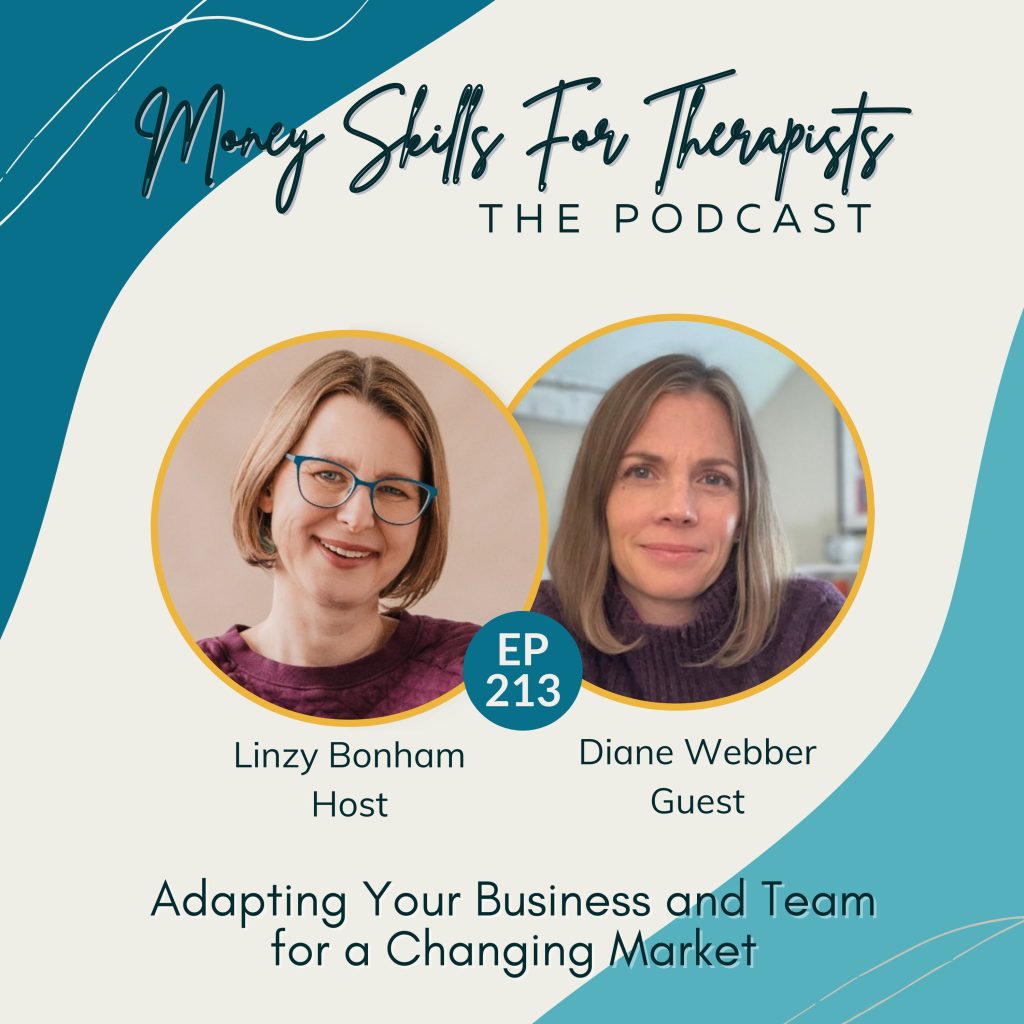
Let’s get started. Hello and welcome back to the podcast. Today’s guest is Diane Webber. Diane is my right hand coaching lady. I was gonna call her a lady. I don’t know if she identifies as such. She is my right hand coach in all of our programs. And today Diane and I talk about when you need to shift and pivot and change things in your business.
Linzy Bonham [00:01:53]:
We talk mostly about changes we’re making in our own business here. Money nuts and bolts slash moneyskills for therapists, which you’ll hear about that change in this conversation. The changes that we are making, kind of the attitude to hold towards change. How do we think about needing to explore or maybe change something you’ve been doing for a long time. The way that you market for therapists, it could be the way you set up your schedule, the way that you hire your team. There’s always so many things in our businesses that need to shift and change over time because as the economy shifts, as the culture shifts, as the places that people’s attention are shifts, and these things are changing constantly, we also need to change that we’re doing in our businesses, in our private practices, in our group practices, to keep getting the results that we want. So today is a little bit of a behind the scenes conversation with Diane and I sharing about the many, many, many changes we’ve been making over here in our business and talking about also how that connect connects to therapists and some of the things that therapists and group practice owners also need to be keeping their eyes on and might be needing to shift and change and play with as the world changes. Here’s my conversation with Diane Webber.
Linzy Bonham [00:03:08]:
So, Diane, welcome back to the podcast.
Diane Webber [00:03:10]:
Thanks, Lindsay. I’m glad to be here.
Linzy Bonham [00:03:13]:
I’m glad to have you here today. I’m excited for what we’re going to talk about and explore because something that I’ve noticed happening in the last, I’m going to say two years in private practice is a lot of our students are starting to find things that maybe used to work aren’t working anymore. And we’re finding people are like having a harder time filling their caseloads. For instance, that’s been a big one that we’ve seen, you know, as things are happening politically, we see therapists struggling with that. You know, the way that therapy is being done has been changing over the years and we thought that that would be a great reason to talk about change in business and some of the changes we’re making in our business.
Diane Weber [00:03:52]:
Absolutely. Yes, we are.
Linzy Bonham [00:03:54]:
So we’ve been rolling out a bunch of changes and we want to talk about those and kind of explore. When do you decide to make a change? What is that change? How do you decide what that change is? So let’s start by talking about some of the changes we’ve been making over here. For folks listening, you might know about this and you probably don’t because I find sometimes there’s a disconnect between the stuff that we get to talk about on the podcast and what we’re actually doing as me as the business owner, you as one of our team members over here at My Skills for Therapists, and I think that’s the first one I’m gonna mention is we’ve changed our outward facing name.
Diane Weber [00:04:25]:
Yes, yes. The website, everything. The team.
Linzy Bonham [00:04:29]:
The team. So my business is actually called Incorporation is for Money. Nuts and Bolts Consulting Incorporated. I know, right? So that’s a business name. And for years that’s been the name of our website. Has been moneynutsandbolts.com, our Instagram was moneynuts and bolts. And something that we started to notice is. That’s confusing.
Linzy Bonham [00:04:51]:
Nobody knew the name of my business. And our podcast manager even commented on that. When she has to go look up our Instagram, she has to stop and think about, wait, what is the name of their business? Because that’s the name of my company. But that’s not. Nobody knows that name. That’s not at all associated. Even our students probably don’t know that name. I remember back in the day when we started the course, people used to call the course the Money Nuts and Bolts course.
Linzy Bonham [00:05:14]:
Like Money Skills for Therapists. And I was like, oh, now I’m just confusing people. I’ve got a business name and a course name, but really, Money Skills for Therapists is what people are finding.
Diane Weber [00:05:23]:
Right. And that’s what we offer.
Linzy Bonham [00:05:25]:
Yes, exactly. That’s a name that says what it is. Yes. So now too, you know, I think part of what made us make this decision in terms of evolution, how you come to make a decision, is Rodrigo, my spouse, and I, who works for us in the business as well, got an office downtown and we had to decide what name to put on our door, which is kind of one of those moments when you’re like, wait a second, who are we? Who, who are we? And what I found by putting that new name on our door is folks look at it and they know what we do.
Diane Weber [00:05:54]:
Yeah. Yeah, I could see that.
Linzy Bonham [00:05:56]:
Right. So like therapists walk by and they like, back up and they’re like, oh, hey, I feel like I should talk to you.
Diane Weber [00:06:02]:
Oh, I need you.
Linzy Bonham [00:06:03]:
Yes. Whereas Money Nuts and Bolts didn’t mean anything. It was like a generic name.
Diane Weber [00:06:08]:
Yeah. It could apply to lots of different things, both professional and personal.
Linzy Bonham [00:06:11]:
That’s it. That’s it. It was more open ended. So that has been a change we’ve made. That is like one of those things that maybe I could have foreseen, but it just was an evolution.
Diane Weber [00:06:19]:
Right.
Linzy Bonham [00:06:19]:
Like, I started Money Nuts and Bolts Consulting. I started by doing private consulting work with people. Started the course soon thereafter. But the business has grown to become Money Skills for Therapists. No longer do I do like private consulting, you know, really? We have our. We have the podcast by this name, we have the course by this name. Then we have Money Skills for good practice owners for our GPOs. I did have somebody once tell me that someone who listened to this podcast contacted her, as, you know, heard the guest on the podcast contacted her and was like, oh, I heard you with.
Linzy Bonham [00:06:48]:
You were on the Money Skills Ladies podcast.
Diane Weber [00:06:51]:
Oh, okay.
Linzy Bonham [00:06:52]:
Okay.
Diane Weber [00:06:53]:
You’re the Money Skills lady.
Linzy Bonham [00:06:55]:
I don’t identify as a lady. For those of you listening, I was
Diane Weber [00:06:57]:
gonna say picture an apron.
Linzy Bonham [00:06:59]:
I know. Yeah.
Diane Weber [00:07:00]:
Maybe a floral dress.
Linzy Bonham [00:07:02]:
Lynn was saying. Our marketing and operations coordinator was saying she was doing some AI images of us the other day, trying to put two of us on an image. And AI gave me an earring, which I’m very offended by. I feel like that’s. That the Money Skills lady would have an earring. I do not.
Diane Weber [00:07:16]:
Maybe a dangly earring.
Linzy Bonham [00:07:18]:
Oh, it would be dangly, for sure. Yes. And that’s just not my gender identity. So that has been one change that we’ve made. And so, you know, for folks listening, it just makes it easier and clearer for all of us. Right. The podcast is Money Skills for Therapists. Our Instagram is Money Skills for Therapists.
Linzy Bonham [00:07:30]:
Our Facebook page, which we never use. Money Skills for Therapists. And then the course.
Diane Weber [00:07:35]:
So it’s like we’re.
Linzy Bonham [00:07:37]:
But that’s one of those things that I think, you know, when you set out in business, you don’t necessarily know what you’re building is going to really get traction.
Diane Weber [00:07:43]:
Right, right. And that’s just as true in private practice and with group practice as it has been here for us.
Linzy Bonham [00:07:49]:
Yeah. Like, business is an evolution. So we kind of grew into something that I could not have foreseen. I didn’t know back in 2018 that this course would be the course I keep teaching and that, you know, we would end up having this be, like, the phrase that’s associated with us. But what we did is when we realized that that was the case, we adjusted our business to, basically, we grew into ourselves. There’s. There’s a line in comedy, I’ve heard people say, where the audience will tell you who you are.
Diane Weber [00:08:15]:
Oh, wow.
Linzy Bonham [00:08:16]:
Right? You get up on stage and you, like, might try to be somebody who’s, like, a little bit edgy or you’re, like, you know, do a little bit of voices or whatever, but the audience will tell you who you are. Like, the audience will respond to the thing that really fits you.
Diane Weber [00:08:27]:
Yeah.
Linzy Bonham [00:08:28]:
And our audience has told us that we are Money Skills for Therapist.
Diane Weber [00:08:31]:
That’s what we are. That’s what we do. That’s what we are.
Linzy Bonham [00:08:34]:
Yeah, yeah. And it would be the same in private practice you were mentioning.
Diane Weber [00:08:37]:
Yes, yes. Yeah, yeah. I have found in my own private practice, as it has evolved over time, where I show up the most authentically where I’m the most excited is where I do the best work and where I tend to attract the clients that fit me and where I can, I can see the most transformation happen. So by really pausing years ago and just asking myself, like, look at your client list. Which ones do you get excited to see and why? Helped me kind of figure out what direction I wanted to go. And we know we do the same thing in our programs is thinking about what’s working well, what kind of people do we want to attract and why? What kind of a difference do we want to make and how can we do that? And that’s been shifting.
Linzy Bonham [00:09:22]:
Yes.
Diane Weber [00:09:22]:
As our populations have been shifting or as their needs are shifting, we’re kind of meeting them where they need to be or where they are.
Linzy Bonham [00:09:30]:
Because with smaller businesses like this makes me think about with a smaller business too, because there’s so few people involved. You know, our team, there’s myself, there’s you, you coach for us in all of our programs. There’s Rodrigo, my partner who works with us half time behind the scenes doing all the tech and build out stuff. And then there’s Linz, who’s full time marketing and operations. Then we’ve brought on Clinton. After many years of you hearing about Clinton.
Diane Weber [00:09:55]:
Yes. It’s so much fun to work with him. He’s like this rocket, you know, he is a rocket. He’s really fun to work with.
Linzy Bonham [00:10:01]:
He’s a rocket. And Clinton is somebod that I’ve made reference to on this podcast over the years because he’s been a good friend of mine for 10 years. So that’s an interesting thing too, actually, if we think about evolution is like, generally speaking, I advise against working with friends. Sure.
Diane Weber [00:10:13]:
Which makes perfect sense because so often
Linzy Bonham [00:10:15]:
it goes so poorly. Right. And especially when folks are starting a small group practice and they’re like, well, could I just start this with my friend? It’d be so much better to do it with somebody. I don’t want to be lonely. Generally speaking. My advice is, unless it’s an exceptionally strong working relationship and you have excellent communication and you can like hammer out a really good contract, it’s really clear. You’re basically ready to like bake in the end at the beginning, to be like, when we don’t want to work together anymore, what happens? Not if.
Diane Weber [00:10:39]:
Yep.
Linzy Bonham [00:10:40]:
Then working with a friend makes sense. But again, in terms of evolution, bringing on Clinton, who is like, basically like a real estate genius who speaks Reddit finance, which none of our team do.
Diane Weber [00:10:52]:
No.
Linzy Bonham [00:10:52]:
Who just sees the Machine, like, he just looks at business and he sees the matrix, all the emotion and drag that, like, kind of we feel is really being emotions, people and relationships, people. He has none of that.
Diane Weber [00:11:03]:
Right.
Linzy Bonham [00:11:03]:
He sees. He just purely sees. The machine really infuses a completely different energy into our business.
Diane Weber [00:11:10]:
It does. It does. And it’s been really interesting for him to learn about our business and our industry and see, oh, well, you can apply these same strategies here. It’s just. You might name it things differently to evoke a different feeling, but the process is still the same. And then he’s been going to town.
Linzy Bonham [00:11:28]:
He has been going to town.
Diane Weber [00:11:29]:
Really fun.
Linzy Bonham [00:11:30]:
And to be clear, Clinton and I have, like, worked out a very clear relationship of how he’s getting compensated and for how long. And these pieces we’ve had to talk about. And even still, though I have noticed that it is still harder to have these conversations with a friend. Right. And him and I have also talked about how our friendship is very important to us. Right. And like, and the way he says it is, like, if we’re both having fun and making some money, then we’re doing the right thing.
Diane Weber [00:11:51]:
Keep going. Yeah, keep going.
Linzy Bonham [00:11:52]:
Right. But in terms of team, that’s another place where we need to pay attention and evolve. Because what I’ve noticed is even even though our team, before I would have said is, like, cohesive, we all like each other. We’re all doing our thing, bringing in this outside energy. This new person has really shaken things up.
Diane Weber [00:12:09]:
Yes, yes.
Linzy Bonham [00:12:10]:
You know, both from the. Like, we’re sleepy. We’re like, oh, he has a lot of ideas.
Diane Weber [00:12:14]:
He does. He does. And he does. Intensely.
Linzy Bonham [00:12:17]:
Yeah, he does. We’re moving. Right. In a way that we weren’t before, which I think is an interesting piece in terms of when you have a business, whether it’s just you as a solo practitioner running your own solo practice, or whether you’re in a group and you already have a team paying attention to when you need kind of an infusion of a different kind of energy or skill set. It does make me think about that book, who, not how, that we used to talk about with students a couple years ago. And I feel like I kind of forgot about that book. But I had a realization the other day that bringing in Clinton for us, that was a who, not how moment. Right.
Linzy Bonham [00:12:47]:
Like, we have been as a team trying to implement some improvements into the way that we operate, like some better databases, SOPs. We’ve been talking about those things for so long.
Diane Weber [00:12:57]:
Yeah.
Linzy Bonham [00:12:57]:
Clinton comes on board, and those Things start happening the first week.
Diane Weber [00:13:01]:
Yeah, absolutely. Right.
Linzy Bonham [00:13:03]:
So the idea of who, not how do you want to speak to that concept?
Diane Weber [00:13:06]:
Sure, sure. Yeah. So a lot of times it’s thinking about there are specific tasks that a, whether it’s within a private practice, a small practice, or in a group where there’s a specific job that needs to be done. And thinking about, let’s say in someone in solo practice who’s dealing with bookkeeping and, or their accounting pieces and really thinking about that, the focus tends to be on how, how can I do this, how can I get this done? When in fact the question might be more appropriately asked of who is the right person to do this and am I that person or is this a job that’s better outsourced to someone else?
Linzy Bonham [00:13:43]:
And I think this is something therapists really struggle with.
Diane Weber [00:13:46]:
Yes, in general, absolutely. Yeah.
Linzy Bonham [00:13:48]:
Because a few reasons I want to jam on these reasons because I think that this is an area that a lot of therapists, sometimes I feel like my group practice owners and money skills practice owners. I’m begging them to hire administrators if they don’t already love. Oh gosh, for the love of God, if you do one thing and then when they do bring on an administrator and they’re like, you know, like, it’s so nice to be able to celebrate that with them. But one thing that I do notice about therapists, or at least the therapists that you know are in our world, there’s, there’s obviously a range, but the folks that tend to hang around our corner of the universe tend to be hyper independent.
Diane Weber [00:14:21]:
Right.
Linzy Bonham [00:14:21]:
They don’t want to ask for help. They either don’t feel like anybody could do something as good as they can, or it’s vulnerable to ask for help. Or like what if the person doesn’t do it properly? Like it’s exposing to ask for help, it means you’re indicating you can’t do it yourself. So I find generally many therapists struggle either because of the need for control or just like that vulnerability piece, have a really hard time bringing in help.
Diane Weber [00:14:44]:
Right. And the few who have and it wasn’t a good fit are then gun shy to try it again.
Linzy Bonham [00:14:49]:
Totally. It’s like, well, I did have a VA and it didn’t work out.
Diane Weber [00:14:52]:
It was awful.
Linzy Bonham [00:14:52]:
Or, or I did hire a team to help with Google Ads and it was terrible. So Google Ads don’t work for me. Right. Even though we know that Google Ads tend to work really well for therapy businesses. But we can, we can be a little bit sensitive we get burned pretty easily, and we remember.
Diane Weber [00:15:07]:
It’s where we tend to forget our own advice, our own clinical work and clients. When. When a client has a situation like that, we have all kinds of good advice or suggestions or can hold that.
Linzy Bonham [00:15:17]:
Yes.
Diane Weber [00:15:18]:
But somehow the rules are a little different when it’s on ourselves, because we
Linzy Bonham [00:15:21]:
can do it all ourselves.
Diane Weber [00:15:22]:
Right.
Linzy Bonham [00:15:23]:
And this is what in Money Skills for Therapists, that’s an interesting almost contrast to what we’re talking about, because in Money Skills for Therapists, which is our course with solo practitioners, my thinking behind that course is I want you to understand how numbers work so that if you do outsource it, you have the literacy. Right. To be able to still be the financial leader and still look at the reports, be able to look at your numbers that maybe your bookkeeper has done and be like, that looks weird. That looks funny. That doesn’t belong there. Or like, I think you might have missed some revenue because by my track, I should have had $12,000 last month, and you’re only showing 8. Something’s wrong. So having the literacy to be able to delegate effectively.
Linzy Bonham [00:15:59]:
Right. Because I think that’s where sometimes we can really get burned, is we delegate something to somebody, but we don’t really know what we’re asking for. We’re not really, like, looking over their shoulder or checking their work. Then it doesn’t really happen, and then it’s disappointing, and then we’re like, never mind. I’ll just do it myself.
Diane Weber [00:16:15]:
Right.
Linzy Bonham [00:16:16]:
So in Money Skills, it’s like we’re teaching you how to understand numbers. And tracking your own numbers for a while is a really great way to do that. And then some folks do continue to do that, because it’s not a lot of work in a solo practice to track your numbers. But if people hate it, they can delegate it to a bookkeeper, but they actually understand what they’re looking at.
Diane Weber [00:16:31]:
They have the working knowledge then to have the conversations. Yeah.
Linzy Bonham [00:16:34]:
Whereas you get to the group practice level, doing your own bookkeeping is never strategic.
Diane Weber [00:16:40]:
It’s not. Right. Right. It’s way too in the weeds, and it takes you away from the leadership decisions that need to be made.
Linzy Bonham [00:16:46]:
Exactly. Yes. Yeah. So there’s also, like, these different pieces, you know, depending on the size and scale of your business and your own confidence. But the who, not how, piece is really valuable once you get to the point where you have enough money that you can pay other people.
Diane Weber [00:17:00]:
Right.
Linzy Bonham [00:17:01]:
Harder to do sometimes at the very beginning, but bringing in somebody else who just, like, lives and breathes something that you hate or are just not good at just brings up the skills on your team. So much so.
Diane Weber [00:17:14]:
Yeah. Very. In a really nice way.
Linzy Bonham [00:17:16]:
Yeah. So for folks listening, you know, I think I would encourage you to think about, is there an area of your business where you could actually bring in somebody else to solve a problem for you? Especially if it’s a problem where you’ve been spinning your wheels and it just feels like you’re just not getting traction or you’re avoiding it because it’s a task you really don’t like.
Diane Weber [00:17:32]:
Yeah.
Linzy Bonham [00:17:32]:
Bringing in somebody who likes it. And this is something that I think about too, especially, like, for things like marketing or for folks who don’t like admin. Like, say, folks who, especially with, like, adhd, where they’re just like, ah, this stuff is terrible. There are people who love the stuff that you hate.
Diane Weber [00:17:45]:
Yep.
Linzy Bonham [00:17:45]:
It’s always shocking and strange, but it’s true.
Diane Weber [00:17:47]:
It’s so true. Yeah. It comes up a lot. Wjab you hate. There’s someone out there who loves it.
Linzy Bonham [00:17:52]:
That’s it. That’s it. So, yeah, like, bringing those skills onto your team has been another change that we’ve made, is we’ve brought in somebody who has completely different knowledge and skill set than we do.
Diane Weber [00:18:01]:
Yeah.
Linzy Bonham [00:18:01]:
And he’s helping immensely make some things happen that we could not and we were not able to do on our own.
Diane Weber [00:18:07]:
Right. Really fresh eyes. Great questions.
Linzy Bonham [00:18:09]:
Yes.
Diane Weber [00:18:10]:
And the other thing I think we’ve done well as a team, as we. And this has been happening over the last couple of months is as different roles and responsibilities are shifting from one person to another. We’re aware of where we might overstep or we might drop a ball and have weathered those fine. You know, if. If a ball gets dropped. Here we go. Oops. We’ll pick it up next week.
Diane Weber [00:18:33]:
And if we overstep, we say, oh, sorry about that. Now we know you’ve got it, I can let go of it, or some things like that in teams that can create a lot of tension, and we’ve been very mindful of that, to just be aware of it and roll with it. And I think I credit you and Rodrigo a lot to that. Lindsay and I will talk about how we look at the way you manage hiccups, the way you manage an unexpected event, whether it’s on a live workshop where there’s a tech issue or there’s, you know, and that showing that human side of us as we’re growing and evolving is actually an asset and not something to be upset about, but more just, okay, here we go.
Linzy Bonham [00:19:17]:
And I think that’s also makes me think about another book that, you know, we used to talk about a lot about a year ago and haven’t maybe in a minute.
Diane Weber [00:19:23]:
Actually.
Linzy Bonham [00:19:23]:
That’s true. We talked about this at MSGBO a lot. Hiring for attitude, right?
Diane Weber [00:19:27]:
Yeah.
Linzy Bonham [00:19:27]:
Part of that is we have built a culture of graciousness where it’s just like, okay, yeah, you dropped that. Or I, you know, you and I bumped heads on that thing, or we both thought the other person have it, but it fell through between the two of us. And that’s okay. This is how we’re gonna fix it. This is how we’re gonna make it different next week. But I think, you know, as a culturally, as a leader, it’s actually not a big deal to me when shit goes wrong.
Diane Weber [00:19:54]:
And we love that. Yeah. We’re like, oh, thank God.
Linzy Bonham [00:19:58]:
Right? Because that also. Yeah. That just allows it to be just something that’s fine. It’s just neutral. And I think that’s partially about me as a person. Right. If I was somebody who maybe had more anxiety or more narratives around failure or these kinds of things, but I’m just kind of like a role with it person. And I’ve cultivated a relationship because also if I had somebody work with me who’s not a role with it person, they’re not going to like how I work.
Diane Weber [00:20:20]:
Right. There’s gonna be a little bit of
Linzy Bonham [00:20:21]:
a shit goes a little bit sideways or, you know, I have a great idea that in two weeks we’re gonna do this brand new thing. And so I do think too, that our team culture again, cause we’re such a small company, we’ve created a culture of kind of like, roll with it. You know, whether that’s a mistake or a new fun idea. Which is exactly, I think why it’s worked so well bringing Clinton into our team, is that you and Linds are receptive to just like, okay, sure. What are we doing now? Like, let’s go. And you made this comment the other day about my phosphorus energy being in FL flair right now. Do you want to speak to that? Because I think that’s an interesting team culture piece.
Diane Weber [00:20:55]:
I will. Yes. So we have, over the years, we’ve worked together almost three years now, which is really exciting. And one of the things we’ve recognized about ourselves is that I am a circle the wagons kind of person. And so I will. I will look ahead and think about things, and then I will. I will methodically, kind of Approach something, you are a burn the boat and figure it out kind of person with the Viking, you know, the Viking analogy and, or you get, you get bursts of energy where you get an idea and you run with it. And so it’s been really interesting to kind of learn how, how our different styles can complement each other and to realize or appreciate the benefits of both.
Linzy Bonham [00:21:39]:
Yeah.
Diane Weber [00:21:40]:
So recently you made the decision to launch a WhatsApp community, which is free to our listeners, free to our community, as a way to build connection for current or past MSFT and MSGPO students, as well as potential future students to have a space where we can talk about things and people can reflect on the podcast. People can post questions based on what’s going on in their business in a nice environment of like minded other fellow therapists. And so you and Clinton have been building the platform and creating the spaces. And then the other day, reached out, you reached out and said, okay, here it is, Diane, can you start doing bup, bup, bup, bup. And I was like, what? What? So remember, I’m a circle the wagons. So I’ve been hearing about this and trying to get a sense of it and wrap my head around it. And then boom, you had some movement, you created a map and you said, here’s how you can do X, Y or Z. Still figuring it out as this came.
Diane Weber [00:22:45]:
And so I thought, okay, you know, and I pulled it up and I think in the past I would have had a pretty strong reaction and I would. This time I was able to see it and go, oh, here she comes. You know, here she comes. That’s all right. You know, she’s not going to demand or ask anything more of me than I can handle. This is just. She got a burst. So I’m going to be curious about the burst and not see it as intimidating.
Diane Weber [00:23:10]:
And I think that’s so important in private practice and also in group practice too, to try things, give it a go, see what happens. If it works out, great. If it doesn’t work out okay. And that is not a comfortable place for many therapists to just kind of try something and get excited about it and see where it goes and not quite know where it’s going to go. And that’s where we are, as well as supporting our students in their own journeys as well.
Linzy Bonham [00:23:38]:
Yeah, yeah, yeah. The trying things. Because I think that also thinking about this broader topic of when we have to pivot and shift in our business and how and when do we do that? Marketing is an area right now where things have changed.
Diane Weber [00:23:51]:
Absolutely.
Linzy Bonham [00:23:52]:
You know, like, I started money skills for therapist, the solo practitioner course. I started teaching in 2018. I was basically out for all of 2019. Well, I was fully out for 2019 with my maternity leave with my son. Came back in 2020 and launched the new version of the course in 2020. Right when Covid hit. Covid was a very weird time in so many ways. So many ways.
Linzy Bonham [00:24:16]:
But for online businesses and for therapy, it was a boom time for us because everybody was stuck at home and they had nothing to do but actually face the fact that they were super anxious and maybe they should finally talk to somebody or do a bunch of courses because they couldn’t go do the fun things. Right. We had money, and that money, I think, was largely spe on education and mental health because we couldn’t go on vacations or, you know, any of those fun things. So a lot of therapists that we saw, you know, working with them back, you know, you started with us three years ago, as you said. And I’m thinking about kind of the conversations that we were having with therapists through 2020, 2021, 2022 is when it started to shift away. But those conversations were all about preventing burnout. It’s like there was a deluge of possible clients. So then it was like we were having to support our therapists in our courses with, okay, but what are your limits? You know, what.
Linzy Bonham [00:25:06]:
What is the point at which you can’t see any more clients because you’re going to burn out? Like, you. Your energy is such a valuable resource. You need to protect yourself. We kind of had just this onslaught of Demand now in 2026, at the time that we are recording this, things are looking pretty different. And the marketing that either used to work for folks, or maybe they weren’t even doing marketing because they were just able to ride off of their local reputation, the networks they already have. Many of those things are not working as well now as they were back through the COVID years. And I think we’re really starting to feel that now. So marketing is somewhere where a lot of folks listening might already be having to play and shift or explore.
Linzy Bonham [00:25:45]:
But marketing is not therapist’s favorite things.
Diane Weber [00:25:48]:
No, no. Because we put it in the same boat as sales, which also is not what we’re supposed to be doing.
Linzy Bonham [00:25:54]:
Right.
Diane Weber [00:25:55]:
We’re supposed to be providing a service. And we therefore can get confused with marketing versus sales.
Linzy Bonham [00:26:02]:
For sure. Yes. Yeah. You know, and of course, like, the business part of me is like, well, you can’t provide services if nobody comes in the door, if you haven’t made the sale.
Diane Weber [00:26:10]:
Right, right. And you can’t. People can’t know who you are and what you can provide unless you get your name out there.
Linzy Bonham [00:26:16]:
Yes.
Diane Weber [00:26:16]:
And your face out there.
Linzy Bonham [00:26:17]:
But marketing is an area where I think we have to continually pivot because the, the basic kind of premise of marketing is you need to assume that everybody is distracted at all times.
Diane Weber [00:26:28]:
Yes. Yeah.
Linzy Bonham [00:26:30]:
So you need to do something that’s different from what other people are doing or catch them where their attention is at that moment. So you get like a few microseconds of their attention.
Diane Weber [00:26:39]:
Yes.
Linzy Bonham [00:26:40]:
In their day. Which for most of us at this point, every day is an endless onslaught of businesses trying to get our attention. Right. Like you’re on social media, that’s like nothing but things trying to catch your attention. You’re driving down the street, there’s signs, there’s billboards, there’s ads. So part of marketing is figuring out how to do something that’s different enough from what other people are doing or catch people where they are at that very moment, but they won’t be there a year from now.
Diane Weber [00:27:08]:
Right. And catch them in a way that’s appealing.
Linzy Bonham [00:27:11]:
Yeah, yes, yes. Which means a lot of experimentation. Right. And seeing like this is what works and this is where the metrics piece really comes into play to track what is working. If you reach out, for instance, as a therapist, if you reach out to 50 doctors offices, then you need to track to see the new people are coming. Are they coming from some of those doctors? Which doctors? Are they then reaching back to those doctors to thank them to strengthen that relationship further? But it’s like you need to try things and then hold still long enough to make sure those things are working before you try the next thing.
Diane Weber [00:27:42]:
Yep, yep.
Linzy Bonham [00:27:44]:
Right. And so I think this is an area of business where we’re constantly having to shift. And for us, you know, in terms of being able to connect with our people who have that delusion of attention, they’re constantly having their attention taken by other places. This is where we’re trying. The WhatsApp community, this is our way to have more connection with the folks who want to be having conversations with us and benefit from what we’re doing.
Diane Weber [00:28:05]:
Right. And it also spotlights the community aspect of our programs, which is so unique and really powerful. So we give them a taste of that even before they’re in the program by creating this community.
Linzy Bonham [00:28:19]:
Yes. And it’s an experiment. So, you know, folks listening, if you’re interested in Being part of our WhatsApp community, where we have a channel to talk about podcast episodes like this one. When this comes out, we’ll post it in that community and I’ll send a voice message inviting folks to chat and people will share their reflections and questions. We have that podcast channel. We have a channel to share about the free workshops that we’re doing. So folks actually hear about those emails, stuff gets buried. So, like, this is basically something that we’re trying right now.
Linzy Bonham [00:28:43]:
Maybe two years from now, when people listen to this episode, we won’t have the WhatsApp community anymore. I don’t know we’re going to see, but this is part of business, right? Is like just trying and seeing if something is going to work and giving it enough of a try and collecting the information enough to be able to see if it is actually working or not. So for folks who are listening, if you’re interested in being part of our WhatsApp community, just email us at hellooney. Nuts and bolts. Oh, there’s that money. Nuts and bolts. We didn’t change that one yet. Hello@moneynutsandbolts.com and we’ll send you an invite because that is a small community.
Linzy Bonham [00:29:12]:
It’s only folks who are actually reaching out to us and letting us know that they’re really interested. Because for me, Diane, too, thinking about catching people’s attention in a way that they enjoy and understand. I can’t do large Facebook groups. If I’m in a Facebook group and there’s like a thousand people and it feels just like random and I don’t know who people are, I am like, fucking out of there.
Diane Weber [00:29:30]:
Absolutely. Yeah. It’s not very much.
Linzy Bonham [00:29:32]:
Very overwhelming to me.
Diane Weber [00:29:33]:
I don’t know who we are. No, it’s not how we roll.
Linzy Bonham [00:29:35]:
Yes.
Diane Weber [00:29:36]:
You know, we prefer smaller, more intimate, and much more personal.
Linzy Bonham [00:29:40]:
Yes. So this is where our marketing, too, needs to reflect. Kind of attracting the kind of people that are going to like what you do and giving them a taste of what you do. And so for us, the WhatsApp is our community piece of being able to have folks gather before they’ve decided if they actually want to, like, give us money or not, or if they have given us money and now they want to still be able to stay in touch.
Diane Weber [00:30:01]:
Right.
Linzy Bonham [00:30:01]:
And have that sense of connection and community.
Diane Weber [00:30:04]:
Yeah. And I think one of the things that sparked it is seeing how well it has worked in our financial leader circle, which is our follow on support for our graduates of the Money Skills for Group Practice Owners Program. So These are very busy people. Our group practice owners, very busy, have a lot on their plates. And when we made the decision to provide some ongoing support for group practice owners who wanted to stay in community after they graduated from the program, one of the things that we talked about was having a WhatsApp community for staying in touch versus something that’s more formal, like Mighty Networks, like more like a classroom platform. And our grads in a financial leader circle have loved it. It has been so nice to see the energy, both professionally and personally, in that space. There’s a lot of tough questions being asked with supportive solutions being offered, and then a lot of celebrating and supporting with life as well.
Diane Weber [00:31:03]:
And that’s been really, really fun to
Linzy Bonham [00:31:05]:
see pictures of kindergarten graduations and volleyball
Diane Weber [00:31:09]:
trips, baseball tournaments, as well as hard questions about hiring a marketing coordinator or terminating a contract for a clinician that’s not working well, and managing both the business side and the personal side of those kinds of business leadership challenges that are hard. So I think that sort of gave us an idea or a sense of hope that doing it again in a different capacity may have similar success.
Linzy Bonham [00:31:36]:
Well, and WhatsApp is where our team hangs out.
Diane Weber [00:31:38]:
Absolutely. Yeah.
Linzy Bonham [00:31:39]:
So that’s actually the channel we use in our business. That’s what we use to be able to connect. And we have different groups of, you know, our coaching team is in one group, which is one cluster of us, and then the marketing team, and now we have our WhatsApp moderators group. So also, generally speaking, when we’re thinking about marketing, you also want to think about what do you use and consume, and the people that you’re trying to attract, are they also using. Consuming those kinds of things? That’s a good place for you to be. A good marketing channel for you, generally, is the things that you’re using. Right?
Diane Weber [00:32:07]:
Yeah.
Linzy Bonham [00:32:08]:
So that’s. That’s always an interesting. But, yeah, just experimenting and playing. Right. I think. I think when. When you can make business into play and just be curious about results and, yeah, allow yourself to be surprised. That’s when really cool things that happen that you’re like, oh, my God, I had no idea that this would work for us.
Linzy Bonham [00:32:24]:
But if you don’t do it, you’re never gonna find out.
Diane Weber [00:32:26]:
Right, Right.
Linzy Bonham [00:32:27]:
So there is that little bit of just having to, like, try and it might not work, and finding a way to make peace with that and maybe even make that interesting.
Diane Weber [00:32:35]:
Failure.
Linzy Bonham [00:32:35]:
Yeah. Yeah.
Diane Weber [00:32:36]:
Yep.
Linzy Bonham [00:32:37]:
It’s data. It’s all data.
Diane Weber [00:32:38]:
Yeah.
Linzy Bonham [00:32:39]:
Because the final change I want to talk about that we’ve rolled out is a big one for Money skills for therapists, which is that we are moving back to a cohorted model. Yes, we are going back to the way that it used to be. When I first started teaching Money Skills for therapists in 2018, I ran a cohort and then I ran a second cohort right before I went on mat leave when I was like, super preggers, I had my second cohort of msft. But then when I came back during the COVID era, Evergreen courses were kind of the way that it was being done. Right. With an Evergreen course, somebody can join your course at any time. When they’re ready, they can get in, they kind of step into a stream that’s already in motion and then they’re on their own individual journey. And that was how the vast majority of online courses were run back in 2020, when I created this format.
Linzy Bonham [00:33:24]:
And that was kind of my way at the time of being like, part of it too. For me at that time, just thinking about how, as business owners, we make decisions for ourselves, I was like, I can’t say goodbye to a cohort every like three or four months. Like, it’s too sad.
Diane Weber [00:33:37]:
You get to know them and then they’re gone.
Linzy Bonham [00:33:40]:
I think it was a little bit of an emotional decision for me too, just to be like, I can’t constantly be having like, you know, new students. Oh, I love them. Oh, goodbye. New students. Oh, I love them. Oh, goodbye. So when it was a three month course for me at that time, with a team size that we had, which was just me and Rodrigo, the thought of having to start and end cohorts every three months, which was the length of the course that time, did not feel emotionally sustainable. I couldn’t do that.
Linzy Bonham [00:34:06]:
So we’ve changed to a four month uncohorted, sorry, Evergreen course. Then more recently, in the last few years, it’s been a six month uncohorted course, which means folks get more time to do the work, but there’s less cohesion in terms of people starting and ending at the same time.
Diane Weber [00:34:20]:
Right, right.
Linzy Bonham [00:34:21]:
You might join with a group. Like if you’re joining off of an event, there might be like 10 or 12 of you who are joining all at the same time. But there isn’t that sense of like, I have to show up for this call because I don’t want to let down my group.
Diane Weber [00:34:32]:
Yes, yeah, right.
Linzy Bonham [00:34:34]:
You’re on your own individual journey. And we’ve decided to change that. We’re going back to cohorts. Do you Want to speak a little bit more to that change?
Diane Weber [00:34:40]:
Yeah, absolutely. So we’re switching back to a cohort, to three cohorts a year. So where it was a six month program, we are condensing it back down to a four month program that will run in. I always get the dates September, September, January and May. So still all of the same courses, all the same lessons, and a live coaching call each week. But there will be a start and end date for everyone in that four month cohort. Now we have. One of the really nice things about our program is that we offer the opportunity to defer.
Diane Weber [00:35:16]:
So students who are in the ongoing or the kind of the evergreen could pause their time and then restart at a later date. We will still be able to offer that. We will offer it within that cohort model. So if someone starts in September, has an extenuating life circumstance happen where they may need to take a pause, then they’ll be able to rejoin in January or rejoin in May. So there’s still a lot of autonomy and a lot of independence in that approach. There will also be more sense of community and I think the administrative management will be easier for us on the back end for sure, because we’ll have one community that we will kind of follow and work with and support for those four months.
Linzy Bonham [00:36:00]:
Because part of this too, you know, in terms of how you make decisions about changing things, is we’ve had a couple discovery calls with folks where once we tell them, oh, in money skills for therapists in our course, you know, you get these weekly calls with us, you get a lot of pace time. They’re like, oh, this isn’t a course. This isn’t intensive, which is feedback. Right. Like our clients give us feedback. And that also made me realize, right, we’re using the term course. But a course can also be just like six lessons that you buy that you watch on your own and do some worksheets for like $400.
Diane Weber [00:36:33]:
Yeah.
Linzy Bonham [00:36:34]:
A course can be a place where there’s like a community with like 400 people in there at once. And like the coaches, you get no time with the coaches and they never know you. So part of cohorting too, for me, in terms of where we are with business, is also naming the fact that this is a really high touch support program. It is. And we have been running it Evergreen, where folks join when they want to, but they have so much access to us. And I think that’s really unusual. So part of it too is naming, like, this is a four month program. We’re gonna have to retrain ourselves to say program, program, program, program, to really reflect that what we’re offering is not what people would expect with a course.
Linzy Bonham [00:37:09]:
It’s not a course. It’s a program in terms of the levels of support. So we’re going to be changing that in our marketing to make the term program more forward to name. This is intensive support to distinguish ourselves, too, from some courses that are out there that folks are paying, like, $3,000 for no coaching or $15,000 for coaching in our program. They get all of that coaching just at, like, the one price right there. I think we’re offering a lot more than is usually offered. And so as the market has changed and people are offering less for more, we need to change the way we’re talking about what we do to make it clear that we’re offering more for this price.
Diane Weber [00:37:47]:
Yeah, yeah. The other thing that. And this is kind of my own background in higher education for many years, is it aligns a lot more with, say, a fall semester, spring semester, summer term, which gives it that gravity of, like, this is learning. This is. And so many times we will talk with students about how this is a piece of private practice that we are not taught in graduate school. And so this has been a really nice way to kind of piggyback on that culture, that atmosphere. And it better reflects the level of support, the level of education, the level of learning that happens during the people’s time in the program.
Linzy Bonham [00:38:25]:
And it’s going to let our students plan better, too. Right. Because for folks listening now, if you’re listening to this podcast and you’re thinking, okay, it might be time that I want to do the money skills for therapist program. I’ve been listening to this podcast for four years. Maybe it’s time to jump in and really do the work now. You know, our upcoming cohorts start in September, January, or May. Now, you can plan ahead, because I think one of the most challenging things about being a therapist is your schedule.
Diane Weber [00:38:50]:
Yes.
Linzy Bonham [00:38:50]:
Your schedule is so packed, and we can feel so beholden to those times where it’s like, oh, but I have this other client that I see every Tuesday at 1, and we can get very. I think that we can get a little bit codependent in the stories that we make up about our clients and changing times. We’re like, no, no, they’ll die if I change their Tuesday appointment. This is the only time they can see me. Which is almost never true.
Diane Weber [00:39:13]:
Right. So often I don’t want to lose that income.
Linzy Bonham [00:39:15]:
Yes. Or I don’t want to lose that income. So the scarcity piece. Whereas if you’re planning in July for a course in September, now you can have that conversation with that client way in advance about changing the regular time starting in September, rather than joining a course and being like, oh, shit, calls are on Tuesdays now I need to move all my Tuesday people, or now I can’t move my Tuesday people because these people can’t come. Other times, it’s taking your education seriously by putting into that regular and same thing with money skills for group practice owners, which is another evolution we’ve had in our business is making that course has become a bigger and bigger part of the work that we’re doing. That course runs every October and April.
Diane Weber [00:39:50]:
And April.
Linzy Bonham [00:39:51]:
Right. So again, as folks are thinking about it, that course is a larger course. It’s a lot of work, it’s an investment. It is an absolutely business changing course. But being able to plan ahead. So we’re trying to set our students up to succeed that much more with being able to knowing that they’re going to be walking step and step. They’re like, oh, I don’t want to miss today because I’m going to let down my colleagues who are expecting me there. But also being able to plan ahead and as you say, carve out space.
Linzy Bonham [00:40:16]:
If you’re doing a master’s course, you’re not like, oh, actually I have a client at the time of that master’s course, so I’m not going to go.
Diane Weber [00:40:22]:
Right, you would never do that. I’m going to miss class.
Linzy Bonham [00:40:26]:
Yeah, you would never miss class. And learning skills for your business is just as important, if not more important, than anything you learned in your Masters, because this is about your livelihood.
Diane Weber [00:40:33]:
Yep, it is.
Linzy Bonham [00:40:35]:
Yeah.
Diane Weber [00:40:35]:
And for those who are interested in joining in September or October and they’re enthusiastic now, they can join the WhatsApp community.
Linzy Bonham [00:40:42]:
Yes, they can join the WhatsApp community.
Diane Weber [00:40:43]:
So that’s a really nice segue piece until those programs launch again. Right.
Linzy Bonham [00:40:48]:
Again with marketing. It’s like we want the folks who are interested in thinking about us to, like, keep remembering that we exist.
Diane Weber [00:40:55]:
Right. And get to know us and get to know each other and also see
Linzy Bonham [00:40:58]:
if they actually want to work with us.
Diane Weber [00:40:59]:
Right.
Linzy Bonham [00:41:00]:
Because that’s important too. So, you know, these are some of the tweaks and changes we’ve made. So to recap, then, we have changed the business name to Everywhere except the Email. I’ve now noticed, as I’ve spread our email out loud, we’ll have to do something about that. We’ve changed our business name. We have brought in a new team member who’s bringing in completely different energy. He’s coming in in, like, a consulting kind of role, but he’s touching everything and making everything better in his way, bringing in lots of different new energy for us. We have changed to a cohort model in our courses, and we’ve started offering regular course times.
Linzy Bonham [00:41:31]:
Did I catch all those? Did we have any other changes?
Diane Weber [00:41:33]:
Free workshops.
Linzy Bonham [00:41:34]:
Oh, yeah, yeah. Free workshops. That’s true. Once or twice a month. And the ones that.
Diane Weber [00:41:38]:
What’s up, community?
Linzy Bonham [00:41:39]:
And those are all just changes we’ve made in the last, I don’t know, three months, four weeks.
Diane Weber [00:41:44]:
Yeah. It feels to me like three or
Linzy Bonham [00:41:47]:
four seconds ago, Lindsay made this decision.
Diane Weber [00:41:50]:
You had your birthday week.
Linzy Bonham [00:41:51]:
I did.
Diane Weber [00:41:52]:
Where you did some soul searching, and we’re acting at the same time.
Linzy Bonham [00:41:56]:
I just didn’t watch a heated rivalry, and I woke up a new woman.
Diane Weber [00:41:59]:
Like, here’s what we’re gonna do with the business. Yeah.
Linzy Bonham [00:42:02]:
But I think that’s another really important piece for people to think about. Whether you are a therapist in solo practice and you’re the. The only employee, maybe you don’t have anybody working with you, or whether you’re a group practice owner. When you stop and refill your own batteries, all these things that can feel so tiring and difficult suddenly become easy. Right. Like, we need time to actually just recharge, refuel. My therapist from years ago used to use this phrase, let the programs run in the background. We can’t always be solving everything.
Linzy Bonham [00:42:32]:
And in everything, sometimes it’s when you step away that you get inspiration. I just read an article the other day of somebody who talked about how he’s taken two sabbaticals, like a month or two off of his career. Between career shifts and those taking those breaks where he’s not working and being somewhere else or doing something else have actually powered up his career. Cause it allows him to really, like, sit back, rest, think about, what do I want to do, what am I excited about, where do I want to live? Like he’s, you know, able to live in different countries. And as therapists, I feel like we so rarely do that because we’re so beholden to what we feel are other people’s expectations of us. Whether they’re actually other people’s expectations or not is like a different conversation. But we’re like, well, I couldn’t take two weeks off of work. I can’t take off my birthday week every year, which I do by the way, I can’t take a month off in the summer like my clients.
Linzy Bonham [00:43:18]:
What will they do without me? They’re probably going to be totally fine. Jump back in. But it allows you as the visionary to have time to vision. When we’re in the weeds, we can’t vision. We don’t have the perspective. So that’s another piece that I would recommend folks play with and try is try actually just stepping away for a bit and seeing what changes and pivots come to mind when you have that little bit of perspective.
Diane Weber [00:43:42]:
Absolutely.
Linzy Bonham [00:43:43]:
Yeah. And then come back and thrust them all upon your team.
Diane Weber [00:43:46]:
That’s right.
Linzy Bonham [00:43:46]:
And they’ll roll with it.
Diane Weber [00:43:49]:
If you hire the right people, they will love it. They’ll love it. It’s awesome.
Linzy Bonham [00:43:55]:
Diane, thank you so much for joining me today on the podcast. So, yeah, for folks listening, if you’re interested in being part of our WhatsApp community, a place to talk about the podcast, talk about our workshops, connect with us. We also have private rooms. I’m using the metaphor of a house. So in our house we have like a lobby, a private lobby for private practice and a couple of private rooms for private practice. So solo practice folks, plus a private spaces for group practice owners so you could have those more specific, nitty gritty conversations with folks who are exactly the same place that you are. If you’re interested, email us at hellooneydesignbolts. We’ll send you the Come join us the exclusive link.
Linzy Bonham [00:44:28]:
Yes, come, come join us. And Diane, it was so nice to have you on the podcast today.
Diane Weber [00:44:32]:
It’s always great.
Linzy Bonham [00:44:33]:
Thanks, Linzy.