Linzy Bonham 00:00
So that’s our broader picture of where we are now. And I want to name that pendulum swing because I do think there is a change in conversation there, a change in focus then that has to happen. Which is a little weird because we’ve been so used to being like, “But don’t burn out,” because again, that has been our biggest threat.
Linzy Bonham 00:17
But I’m gonna say, like, our biggest threat is starting to change, and it’s important for us to stop and notice that. Because otherwise, we can spend all of our time still trying to protect ourselves from this old problem when it’s not actually the new problem. It’s not the biggest challenge we have right now anymore.
Linzy Bonham 00:37
Welcome to Money Skills for Therapists, the podcast that helps therapists and health practitioners in private practice go from money confusion and shame to calm, clarity, and confidence with their finances. If you’ve ever felt overwhelmed by numbers or avoided looking at your business money, you’re in the right place.
Linzy Bonham 00:53
I’m Linzy Bonham, therapist turned money coach and creator of Money Skills for Therapists. Before we jump in, I want to remind you of something really important. Most of us highly skilled and competent therapists and health practitioners were never taught about money, not in grad school, not in supervision, not anywhere.
Linzy Bonham 01:10
And yet, here we are running businesses that need to take care of us while we’re busy taking care of others. It is a lot of pressure. So if part of you feels anxious about money, avoidant, or like a bit of a hot mess financially, I want you to know that you are not alone and I am here to help. Through my free live workshops each month, I teach practical financial skills to help you feel more grounded, calm, and confident with your private practice money.
Linzy Bonham 01:33
You can see what’s coming up and save your spot to join live or register for the replay at moneyskillsfortherapists.com/workshops. Let’s get started.
Linzy Bonham 01:42
Hello and welcome back to the podcast. We are currently between seasons of the Money Skills for Therapists podcast, but this time around, rather than radio silence, we’re doing things a little differently. We’re gonna continue bringing you great conversations each week. And to do that, we’re releasing a mix of best-of episodes, a compilation episode, and a podcast takeover episode during what would have been, and still kind of is, our five-week break.
Linzy Bonham 02:05
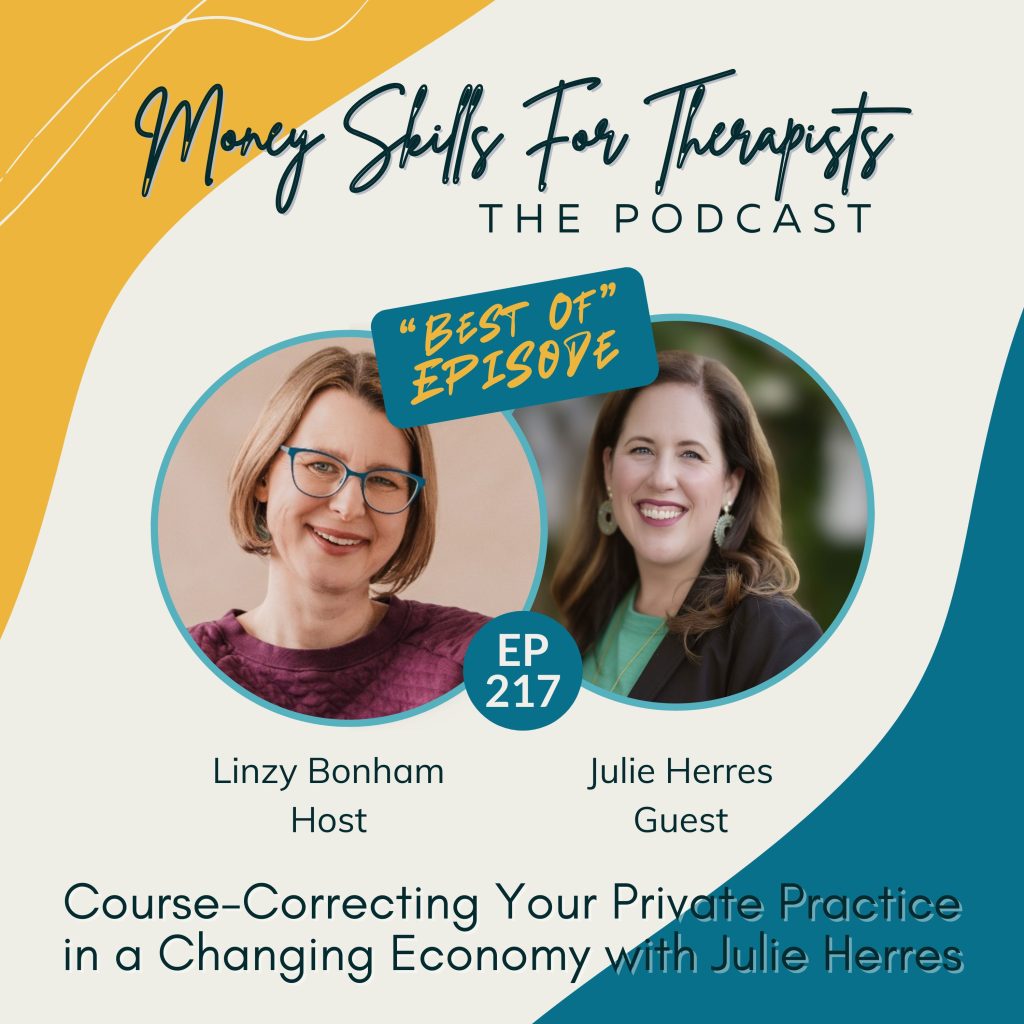
Today’s episode is a “best of” with Julie Herres. This was one of our top downloaded episodes this past year. Julie Herres, as you probably know if you’ve listened to this podcast, is the owner of Green Oak Accounting, which specializes in working with therapists, and she’s also the author of Profit First for Therapists.
Linzy Bonham 02:23
In this episode, Julie and I look at what you can do as a practice owner to course-correct if things aren’t going your way in the changing economy. This is actually part two of a two-part podcast kind of series we did. Part one, the episode where Julie and I talked about what was happening in the economy at that time and kind of the uncertainty that was abounding.
Linzy Bonham 02:45
It was a real downer, that episode. For the best of, we’re just bringing you part two, which is where we talk about what you can actually do. While the conversations over the last few years in private practice have really focused on preventing burnout and not overworking, because that was really our risk during COVID, our problem now is starting to change.
Linzy Bonham 03:04
Right now, we’re finding that folks are feeling a little bit more cautious with their dollars, which translates to shorter wait lists for us as therapists, a harder time filling up clinicians if you’re a practice owner, and generally, like, less money coming in the door. While looking at the economy can sometimes feel like a bit of a downer, this episode is the uplifting part of this conversation.
Linzy Bonham 03:24
Julie and I explore how part of the solution might be allowing ourselves to be more flexible and maybe working a little bit more than we used to. We also break down the difference between taking actions that get fast money in the door in our practices versus taking strategic actions that work on improving the business long term.
Linzy Bonham 03:42
Let ‘s dive in.
Julie Herres 03:49
Today is part two of my episodes with Linzy Bonham from Money Skills for Therapists. So last week, we talked about “in this economy, dot, dot, dot,” is how we unofficially named the episode, but we talked about kind of what’s going on in the economy.
Julie Herres 04:03
Honestly, it was a little bit of a downer episode, but the economy is a little bit of a downer right now. Yeah, that’s just how it is. But in this episode, we’re gonna be much more uplifting, or we’re gonna try at least, and we’re gonna talk about what you can do as a practice owner to course-correct. If things aren’t going your way, what are some of the things that you can do?
Julie Herres 04:21
So Linzy, do you want to add some context to that?
Linzy Bonham 04:24
I do, yeah. I do want to add context, because I’m all about context. You know, something that occurs to me, and you and I have talked about this idea before, is culturally with therapy, too, we’re in a little bit of a pendulum swing in that the things that we’ve been talking about so much and that we’ve been concerned about the last five years mostly has been burnout, right? Like, we’ve been talking about, like, “Okay, again, you have all these folks beating down your door. If you say yes to everybody, you’re gonna be seeing 25 complex trauma clients a week. Don’t do that. You’re gonna die.”
Linzy Bonham 04:52
So, you know, how do we set the right boundaries? How do we take care of ourselves? How do we space out our schedules? We’ve had to think a lot about self-preservation in terms of not overworking because that’s kind of been the problem that we’ve had. We’ve had the problem where if you’re not intentional, you’re gonna overwork and you are going to, like, burn right out of the field. And that does happen to folks, right?
Julie Herres 05:12
It does.
Linzy Bonham 05:13
So that’s kind of the conversations we’ve been having a lot over the last five years because that’s the problem that we’ve had. But our problem is starting to change. Now we have a new problem, which is, as we talked about last time, folks, all of us, myself included, we’re feeling a bit more cautious with our dollars.
Linzy Bonham 05:30
You know, we’re thinking kind of twice before we make big investments. People who might have been really happy to spend 200 bucks a week on therapy a year ago now are like, “Maybe I’ll just leave that money in my household for now. Is that really worth it to me right now?” So we are seeing this dampening on demand. And the way that’s showing up is we’re seeing less wait lists for folks who used to always be wait-listed. We’re seeing group practice owners having a harder time filling up their clinicians, you know, like caseloads just not being full.
Julie Herres 06:02
Yeah. Just less calls altogether, right? Less calls, less outreach, less demand.
Linzy Bonham 06:06
And of course, what that means for all of us is less money coming in the door.
Julie Herres 06:10
Yeah.
Linzy Bonham 06:10
So that’s kind of like our broader picture of where we are now. And I want to name that pendulum swing because I do think there is a change in conversation there, a change in focus then that has to happen. Which is a little weird because we’ve been so used to being like, “But don’t burn out,” because again, that has been our biggest threat. But I’m gonna say, like, our biggest threat is starting to change, and it’s important for us to stop and notice that. Because otherwise, we can spend all of our time still trying to kind of, like, protect ourselves from this old problem when it’s not actually the new problem. It’s not the biggest challenge we have right now anymore.
Julie Herres 06:46
So what would you call the new problem?
Linzy Bonham 06:49
I’m gonna say, oh, the new problem is crickets. Tumbleweed Town. What do we call it?
Julie Herres 06:57
Okay. Yeah. So I was thinking more of a, like, to me, the new problem is sometimes you just have to get to work.
Linzy Bonham 07:05
That’s a solution, Julie.
Julie Herres 07:06
Or, okay. Yeah. So maybe the problem then is not being willing to do the things that need to get done at this point.
Linzy Bonham 07:15
Right. And this is where our fear of burning out, and sometimes what has become maybe a bit of rigidity to protect ourselves, where we’re like, “No, I do not work past 4:00. I always pick my son up from the bus stop every day. I always do yoga every Thursday morning.” Like, these things that we have put in place to make sure that we don’t burn out. What I’m hearing from you is, like, part of the solution for some folks might be that we have to be more flexible.
Julie Herres 07:41
Yes.
Linzy Bonham 07:41
Work a little more than we used to.
Julie Herres 07:44
Yeah, and this came from a conversation that you and I had a couple weeks ago, Linzy, right, where I was telling you we’re seeing group practice owners say, “I worked so hard to get my caseload down to three clients. Do I really need to start seeing clients again?” And sometimes the answer is yes. If you’re down to almost $0, yeah, you probably do need to get back to seeing clients, even though I don’t love that for you, right? I don’t necessarily want that for you long term and permanently, but just because we got to this point doesn’t mean that that’s what works for the practice right now, right?
Julie Herres 08:21
Or we’re having clients tell us, like, “Oh, my clinical director can’t possibly have a client load.” Okay, but you’re down to now four therapists. Your clinical director probably shouldn’t even be a clinical director. They need to see clients today, like this week.
Linzy Bonham 08:35
Yes. Yeah.
Julie Herres 08:36
But we’re seeing a lot of rigidity of, “I couldn’t possibly ask them to do that.” Like, okay, well, if you’re not willing to do the things that need to be done, there are downhill repercussions to those decisions as well, right? So that’s the, like, let’s get to work, let’s do the hard things, because there are sometimes some hard decisions that are not fun, but that are the job of the business owner.
Linzy Bonham 09:00
Yeah. They are not fun. They are not fun at all. I’m sighing, you know, thinking about some of my own decisions I’ve had to make over time where you’re like, “Okay, wow, for the good of the business, I have to make this particular decision,” and I literally want to barf. But for the business to continue to exist and take care of all of us and take care of all of the folks that we serve, we have to make these hard calls sometimes.
Linzy Bonham 09:20
Partially what I’m hearing from you right now is, like, it makes me think about kind of two different types of actions that we can take as business owners. One is: An action that’s gonna get fast money in the door. And the other is kind of like investing in the business, taking strategic action that will give us, like, longer term money.
Linzy Bonham 09:35
So as a group practice owner, you know, in this scenario, if you’re seeing three clients a week and you’re like, “Oh, I worked so hard to get here, like, I don’t want to go back,” and again, this is where I think we’re suggesting that maybe there’s a bit of rigidity there. My son’s occupational therapist would call that rock brain. You might be in “rock brain”.
Julie Herres 09:53
Okay.
Linzy Bonham 09:54
If I tell my son he’s in “rock brain”, he loses his shit, by the way. He’s not into it. “Okay, Augie, are you in rock brain?” He’s like, “I’m not in rock brain.” But this is where we could be superflex instead, right? So it’s like sometimes we do get into this mode of, like, “No, I can’t possibly. I worked so hard. That would be like a loss or a failure or moving backwards.”
Linzy Bonham 10:08
But, you know, what I’m thinking is, as the practice owner, if you have a great reputation in the community and if there’s folks who come to the practice because they want to see you and they end up seeing somebody else instead, but they really wanted to see you, that’s a fast way to get, like, a bunch of money in the door quickly if you are in demand and you have been turning away that demand.
Linzy Bonham 10:31
So I’m thinking, like, that’s a way to get fast money. Sometimes our businesses need fast money. Sometimes, like, we just need to get some money in the door right now to pay the bills that are coming. Especially for a group practice, this is the most relevant, I think, to pay your payroll. You seeing five clients a week in addition, at 200 bucks each, let’s say that’s an extra $4,000 a month coming into the practice that pays for all the things that are going to have to be paid for anyways.
Linzy Bonham 10:57
So that’s kind of what I hear is partially it’s doing the things that are gonna get us those results that immediately start to create stability.
Julie Herres 11:05
Yes. There’s the working in the business and then working on the business, right? And sometimes it’s like, “Oh, well, I’m used to having Fridays off, and I’m not willing to give that up.” And I’m not saying you should give up your Friday forever and ever, but maybe you do need to do some marketing activities for a couple of hours on a Friday, right? Or there’s some kind of give. And maybe it’s Saturday morning because your partner is home and they can manage the kids, right? And so they can have some great time together, and you’re doing something that’s helpful for the business.
Julie Herres 11:35
But that’s the pendulum swing that I’m seeing, right? Where I’m hearing a lot of “I can’t,” which to me really usually means, “I won’t. I’m not willing to.”
Linzy Bonham 11:47
“I don’t want to.”
Julie Herres 11:47
“I don’t want to.” Yeah. And sometimes, like, as the business owners, we’re just the ones that have to do the hard thing. And it can be fun things. It can be new adventures, right? That’s part of business ownership that I actually really like, is the figuring outing, or the figure outing, of, like, what do we need next? What are we gonna try, right? A, B, C, D, E. Who knows? And you just kind of test things out. I like that part.
Linzy Bonham 12:12
Me too.
Julie Herres 12:13
You do? You like that?
Linzy Bonham 12:18
Which is why we’re still in business.
Julie Herres 12:20
Yeah.
Linzy Bonham 12:22
Because, yeah, if you can think about things as kind of a fun experiment and be like, “Well, what if? What if this? What if that?” Like, we’re in the middle of a sales launch right now, and it’s like we’ve done something totally different. Might not look too different to our audience, but we know that, like, we’re kind of doing things in a different order than we usually do, and we’ve kind of remixed things, and we’re seeing what’s happening.
Linzy Bonham 12:39
Honestly, it’s not going great, so we’ll probably do something different next time. But when you have the resilience to try things, to see how they go and take that as data, you can have fun with it. And also, you can just make your business work because you start to really figure out what works for you.
Julie Herres 12:53
Yeah.
Linzy Bonham 12:53
Yeah, I mean, thinking about the Fridays, like I used to not work Fridays, and now I do. That has changed in my own business again, just as, like, the market has changed, you know, and we’re having to maybe, like, think differently and try different things. I have more work to do, so I work on Fridays. And I have actually noticed for me right now, that actually feels totally fine, because I’m like, okay, this is the season we’re in, right? Like, I think if we can make peace with the season we’re in, then we can embrace what we need to do.
Linzy Bonham 13:23
But yeah, so that’s kind of like, because I’m thinking too, the Fridays, this makes me think about the “working on the business” piece. Because there’s these actions that sometimes we have to take where we’re just like, okay, I know that, like, maybe it’s a bruise to my ego that I need to start seeing more clients again, because I really prided myself on getting down to four clients a week as an owner, or only 12 clients a week as a solo practice owner. But also, I’m seeing some of my clients are dropping off, so I’m gonna, like, open up more spaces. That’s fast money.
Linzy Bonham 13:48
The kind of more slow money or working on the business, for group practice owners specifically, I will say, and for solo practice, it’s often about marketing.
Julie Herres 13:56
Yeah.
Linzy Bonham 13:57
Just like we need to find new ways now to get found. And yeah, what are your thoughts on marketing with how things are changing and how much more just, like, price sensitive people are these days?
Julie Herres 14:07
Yeah. So I’m generally, Linzy, a big believer in hiring people who are experts in their own space. And that’s the really interesting part, though, is when the market feels a little bit tighter, when everyone’s just being a little tighter with their dollars, they’re often not willing to do that. But I think that is often a mistake, where the way I think of spending money or investing money in a program or in a professional is you’re just shortening the length of time to execution, right?
Julie Herres 14:39
So instead of like, yeah, could I figure out how to ChatGPT an employment contract? Not that I have employment contracts already, right? But I’m just, as an example. Yeah, I probably could, and it might be somewhat good or not, depending on the input that I put in it. Or I could spend a few hundred dollars with my attorney and know with certainty that they are actually correct and legal in my state, right?
Julie Herres 15:03
So you’re just shortening the amount of time where even with your ChatGPT thing, you’re probably eventually going to need to go to an attorney and have to rewrite them and do it right. You’re just lengthening the time to do that. So the same right now applies to, I mean, to marketing, to hiring, to building a business.
Julie Herres 15:19
Facebook advice is worth what you pay for it, right? It is free, and sometimes it is lacking tremendously in context, especially for really complex pieces like accounting, which depends on your specific facts and circumstances and your state. Where do you have employees, right? It depends on a lot of very specific things.
Julie Herres 15:40
So people can give you lots of advice that is good for them on social media, and it is crappy for you. But by going to that free advice, you are just lengthening. Ultimately, you’re gonna end up at some point in the same position.
Linzy Bonham 15:57
Yes.
Julie Herres 15:57
You will. It will just take a lot longer. So I’m a fan whenever possible, whenever money will allow, to shorten that timeline and just pay someone who’s good at it to get you on the right track right now, right?
Julie Herres 16:10
But I think what I’m seeing specifically is the practice owners that are really successful in adapting, and again, solo to group, they are themselves adaptive. They’re saying, “This feels different, and I’m not sure what’s going on, but I’m gonna go figure it out.” So they’re looking at the data. They’re talking to people. They’re trying different things. They’re networking in the community.
Julie Herres 16:30
They’re not just saying like, “Well, let me spend more money on the same ads that we’ve had for years and see if that works,” right? They are adapting and iterating and course correcting. And that is what is causing them to still be successful in this economy. That’s the traits that I am seeing. Yeah. What about you? What are your thoughts?
Linzy Bonham 16:51
Yeah, I think, you know, the words that come to mind for me as well are, like, adaptive, resilient, right? So trying different things and also, you know, I just had a conversation last week with some of my therapists inside Money Skills group practice owners about marketing and yeah, just really being creative too. But being creative but then also being present enough to notice what works and what doesn’t, right?
Linzy Bonham 17:14
So there’s this mix of creativity, trying stuff, but also being organized enough that you can actually see the results. Because when we’re just kind of, like, randomly throwing things left, right, and center, sometimes it’s hard to know what has actually worked and what hasn’t. So this is where having some nice metrics that you’re tracking, this is true for solo practice owners and group practice owners, of like, “Okay, these are the marketing activities that I took last week. Here are the inquiries that came in. This is where the people who converted actually came from. Okay, interesting. That marketing dinner that I attended that I didn’t really enjoy actually gave me a couple leads. Okay. So I’m gonna go back to that group, or I’m gonna thank those people. I’m gonna deepen those relationships.”
Linzy Bonham 17:54
I was suggesting, again, just something to try to one of my group practice owners the other day. She’s built relationships with a doctor’s office. She got a couple good referrals. Send them a box of treats that says thank you with your card next to them. Be memorable. Try stuff, right? What is the cost to your business of sending, like, a box of baked goods? Like 45, 50 bucks, right? Put your business cards next to them. People come into the break room. They’re like, “Oh, donuts. Cool. Who’s this? Oh, this is from the psychologist down the road. Oh, yeah.” And then you’re top of mind, right?
Linzy Bonham 18:22
That’s not just like a, you know, to be clear, I’m not teaching marketing. But it’s a fun idea, and see what happens, right? Like, that’s a great example of something that doesn’t cost a lot but makes you stick out because how many people do that, right? But it is that being present and being curious and willing to try different things.
Julie Herres 18:40
I’m gonna admit something that I don’t think I’ve ever said on the podcast, but I’m terrible at predicting which graphics will do well and will not, which creatives. But if we were not measuring those things, we would not know. What I think is gonna do well almost never does, and it’s always, like, the randomest things. Like, okay, but you know, what are you gonna do? But if you’re not looking, if you’re not willing to say, “You know what? I was wrong, and we’re gonna pull it because it’s not doing well.”
Linzy Bonham 19:11
Yes. Even though it’s your baby and you love it.
Julie Herres 19:14
Yes.
Linzy Bonham 19:14
Because there’s that piece too, right? We get sometimes overly attached to things, and we can’t let them go.
Julie Herres 19:19
Yeah, you hit the nail on the head. Yeah. The data will tell us, though, what’s going on, right? If you’re looking at where the referrals are coming from, you will know. We’re talking a lot about marketing, even though that’s really the focus here.
Linzy Bonham 19:32
It isn’t the focus, but part of what I’m thinking is, again, so much about, I think, the challenges these days are that folks are more price sensitive, right? Like, we’re gonna have to attract more people to get them in the door. We don’t have a ton of time left to record, but I do want to throw out a question to you that came to me recently on a call, and I was like, “That is a really interesting question.” What do you think about out-of-pocket therapists, in Canada that’s everybody, lowering their fees to meet where the market’s at?
Julie Herres 20:02
Ooh.
Linzy Bonham 20:03
Yeah. What do you think about that?
Julie Herres 20:05
I think that’s an interesting one. I do think, I mean, there’s kind of a high horse and then there’s a practical approach as well, right? So I think it’s not necessarily for everyone. But I would go to the data. If you have seen a big drop-off in clients, and as you’re reaching out to folks and saying, “Hey, we noticed you didn’t reschedule,” or you’re sending them a short survey and they’re saying it’s the cost, I think it could be worth running an experiment and trying to see what is going on.
Julie Herres 20:38
Of course, if that makes sense for you and your practice, right? That probably means all the other expenses have to be reviewed as well.
Linzy Bonham 20:44
Yes.
Julie Herres 20:45
But I think it’s at least worth the experiment. And then also in reality, right, we live out here in the real world, you and I. If you need money, right? If you’re a solo therapist and you just simply need money to run your household, yeah, absolutely. Do what needs to be done. I would rather have some money coming in than zero dollars.
Julie Herres 21:06
So in that sense, I would go back to an analogy you used for our last episode, which was the ship, right? If you have a large group practice that’s a big cruise ship, it’s a lot harder to move and say, “Hey, we’re gonna do things differently. We’re gonna try this thing.” But the smaller your practice, the more you can kind of adapt and zoom around and see, test things out. And I would definitely try. Yeah. What’s your opinion?
Linzy Bonham 21:31
Yeah. I mean, the answer that I gave to that therapist, because it was on, like, a coaching call, was run the numbers to see what the difference would actually be.
Julie Herres 21:40
Yeah.
Linzy Bonham 21:40
Like, let’s say your standard fee is $175 and you want to bring it down to 150. There might be something magic about that number. Like, numbers are not logical, right? Like, we all have very emotional relationships with numbers. So there are some numbers that it’s easier for people to pay, right? You kind of, like, you get. There’s these different thresholds that become like, “Ooh, that’s expensive.” You know, like, 180 wasn’t expensive, but 200 is too much or whatever.
Linzy Bonham 22:03
But running the numbers of what the actual difference would be, like, let’s say people come for three more sessions because of that, right? Like, what would be the actual impact of clients being retained or converted compared to the money that you’re losing? Because yeah, and this is where I think I bring this up, not because I actually have the answer, but I do think it’s a good example of a spot where we have learned to be a bit, like, sanctimonious, right?
Linzy Bonham 22:29
We’re like, “No, no, no, no, no. I am a $300 an hour therapist. Like, that’s who I am. I’ve worked really hard on my mindset to get to this place, and if I go backwards, then I’m kind of like failing or I’m letting myself down.” And I think that there’s that take on it. But I do think that that’s where we’re maybe making it too personal. We’re making it too personal, right?
Linzy Bonham 22:50
And really, it’s like, we are in business, and part of business is like meeting the world where it’s at and being able to, like, sell the right thing at the right time. And if it’s really hard for you to sell a bunch of $300 sessions, but a whole bunch of people are happy to pay you $180, again, like some dollars is a lot more than no dollars.
Julie Herres 23:11
Yeah, run the numbers.
Linzy Bonham 23:12
Yeah, again, run the numbers. See what makes sense. If you’re small, you can experiment. If you’re big, it’s definitely harder. But yeah, I wanted to put that out there because I do think that, again, that’s another area where so much we have kind of, like, dug in of, like, “No, no. My work is worth this much.”
Julie Herres 23:25
Yeah.
Linzy Bonham 23:26
And it’s like our work is only ever worth as much as people are willing to pay us.
Julie Herres 23:29
Ooh, yes. Yeah. Same like houses, right? It’s worth what someone is willing to pay for. That’s it.
Linzy Bonham 23:35
Yeah.
Julie Herres 23:35
Yeah. And it’s not a reflection of your own self-worth as a person or as a therapist either. It’s not personal.
Linzy Bonham 23:42
All right, Julie.
Julie Herres 23:43
Linzy, on that note, we’ve got to wrap it up. Such a pleasure to do a two-parter with you.
Linzy Bonham 23:48
It was a lot of fun. Can we just quickly summarize what we talked about today? Because I feel like there were a lot of ideas.
Julie Herres 23:51
Absolutely.
Linzy Bonham 23:52
We talked about being adaptable and resilient.
Julie Herres 23:56
Course correct if you need to. Be willing to try a bunch of different things. I would approach it with curiosity and just try things out. See what works for you. Be creative.
Linzy Bonham 24:06
And then measure what works.
Julie Herres 24:07
Measure what works. Look at the data. Yeah. Amazing.
Linzy Bonham 24:11
Everybody, you’re all gonna do great. We got this. We’re all in the same soup. We’re all figuring it out together.
Julie Herres 24:15
You’ve got it.
Linzy Bonham 24:16
Yeah.
Julie Herres 24:17
And it’s not easy being a business owner. If it was easy, everyone would do it, but you’ve got this.
Linzy Bonham 24:21
That’s true. Yeah. Thank you, Julie.
Julie Herres 24:23
All right. Bye, everyone.
Linzy Bonham 24:28
I love Julie’s point in this episode about being adaptable and resilient as business owners. When the economy shifts, as it has, we have to be willing to course-correct, right? To try different things, look at the data to measure what works and what doesn’t work. It’s also such a helpful reminder that adjusting your practice or your business to meet the world where it’s at is not a reflection of you or your personal worth.
Linzy Bonham 24:51
Before we wrap up, I want to invite you to join our new private WhatsApp community. It’s a space to connect with other therapists, health practitioners, and listeners of the Money Skills for Therapists podcast to chat about episodes, to ask questions, to share insights, and to get support. If you’re interested in becoming a member of this community, get in touch with us by emailing us at hello@moneynutsandbolts.com.
Linzy Bonham 25:14
And if you’re enjoying the podcast, it’s always really helpful if you leave a review on Apple Podcasts or Spotify to help other therapists and health practitioners find us and join these conversations. Thanks so much for joining me today.