Jelisha Gatling 00:00
I’m looking for a simpler, calmer life. I feel like I got to a place where I became very stable financially, but now I’m shifting into this place of actual freedom. There’s a difference, for me at least, between stability and freedom. What I’m experiencing now is freedom. Freedom in time and location and not being tied to one place, and just the spaciousness that I have now.
Linzy Bonham 00:29
Welcome to Money Skills for Therapists, the podcast that helps therapists and health practitioners in private practice go from money confusion and shame to calm, clarity, and confidence with their finances. If you’ve ever felt overwhelmed by numbers or avoided looking at your business money, you’re in the right place.
Linzy Bonham 00:50
I’m Linzy Bonham, therapist turned money coach and creator of Money Skills for Therapists. Before we jump in, I want to remind you of something really important. Most of us highly skilled and competent therapists and health practitioners were never taught about money, not in grad school, not in supervision, not anywhere.
Linzy Bonham 01:07
And yet, here we are running businesses that need to take care of us while we’re busy taking care of others. It is a lot of pressure. So if part of you feels anxious about money, avoidant, or like a bit of a hot mess financially, I want you to know that you are not alone and I am here to help. Through my free live workshops each month, I teach practical financial skills to help you feel more grounded, calm, and confident with your private practice money.
Linzy Bonham 01:30
You can see what’s coming up and save your spot to join live or register for the replay at moneyskillsfortherapists.com/workshops. Let’s get started.
Linzy Bonham 01:39
So we just wrapped up season 15 of the podcast, if you can believe that. Our seasons are 12 episodes long, which allows us to take naps between seasons. But rather than taking a break between seasons like we usually do, this time we are bringing you a mix of best of episodes, a compilation episode, and a podcast takeover episode over the next five weeks.
Linzy Bonham 02:01
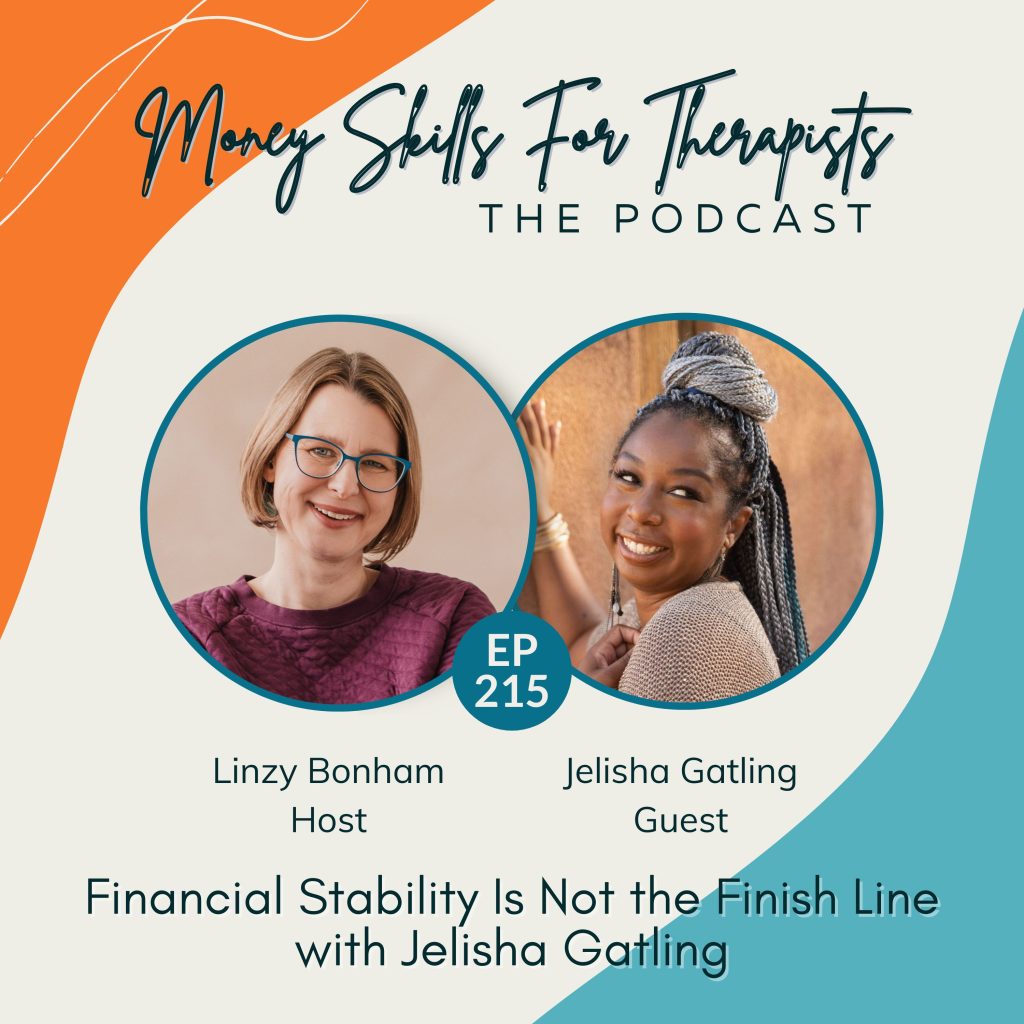
We are kicking things off today with a best of episode featuring the wonderful Jelisha Gatling. She is a graduate of Money Skills for Therapists and a former coach inside the program. Jelisha was actually in my very first beta cohort of Money Skills for Therapists back in 2018 when I was running it off the side of my desk and I was a full-time therapist, and she’s also the first coach that I ever hired to work alongside of me.
Linzy Bonham 02:23
In this episode, we dig into Jelisha’s incredible journey of selling all her things, packing two bags, and traveling the world as a digital nomad while still running her solo private practice. We explore the powerful differences between building financial stability and experiencing true freedom, really seeing your money being aligned with your values and your needs.
Linzy Bonham 02:45
We also talk about how she pushed past the excuses that were holding her back so she could just do it scared. Jelisha’s story is such a beautiful example of stepping out of survival mode and into expansiveness, and I’m so excited to share this conversation with you again.
Linzy Bonham 02:59
Let’s dive in.
Linzy Bonham 03:03
So Jelisha, welcome back to the podcast.
Jelisha Gatling 03:06
Thank you for having me.
Linzy Bonham 03:07
I’m so excited. This is, I think, your third time coming on the podcast. Does that sound right?
Jelisha Gatling 03:13
That makes sense.
Linzy Bonham 03:13
Yeah, that feels right. And I was just saying to you off mic before we started recording that you and I have known each other for seven years now. You were in the very, very first cohort of Money Skills for Therapists. You were in the cohort that I was building the course as I taught it. So I’ve had the honor of witnessing these really cool transformations in your life in the seven years that we have known each other. And I’m excited to dig into what is happening with you right now around money and life and work. ‘Cause you’ve done some cool stuff. So can you tell us about where you are now, what you’ve been doing?
Jelisha Gatling 03:53
Yeah, I have continued to be in solo private practice working with couples. December of last year, 2024, I decided to break my lease and get rid of all my stuff. I sold all my things. And I packed two bags and I started gallivanting across the UK. I’m now currently in Southeast Asia. I just left Vietnam. I’m now in Thailand, and I haven’t really talked much about this, but this has been something that I’ve wanted to do before meeting you. So I was like, I absolutely know I don’t want to retire in the US, and working for myself and being able to shift into teletherapy has always been the plan, even pre-COVID. So I finally decided to do it. I just ran out of excuses and decided to do it scared. And, yeah, I’m on a residency kind of strategy plan. I’m looking for someplace else to call home. That’s a short summary.
Linzy Bonham 04:55
Yes, so this is something you’ve always known you’ve wanted to do. I love the word gallivanting. That’s the word that I use, too. Gallivanting around the world, right? Right now, you’re not really tied down to any one place.
Jelisha Gatling 05:06
No, not tied down to anything. I went to the UK. I just left the UK in March. I needed some warmer weather, but that was an experience. I was doing some house and pet sitting actually, and so it really offset costs, and I got to hang out with the best dogs and cats ever. Really, way more meaningful than I expected it to be. I’m still connected with the pet parents, and it’s just been lovely. Scotland, all over the place. It’s been amazing. But anyway, I’m here in Asia now and I’m looking for a simpler, calmer life. I feel like I got to a place where I became very stable financially, but now I’m shifting into this place of actual freedom. And before I used to talk about financial freedom, and there’s a difference, for me at least, between stability and freedom. What I’m experiencing now is freedom. Freedom in the time and location and not being tied to one place. And just the spaciousness that I have now.
Linzy Bonham 06:08
Yeah, and that distinction between stability and freedom is really interesting, ’cause a lot of folks that I think about that we’ve supported when you worked with me back in Money Skills for Therapists a few years ago, and that we’ve supported first, stability is what they’re looking for first, right? It’s to get out of that feeling of constantly being behind, financially stressed, not able to make bills. And so finding that financial stability, which I’m a huge fan of stability, right? I get really jazzed about stability. Helping folks have that regular paycheck. Get you out of that, “This is an amazing month, I’m rich, and oh my god, I’m poor. How am I going to make my bills?” So let’s get out of the unnecessary emotional rollercoaster that just has to do with your revenue in your business, because our emotions should not be dictated by what’s coming into our business.
Linzy Bonham 07:00
So there’s a stability making there, but I’m hearing for you, it’s once you get to stability, that’s not really what you wanted, right? People talk about financial freedom, but I also think a lot of folks who get to that point of financial freedom, and I’m putting that in quotations, where there’s really nothing left to worry about financially, just find other shit to worry about, right? There’s this interesting… I don’t know, human condition piece that happens there, where you just find other things to be stressed or unhappy about. And I’m hearing for you, once you hit stability, it’s given you the financial means to do things you want to do, right? It costs money to get on a plane, and the UK is not a cheap place to be, and that kind of stuff. What I’m hearing for you is freedom is what you’re really looking for.
Jelisha Gatling 07:39
Yeah, more peace, peace of mind. There’s just so much going on in the US, as we all know. It’s so hard, and I really want to live in a place where everything isn’t centered around work. I think that’s another piece. Being in these cultures, no one’s asking me what I do for work.
Linzy Bonham 07:59
Yes.
Jelisha Gatling 08:00
No one cares.
Linzy Bonham 08:00
No.
Jelisha Gatling 08:01
And it’s helping me to continue to divorce my worth from how much I make or what I do. I feel like that’s been something I’ve been trying to work on the past few years, and it’s just so much easier. People are like, what do you like to do? Who are you? It’s so interesting, and I love it.
Linzy Bonham 08:20
Yeah, we are, in North America, such a work-obsessed culture. And I think part of it is the cost of living is so high, right? It costs a lot to live here. And especially in Canada, where I am, the cost of housing has gone bananas in certain cities, especially where you have to work so hard just to have a toehold in living in the place that you want to live. So I think that is part of it, is cost of living. When most of your time has to go to not just working but making sure you’re earning a really good living, that is a really important part of your identity, ’cause if you neglect that, you’re going to lose your house.
Jelisha Gatling 08:58
Exactly, there’s a lot at stake.
Linzy Bonham 09:00
There is a lot at stake. Yes.
Jelisha Gatling 09:02
It feeds into the anxiety and it’s constant, because everything you just said, I totally resonate.
Linzy Bonham 09:08
Yeah, and what you’re doing now is what people have referred to over the last few years as a digital nomad kind of life, right? You’re able to work in the US, so you’re earning US dollars, which is pretty key, I think, to this strategy.
Jelisha Gatling 09:22
Yes, yes.
Linzy Bonham 09:23
To be clear, you’re able to enjoy the cost of living in other places. Now that being said, the UK is very expensive. I feel like the geographic arbitrage does not work in the UK, but certainly in Southeast Asia, earning in US dollars, I’m going to assume you’re pretty comfy.
Jelisha Gatling 09:40
I am. It’s interesting because, though I’m more comfortable than I was, I still have to catch myself. Sometimes it’s, oh, there’s too much space. Like you said, you find new things to worry about, and so I’m still very much a work in progress on getting out of the productivity trap.
Linzy Bonham 09:57
So I’m curious, the lifestyle that you are living right now, do you think this is something specific about your personality? Do you think that lots of folks would benefit from letting themselves just explore and wander? I’m thinking about therapists who are listening. Do you think that it’s a common overlap that therapists also, really deep down, we want to be free, but we’re tied to responsibility?
Jelisha Gatling 10:20
I think it’s pretty common. The feedback that I’ve gotten just from sharing with colleagues and therapist friends has been supportive of that.
Linzy Bonham 10:27
Yes, yes.
Jelisha Gatling 10:30
I’m already getting to the point where I want to chill. I think I’m going to be in Thailand for a hot minute. I was in Vietnam for one month, and it gave me just so much space and time to really explore the neighborhood, and I got to know a lot of locals and I have people that I’m absolutely going to go back and see, and it was just amazing. I know I’m not the only one because I definitely was looking into different communities of therapists that are doing telehealth around the world. I didn’t end up working with anyone specifically in the therapist realm, but was following a few things and was thinking about it. And I’ll also add this. I don’t really have a lot of responsibility. I’m not married. I don’t have anyone else I have to consider. I don’t have kids. And I know that makes a big difference. It’s just me.
Linzy Bonham 11:12
Definitely. Definitely. Yes.
Jelisha Gatling 11:22
The scary part of that too, where it’s, oh, it’s just me. It’s all on me. So I’m like, is there something about my personality? I’ve always wanted to travel, so…
Linzy Bonham 11:30
Yes, and yeah, I totally hear that. What is amazing about it is also what’s terrifying about it. Like that level of freedom, freedom from responsibility also means freedom from… I don’t know, there’s a lack of reciprocity there somehow. It’s like you’re not responsible for anybody, but also nobody’s responsible for you. And when I got your message, ’cause we were chatting a little bit before we started recording. You messaged me. I think two weekends ago now, you sent me a message and I try to, I’m a practicing digital minimalist, to greater or lesser degrees of success, depending on my levels of anxiety.
Linzy Bonham 12:06
And I saw a message come through from you, which was like 9:00 PM my time on Saturday, which is pretty damn close to bedtime. And when I saw a photo come through, I was like, this probably isn’t for me. Jelisha and I haven’t chatted in probably like a year. I must have accidentally got added to a channel. But then when I saw it the next day, it was all these fucking beautiful pictures from Vietnam. And you were like, “Linzy, I wanted to give you an update.” And interestingly, I noticed for myself, I was like, “Oh my god, that’s amazing.”
Linzy Bonham 12:44
Number two, I was jealous. I was like, dammit, Jelisha off having fun, and I’m parenting, and having challenges in my business. But then number three, inspiration immediately. ‘Cause something that you said in your message to me was that Tiffany and I… I think you mentioned both of us, as you often do. I feel like we’re like a pair in your head, Tiffany McLain and I. That we had inspired you in the work that we’ve done with you, not just financially. You can have what you want, but you have the confidence that you can do anything. And that was a really powerful message for me to receive, I think, at a time where just emotionally, in that moment, I was having to make a difficult personal decision. And I was like, Jelisha can do anything. I can do anything.
Jelisha Gatling 13:15
I love that.
Linzy Bonham 13:16
So it was a nice little feedback loop. I felt really grateful for that. I was like, oh, I put something beautiful out in the universe years ago, and now you’re bringing it back to me. Because I do think you and I have very different lives, right? I do have a child. Do I ever have a child? So what I’m focusing on right now in my life, my chapter, is about creating stability for him, right?
Linzy Bonham 13:33
And I’m very aware of that, as I’ve zoomed out to do some planning around life and this idea of buckets or chapters. The book Die With Zero I read recently, and he talks about this idea of your money. It’s not just saving money for the end of your life, where we often think we’re saving for the future, we’re saving for retirement. I’m going to have a great retirement, but not all of us make it to retirement. Or we don’t have health when we’re in retirement, so thinking about your life in terms of these, he describes ’em as buckets.
Linzy Bonham 14:03
I would think about chapters, too, where it’s, okay, what are the experiences that you want to have in your forties? What are the experiences you want to have in your fifties? And some of those experiences that you want to have make a lot more sense in your forties. Go do Mount Everest in your forties. Don’t wait till your seventies. It’s going to be a different situation, right? So I like thinking about those buckets. So that has helped me to stop and think about, okay, what are the things I want to do in life, but also what makes sense now? So right now, I’m creating stability for my son. We’re really involved in his school community, right? We have an event tonight. I’m the treasurer of the school council. Surprise!
Linzy Bonham 14:38
I’m going to pick up the float, drop that off, and count the cash at the end of the night. My partner is going to be volunteering at the ticket selling table. I got my dad on the barbecue, pulled in the grandparents. This is my chapter, which is actually only probably going to be about 10 more years until my son’s a teenager and is like, “Mom, leave me alone.” So I have noticed that it helps to zoom out and think about, okay, what is this chapter of my life? What needs to happen in this chapter?
Linzy Bonham 15:05
What’s nice to have happen in this chapter, and what should actually not happen in this chapter? So I, for instance, have a dream of doing some sabbatical time. I would love to live in Portland for a good six months. We’ll see what happens with the US situation. But then I realized it doesn’t make sense to drag my son to Portland. That’s not good for him, right? It’s not good for a 7-year-old to be removed from his friends and from his school and go live in another city where he doesn’t know anybody for six months. That’s actually not a great experience for a child to have. What he needs is the stability to build continual friendships and learn how to work through things with his friends and build a community and a sense of belonging.
Linzy Bonham 15:38
And what I’ve heard from folks who were moved around a lot by their parents, usually for work situations, is that they never felt like they really had a home, or never felt like they had a community. So that has been a helpful reflection for me to be like, yeah, okay, right now is stability time in my own life. But when my son is off and on his own, oh man, do I have plans? I love Iceland. I would love to live in Iceland for a solid year. Fucking love Iceland so much.
Jelisha Gatling 16:03
You’ve been there?
Linzy Bonham 16:04
Twice.
Jelisha Gatling 16:05
Oh my gosh. I’m jealous.
Linzy Bonham 16:08
Yes. See, you’re jealous of me now. And I feel like I’m doing what you’re doing a little bit, but in little bursts. Last year when I turned 40, I made a really big deal of it when I turned 40, and I went to London for a week, and I went to Iceland, and I went with Tiffany McLain and Maegan Megginson and Annie Wright.
Jelisha Gatling 16:26
I’m jealous now. What? You’re going to make my head explode. I can’t take it.
Linzy Bonham 16:33
Yeah, those three friends, who some of you listening might recognize as therapist consultants in the space. Annie Wright is an incredible therapist who’s now moved into helping high-functioning women who were under-parented, developmental trauma. Amazing, incredible women who I don’t get to see much. So they actually came with me to England, which was fucking incredible, right? So beautiful. So now I have these gorgeous memories of them. And then Annie came with me to Iceland. We stayed at this incredible hotel. So I’m giving myself these little beautiful experiences. And also I’ll say, the hotel where Annie and I stayed, later that year the parking lot was filled with lava when a volcano went off nearby. So I was like, great timing for us.
Jelisha Gatling 17:11
Oh my goodness.
Linzy Bonham 17:13
But I feel like for my life, as I think about our different levels of responsibility, ’cause I’m responsible for a lot of people right now, I’m giving myself this little, almost like taste of what you’re doing, right? This little burst and doing it the high-ticket way, going to expensive places, doing all the things. But those memories I have forever now. And just the other day Maegan reflected to me that it’s a year ago that we were in London together. But for my life, given the stability that I need to create for my son, I wouldn’t be able to do what you’re doing now, but I could do it in 10 years. So stopping and thinking about our context and how do we get what we need in our context?
Jelisha Gatling 17:51
I love you sharing this, Linzy, because getting a taste, it’s like getting out of the all or nothing. And I think I didn’t have a fully fleshed out plan like I thought I should have over the years, but I love you breaking down how you’re getting a taste of those things and how rich those kinds of memories are. And also, we both turned 40 last year. I turned 40 last year and I had a whole, yeah.
Linzy Bonham 18:13
Okay. There you go. Yeah, same page. And I think part of that illustrates too, it showcases that we’re the same age, 1984 babies, how our lives have ended up looking a bit different, but we’re both still seeking how do we have the richness that we seek within the context that we have. And your reflection of getting it out of all or nothing. ‘Cause this is something that I talk about too with my students in the course. It’s so easy to fall into all or nothing all the time, right? It’s like, I have to work super, super hard and make a ton of money to make up for these things.
Linzy Bonham 18:45
Or I have to put all my money toward debt. The fact that I have debt is the most pressing issue in my life. I have to put all my money there. But usually, I find the solution to most of life’s problems is somewhere in the middle. Yes. Yeah, and seeking, what is it that you’re actually looking for? So I’m curious, you had mentioned earlier that you had all these excuses for not doing this thing that you really wanted to do, and eventually you ran out of excuses. What were some of the excuses that you gave for not setting out and traveling in the way that you’ve managed to do now? What was getting in your way?
Jelisha Gatling 19:15
Big one, it’s interesting. You don’t have enough money saved, or it just felt like it was never going to be enough. Just finally got to a point where it was like, you don’t know what the hell you need. I don’t know, I think I was approaching it like you’re never going to be ready. And also thinking about all the scary things that I’ve done financially with you. Even investing in your course and in Tiffany’s course, for me that was scary as hell. And just thinking about, Jelisha, just do it scared.
Jelisha Gatling 19:46
You’ve done it scared. So that piece, years ago, it was like, maybe I should wait until I meet someone. And I’ve met people, I’ve dated, whatever, but you can’t wait. I knew that logically, but yeah, part of me was like, it would be nice to not do this alone and have someone with me to share all the unknowns. But yeah, so that was probably a thing. Or even dating someone for a couple of years and trying to talk them into it, and trying to work out how they’re going to work out their job and do it with me, but them not really truly wanting that for themselves. What were other excuses? I’m not mature enough. I’m not healed enough. I need more therapy. A lot of it was around that.
Linzy Bonham 20:28
Oh, interesting.
Jelisha Gatling 20:29
I’m too depressed. I don’t know that I’m strong enough to do this. Yeah, I’d say probably the top ones were, you’re not mentally sound enough to take on this fucking big journey. And being scared that I was just not going to be able to handle it.
Linzy Bonham 20:45
I’m hearing just a lot of not enough. Money, not enough. Companionship, like somebody should be with me, not enough. Mental fortitude, like I’m not going to be able to handle it. And I’m curious, how has it been to just do it scared?
Jelisha Gatling 20:59
It’s been fantastic. One, I’m not really alone. With the pet sitting in the UK, the pets are the best companions ever. Also, it’s not as if I’m this person who’s super anxious. I go out by myself, I don’t get anxious. I’m fine eating alone. I’ll do things alone. That’s never really been a thing for me.
Jelisha Gatling 21:17
And when I go out, I just do. And so that’s not going to turn off. And also I think I’ve, and this is even pre-leaving, I’ve come to really appreciate shorter term connections. Or, like, we don’t have to be friends forever, or see each other again or whatnot. And so I feel like I’m just having these meaningful connections with people that I probably will never see again. It’s just been really nice, and people have been so kind. That’s been blowing my mind.
Linzy Bonham 21:50
And I think that is a really world-expanding experience to give yourself in itself, is just let yourself meet people and realize the goodness of people. ‘Cause if I think about, too, things are politically, especially in the States, like in Canada, we just had an election that went remarkably, Canadians listening, everybody might not agree with me, but I feel like they will just given who listens to this podcast, we were really starting to head down that more divisive road, as America has. And we fucking turned it around, which is incredible, and leaned back into our kind of original values.
Linzy Bonham 22:21
So that has been a real, whew, relief. But I feel like this intense divisiveness has really been in the air for the last, let’s say, 10 years, where it’s whose side are you on? One of my friends who was a firefighter was saying that he was getting grilled by guys at work with, who are you voting for? And he’s, dude, I’m not going to tell you who I’m voting for. People around the world die for the right for private votes. They’re like, oh, so you’re voting for the wrong people. You’re voting for these guys or these guys, right? Like this intense, you’re with us or you’re against us, and how poisonous that is to us as people and as communities, and how it just blocks connection and humanness. And I think when you just put yourself out in the world in the way that you are, you end up meeting all sorts of people and having all sorts of conversations and just getting exposed to perspectives you never would if you just stayed home and talked to people just like you.
Jelisha Gatling 23:08
Totally, exactly, everything you just said. Spot on.
Linzy Bonham 23:12
Yeah, and that’s been my experience too when I’ve traveled a bit. It’s like you make a friend for a night, you make a friend for dinner. When we were in Iceland, we adopted this travel nurse from the US who was there by herself, and we were like, come have dinner with us. And then the three of us asked her very detailed systems-based questions about the gendered role of nursing, and toxicity in nursing workplaces.
Linzy Bonham 23:31
And she was awesome. We had a great conversation, but she was just our friend for dinner and then she headed on her way. There’s a really beautiful thing about that. So I guess my final question, ’cause we should wrap up eventually, is what have you learned about yourself in taking this step, in doing this thing that many parts of you thought you couldn’t handle and that you couldn’t do? What have you learned about yourself?
Jelisha Gatling 23:53
What have I learned about myself? Oh. I am stronger than I thought. It sounds so simple. I’m stronger than I thought, and I’ve got it together. I don’t know. Yeah, I don’t know if this is also answering your question, but this is what’s coming up for me. It’s okay to change your mind. It’s okay to reroute, and you’re going to have to if you take on a journey like this.
Jelisha Gatling 24:09
And I think the same thing in private practice, even in one location. I feel like that’s probably been a huge burning thing when things haven’t gone right. Or the code’s not working to get in, and it’s midnight, and it’s raining, and you’re on this hill, and the host is not answering. I can tell you so many stories, but it’s okay to change your mind. It’s okay to think, oh my gosh, I think I really want to live here and then get there, and it’s not what you thought.
Jelisha Gatling 24:31
And then I feel like there’s this pressure, and I don’t know if other people resonate with this pressure too. What are you going to do? Where are you going to go? Where are you going to live? Where? And if you know, and if you don’t follow through with that, you feel like a failure. Or if you don’t try to make yourself… That’s been huge and is really helping me move through some of the bumps and the unknowns, and visa stuff. I just have, like you said, I have a whole new set of, I don’t want to say problems, but things to work out. Even from how to work this washing machine. It’s totally in Thai, and I don’t know what coins it needs. I’m chatting with ChatGPT, guessing. I’m hitting it. I don’t know.
Linzy Bonham 25:23
Yes, totally. And I think in those moments we really meet ourselves in new ways with those little moments. I have travel stories that are coming up that I want to tell you, but I’ll tell you after ’cause, you know, this is not a travel podcast. But Jelisha, this has been so fun. Thank you for sharing about this most recent leg of your journey. If folks want to find you and learn more about you, ’cause you are a therapist based in New York, where can they learn more about you?
Jelisha Gatling 25:53
They can learn more about me at savingthesaver.com. So that’s my handle on Instagram, TikTok, that’s where I’m rocking out. So, yeah.
Linzy Bonham 26:02
Wonderful. Thanks, Jelisha.
Jelisha Gatling 26:04
Thank you.
Linzy Bonham 26:06
I love Jelisha’s point in this episode about doing it scared, ’cause there are so many things in our life that we want to do but we hold ourselves back from, whether that is starting a practice, becoming more visible, or traveling, just like Jelisha has done. It’s wise to realize that we’re never going to feel completely ready, and that discomfort is a natural part of experiencing growth and expanding into new spaces.
Linzy Bonham 26:32
I appreciate Jelisha coming onto the podcast to share her experiences, and you can learn more about the work that she does to support other therapists by checking out the link in the show notes. Before we wrap up, I want to invite you to join our new private WhatsApp community.
Linzy Bonham 26:45
It’s a space to connect with other therapists, health practitioners, and listeners of Money Skills for Therapists to chat about episodes, to ask questions, to share insights, and to get support. If you’re interested in being part of our community, get in touch with us at hello@moneynutsandbolts.com. Thanks for listening.