Wendy Pitts-Reeves 00:00
Telling your job that you’re leaving, turning in your notice, finding an office to rent, finding a private practice to join, any of those things, it pulls you through. And you’ll figure out, I always say that people get hung up on the how.
Wendy Pitts-Reeves 00:14
I see this in my clients, like even in my counseling work and coaching work, that when you give yourself permission to go after what you really want to do anyway, you will figure out the how every single time. You may stumble around a while, but you’ll figure it out.
Linzy Bonham 00:30
Welcome to Money Skills for Therapists, the podcast that helps therapists and health practitioners in private practice go from money confusion and shame to calm, clarity, and confidence with their finances. If you’ve ever felt overwhelmed by numbers or avoided looking at your business money, you’re in the right place.
Linzy Bonham 00:48
I’m Linzy Bonham, therapist turned money coach and creator of Money Skills for Therapists. Thank you.
Linzy Bonham 00:54
Before we jump in, I want to remind you of something really important. Most of us highly skilled and competent therapists and health practitioners were never taught about money.
Linzy Bonham 01:04
Not in grad school, not in supervision, not anywhere. And yet, here we are, running businesses that need to take care of us while we’re busy taking care of others.
Linzy Bonham 01:13
It is a lot of pressure. So if part of you feels anxious about money, avoidant, or like a bit of a hot mess financially, I want you to know that you are not alone, and I am here to help.
Linzy Bonham 01:24
Through my workshops each month, I teach practical financial skills to help you feel more grounded, calm, and confident with your private practice money. You can see what’s coming up and save your spot to join live or register for the replay at moneyskillsfortherapists.com/workshops.
Linzy Bonham 01:40
Let’s get started. Hello and welcome back to the podcast.
Linzy Bonham 01:43
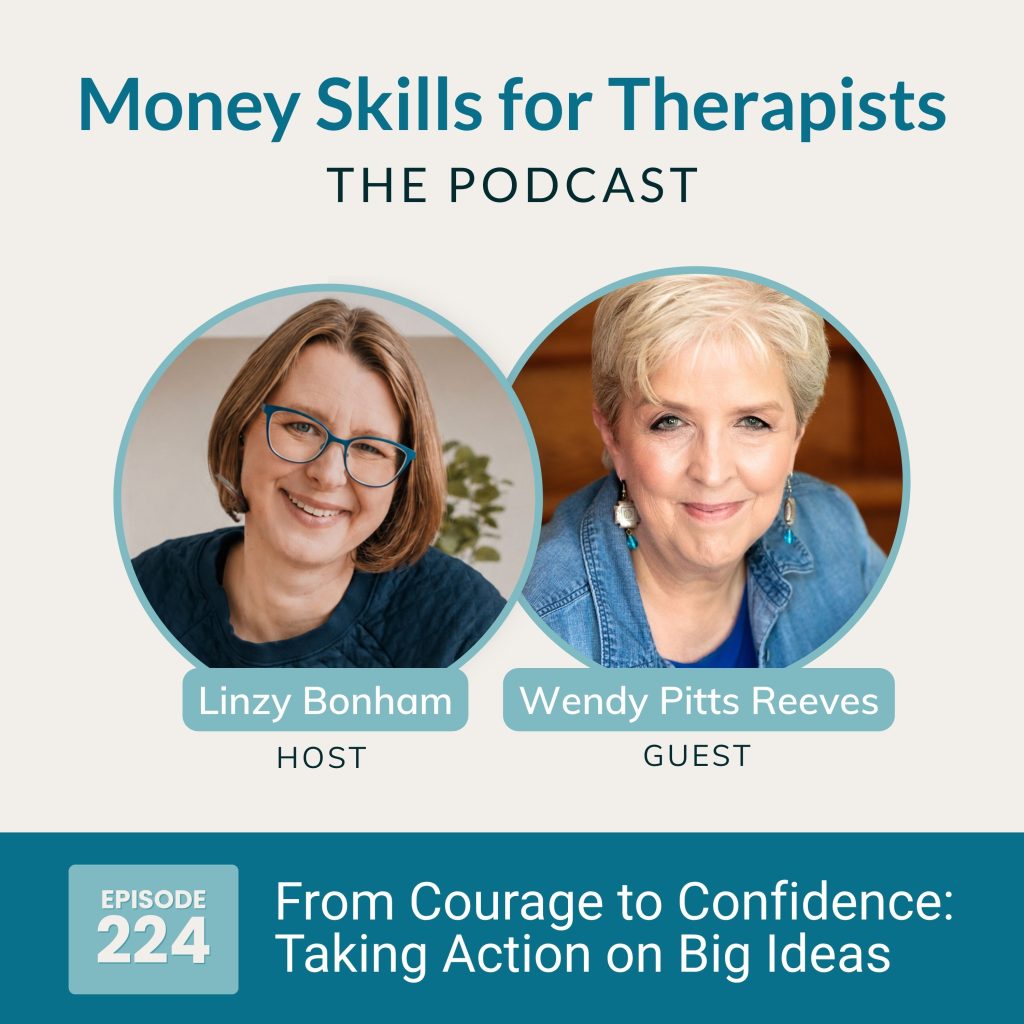
Today’s guest is Wendy Pitts-Reeves. Wendy is a therapist and a consultant for therapists.
Linzy Bonham 01:48
She is the creator of C2C Consulting, which is Courage to Confidence Consulting. And today we talk about how therapists can move from courage to confidence when you have an idea as a therapist that you need to take action on.
Linzy Bonham 02:01
Wendy today walks us through her framework, which really resonated with me about how to move from that place of like, I think I might want to do something else. I might want to grow a group practice.
Linzy Bonham 02:13
I might want to offer therapy groups. I might want to write a book.
Linzy Bonham 02:16
How do you move from that place into actually taking action and making it happen? I think it’s so easy for us as therapists with the perfectionism that can come with that, with the being so aware of everything that we don’t know, with all the other work that we’re doing, the caregiving that we’re doing in our lives and in our practices, it’s so easy to defer our dreams, right, and, and have an idea that we never make happen.
Linzy Bonham 02:41
Today, Wendy walks us through her framework to actually move into building your dream and seeing it happen in reality. The framework that she leaves us today really resonated with me.
Linzy Bonham 02:51
Wendy and I talk about our own examples of, you know, basically feeling the fear and do it anyways, if you remember that self-help book from the ’90s, to create the thing that you actually want to create in the world and not get stuck in just dreaming about it or stuck in indecision. Here is my conversation with Wendy Pitts-Reeves.
Wendy Pitts-Reeves 03:10
So…
Linzy Bonham 03:10
Wendy, welcome back to the podcast.
Wendy Pitts-Reeves 03:12
Thank you. I’m thrilled to be here, finally.
Wendy Pitts-Reeves 03:14
Yeah.
Linzy Bonham 03:14
I said welcome back. It’s not welcome back.
Linzy Bonham 03:16
I have been on your podcast. And so I have this sense that we’ve had a conversation before, but it was actually on your podcast.
Linzy Bonham 03:22
And now you’re finally coming on my podcast after two or three years.
Wendy Pitts-Reeves 03:25
Okay. Yep.
Wendy Pitts-Reeves 03:26
That’s right.
Linzy Bonham 03:27
So we were just chatting, you know, for a good 15 minutes before we started recording this about our various entrepreneurial projects that you and I are constantly getting up to. And I know for a lot of folks listening, they’re in private practice.
Linzy Bonham 03:42
It’s going pretty good. They’re at a point where maybe other people in life think that they should be satisfied or isn’t this enough?
Linzy Bonham 03:50
But they have ideas floating around. There’s a certain subclass of therapists I found who, like us, are…
Linzy Bonham 03:56
Like to make things happen, maybe have a little dream, but that can also be really daunting. So I wanted to talk to you about how do folks actually make that happen?
Linzy Bonham 04:06
If you’re in private practice and you’re thinking about some other fun idea, how do you actually move into action around that?
Wendy Pitts-Reeves 04:14
Yeah, yeah. Like, now what?
Wendy Pitts-Reeves 04:16
I’ve got this crazy idea and I’ve had this idea for a long time. And now what?
Wendy Pitts-Reeves 04:20
Right. Yeah, yeah.
Wendy Pitts-Reeves 04:21
So I do actually have a process that I have done instinctively my whole life. And I didn’t realize it was a process until I got an invitation to speak, actually, in Dublin a few years ago.
Wendy Pitts-Reeves 04:32
And I said, what do you want me to speak about to a group of entrepreneurs? And I said, what do you want me to speak about to a group of entrepreneurs?
Wendy Pitts-Reeves 04:41
And they said, I don’t know, just how you do what you do. And I’m like, well, I don’t know how I do what I do.
Wendy Pitts-Reeves 04:47
And I literally sat down and started… brain, like, just making a list of all the big things I’ve done in my life of which I’ve been on the planet a while. There’s been quite a few.
Wendy Pitts-Reeves 04:58
And what did they have in common? And the thing that was, like, showed up was there was a very specific pattern to how I’ve approached every big scary thing I’ve ever done in my life, including professionally and personally, right?
Wendy Pitts-Reeves 05:11
So today I call this the C to C Success Cycle, C to C, the letter C and the number two, stands for courage to confidence. That’s the, that’s actually my, my business is C to C Consulting.
Wendy Pitts-Reeves 05:22
And the gist of that is that when I, I… So what I see in my clients is that they are already courageous, and I see this in entrepreneurs and practice owners, but they don’t always own it.
Wendy Pitts-Reeves 05:33
And the way we recognize and claim the courage that we already have is by doing the thing that scares us, right? Feel the fear and do it anyway, that idea.
Wendy Pitts-Reeves 05:42
Well, the pattern that I recognized was repeatable. And I’ve realized now that this is how I’ve done everything I’ve ever done.
Wendy Pitts-Reeves 05:50
So if you’d like, I can just like walk you through what those steps are. And then I can give you an example of how, like one way that I’ve used that in my practice.
Wendy Pitts-Reeves 05:59
Because we are crazy people, right? You and I, we’re crazy.
Wendy Pitts-Reeves 06:03
Yes.
Linzy Bonham 06:03
Certifiably.
Wendy Pitts-Reeves 06:04
Certifiably crazy. Yeah.
Wendy Pitts-Reeves 06:05
And when I’ve given talks to groups, I always like, you know, the people in your, if you’re an entrepreneur, you’re a business owner, you are already a little different than everybody around you. And I know your family and your friends look at you like you’re crazy because you’re doing what?
Wendy Pitts-Reeves 06:22
Why would you do that? Why would you give up a perfectly good job with benefits and go do this crazy thing?
Wendy Pitts-Reeves 06:28
Because that’s how we’re wired. So let’s talk about how to take action on the idea.
Wendy Pitts-Reeves 06:32
You and I were just talking about how we can never be settled with things. We are wired differently than a lot of people.
Wendy Pitts-Reeves 06:39
And our family and friends often think we’re a little crazy. So if your listeners are like you and me, Linzy, who are never satisfied with the status quo and always have another idea, this is how you can get yourself off of the couch and into action, like start taking action.
Wendy Pitts-Reeves 06:54
So I’m going to name what the pattern is. And then I’m going to walk you through how this shows up in real life.
Wendy Pitts-Reeves 07:01
Okay. So the pattern is: dream, decide, declare, design, deliver, debrief, dance.
Wendy Pitts-Reeves 07:05
I have to say it faster. I can’t do it.
Wendy Pitts-Reeves 07:07
I want to do it slow. I mess up.
Wendy Pitts-Reeves 07:09
Dream, decide, declare, design, deliver, debrief, dance, which, when I walk through those you’re going to say, and I bet you money, I’ll be really curious to see if you’ve done this yourself and the things that you’ve done. Okay, okay, so dream.
Wendy Pitts-Reeves 07:23
Like, what is the idea? What is that?
Wendy Pitts-Reeves 07:25
I would… it’d be really cool to start a group practice. I’m a solo practitioner.
Wendy Pitts-Reeves 07:30
It would be really cool to get off, in, in the U.S., to get off of insurance and move to self-pay. I would love to start offering intensives or retreats, but I’ve never done that before.
Wendy Pitts-Reeves 07:40
So what’s the dream? What’s the vision?
Wendy Pitts-Reeves 07:42
Where is it that you want to go that feels big? Feels big.
Wendy Pitts-Reeves 07:45
This is… the key to me is that it has to feel bigger than you. That’s a little scary, makes your heartbeat faster to think about it.
Wendy Pitts-Reeves 07:53
Dream, decide. The decision is the beginning of everything, right?
Wendy Pitts-Reeves 07:57
There’s a thing about the root word of decide, which comes from the Latin word desir, I think, which means to cut. So when you make a decision, you… right?
Wendy Pitts-Reeves 08:05
I’m not doing that. I am doing that.
Wendy Pitts-Reeves 08:07
Okay. I don’t know how I’m going to do it.
Wendy Pitts-Reeves 08:10
I have no idea how I’m going to do it. But let’s say you’re offering intensives.
Wendy Pitts-Reeves 08:14
You’re going to start doing that in your practice. I don’t know, but I’m going to do it.
Wendy Pitts-Reeves 08:19
So dream, decide. And here’s the part that I do that I think is different.
Wendy Pitts-Reeves 08:23
Declare. Declare.
Wendy Pitts-Reeves 08:24
When you declare your decision, your intention to the world, and I say with your words or your wallet, you are so much more likely to follow through on that intention. So in this particular example, and I can…
Wendy Pitts-Reeves 08:36
I have done this so many times in my own world. I’m going to offer intensives.
Wendy Pitts-Reeves 08:41
I don’t know how I’m going to do it, but you know what I’m going to do? I’m going to send out a note to all my clients and say, hey, guess what?
Wendy Pitts-Reeves 08:49
Three months from now, I’m going to start offering intensives. Yes.
Wendy Pitts-Reeves 08:52
Ah, okay. Right?
Wendy Pitts-Reeves 08:53
I don’t know what I’m going to charge. I don’t know what they’re going to look like.
Wendy Pitts-Reeves 08:58
I don’t know what I’m going to call them. I don’t even know how to do them, but I’m going to do it.
Wendy Pitts-Reeves 09:04
And you tell your clients. And you tell your clients, or you sign up for a coaching course on how to do intensives and you put the money down for that course.
Wendy Pitts-Reeves 09:12
You have declared your intention. So either verbally or monetarily.
Wendy Pitts-Reeves 09:16
Right. So the podcast, when I decided to do the podcast, the first thing I did was sign up for a course on how to learn how to do this thing.
Wendy Pitts-Reeves 09:24
Right? And if I was going to spend the money on it, then I’m going to take action on it.
Wendy Pitts-Reeves 09:29
So dream, decide, declare, design. Design is the next part.
Wendy Pitts-Reeves 09:32
So this is the reason I do it this way. So where most people get hung up is they come up with the idea, they make the decision, and then they get stuck on the how.
Wendy Pitts-Reeves 09:41
And you can stay there for years. You can stay there for years, making notes, reading books, taking courses, following YouTube, blah, blah, blah, blah, and never, ever take action.
Wendy Pitts-Reeves 09:51
So the declare piece is important. Now you go figure out the how.
Wendy Pitts-Reeves 09:55
You design whatever it is you’re going to do. Dream, decide, declare, design.
Wendy Pitts-Reeves 09:59
Deliver. Go do it.
Wendy Pitts-Reeves 10:00
Try it. It can be a pilot project.
Wendy Pitts-Reeves 10:02
It can be an experiment. Do it one time.
Wendy Pitts-Reeves 10:05
Do it badly, but do it. And I can give you so many examples.
Wendy Pitts-Reeves 10:08
Right? And then once you’ve done whatever this crazy thing is that you told the world you were going to do, now go back and debrief what worked, what didn’t, what I like about that, what almost killed me, what would make it more worth my time next time, how can I improve?
Wendy Pitts-Reeves 11:23
Okay. And grow from there.
Wendy Pitts-Reeves 11:25
And then the last part that we also tend to ignore, I call it dance. Basically celebrate what you just did.
Wendy Pitts-Reeves 11:31
Celebrate no matter how it went, no matter if you had one person show up for your program. I don’t care.
Wendy Pitts-Reeves 11:36
You did something. So take a moment to go, you know what?
Wendy Pitts-Reeves 11:40
I did it. And then the circle starts over again.
Wendy Pitts-Reeves 11:42
So it’s repeatable. And when you do this over and over and over and over and over again, where it leads you to is results, because you’re going to get better and better, and resilience, because you’re going to grow and become stronger and sharper and more experienced along the way.
Wendy Pitts-Reeves 11:58
And I can tell you some really crazy stories about ways I have applied this in my practice. Yeah.
Wendy Pitts-Reeves 12:04
It just makes me laugh when I think about it.
Linzy Bonham 12:06
I want to think about examples. And I also… can I, can I, like, jam with you on these different steps and why I think it works for people like us too?
Linzy Bonham 12:13
First of all, as you’re talking, I’m thinking about my own examples. I’m thinking about like when I left private practice, how I did this.
Linzy Bonham 12:19
Yes. And when I, sorry, when I left for private practice, when I started my private practice.
Linzy Bonham 12:23
And it’s funny when you say the declare piece, because I’m… I was just having a conversation yesterday with students in Money Skills for Therapists on a coaching call about the idea of the Four Tendencies.
Linzy Bonham 12:32
Gretchen Rubin, are you familiar with that framework? She’s like a pop psychologist and it’s about your relationship to expectations.
Linzy Bonham 12:38
So the Four Tendencies, I rhymed them off yesterday and one of our brand new therapist students on the call was, like, knew everything about it. She was like, actually, 42% are this type of person.
Linzy Bonham 12:47
Yeah. And that type of person that we were talking about is the Obliger.
Linzy Bonham 12:50
And the Obliger personality, I think a lot of therapists were obligers, which means if we tell somebody else we’re going to do it, if there’s the expectation externally, if we told our partner or a best friend or colleagues, then we’re going to do it because somebody externally is expecting it from us. So I think that this stuff especially applies to people, people like we are.
Linzy Bonham 13:07
I love that because then you’re like, once you have a witness once you’re accountable to somebody else, I have to do it. You don’t want to let them down.
Linzy Bonham 13:14
You don’t want to be like oh I told everybody I was going to do this and then I didn’t. There’s certain personality types that I think would not be held to that but for people people like us for Obligers, it really works.
Linzy Bonham 13:24
And when I stepped into private practice, Wendy, I… all I knew is I wanted to leave my agency job where I was and I didn’t have the bravery just to be like, I can’t be here anymore because it’s killing me and I don’t know what I’m doing. So I was like, I’m starting a private practice.
Linzy Bonham 13:37
Whatever that is. Yeah.
Linzy Bonham 13:38
You know, and like I just told them that’s what I was doing and I needed to do something, obviously. But I remember that moment of declaring, like I can remember what that felt like.
Wendy Pitts-Reeves 13:46
Yeah.
Linzy Bonham 13:47
I’m starting a private practice. And in my brain, I’m like, I have no idea what I’m doing.
Linzy Bonham 13:51
Help. But I declared it.
Linzy Bonham 13:52
That’s why I’m leaving and this is what I’m doing next. I put it out there and then I had to make it happen.
Wendy Pitts-Reeves 13:57
It pulled you through the fear. That’s it.
Wendy Pitts-Reeves 13:59
When you said that, it pulls you through. And you’ll figure out, I always say that people get hung up on the how.
Wendy Pitts-Reeves 14:05
I see this in my clients, like even in my counseling work and coaching work, that when you give yourself permission to go after what you really want to do anyway, you will figure out the how every single time. You may stumble around a while, but you’ll figure it out.
Wendy Pitts-Reeves 14:19
Yeah, which you did. I love that.
Wendy Pitts-Reeves 14:21
That’s a great example.
Linzy Bonham 14:22
Which I did, and then some. Yeah, and I was thinking too, as you were describing, I can apply this to the first time I launched Money Skills for Therapists, the course, right, in 2018.
Linzy Bonham 14:31
And like, yeah, so many examples. So yeah, I would love to hear for you of some examples, because I think a lot of folks listening… are wired like we are.
Linzy Bonham 14:38
They either are already in private practice or they’re strongly considering it. They know that they want to step out and make their own thing.
Linzy Bonham 14:45
And again, that’s not everybody. Like that kind of entrepreneurial type of personality where you’re even willing to consider just kind of standing on your own is a pretty small segment of the overall population.
Wendy Pitts-Reeves 14:55
Right, so folks, I’m…
Linzy Bonham 14:56
Telling you have to be a little crazy. Yeah, yeah.
Linzy Bonham 14:59
Folks who are listening, you’re probably also a little bit crazy like Wendy and I, or you want to be crazier than you are. You’re dreaming of going this way.
Linzy Bonham 15:07
Yes. So, yeah, tell me how this has looked for you, Wendy.
Linzy Bonham 15:10
I know you had like some cool examples.
Wendy Pitts-Reeves 15:12
Yeah, well, your example about the private practices are really good, and I can relate to that, too. And that is a really common one.
Wendy Pitts-Reeves 15:20
So just telling your job that you’re leaving, turning in your notice, finding an office to rent, finding a private practice to join, any of those things, like all of those are great examples. For me, and just like you with Money Skills for Therapists, I have launched courses this way where I have literally gone online and announced I was going to be doing a course that didn’t even have a name yet.
Wendy Pitts-Reeves 15:42
Here’s what it’s going to be about. It’s going to be roughly about this long, and we’re going to be talking about this long.
Wendy Pitts-Reeves 15:49
If you’re interested, let me know. And then figure the thing out, right?
Wendy Pitts-Reeves 15:53
But the biggest, one of the best examples that I like to talk about when I share this is that several years ago, I was going through a restless period. And entrepreneurs, we do this.
Wendy Pitts-Reeves 16:03
Everything’s fine. I’ve been through, but I’m ready for something more.
Wendy Pitts-Reeves 16:07
I had actually served a term in public office, talk about doing something scary, and had come out of that and had sort of expanded through that process and came out of it wanting more, like in a way that I couldn’t even really identify.
Wendy Pitts-Reeves 16:21
And I won’t go through the whole thing, but long story short, what eventually came to me over a period of time, the dream piece was… was that in my counseling work, I had noticed that when I could get some certain women clients of mine who were struggling in a particular way, if I could convince them to go do something big, which in my favorite example was to take a trip by themselves, if I could get them to travel,
Wendy Pitts-Reeves 16:44
I didn’t care if it was a huge cross-country trip or it was a weekend close by, but to do some kind of a travel on their own, if I could talk them into trying that, they came back together different people. Like it was a huge, huge transformative experience.
Wendy Pitts-Reeves 16:59
Out of that, over time, the idea came to me that if I couldn’t convince them to go, I would just take them. So this was like, there’s a lot to this story, but the gist of it is…
Wendy Pitts-Reeves 17:09
And I was in a moment in a particular place in a particular conversation where I got struck by lightning with this idea of taking women on adventures that were a little scary, a little different, a little out of the box for courage to turn courage into confidence, right? C to C.
Wendy Pitts-Reeves 17:25
And so I talked about it and talked about it and talked about it. And I had a coach and it was like, were you going to do anything?
Wendy Pitts-Reeves 17:32
So dream, decide. The decide is I am going to take them.
Wendy Pitts-Reeves 17:35
And with this coach’s help, I decided to do something that was like not a big, like, week-long trip or weeks-long, but more like a local day event of some sort. So that was the decision.
Wendy Pitts-Reeves 17:46
I am going to do this. I’m going to take people on an adventure at some point.
Wendy Pitts-Reeves 17:50
And then I had to declare that. And well, the crazy thing was this coach that I was working with said, what if you did something where they didn’t know what they were going to do and they just show up and you take them somewhere and you do some kind of an activity, but they don’t know what they’re getting into.
Wendy Pitts-Reeves 18:08
And she had had some experience like that. And I was like, oh, that is a really, really cool idea.
Wendy Pitts-Reeves 18:13
Background, I’ve done a lot of experiential work. So a lot of wilderness-based work, a lot of all kinds of things with teenagers in the woods, all kinds of stuff.
Wendy Pitts-Reeves 18:22
So I have a bias that way anyway. So she’s like, what if you did an adventure and they signed up, and they came, but they didn’t know what the adventure was going to be.
Wendy Pitts-Reeves 18:32
And I’m like, this is super cool. So that’s a decision point.
Wendy Pitts-Reeves 18:35
How the heck do you sell that? I want you to pay me, but I’m not going to tell you what you’re paying me for.
Wendy Pitts-Reeves 18:42
And I’m not going to really tell you, you may be jumping off a cliff. You may be making pottery.
Wendy Pitts-Reeves 18:47
I don’t know, but we’re going to do something. Yeah.
Wendy Pitts-Reeves 18:50
So it was a great idea, but I could not make myself take action because for the life of me, I couldn’t figure out how do you sell that? And one night when I couldn’t sleep, literally at four o’clock in the morning, I woke up and I’m like, there was a full moon coming.
Wendy Pitts-Reeves 19:05
I live near the mountains in the Southeast United States and East Tennessee. And there’s a beautiful mountain range close to here.
Wendy Pitts-Reeves 19:12
It’s very popular. And there was a full moon coming.
Wendy Pitts-Reeves 19:15
And what I wanted to do for my first adventure was take a group of women on a moonlight hike in the dark to a particular spot that’s up high around here. Like, how cool would that be?
Wendy Pitts-Reeves 19:26
So now I had a deadline. The full moon is on a certain date.
Wendy Pitts-Reeves 19:29
And if you’re going to do it, you better do it, right? And I was so sick of myself of just going around and running around in circles with this and never doing anything.
Wendy Pitts-Reeves 19:39
But now I had a deadline. So at 4 o’clock in the morning, I literally went onto Facebook, and I started creating an event.
Wendy Pitts-Reeves 19:46
Right? And I didn’t know how to describe it because I didn’t know I couldn’t tell them what it was.
Wendy Pitts-Reeves 19:51
Yeah. So I start writing this thing about I’m going to do this really cool thing and you should come and no, I’m not going to tell you what it is.
Wendy Pitts-Reeves 19:59
But if you are tired of being the one who has to make all the plans and have to figure everything out and you would like to do something a little different, a little out of the box and someone else figures it out for you, come join me. And I could only take four people because that’s how many I could fit in my car.
Wendy Pitts-Reeves 20:17
This is literally what I was doing. I spent two hours, 4 a.m. to 6 a.m., writing this event description.
Wendy Pitts-Reeves 20:23
I didn’t even know what to call it. So when I was writing the description, I said, this is a secret adventure for courageous women.
Wendy Pitts-Reeves 20:30
Because you have to be kind of crazy to do this, right? And I priced it something ridiculously low because I had no idea what I was doing.
Wendy Pitts-Reeves 20:38
And at six o’clock in the morning, I hit, after obsessing for two hours, I hit publish. And then I held my breath.
Wendy Pitts-Reeves 20:45
And an hour later, at seven o’clock in the morning, as I’m putting on my makeup, my phone goes ding. And a friend of mine said, I don’t know what you’re up to, Pitts-Reeves, but I’m in.
Wendy Pitts-Reeves 20:55
Yeah. And that was the beginning of it.
Wendy Pitts-Reeves 20:57
And that became Secret Adventures for Courageous Women, which I then began to lead monthly for the next three years. And we did do everything from extremely physical activities like hang gliding, kayaking, backpacking, all kinds of stuff like that.
Wendy Pitts-Reeves 21:11
But I also wanted to do things that you could do in a wheelchair. So we did a classical music concert and a fancy dinner, pottery classes, I took them fishing, which was one of the funniest ones I ever did.
Wendy Pitts-Reeves 21:23
And in every single one of these. So, dream, decide, declare: that, that Facebook post.
Wendy Pitts-Reeves 21:28
And when I’ve given this in a talk, I’ve shown people a screenshot. It’s like, why would you sign up for this?
Wendy Pitts-Reeves 21:34
It’s crazy. It’s crazy.
Wendy Pitts-Reeves 21:35
Dream, decide, declare, design. Once I had, I got people, like, with, by nine o’clock that morning.
Wendy Pitts-Reeves 21:41
I had my four people. Oh my gosh.
Wendy Pitts-Reeves 21:43
And then I had a problem because I had more people who wanted to come. So I roped a friend in to drive.
Wendy Pitts-Reeves 21:49
I didn’t have insurance. I had, like, it was just crazy.
Wendy Pitts-Reeves 21:52
Talk about the how. Yeah.
Wendy Pitts-Reeves 21:53
We ended up, it turned out to be a lovely, beautiful evening where I had a gourmet picnic dinner at an overlook set up in the mountains. We watched the sunset and they thought that was the treat.
Wendy Pitts-Reeves 22:04
And then I lured them back into the car with an excuse and took them to another place where I knew that there was a particular trail. And I ended up in the dark, gave them a flashlight and a bandana, and led them through the dark to an overlook, to a very high overlook, where we watched the full moon come up over the town we live in and the Great Smoky Mountains National Park.
Wendy Pitts-Reeves 22:26
And this is significant. In that group, there was one woman there who had gone through a divorce.
Wendy Pitts-Reeves 22:31
And the place I took them to was the place she and her husband used to always go. And she had never been back up there since the divorce.
Wendy Pitts-Reeves 22:39
I had no way of knowing that, right? No.
Wendy Pitts-Reeves 22:41
That dynamic happened on every, almost every trip I ever led after that. Almost everyone.
Wendy Pitts-Reeves 22:46
There was someone who, like, I swear it was like magic, would show up who needed exactly what we did that day. And some of them were fun and light.
Wendy Pitts-Reeves 22:55
Some of them were really hard and emotionally challenging. After that first one, you know what I did?
Wendy Pitts-Reeves 23:00
I went back and debriefed, right? Yes.
Wendy Pitts-Reeves 23:02
I designed it. I delivered it.
Wendy Pitts-Reeves 23:04
And then I debriefed what worked, what didn’t. Oh, I should probably get insurance if I’m driving people in my car.
Wendy Pitts-Reeves 23:11
And then I celebrated. And then I started this cycle over again quickly because I knew myself and I knew I would lose my nerve if I didn’t do another one right away.
Wendy Pitts-Reeves 23:20
Yes. So I did another one like three weeks after that.
Wendy Pitts-Reeves 23:23
And then after that, I started to spread them out. But yeah.
Wendy Pitts-Reeves 23:27
That became a thing that took on a life of its own. And I eventually stopped.
Wendy Pitts-Reeves 23:31
Life happened and transitioned. And it was a massive amount of work.
Wendy Pitts-Reeves 23:35
But it did change lives in a really dramatic way. And I had a lot of fun.
Wendy Pitts-Reeves 23:39
And after that, people would come up to me on the street and say, Wendy, I want you to meet my friend. She’s a courageous woman, too.
Wendy Pitts-Reeves 23:46
Like it became like this thing in my community. And when I finally stopped doing it, like literally years later, people would say, I wish you still did that.
Wendy Pitts-Reeves 23:55
But it was this whole like I was literally selling something I couldn’t, I couldn’t tell them what it was. And they were buying it.
Wendy Pitts-Reeves 24:03
Crazy.
Linzy Bonham 24:03
It is crazy.
Wendy Pitts-Reeves 24:04
And it worked.
Linzy Bonham 24:05
It works. And this is what I’m thinking about, too, as you’re, as you’re talking.
Linzy Bonham 24:09
I’m thinking there’s a few things here that I find can be hard for therapists, particularly as a type of human. One is this process that you’re describing.
Linzy Bonham 24:17
I like that it’s a process because then you know what you need to do next. You’re like, okay, I did that one.
Linzy Bonham 24:22
This is the next step. Doing something imperfectly can be really hard for folks who are perfectionists.
Linzy Bonham 24:28
And this is something that I’ve also shared with my students who are thinking about doing a thing. I do the same thing as you.
Linzy Bonham 24:34
I have sold. I sell things before I make them.
Linzy Bonham 24:36
Right. All the time.
Linzy Bonham 24:37
Money Skills for Therapists, my first course, still teaching it now, eight years later, sold it before I made it to a list. I had an email list of like 300 people at the time.
Linzy Bonham 24:46
Made it as I went.
Wendy Pitts-Reeves 24:47
You build a plane while you’re flying it.
Linzy Bonham 24:49
That’s it. Because when you have that spark of inspiration, too.
Linzy Bonham 24:52
Also, you know, so many folks who are listening, like you and I, are also caregivers to kids or parents. We’re busy people.
Linzy Bonham 24:58
And that spark can be kind of consumed by other things. Right.
Linzy Bonham 25:01
Right. And so I think there is something precious that happens when you do feel that real inspiration to make something, like, you need to treat that with, with reverence and like follow it because, like…
Wendy Pitts-Reeves 25:11
Yes.
Linzy Bonham 25:12
You know, nothing is worse than like a dream dying inside of you to be dramatic. But like, yeah, so I’m thinking about, like, part of what you’re describing is imperfect action.
Linzy Bonham 25:22
Do it anyways. You’re kind of doing it on the fly.
Linzy Bonham 25:24
You’re selling it first, then you’re making it. Now you have to make it because people are coming.
Linzy Bonham 25:30
You have to do something. So you can’t get stuck in your perfectionism.
Linzy Bonham 25:34
But I was also reflecting on how, for me, the decide is the worst part. I hate being in decide.
Linzy Bonham 25:39
I hate it. Right?
Linzy Bonham 25:40
So it’s like, for instance, recently we made a decision to do a major project on our house. So dream was there.
Linzy Bonham 25:46
I was like, okay, I can imagine, you know, staying in this neighborhood, making this the house we want it to be rather than having to move somewhere else. I can visualize that.
Linzy Bonham 25:55
That’s nice. But the actual decide, like, are we putting in the money?
Linzy Bonham 25:59
You know, is the rubber hitting the road? I stayed in decide for probably about six months and it sucked.
Linzy Bonham 26:05
Yeah.
Wendy Pitts-Reeves 26:05
I hate being in decide. And, like…
Linzy Bonham 26:07
I’m curious about your experience with decide, if decide is a sticking point for you too, because I find for myself, if I’m stuck in decide, I hear myself talking about it to everybody. I’m constantly seeing myself like, in my case, like running numbers over and over.
Linzy Bonham 26:21
Like, it’s repetitious and it feels… Yeah, there’s a stuckness there that I hate being stuck.
Linzy Bonham 26:26
I’m curious, like, do you find, are there certain points in the process where people tend to get stuck? Like, is decide a common stuck point?
Linzy Bonham 26:34
Do you see other stuck points in the process?
Wendy Pitts-Reeves 26:36
100%, which I think is why this Declare piece is so powerful. Yeah.
Wendy Pitts-Reeves 26:40
Because… We will drive ourselves crazy with that.
Wendy Pitts-Reeves 26:43
And I love what you said, Linzy, about that this is a sacred thing. Like, respect this, honor this.
Wendy Pitts-Reeves 26:49
It’s not as, for all of my joking, it’s not necessarily crazy. It really is a part of you that is calling you forward.
Wendy Pitts-Reeves 26:56
And you know this as a coach. You and I both coach folks in practice.
Wendy Pitts-Reeves 27:00
There’s something in you that wants something more. And to be deadly serious about it.
Wendy Pitts-Reeves 27:06
I want to honor what you just said. Listen to that.
Wendy Pitts-Reeves 27:09
Respect that. You cannot.
Wendy Pitts-Reeves 27:10
It will not go away. It will keep bothering you.
Wendy Pitts-Reeves 27:13
And I have done lots of off-the-cuff stuff. I have done courses like you’ve done.
Wendy Pitts-Reeves 27:18
I really have just announced them and done them. And they have come from different places of motivation.
Wendy Pitts-Reeves 27:24
But the big stuff, like this adventure thing, I love experiential work. And so that was, I probably spent a year working my way up to that idea.
Wendy Pitts-Reeves 27:33
Like when it hit, it hit like this and I took action on it probably within a month, honestly. But it had been building for a long time.
Wendy Pitts-Reeves 27:41
And I can tell you other examples where I sat on it and sat on it and sat on it and sat on it. A funny… here’s a funny one.
Wendy Pitts-Reeves 27:49
Here’s another funny one was I was afraid of doing video, which just cracks me up now because I don’t think anything about it now, right? But I knew that this, when was this?
Wendy Pitts-Reeves 27:59
It was like, I’ve been doing business. I’ve been unofficially business coaching for like 100 years ever since I ran my group practice.
Wendy Pitts-Reeves 28:07
But officially, I mean, because I was always teaching therapists how to get their practice off the ground when I ran a group. I ran a group practice for 25 years.
Wendy Pitts-Reeves 28:17
But I officially began doing the business coaching piece as a thing 10 years ago, 2016, I think, is when I first started doing that and I had a client that I was trying to convince her… That’s what… oh, yeah, I was trying to remember this story.
Wendy Pitts-Reeves 28:32
I had a client that was trying to convince her to make videos of a meditation practice that she taught. That would have been a really good thing for her clients, and she was holding her breath and holding her breath.
Wendy Pitts-Reeves 28:45
And I, I had been trying to talk myself into making videos for two years, and, and I said to her, if you’ll do it, I will. If you’ll make a video and show it to your clients, I’ll make a video, which was declaring to her and giving myself a deadline.
Wendy Pitts-Reeves 29:00
And so she, she were… we were accountability partners. I was her coach, but we were.
Wendy Pitts-Reeves 29:05
So I had to do it now because I couldn’t let my client down. And it was so bad.
Wendy Pitts-Reeves 29:10
It was so bad. I sat on a rocking chair on my front porch with my arm propped up on a stack of books holding my phone.
Wendy Pitts-Reeves 29:17
And it recorded the video and there was no sound. And then I had to go back and figure out why there was no sound.
Wendy Pitts-Reeves 29:24
Oh, it was just… It was so bad.
Wendy Pitts-Reeves 29:26
It just hurts to think about. But you know what?
Wendy Pitts-Reeves 29:29
I did it. Yeah.
Wendy Pitts-Reeves 29:30
Right? So dream, decide.
Wendy Pitts-Reeves 29:31
It was the exact same process. And then after that, I did it again and again and again.
Wendy Pitts-Reeves 29:36
And so did my client. So, yeah.
Wendy Pitts-Reeves 29:38
I think… I think people sit on ideas for a long time because the fear is holding us back.
Wendy Pitts-Reeves 29:44
And y’all, the fear is not going to go away ever. It’s not.
Wendy Pitts-Reeves 29:47
I mean, if you’re waiting for that, you’re never going to do this. Yeah.
Wendy Pitts-Reeves 29:52
And you’ll spend your whole life wishing you had done it. Yeah.
Wendy Pitts-Reeves 29:55
When I told you I was giving that talk in Dublin and they were asking me how you do what I do. The very first big thing I did was in my early 20s when I had no money and had a minimum wage job and I wanted to go to Europe.
Wendy Pitts-Reeves 30:09
And I couldn’t figure out how I was going to get there. And I, long story short, made a plan, started telling people I was going to go, researched things, started saving money, and two years after I made that decision and declared it, I went to Europe when I was making like $4 an hour, like really, really, really, really no money at all.
Wendy Pitts-Reeves 30:29
And it was a, at the time, absolutely astronomically huge thing for me, like something I didn’t think I would ever be able to do in my life because I didn’t know anybody who’d ever been overseas. Right?
Wendy Pitts-Reeves 30:41
Oh, wow. I never thought about that until I looked back on it, like how I got myself through that.
Wendy Pitts-Reeves 30:47
And it was only in that reflection that I realized this is a pattern of, I did it when I went to Europe in my 20s. I did it when I, we adopted children from Guatemala.
Wendy Pitts-Reeves 30:57
I did it when I launched a practice. I had never had any intention of owning a business.
Wendy Pitts-Reeves 31:02
And it was insane. But I was adopting a child and wanted to work part time and couldn’t find a part time job.
Wendy Pitts-Reeves 31:09
So here you go. Right?
Wendy Pitts-Reeves 31:10
Rent an office. Had no idea how to get a client.
Wendy Pitts-Reeves 31:13
I didn’t know what I was doing. Right.
Wendy Pitts-Reeves 31:16
Open a group practice. Had no idea how to do that.
Wendy Pitts-Reeves 31:19
Same thing. Running for office.
Wendy Pitts-Reeves 31:21
Had no idea how to do that. Same thing.
Wendy Pitts-Reeves 31:23
Right. It’s the same process.
Wendy Pitts-Reeves 31:25
But okay, this is terrifying. But everything in me is calling me into this and I cannot ignore it.
Wendy Pitts-Reeves 31:31
Everything. It will not leave me alone.
Linzy Bonham 31:33
Yeah. Like there are certain things where it would be a denial of self to not follow it.
Wendy Pitts-Reeves 31:37
Yes.
Linzy Bonham 31:37
Right. Like, it’s… yeah.
Linzy Bonham 31:39
You know, I use the word sacred. I think, you know, other… you know, you describe it different ways, but…
Wendy Pitts-Reeves 31:45
That’s beautiful.
Linzy Bonham 31:54
Yeah. Yeah, like it certainly applies to entrepreneurial people so deeply.
Linzy Bonham 31:56
And it makes me curious, like, if this framework applies to everybody or if it’s like for people just like us. And I don’t know.
Linzy Bonham 32:00
But I do know for folks listening, like this is certainly what you’re describing, I feel like really sums up my own experience of building things and doing things. And as you say, the fear doesn’t go away.
Wendy Pitts-Reeves 32:07
Yeah.
Linzy Bonham 32:07
You know, like I have fallen on my face so many times trying to like get folks into my courses. Like, yeah.
Linzy Bonham 32:13
And I’ve launched products like courses and then change the name mid-launch because I’m like, oh, that wasn’t the name. This is the name.
Linzy Bonham 32:20
Right. And I think that… when we have been in our comfort zone for a long time, and for a lot of therapists, being a therapist is a comfort zone, right?
Linzy Bonham 32:28
It’s very safe being a therapist in a lot of ways. We get to show up in this very zipped up, contained way.
Wendy Pitts-Reeves 32:33
We get to use all of our interventions.
Linzy Bonham 32:35
Somebody’s bringing you all of their messiness and contradictions and their flaws, but you get to sit in this very nice little zipped up shell in order to make the space all about them. I think being a therapist is very emotionally safe for most of us.
Linzy Bonham 32:49
And when you go to step out to do almost anything else in your business.
Wendy Pitts-Reeves 32:53
Yes.
Linzy Bonham 32:54
It’s going to be scary.
Wendy Pitts-Reeves 32:56
And I’ll tell you, not everybody’s wired this way. When I ran a group practice, it was surprising to me.
Wendy Pitts-Reeves 33:02
And I had a very successful practice with wonderful people. We had a great reputation.
Wendy Pitts-Reeves 33:07
They did good work. Really, really good work.
Wendy Pitts-Reeves 33:10
But they were not all wired like this. There are people who are quite happy to just sit in their office and see people all day long.
Wendy Pitts-Reeves 33:18
I’m not that person. And so I don’t want to, like, no shame.
Wendy Pitts-Reeves 33:21
If that’s who you are, I wish I could be that way. I’m just, I just am not.
Wendy Pitts-Reeves 33:26
So for those of you who are like, all I want to do is make, I just would like to get paid better for the work that I’m doing and not be stressed over money all the time. Girl, do it.
Wendy Pitts-Reeves 33:36
Like, figure that out. Learn from Linzy.
Wendy Pitts-Reeves 33:39
Learn. That is plenty.
Wendy Pitts-Reeves 33:40
But if you are a restless soul who is creative and is always feels that you are called to do more, then I encourage you to give yourself permission to go after it and work through this process and you can do it. Absolutely.
Linzy Bonham 33:53
That was such a beautiful summary. I think we’re going to have to end there, Wendy, because that was a beautiful, beautiful sendoff.
Linzy Bonham 34:00
Thank you so much for joining me today, Wendy. It’s so nice to finally have this conversation on the podcast.
Linzy Bonham 34:06
And for folks who want to get further into your world, where can they find you?
Wendy Pitts-Reeves 34:10
The simplest way is just to listen to my podcast, which is called Ideal Practice. You can find it anywhere that you listen to podcasts.
Wendy Pitts-Reeves 34:17
My basic principle is that what’s ideal for you is going to be different from what’s ideal for someone else. And you should design a practice that makes you really, really happy.
Wendy Pitts-Reeves 34:25
So we’ll talk about how to do that. Yeah.
Wendy Pitts-Reeves 34:27
Wonderful. That’s the easiest way.
Wendy Pitts-Reeves 34:29
Thank you so much for being here today, Wendy. Thank you.
Wendy Pitts-Reeves 34:32
And thank you for being a guest on my show. I’ll be… we should make sure we link to that too.
Wendy Pitts-Reeves 34:37
Sure. Yeah, let’s do it.
Wendy Pitts-Reeves 34:38
Okay.
Linzy Bonham 34:38
Check out the link in the show notes for me on Wendy’s Ideal Practice podcast. Thanks, Wendy.
Wendy Pitts-Reeves 34:42
Thank you.
Linzy Bonham 34:47
I really appreciate Wendy bringing her perspective and her experiences and her framework to the podcast today.
Linzy Bonham 34:53
If what Wendy was describing resonates with you in terms of wanting to build out something, wanting to make changes, whether it’s stepping from your agency work into private practice, whether it’s being in private practice and wanting to build out a group or step into a group practice or build out a course or write a book, I’d encourage you to think about where you are in that framework that she described to us. Right?
Linzy Bonham 35:17
The, like, dream, decide, design. I can’t list it out perfectly.
Linzy Bonham 35:20
Wendy’s not here. But thinking about where you are in the process and noticing, are you stuck?
Linzy Bonham 35:25
And if you’re stuck, what is that next step? That imperfect action piece that I mentioned is so important to actually make things happen.
Linzy Bonham 35:33
So many, so many things that I have built. I built on the fly.
Linzy Bonham 35:37
I made myself do it. I told other people, right?
Linzy Bonham 35:39
Declare. That’s the other one, right?
Linzy Bonham 35:41
Dream, decide, declare. As people who are externally motivated, as therapists tend to be, declaring is a great way to get yourself moving.
Linzy Bonham 35:49
So think about where you are right now in a project that you have or a desire that you have. Where are you in this process?
Linzy Bonham 35:56
And what do you need to do next to actually keep moving and build it out? There’s a saying, which I’m probably going to butcher because I don’t remember it perfectly, but basically like a ship that’s in a harbor cannot change course, right?
Linzy Bonham 36:09
It’s only a ship in motion that can change course. Getting into motion allows us to actually make something happen.
Linzy Bonham 36:16
And if we make a mistake, when we’re in motion, we can shift and change. But when we’re stuck, when you’re a ship in the harbor, you can’t go anywhere, right?
Linzy Bonham 36:24
You haven’t built up that momentum yet.
Linzy Bonham 36:27
So thinking about where you are right now in the process, thinking about what that next step is and moving yourself through it, I will say from personal experience, just going and doing the thing, even though you’re so scared and you have all these stories of all the bad things that could happen, doing it anyways is what you actually need to do in so many cases to be in alignment with yourself and actually live your life authentically, not be stuck in fear or inaction.
Linzy Bonham 36:53
So thank you so much, Wendy for coming on the podcast today and sharing this really helpful framework with us. And thank you so much for joining me today.
Linzy Bonham 37:01
I’m Linzy Bonham. I’m a therapist turned money coach, and I’m the creator of Money Skills for Therapists.
Linzy Bonham 37:07
If you are ready to feel more calm, confident, and grounded in your private practice finances, then attending one of my free upcoming live workshops is the best place for you to start.
Linzy Bonham 37:18
From saving enough for taxes, to creating stability in your private practice, to overcoming money shame and building a practice that actually takes care of you, we’re bringing you a variety of workshops to help you begin to shift your relationship with money and get your private practice finances working for you. Register today using the link in the show notes or at moneyskillsfortherapists.com/workshops.
Linzy Bonham 37:40
I look forward to supporting you.