Dana Corr [00:00:00]:
I started working with an ad agency, which was like, setup fee plus six months of their work all up front, which felt super risky. I think that it’s definitely having a positive impact, but it just, it was that moment of, like, sending over that big lump sum that I’m like, ugh.
Linzy Bonham [00:00:24]:
Welcome to Money Skills for Therapists, the podcast that helps therapists and health practitioners in private practice go from money confusion and shame to calm, clarity and confidence with their finances. If you’ve ever felt overwhelmed by numbers or avoided looking at your business money, you’re in the right place. I’m Linzy Bonham, therapist turned money coach and creator of Money Skills for Therapists. Before we jump in, I want to remind you of something really important. Most of us highly skilled and competent therapists and health practitioners were never taught about money. Not in grad school, not in supervision, not anywhere. And yet here we are, running businesses that need to take care of us while we’re busy taking care of others. It is a lot of pressure.
Linzy Bonham [00:01:04]:
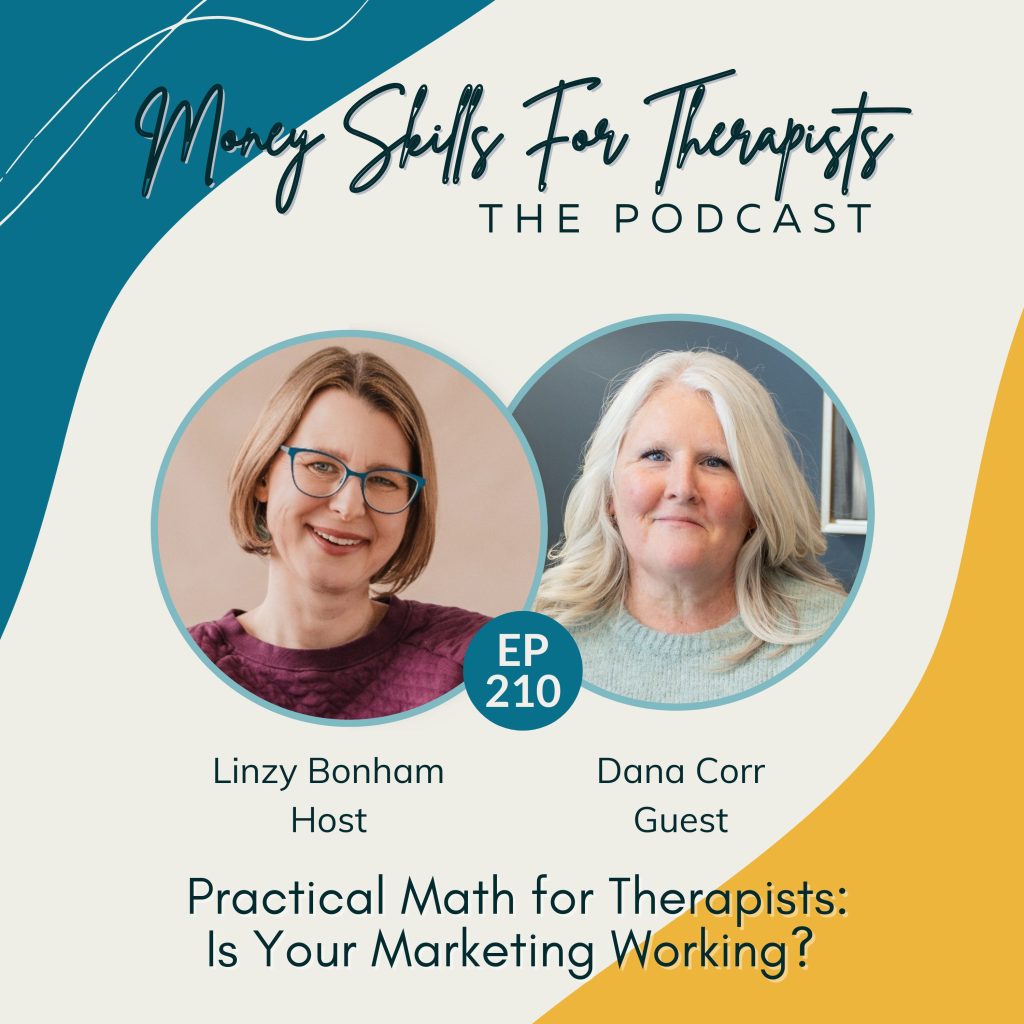
So if part of you feels anxious about money avoidant or like a bit of a hot mess financially, I want you to know that you are not alone. And I am here to help. Through my free live workshops each month, I teach practical financial skills to help you feel more grounded, calm and confident with your private practice money. You can see what’s coming up and save your spot to join live or register for the replay@moneyskillsfortherapist.com workshops. Let’s get started. Hello and welcome back to the podcast. Today’s episode is a coaching episode with graduate Dana Corr. Dana is a graduate of the Money Skills for Group Practice Owners program, and our conversation today focused in on return on investment, specifically around marketing.
Linzy Bonham [00:01:47]:
Dana has been in what we call an investment period for a little while, putting money into the business, kind of building it up. And we talked today about how to get clarity on whether she’s actually getting money back from all this money that she’s putting in, specifically zooming in on her Google Ad spend and some marketing work she’s having done by a marketing company. This is a really helpful conversation for those of us who are thinking about how can you tell if the money that you’re spending specifically on marketing is bringing money back Again, we talked today about the numbers that you need to actually do the math to understand. Is the money that I’m spending on advertising actually paying off? What is the kind of multiple that I’m getting on these dollars? And today we talk about really zooming in and creating clarity so that you understand the actual numbers that you’re working with, not kind of like the general feeling. How do you feel about the people that you’re working with or how do you feel the ads are going to? What are the metrics you need to track and understand to know if the money that you’re spending is giving you good return on investment? Here’s my coaching conversation with Dana Corr. So, Dana, welcome to the podcast.
Dana Corr [00:02:58]:
Oh, thank you so much for having me here. I feel like I’ve won the lottery getting a chance to sit with you for a little bit.
Linzy Bonham [00:03:05]:
Oh, that’s very kind of you. And it’s so nice to see you again. We were just saying it’s been a little while since we worked together and since I got to see you.
Dana Corr [00:03:12]:
Yeah. Although you’re in my mind all the time, so I feel like you haven’t left me for sure.
Linzy Bonham [00:03:17]:
Okay, beautiful. Good, good, good. I hope I’ve been giving you good advice and insights always. Okay.
Dana Corr [00:03:21]:
Always.
Linzy Bonham [00:03:21]:
Beautiful.
Dana Corr [00:03:21]:
Always.
Linzy Bonham [00:03:22]:
So for our time together today, Dana, what do you want to focus on?
Dana Corr [00:03:26]:
I’m finding that through the work that I’ve done with you, I have, like, the tracking and the keeping on top of finances feels pretty good. Or just being clear on my numbers feels good. But it’s the investment period and knowing how long, what are the kind of the guardrails that tell me continue with investing or it’s time to pull that back and reassess and just sort of how to work more in the projections and cash flow pieces of real time rather than just sticking in the historical numbers.
Linzy Bonham [00:04:09]:
Yes. Okay. Yeah. Yeah. I mean, what I’m hearing is getting more clarity on what’s happening now and like, where, where is this going? Like, are the decisions. You’re making good decisions, right? Yes.
Dana Corr [00:04:19]:
Right.
Linzy Bonham [00:04:19]:
Okay. Okay. So an investment period for folks who are listening, who don’t know what it means, because it’s a phrase that I kind of made up. Can you tell them how you think about the investment period that you just described? What is that?
Dana Corr [00:04:31]:
I think it’s when I am putting money into something with the intention that it’s going to grow and have financial benefit on the other side. So for us, that’s been like, we bought a building a couple of years ago and sort of the growth and expansion that that took or putting a chunk of money into Google Ads for the first time and knowing, okay, is this really. Is this worth it? And how do I know?
Linzy Bonham [00:05:02]:
Yes. Investment period. I think about it too, is like, it’s when we’re kind of sticking our necks out. Right. Like, it’s like. And I know you’re not somebody who loves to stick your neck out.
Dana Corr [00:05:10]:
No.
Linzy Bonham [00:05:11]:
You like to keep your neck close to your body. But, yes, you bought a building. You bought a bank, to be clear, an old bank building, which is still so cool. And I’m hearing you’re making these Google Ads, investments, and so money has been going out to make these things happen. Okay. Okay. So let’s actually think about each of these as a separate piece to think about what clarity you’re needing on the numbers buying the property. How has that looked from a financial perspective? What has that done to your numbers?
Dana Corr [00:05:39]:
I think because we did buy the property personally.
Linzy Bonham [00:05:43]:
Yes.
Dana Corr [00:05:44]:
So I feel like it has been not as much pressure to make, like, make sure that the finances are working because probably personally, we’re just holding it.
Linzy Bonham [00:05:56]:
Yes, yes.
Dana Corr [00:05:57]:
So if I was having to pay somebody else rent, it would definitely be tight.
Linzy Bonham [00:06:01]:
Okay. Yeah. So the business relationship then for the rent is between your corporation and you.
Dana Corr [00:06:07]:
Yes.
Linzy Bonham [00:06:07]:
You’re the landlord for your corporation, which is your business. So the rent is coming back to your household. And so, yeah, as you say, like, your household is probably kind of cushioning that. Right? Yeah. Okay. Okay. So that piece I’m hearing then is not as hard on the business.
Dana Corr [00:06:21]:
Right.
Linzy Bonham [00:06:22]:
Because you’re just paying rent back to yourself.
Dana Corr [00:06:25]:
Yeah. Or not.
Linzy Bonham [00:06:26]:
Or not. Okay, well, that’s interesting. Tell me about the or not part of paying rent to yourself.
Dana Corr [00:06:31]:
Well, I think it’s just a holding pattern right now. Right. So the business pays all the operating costs and, you know, insurance, and that’s sort of like the rent the business pays is just to. For the building to function, covers all the costs that way.
Linzy Bonham [00:06:49]:
Okay. Okay.
Dana Corr [00:06:50]:
But there’s not necessarily real rent crossing hands, which is, I think just personally is okay right now. Like, you know, in terms of home income.
Linzy Bonham [00:07:00]:
Yeah, that’s fine at this moment. That’s not hurting your household income or finances. Okay. Okay. Yeah. And you know, like, a phrase that comes to mind for me when you think about buying a building is a friend of mine said to me once when I was thinking about getting into real estate and being a landlord, he was like, when you buy property, it’s like you’re burying money in the ground.
Dana Corr [00:07:16]:
Right.
Linzy Bonham [00:07:17]:
It’s like, you know, it’s, do not buy property for cash flow. It’s not going to make money show up in your life now. But, you know, you’re. You’re building up this asset, and at some point you’ll be able to Sell it and you’ll get a bunch of money at once. Right. But it definitely does not add more money into our pockets in the short term. No. Yes.
Dana Corr [00:07:32]:
No.
Linzy Bonham [00:07:32]:
Okay. Okay. So you’re right. You’re riding that out, you know, And I’m hearing personally that’s not too painful, the fact that you’re probably absorbing some extra. You’re paying less rent as a business, I’m hearing, than you would be paying to a landlord. Right? Yeah. Okay, so is it that the business is just paying the bills? Like who’s paying the mortgage on the building?
Dana Corr [00:07:48]:
So we don’t have a mortgage on the building.
Linzy Bonham [00:07:51]:
Right.
Dana Corr [00:07:51]:
Because we have. Yeah.
Linzy Bonham [00:07:53]:
So that’s. That’s gotcha.
Dana Corr [00:07:55]:
Because we live in a little hick town that’s right.
Linzy Bonham [00:07:57]:
Where the bank was like $5, right? Yeah. It wasn’t, to be clear, but it was a smaller amount than any of us, you know, most of us could ever imagine paying for a building. Okay, so you own the building outright. Yes. Got it. Okay. Okay. Okay.
Linzy Bonham [00:08:11]:
Okay. Okay. So there’s that piece then, I’m hearing. Yeah, you’re holding the building as a household. You’ve managed to basically just buy that piece so the business doesn’t have to worry about it. Right. Okay. Okay.
Linzy Bonham [00:08:21]:
Let’s talk about the Google Ads piece then. That investment period. What’s happening with Google Ads?
Dana Corr [00:08:26]:
So I have never done Google Ads before, or I had tried just doing it without the actual skills and knowledge of Google Ads and it wasn’t successful, surprisingly. So with that, I started working with an ad agency which was like setup fee plus six months of their work all up front, which felt super risky. I think that it’s definitely having a positive impact, but it was just, it was that moment of like sending over that big lump sum that I’m like, ugh, is this the right thing to be doing? Like, how do I know?
Linzy Bonham [00:09:05]:
Yeah. Yes.
Dana Corr [00:09:07]:
If putting this money out is the right thing to do based on the numbers, not just how it feels.
Linzy Bonham [00:09:12]:
Yes. And with something like that, where you’re paying up front, there is risk there. Right. Because like you’re paying for something that hasn’t happened yet. Right, Right. So you put down, I’m hearing six months of money upfront plus the setup fee, which is a lot just to say for a service based business. That’s a lot for them to ask you to put up front for service that has not been rendered yet.
Dana Corr [00:09:33]:
Right?
Linzy Bonham [00:09:34]:
Yeah. Okay. And how have the ads been working? What are you noticing?
Dana Corr [00:09:38]:
It’s been good. Like, we are probably getting probably around Nine new clients a month.
Linzy Bonham [00:09:44]:
Okay, okay. From Google Ads specifically.
Dana Corr [00:09:48]:
Well.
Linzy Bonham [00:09:49]:
Or in general?
Dana Corr [00:09:49]:
In general. Which is definitely, like, way more than we would get.
Linzy Bonham [00:09:55]:
Okay, so you have seen it again quickly. Okay. Okay. Yeah. And with your Google Ads, are you able to attribute if folks have come directly from Google Ads, like, what’s the tracking looking like?
Dana Corr [00:10:04]:
It was a little sketchy at the beginning or a little hard to follow. I feel like it’s getting better to see where those conversions are coming from. So we are trying to track that.
Linzy Bonham [00:10:15]:
Yeah. And with the people who you have been able to see have come from Google Ads specifically, how many folks a month are you getting from your ads?
Dana Corr [00:10:22]:
Yeah, I don’t know if I have. I have that number completely.
Linzy Bonham [00:10:26]:
Yes, yes. Because this is a piece, you know, when we’re thinking about random return on investment. ROI is an important part of being able to determine ROI is being able to understand has this outcome actually come from this specific investment? Or, like, would this have happened anyways that you would have gotten these clients? Right. And so with something like Google Ads, where they’re taking a specific action, they’re like putting ads out into the world sometimes what ad agencies or just Google Ads, people will say is, we’re just going to kind of start like, this is your baseline and anybody above we’re going to attribute to these ads. Advertisers sometimes take a lot of credit for things that are not actually things that they have done. Right. And I see this with Facebook. Like, the Facebook.
Linzy Bonham [00:11:07]:
This is more of a tech piece, but the Facebook tracking is just broken. So I’ll run an ad and it’ll be like, oh, you made 20 sales off this ad? I’m like, I did not, sir. I wish I did. But you know, there is this blurriness sometimes that we get from advertising and marketing companies.
Dana Corr [00:11:23]:
Right.
Linzy Bonham [00:11:24]:
And like, yeah. How clear are you feeling that you can actually tell who’s come from Google Ads?
Dana Corr [00:11:29]:
With this work getting better, I feel like we have lots of. So I think the conversion tracking is the contact forms, which is great because we can tell, like, there’s lots of contact forms, but not all of those contact forms actually convert into people in chairs, Right?
Linzy Bonham [00:11:46]:
Yes. And you can tell which contact form has come from the Google Ads when folks come through the website. Okay, great. So you have a specific contact form that you can trace back to the Google Ads and then you can see if those folks have actually converted into clients.
Dana Corr [00:11:58]:
Right?
Linzy Bonham [00:11:59]:
Yeah. Do you have a way of actually visualizing those metrics?
Dana Corr [00:12:03]:
Kind of.
Linzy Bonham [00:12:04]:
Okay, okay.
Dana Corr [00:12:05]:
I don’t know. So we definitely have the client and how they contacted us, I don’t think that’s specifically connected to Google Ads.
Linzy Bonham [00:12:15]:
Yeah, I’m going to say that you need that. That’s a really important missing piece of information here. Because what we need to know is the folks who contacted you, did they come through the Google Ads or did they actually find you through a friend and they came through your organic doorway instead of that paid ads doorway. Right.
Dana Corr [00:12:31]:
And I think that also, like with Google Ads, I think even that that can be generating more organic traffic. Right. Like, even if they’re not coming from Google Ads, but just that visibility piece. Right. But that’s all feeling.
Linzy Bonham [00:12:43]:
It is feeling. It is feeling. Well. And with marketing too, what’s a little tricky is we’re building an ecosystem and that’s what you’re talking about there, right? Like, we build up the ecosystem because sometimes folks need to see or, or hear about us like seven times before they actually reach out and make contact. Right. And so you’re absolutely right that like somebody seeing your name pop up at the top of Google, even if they don’t click on it the first time, or if they see an ad go by on their Facebook feed, it starts to. You start to be kind of just in the air for them. And then eventually they might actually just search you organically for it.
Linzy Bonham [00:13:13]:
But I would, as I’m saying that though, I still, with Google Ads, really, though, you’re just showing up on Google. So I’m like, I don’t know if it actually does work quite the same way as like Facebook ads, where people become familiar with your brand. With Google Ads, when they do a search for like Therapy Manitoba and you pop up at the top, if they don’t click on that, they’re not going to click on you organically. Right. Do you see what I mean?
Dana Corr [00:13:36]:
Yeah.
Linzy Bonham [00:13:36]:
Like, I don’t know if it does actually have the same ecosystem building now that we’re talking it through as like some of those other things like a podcast and Facebook presence and those, those other types of marketing strategies.
Dana Corr [00:13:46]:
Right.
Linzy Bonham [00:13:46]:
Google Ads is a direct, like, I searched your name, I saw your ad, I clicked on your ad. Right? Yeah, yeah. I’m curious, like, what have the marketing people told you in terms of actually tracking the results of their work and, like, if their work is working for you?
Dana Corr [00:13:59]:
Well, I think they think their work is working okay. But I don’t know whether there’s been some confusion even in terms of the setup initially. Like, I feel like it’s, it’s been taking Some work to get clear on the tracking.
Linzy Bonham [00:14:13]:
Yes. And I sometimes see, Dana, with marketing companies that we do put a ton of money up front and don’t get what we were promised. Right. And so part of my question to you is, are you getting what you were promised in terms of clarity, reporting results?
Dana Corr [00:14:32]:
Partially, yes. I think it’s been a work in progress for sure.
Linzy Bonham [00:14:36]:
Yeah.
Dana Corr [00:14:37]:
And it’s not necessarily just happening. It’s. I have to do some asking and re asking for that to be there.
Linzy Bonham [00:14:48]:
Yes. Okay. So this is not something that, like, you’re not getting a nice, beautiful report every month that’s helping you clearly see who’s coming from where.
Dana Corr [00:14:56]:
There is a report. I don’t think it says, like, the clearness is. I don’t know that it’s as clear as it could be.
Linzy Bonham [00:15:01]:
Yes, yes. Yeah. Because this is what I’m hearing is right now you’ve made this investment, you made the investment up front, which is like, you know, it’s that kind of moment when we put down that money, it seems like it’s kind of working, but you actually don’t have the clarity yet in terms of data that you can see or clarity from them, that you’re actually getting specific results, what your specific results actually are. Right. And so, first of all, I want to reflect to you as you’re paying a marketing company some big money, you can demand this from them to be like, I need to actually see who’s coming from where. How do we know these people aren’t organic? How are you differentiating? What are the assumptions that are being made and in who we are saying came from Google Ads and who didn’t write an attribution because again, Facebook wants to take credit for sales I didn’t even get. Right. So it’s like, we do need to be clear that you do already have reputation in this community before.
Linzy Bonham [00:15:54]:
Right. Like, you already have referral sources and you already have a name in the community. So there’s going to be a lot of people who come to you, who would have come to you anyways even without these Google Ads. But the piece here that I think you could really drill down and get extra clear on is the actual return on investment. Like for the dollars you’re paying for marketing, what are you getting back? And to figure out the return on investment to understand is this paying for itself should you keep going? We also need to think about the dollar amount of clients who are retained. Do you have a number yet of what your average client is worth?
Dana Corr [00:16:25]:
I don’t think I’VE done it that way. We have been really trying to focus on what our retention rates actually are.
Linzy Bonham [00:16:32]:
Okay, great. Yeah. Working on retention is awesome.
Dana Corr [00:16:34]:
But I haven’t done that in terms of what.
Linzy Bonham [00:16:37]:
Yes, because what I’m thinking is, even with the folks that you do know have like come through the form, if you can ascribe them back to the form that they came from, the ads form, not the organic form. Now we can see this person came through. Did they actually convert into a client? And if they did convert into a client, maybe they’re a new client. But generally speaking, what’s the average value of a client? Like, how long does a client stay in your practice when they’re a retained client? When they actually, you know, didn’t just come for one session and say nevermind and leave? Because that’s a difference too. Right? Like, are you attracting the right kinds of clients? Are they staying? Or are you attracting folks who come for one or two sessions and then they’re like, no, this isn’t for me. Right. Because there is actually, like you could look at the actual people and see how much have you gotten back from folks who, you know, came from Google Ads so far? Is that math you and your admin have played with so far?
Dana Corr [00:17:25]:
So I have been tracking it by. Because we’re not that big of a practice, I have been tracking it by individual clients so I can tell like how many sessions they’ve had.
Linzy Bonham [00:17:33]:
Okay, and what did those numbers tell you so far?
Dana Corr [00:17:35]:
- If I remember correctly, I feel like we were about 12. Yeah. So our clinic, our clinic average for client sessions is 13.
Linzy Bonham [00:17:46]:
Okay, so we know then 13 sessions average for a client who actually stays. And we can say maybe that they stay after. Like if they, if they stay for three sessions, then on average they’ll stay for 12. Does that seem accurate? Like, because they might be somebody who stays for two sessions and they drop off and they’re not your average client. Right.
Dana Corr [00:18:03]:
So I feel like we had. So in like a sort of a six month period, we had three clients drop off early, like less than eight.
Linzy Bonham [00:18:10]:
Okay. Of your Google Ads people.
Dana Corr [00:18:13]:
See, no, that’s just in general. In general.
Linzy Bonham [00:18:17]:
Okay. Okay. Yes. Okay. So $1,900 a month is what it costs to be running these ads.
Dana Corr [00:18:22]:
Right.
Linzy Bonham [00:18:23]:
If we take that 1900, we can divide that by the number of inquiries that you received that you can attribute to ads.
Dana Corr [00:18:29]:
Right, Right.
Linzy Bonham [00:18:30]:
So in a month, for instance, let’s just play with some fake numbers right now. What would you maybe estimate is the amount of reach outs In a month that are coming from the ads, we’re just gonna make up a number.
Dana Corr [00:18:41]:
So I would say, like, the total number is probably around 27. Okay.
Linzy Bonham [00:18:44]:
For the month.
Dana Corr [00:18:44]:
For the month, Yep.
Linzy Bonham [00:18:46]:
Okay.
Dana Corr [00:18:46]:
And how many of those were for Google Ads? Good question.
Linzy Bonham [00:18:49]:
Yeah, it’s kind of the question, but for now, we’re gonna play with the number. Let’s say half of your inquiries are from Google Ads. Okay. Right. Half are from organic, half are from Google Ads. The cost per inquiry is $146.
Dana Corr [00:19:01]:
Right.
Linzy Bonham [00:19:02]:
So that’s per inquiry. Right. We know. Then not everybody converts into a client. Right. So of the folks who reach out and inquire, how many of those actually turn into, like, a first session for you?
Dana Corr [00:19:15]:
So we’re getting, like, about nine clients a month?
Linzy Bonham [00:19:19]:
Of the 27 that reach out.
Dana Corr [00:19:21]:
Yes.
Linzy Bonham [00:19:21]:
Okay. Okay. So 27 turns into nine. That’s a pretty low conversion rate. Right? Like, that’s only like, a third of people are converting into clients. So right away, right there, as we’re thinking about getting return on investment, that number to me, kind of goes like. Right. Like, what is happening that 27 people are contacting you, but only 9 turn into clients?
Dana Corr [00:19:45]:
Right.
Linzy Bonham [00:19:46]:
Are they not a right fit? Are you attracting the wrong people? Are they getting lost? Are you getting back to them? And they’re like, oh, sorry, I went with somebody else. Are they, like, having a first conversation and then ghosting?
Dana Corr [00:19:57]:
Right. Lots of them are contact forms, and then no response contact forms, and then ghosts, nothing.
Linzy Bonham [00:20:04]:
Okay. Okay. So that’s something for you to think about. How do you improve that funnel? Because if we think about this as a funnel, right? It’s like you’re pouring this money into the top. You’re pouring money into the top of the funnel. You know, you’re spending $1,900 a month to be like, we’re over here. Come find us. Right.
Linzy Bonham [00:20:19]:
But then we know that when people are like, okay, hi, maybe I’m interested in counseling, then 7 out of 10 of them are not actually getting to the next step. Only three out of ten are, like, moving down into booking a first appointment. There’s a huge hole there in that bucket. And so we want to figure out what that hole is.
Dana Corr [00:20:36]:
And one of the things we have noticed is when people call, Right. They convert.
Linzy Bonham [00:20:40]:
Yes.
Dana Corr [00:20:41]:
So we’ve tried to do more phone, like, promoting that a little bit more. Like, call us.
Linzy Bonham [00:20:48]:
Yes. And this is where, as the business owner, you get to play. Right. It’s all just data. It’s data. Right. It’s like Every month you’ve got 27 people. And it’s like, okay, how do we get these 27 people? How do we turn 21 of them into clients instead of nine? Right.
Linzy Bonham [00:21:02]:
And so I’ve been having this conversation lately with. I had a Jane app, Jane. They reached out the other day to folks who support them to be like, we’re trying to do phone calls with people and they’re not answering. What do we do? Right. To try to figure out how do we reach people, how do we get their attention? Right. And so generally, what I’ve heard from group practice owners is a combo response is what’s required. Right. So it’s like, people reach out with the form, you email them, but you also call.
Linzy Bonham [00:21:27]:
Right. And in the email, you reference the call. In the call, you reference the email. It’s like, how do we get their attention? Because it’s really interesting to me that they’re coming to you, they’re filling out a form saying, I’m interested, and then you’re losing them right away. So what is not happening? That they need to actually move down the next step.
Dana Corr [00:21:45]:
And sometimes because of our location, whether that’s a piece of it. Right. Like, so we may get people from a larger center that see our ad and then like, oh, what do you mean, you’re four hours away from us? I was really wanting in person. Even though that information is presented.
Linzy Bonham [00:22:02]:
Right. Like, so that’s. That’s something that is not being made clear enough. Even though you’re making it clear. Right, right. People are missing that detail that the location is not. You’re not in, like, Winnipeg. Okay.
Linzy Bonham [00:22:12]:
So that’s something that, again, I would think about, I would talk to your ads people about that. That’s a problem with this funnel, Right. Is that you’re attracting folks who are not actually. Right. Fit clients because they’re not in the right location. So that would be one piece. That’s a side thing. There’s a hole there.
Linzy Bonham [00:22:25]:
You got to fix the hole. But we’re going to go back to doing this math. So the. It costs. We said that it costs about, let’s say, $146 per inquiry of those inquiries. I’m hearing that 30% of those people turn into an actual client. Right, Right. So you’re getting four clients a month from Google Ads.
Dana Corr [00:22:42]:
Right. Which is not what their numbers would say.
Linzy Bonham [00:22:45]:
No, it’s not. And this is where you have to go back to them with their numbers to be like, where are these numbers coming from? How are these actually being attributed to Ads. If you can’t clearly attribute to ads, how can we make this as clear as possible what is ads and what is organic? Right? Because with these numbers right now we started with the guest number that 13 of these people are from Google Ads. We’re attributing half to Google Ads. Maybe it’s higher, maybe it’s lower, but, but we know that only 30% of those people are going to turn into a lead. So if we go back to our original math, $1900 a month, if of the $1900 that you’re spending, four of those are turning into an actual client, 1900 divided by four is $475 per client.
Dana Corr [00:23:24]:
Right.
Linzy Bonham [00:23:24]:
Acquisition is what you’re paying. Now, we know that your clients, when they stick around, they stick around for a long time where you have long retention. Right? So if it costs you $145 to get a client, that client is going to stick around for like 13 sessions when they’re actually retained.
Dana Corr [00:23:41]:
Right. Or longer.
Linzy Bonham [00:23:42]:
Right. Like, but if we play with the math of 13 sessions as an average, let’s say that they’re an average client, how much did they pay per session?
Dana Corr [00:23:50]:
-
Linzy Bonham [00:23:51]:
Okay. So it’s like every time you get a client, you have taken your money and you’ve multiplied it by four, Right. What are you noticing? Thinking about that? If you think about the fact that you know, with this investment, for every dollar you spend, you’re getting $4 back in terms of client value. If these numbers hold true, you can refine them.
Dana Corr [00:24:08]:
Right.
Linzy Bonham [00:24:08]:
But we’re looking at a four times return. How does that sit with you in terms of the value per dollar?
Dana Corr [00:24:13]:
Well, I have mixed feelings, I think.
Linzy Bonham [00:24:14]:
Yeah, tell me.
Dana Corr [00:24:16]:
So if I was investing money and I got a four time return, like I feel like that would feel pretty good.
Linzy Bonham [00:24:24]:
Yeah.
Dana Corr [00:24:25]:
But also I’m like, well, what if those clients are organic and we actually get like all of that 19, whatever that they generate? Right. So that also feels like a lot at the same time.
Linzy Bonham [00:24:39]:
The question here is, did they actually come from ads or not? This is a really, really important piece of clarity here that you are missing, which is making the return on investment basically impossible to discern until you’re really sure this person came from Google Ads. Because I would say from a marketing perspective, if we think about it this way, if there was a machine that if you stood that machine, you put in $1 and it gave you $4 back, you would stand at that machine all day.
Dana Corr [00:25:06]:
Right.
Linzy Bonham [00:25:06]:
Nothing else would be worth your Time. Right. Like, as you say, with investments, the stock market returns like, I don’t know what it is at this point, like 10% year over year. Let’s say on average for like the s and P500. So that means for every dollar you spend in the stock market, you get an extra 10 cents at the end of the year.
Dana Corr [00:25:21]:
Right.
Linzy Bonham [00:25:21]:
You’re putting in $1 and getting $4 back. Right. That’s incredible return on investment. And in terms of ads, that’s a very good return if these numbers are accurate. Your next step is to make these numbers accurate. Right. How can you start to clarify who is actually coming from Google Ads? So you know, the math is real. Right.
Linzy Bonham [00:25:42]:
What do you need to do?
Dana Corr [00:25:43]:
Well, go back to the ad agency and kind of clarify the.
Linzy Bonham [00:25:48]:
And I would say not kind of clarify, clarify. Go back to the ad agency, say, I need clarity on who is coming from Google Ads.
Dana Corr [00:25:56]:
Right.
Linzy Bonham [00:25:56]:
And if they have an argument for you as to why some of these organic people might be from Google Ads, listen to them. Like, hear them out. You know, again, I’m. My thinking on it is Google Ads are pretty clear attribution. Like, there isn’t a lot of, oh, I saw your Google Ads 17 times. So I went and searched you organically. Like, they see your Google Ad, they’re probably clicking on your Google Ad. But they might, you know, they’re added to shoe people.
Linzy Bonham [00:26:16]:
We are not. They might have a good argument as to how to, you know, ascribe some of these leads differently than we would hear them out. But you need data. You have no data right now because
Dana Corr [00:26:24]:
it’s sort of like Emperor’s New Clothes. Right? Like, it’s. They could convince me or. Right. So I think it is that.
Linzy Bonham [00:26:32]:
Yes, yes. Because in terms of like the spreadsheet, once you start to have numbers, you can start to do the math. Because not only wouldn’t the spreadsheet, when you’re tracking specific leads and you can see, okay, this person definitely came from Google Ads, you’re going to be able to actually see their real behavior. Are they people who do stick around for the average amount of times, or are they people dropping off earlier? You know, but then there’s real numbers you can crunch there. Like, if you can see, John Smith came from Google Ads, he stayed for six sessions. Six sessions times 150. You know, you can divide that into the money it took to get him and still see, like, are you still getting return on investment even if it’s not your ideal clients? Or are the clients that you’re tracking. Once you start to look a couple months, they all drop off early and they’re not right fit people and your ads are not hitting the right target population, then that’s something that can be tweaked and changed and improved.
Linzy Bonham [00:27:18]:
But right now it’s kind of like. Yeah, you’re just having to believe them. As you say, emperor’s New Clothes. They’re like, you look wonderful, Dana. And you’re like, do I? I don’t feel. It feels breezy.
Dana Corr [00:27:27]:
Right. But yes.
Linzy Bonham [00:27:30]:
What do you think about this idea of really working to get clarity on this ad spend so you can really see what you’re getting back?
Dana Corr [00:27:36]:
I think it’s been. I’ve been trying that. I feel like this whole time, like I’m probably coming close to the end of the six months in the next month or so. So. And I think it’s been making progress, but still unclear what has been in
Linzy Bonham [00:27:49]:
the way of getting clarity on who. Where people are coming from.
Dana Corr [00:27:53]:
Maybe my ability to demand what I need might be a piece of it.
Linzy Bonham [00:27:57]:
Gotta step it up, right? Yes. Yeah. Yeah. And how can you be firmer on this? What do you need to be able to actually assert that you need this data to be able to know if this is worth your money?
Dana Corr [00:28:10]:
Well, maybe even just to have that spreadsheet in place. So I actually know what the information I need is rather than blindly following along and learning. I need to understand it.
Linzy Bonham [00:28:27]:
Yeah. And there are equations here. Right. These are equations that. That we’ve had in our business in a long time because we’ve been doing online advertising since 2018. Right. So we over time have drilled down the numbers that we like to see, and we know what is a good cost per lead, for instance, like, what are we willing to pay for somebody to opt into something? All those kinds of things. You will get to know your numbers more and more as you’re with them.
Linzy Bonham [00:28:47]:
But first you have to actually have a place to be with your numbers.
Dana Corr [00:28:50]:
Right. And so then I want to track the ad spend. The. The number of contacts, the number of clients that actually convert from that ad.
Linzy Bonham [00:29:02]:
Yes.
Dana Corr [00:29:03]:
Anything else that I would put in that spreadsheet.
Linzy Bonham [00:29:06]:
Yeah. So it would be, as you say, it would be ad spend. Like, you can put it into kind of like monthly buckets. Like, here’s the ad spend for the month. These are all my June people. This is who came in in June. Did they convert into a client? Did they stay for sessions? What is their value to date on the sessions that they’ve done? Because you could, you know, again, you’re a small practice, you could have your admin just like update this on a monthly basis. Looking back.
Linzy Bonham [00:29:27]:
Okay, this person from April is stayed for 10 sessions. Okay. We’re seeing that we’re getting right fit clients and we’re seeing the return on investment go up. So you’d have the amount of time they’ve actually stayed. What is their lifetime value for you so far as a client? But then also you’ll be able to project forward for the ad spend if they stay the average of 13 sessions like everybody else does. What is my ad spend? What is my return on investment? If this ends up being an average client? So you’ll kind of have almost two numbers. One would be return on investment. So far.
Linzy Bonham [00:29:54]:
So far, how much money are you getting back on these ads? But also lifetime value, how much money are you expecting to get back on these ads if these clients are regular clients who behave like your typical client does?
Dana Corr [00:30:05]:
Right, right.
Linzy Bonham [00:30:06]:
And then you’ll have like numbers and just so you know, like in terms of return, even doubling your money is a good number. But ideally, of course, we want to see higher. Like three and four is awesome. Right. Like those are very good numbers. If these are actually right fit clients that you’re retaining, then I would say, you know, this is a solid investment that you’re making. If you start to look into it and they’re not right fit clients, you might find the math starts not mathing, but then you have information.
Dana Corr [00:30:31]:
And so if it is less, like your return on investment is less than.
Linzy Bonham [00:30:38]:
Well, if it’s less than 1, then you’re losing money.
Dana Corr [00:30:40]:
Right.
Linzy Bonham [00:30:41]:
That’s no bueno.
Dana Corr [00:30:42]:
Yeah.
Linzy Bonham [00:30:43]:
If it’s less than 1, especially for Google Ads like pull the plug. If it’s one and a half, it’s getting there. Two is nice. Two I think is like the number that we would want to start to see as kind of the bottom of what’s worth it. Because not only when we’re looking at these numbers, you’re looking at what you’re paying for them in their time, but also there’s like your time and energy that’s going into maintaining these. And if you’re getting less than two times return, maybe you could be using your energy differently and getting more return in a different way. Right. Like we also have to think about just the cost, the bandwidth cost for our team of having this particular marketing channel running.
Dana Corr [00:31:16]:
Right. And then how long do you give it? Right. Like there’s. Because there’s going to be a lead up or like, it’s going to need
Linzy Bonham [00:31:26]:
time to generate and they’ll be able to help set your expectations. Like Google Ads. We can’t run Google Ads for what we do. Nobody’s looking for what we do. They don’t search for like, oh, financial skills for therapists. That’s what I need. Nobody has typed that ever in the history of Google.
Dana Corr [00:31:42]:
They should. They definitely should.
Linzy Bonham [00:31:44]:
But for you, it’s like what I tend to hear with Google Ads is it takes like a month or two to get working. So you’re already past that window. Right. Like, you’re well past that window. Google Ads are like, pretty fast return generally. So now that you’re, you know, into month three, four, five, six, your Google Ads should be at this point optimized. So the results you’re seeing should be kind of the. The optimal results, right? Yeah.
Linzy Bonham [00:32:07]:
If you’re seeing results and you’re not happy with them, then that’s a conversation to have with the marketing people. But part of what I’m hearing here is you need to step more into your power and author with being clear that you need this information from them. You know, you have big financial decisions to make, and right now the information that you have is not allowing you to make a clear decision.
Dana Corr [00:32:22]:
Right. And, you know, like, I tend to make financial decisions based on feelings. So.
Linzy Bonham [00:32:29]:
Yeah, don’t do it. Yeah. Once you see those numbers, then you’ll be able to, you know, step more into that financial leadership place around this where you still are connected to. Like, does this, does it feel like a good relationship? Does it feel like this is a good way for us to be showing up in the world, but you’ll actually have numbers to back up if it’s just strategic investment or not financially. Dana, what are you taking away from our time together today?
Dana Corr [00:32:56]:
So many things. I think it is just that really good reminder of stay grounded in the numbers and get clear. And when it’s not clear, get, get answers, seek clarity.
Linzy Bonham [00:33:11]:
I’m picturing like, you know, those, like, optometrist testing things that you look through and it’s like ka clink, ka clink, ka clink. It’s like you still have a few K clinks to go.
Dana Corr [00:33:19]:
Yes.
Linzy Bonham [00:33:20]:
But when you get to that point of clarity, you know how to make great decisions. Yeah.
Dana Corr [00:33:24]:
I also feel like in that, that I never. I’m unsure, like, what is the right answer? Like when they’re, when they’re switching this one or this one, I’m like, ah, I don’t know. So I feel like that’s the place I’m in right now.
Linzy Bonham [00:33:34]:
Yes. Yeah. Well, that’s. Cause you’re not clear yet. I think right now you don’t have the data. As you get more data, you will get to that place where you’re like, these are the clear numbers. This makes complete sense. I believe that this is real.
Linzy Bonham [00:33:45]:
And then you’ll be able to see what you’re actually getting back on this ad spend and can decide if it’s a good way to continue putting your dollars. Do you want to keep putting your dollars in this machine?
Dana Corr [00:33:52]:
Right.
Linzy Bonham [00:33:52]:
Or do you want to go to a different machine? Yeah. Yeah. Dana, thank you for coming today for this very, very mathy, numbersy conversation.
Dana Corr [00:34:00]:
Thank.
Linzy Bonham [00:34:06]:
I appreciate Dana coming on the podcast today. And that was a very mathy conversation for a podcast. My apologies to all of you listening if you found it hard to maybe track some of those numbers in the air or maybe you didn’t. But it’s. It’s the math part. Like, sometimes I talk about with private practice, with group practice, there’s. There’s an equation there, right? There’s an equation to what we’re doing in our business that works or doesn’t work. And in Dana’s case, really clarifying what is the equation.
Linzy Bonham [00:34:34]:
You know, how do we actually understand how much is being spent? What is the result of that? How many people are reaching out? How many people turn into clients? If they do turn into clients, are they staying? There’s math to be done there that can help. You know, is this money that I’m spending actually giving me higher return? Am I putting the dollar into the machine and getting $2 back, or $3 or $4? Or am I putting money into the machine and getting 75 cents back? Right. So being able to be with those numbers, understand them, track them, create a. Create a spreadsheet for yourself, or you can look online and find ad return spreadsheets. Those definitely exist. To be able to be really clear on, is the money that I’m spending turning into more money? Is this worth it? Am I getting good return on investment, or am I actually losing money? And it’s time to call this and say that this was not the right avenue for me. So I’m very excited for Dana to actually sit down and find those numbers for herself so she can really feel clear and grounded in the actual finances of what’s happening with her ad spend, and then she can make her strategic decision. Until we have the real numbers, we can’t make a strategic decision.
Linzy Bonham [00:35:36]:
We can only go on how we feel. We can only go on vibes and that is not a grounded way to run our businesses. We need to have access to the vibes and we need to have access to the actual numbers. So I’m really, really excited for Dana as she heads off now to create more clarity in these numbers so she can really see what’s happening with her ad spend. Thank you so much for joining me today. I’m Linzy Bonham, therapist turned money coach and the creator of Money Skills for Therapists. If you are also ready to feel calm, confident and grounded with your private practice finances, then attending one of my free upcoming live workshops is the best place for you to start. Whether it’s saving for taxes, creating stability in your private practice, overcoming money shame, building a practice that actually takes care of you.
Linzy Bonham [00:36:17]:
We offer a variety of workshops each month to help you shift your relationship with money and get your private practice finances working for you. You can register today at the link in the show notes or@moneyskillsfortherapist.com workshops I look forward to supporting.